
Categories
Corporate Relocation

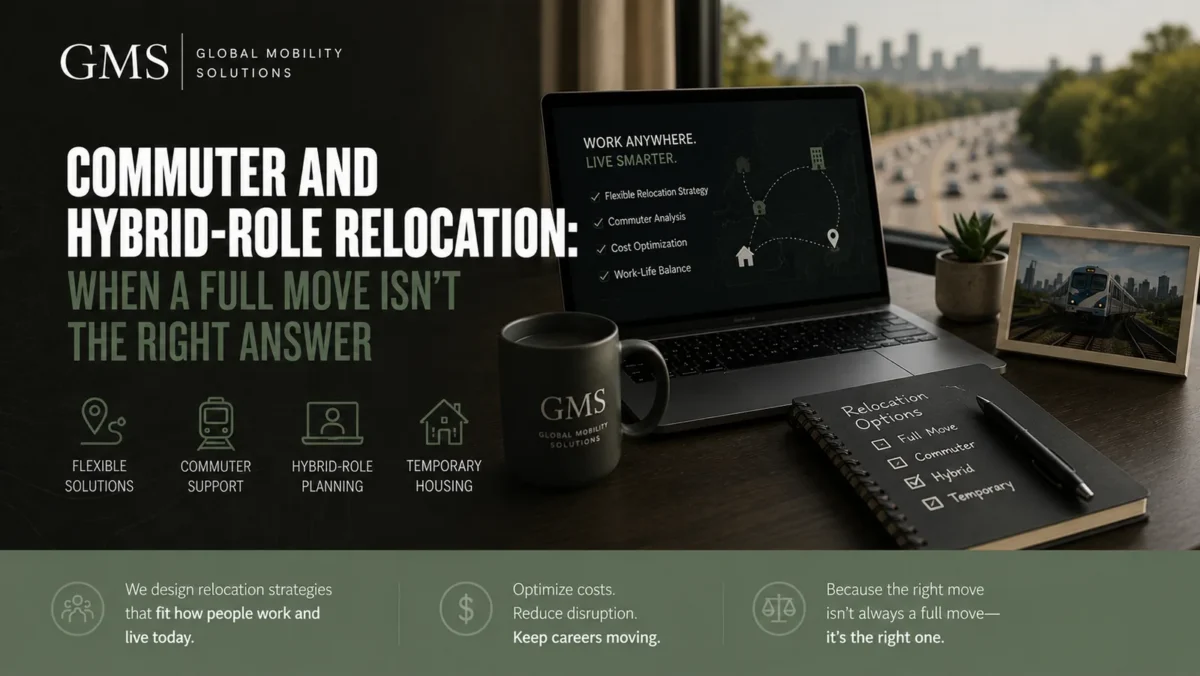
Commuter and Hybrid-Role Relocation: When a Full Move Isn’t the Right Answer

For decades, relocation policy operated on a simple binary: an employee either moved to a location or they did not. Hybrid work broke that binary apart. Now a growing share of roles need someone physically present in a specific city two or three days a week, not five, and a full household relocation, complete with home sale assistance, school changes, and a permanent move, is often the wrong tool for that job entirely.

Companies that have not built a policy for this middle ground are stuck applying an all-or-nothing framework to situations that clearly need something in between, and it is costing them both money and good candidates who would happily take a role requiring regular travel but will not uproot their family for a job that only needs them in the office part of the week

The Gap Between Standard Relocation and No Support at All

Most companies handle hybrid or commuter roles in one of two ways, neither of which works well. Either the employee gets a full relocation package designed for a permanent move, which is expensive and unnecessary if they are only in the office two days a week, or they get no support at all beyond a mileage reimbursement, which quietly pushes the real cost of a demanding commute onto the employee and makes the arrangement unsustainable within a year or two.

The middle ground that actually fits this situation looks more like a corporate travel program than a relocation package: a defined travel and lodging budget for the days the employee needs to be on-site, built around a realistic understanding of how often the role actually requires physical presence rather than a blanket assumption that every senior role needs someone in the building full time.

Building a Commuter Policy That Actually Works

A well-structured commuter policy starts with an honest assessment of how often presence is truly required. A role that needs someone on-site two days a week looks completely different from one that needs someone there four days a week, even though both might get labeled “hybrid” internally. The travel budget, lodging arrangement, and reasonable expectations around work-life balance all shift significantly based on that frequency.

This is a natural extension of the relocation tools and calculators many companies already use to model relocation costs, applied instead to a recurring travel budget rather than a one-time move. For employees commuting a meaningful distance, typically anything beyond a reasonable daily drive, a lodging stipend for overnight stays near the office makes more sense than expecting daily round trips. This starts to resemble the kind of temporary housing arrangements used in full relocations, just on a recurring rather than one-time basis, and companies that already have relationships with extended-stay providers for relocation purposes can often extend those same arrangements to commuting employees at a similar rate.

When Commuter Arrangements Should Convert to Full Relocation

Commuter arrangements work well as a short-term or ongoing solution, but they are not meant to be permanent for every employee. Some commuters, after a year or two of splitting time between two locations, decide the arrangement no longer makes sense and either want to relocate fully or want to reduce their on-site commitment further. Building a clear path for that conversation, reviewed on a regular cadence rather than left indefinitely open-ended, prevents both employee burnout and the awkward situation of a commuter arrangement quietly becoming permanent without either side deciding that was the plan.

This is also where the broader flexibility trend in corporate relocation programs matters. Companies that treat mobility as a menu of options, full relocation, commuter support, remote-first with periodic travel, rather than a single standard package, are better positioned to retain talent that would otherwise decline a role requiring any physical presence outside their current city.

The Case for Building This Into Formal Policy

Ad hoc commuter arrangements, negotiated individually between a hiring manager and a candidate, create inconsistency that eventually causes problems. One employee gets a generous lodging stipend because their manager pushed hard for it during negotiation, while another in a nearly identical situation gets nothing because nobody thought to ask. That inconsistency erodes trust once employees inevitably compare notes, and it creates legal exposure if the pattern breaks down along any protected characteristic, even unintentionally.

A formal commuter policy, with defined tiers based on commute frequency and distance, closes this gap and gives HR a consistent framework to apply rather than negotiating every case from scratch. It also makes the benefit easier to communicate clearly during recruiting, which matters more than it might seem: candidates weighing a role that requires regular travel want to know exactly what support looks like before they accept, not after.

How This Intersects With Group and Team Relocations

Some commuter situations happen at scale rather than individually, particularly when a company opens a new regional office and staffs it partly with existing employees willing to split time between two locations during a transition period. This starts to resemble a group move in terms of coordination complexity, multiple employees needing lodging, travel booking, and consistent policy application at the same time, even though no one is permanently relocating.

Treating this as a coordinated program rather than a series of individual arrangements saves significant administrative overhead and ensures every employee in a similar situation gets treated consistently, which matters even more when the group includes employees who can directly compare what support they each received.

Tax and Compliance Wrinkles Commuter Arrangements Create

Regular travel between two locations for work purposes can trigger tax questions that a one-time relocation does not, particularly when the two locations sit in different states or countries with different tax treaties. An employee splitting time between two states may unknowingly create dual tax residency obligations depending on how many days they spend in each location annually, and a company that is not tracking this can end up with an employee facing an unexpected tax bill they were never warned about.

This is a genuinely underappreciated risk in commuter arrangements specifically because nobody frames them as a “relocation” in the way that triggers the usual tax review. Companies that treat commuter arrangements with the same compliance rigor they already apply to full relocations, tracking days spent in each jurisdiction and flagging potential dual-residency triggers before they become a problem, avoid putting employees in a position where a convenient work arrangement quietly becomes a tax liability nobody saw coming.

What Employees Actually Want From These Arrangements

Employee feedback on commuter and hybrid arrangements consistently surfaces a few recurring themes: predictability in the schedule, a lodging arrangement that does not feel like a downgrade from home, and clarity on how long the arrangement is expected to last. Employees who accept a commuter role with no end date in sight, and no clear sense of whether it is meant to be permanent or transitional, report significantly more dissatisfaction than those given an explicit review point, even if the eventual outcome is the same arrangement continuing indefinitely.

This suggests that much of what makes commuter arrangements work well has less to do with the dollar amount of the travel budget and more to do with how clearly the arrangement is communicated and how much input the employee has in shaping it. A generous budget attached to an open-ended, poorly defined arrangement tends to satisfy employees less than a modest budget attached to a clear, mutually agreed structure with a defined review cycle.

How This Shows Up in Recruiting Conversations

Candidates evaluating a role that requires regular but not full-time presence in an office increasingly ask about commuter support directly during interviews, particularly senior candidates who have navigated a hybrid arrangement before and know what a poorly structured one feels like. A recruiter who cannot answer clearly, because no formal policy exists, either loses the candidate to uncertainty or ends up promising something in the moment that HR later has to walk back or scramble to formalize.

Having a documented commuter policy ready to reference during recruiting conversations removes this friction entirely. It also signals to candidates that the company has thought seriously about flexible work arrangements rather than treating hybrid roles as a workaround nobody has fully committed to supporting.

Building a Policy That Matches How Work Actually Happens Now

Hybrid and commuter arrangements are not a temporary adjustment that will resolve itself once things go back to how they used to be. They reflect a genuine and lasting shift in how companies staff roles that need physical presence without requiring a full household relocation, and a mobility program that only has one setting, full relocation or nothing, is increasingly out of step with how many roles actually need to be staffed.

If your company is fielding requests for commuter or hybrid support and handling them case by case, talk to a GMS relocation consultant about building a formal policy tier for these situations rather than continuing to negotiate them one at a time.

Getting ahead of this now, before commuter arrangements grow into a large enough share of the workforce to create visible inconsistency, is significantly easier than retrofitting a policy after employees have already started comparing notes on what they each received.

Categories
Blog Career Services Corporate Relocation Domestic Relocation Global Mobility

Dual-Career Couples: Solving the Two-Career Problem in Relocation

For most of the history of corporate relocation, policy was written around a single assumption: one working spouse relocates, the other manages the household transition. That assumption stopped reflecting reality a long time ago. In most households today, both partners work, and when one receives a relocation offer, the other is not simply along for the ride, they are weighing whether to give up their own career, their own income, and often their own professional identity to make the move possible.

Companies that have not updated their relocation policy to reflect this are losing candidates over it, sometimes without ever realizing why. An offer that looks generous on paper, covering the transferring employee’s moving costs, temporary housing, and closing costs, can still get declined if the accompanying partner has no support figuring out what happens to their own career.

Why This Is a Bigger Deal Than It Used to Be?

The share of dual-income households has grown steadily for decades, and dual-career households, where both partners are pursuing an active career rather than one working purely for income, have grown right alongside it. That shift changes the calculus of every relocation decision. A partner who is willing to pause their career for a spouse’s opportunity is a smaller and smaller share of the workforce, and companies that assume otherwise are effectively narrowing their own candidate pool without meaning to.

This shows up most visibly at the offer stage. A candidate who is genuinely excited about a role will still turn it down, or negotiate hard for concessions elsewhere, if accepting means their partner faces months of unemployment with no support finding a comparable position. Spousal and partner support is not a nice-to-have add-on to a relocation package anymore, for a large share of candidates it is close to a deciding factor.

What Real Partner Career Support Looks Like?

The weakest version of partner support is a list of local job boards and a pat on the back. The strongest versions treat the accompanying partner’s job search as seriously as the transferring employee’s own onboarding, with dedicated resume coaching, introductions to the company’s own local network where appropriate, and in some cases direct outreach to other employers in the area on the partner’s behalf.

Between those two extremes sits what most companies can realistically offer: a defined career transition benefit, often delivered through a third-party career coaching service, paired with practical logistics support like professional licensing transfer assistance for partners in regulated fields such as law, medicine, or teaching, where a license earned in one state or country does not automatically carry over to another.

This kind of support pairs naturally with the broader pre-decision process, where a company helps a candidate evaluate whether a relocation actually makes sense for their household before an offer is finalized rather than after. It also connects directly to mobility consulting engagements, where companies rebuilding their relocation policy from the ground up often discover partner support was never formally addressed in the first place. Bringing the partner’s career into that conversation early, rather than treating it as a problem to solve after the employee has already accepted, avoids the common scenario where an employee accepts an offer optimistically and then spends the first six months in the new role distracted by a partner who cannot find work.

The Licensing and Credentialing Problem

For a meaningful share of dual-career households, the accompanying partner works in a field that requires state or country-specific licensing: nursing, law, teaching, and financial services are common examples. A partner in one of these fields does not just need a new job, they may need to requalify entirely before they can legally work in the new location, a process that can take months and involves its own fees, exams, and paperwork that most relocation policies say nothing about.

Companies that handle this well treat licensing transfer as its own line item in the relocation package, covering exam fees, application costs, and sometimes a temporary income bridge for a partner whose new license is still pending. It is a relatively small addition to the overall relocation cost, but it directly addresses one of the most concrete reasons a qualified candidate turns down an otherwise strong offer.

Building This Into Pre-Decision Conversations

The earlier a company surfaces the dual-career question, the better the outcome tends to be for everyone involved. Waiting until after an offer is accepted to ask whether the partner has a job lined up puts both the company and the family in a reactive position. Raising it during the earliest conversations about the move, as part of the broader assessment of whether relocation is realistic for the household, gives both sides time to actually plan rather than scramble.

This also gives HR useful information about which offers are at real risk of falling through, and it dovetails with the same tax and compliance planning that matters for understanding how tax gross-up actually gets calculated, since a dual-income household relocating together often triggers its own tax questions around dual employment income in a new state or country. A candidate whose partner has a portable career, remote work, freelance, a field with strong demand everywhere, represents a much lower-risk relocation than one whose partner works in a highly localized field with few opportunities outside their current city. Neither situation should disqualify a candidate, but knowing the difference lets a company calibrate how much partner support to build into the offer, and it fits naturally alongside the group move planning process when multiple households are relocating for the same project or office opening at once.

Measuring Whether Partner Support Is Actually Working

Most companies do not track partner employment outcomes at all, which means they have no real way of knowing whether their partner support benefit is effective or just a line item nobody uses. A simple follow-up, checking in with relocated employees at the six-month and one-year mark on whether their partner found suitable work, and how the process went, gives HR a real signal rather than a guess.

This data matters for two reasons. It shows whether the benefit is worth its cost, and it flags early warning signs of the kind of quiet dissatisfaction that leads to voluntary turnover eighteen months after a move, well after anyone is still thinking about the relocation as the root cause. Companies that track this consistently tend to catch and fix partner support gaps before they show up in exit interviews as “we should have supported my spouse better,” a comment that by then is too late to act on.

What Happens When This Gets Ignored

The cost of ignoring the dual-career question rarely shows up as a clean data point. It shows up as declined offers the company never fully understands, as employees who accept and then quietly start job searching again within a year because a partner never found stable work, and as a reputation among candidates in tight-knit professional communities that a company’s relocation packages look good until you actually try to make the move work for two careers instead of one.

None of these outcomes are inevitable. They are the predictable result of a relocation policy still built around a household structure that stopped being the default a long time ago.

Updating Your Policy for How Households Actually Work

A relocation policy that only accounts for the transferring employee is solving half the problem for a large share of the people it is meant to support. Building real partner career support into the package, and surfacing it early in the pre-decision conversation rather than after the offer is signed, closes a gap that is quietly costing companies strong candidates.

If your relocation program has not been updated to reflect how dual-career households actually make these decisions, talk to a GMS relocation consultant about building partner career support into your policy in a way that actually moves the needle on acceptance rates.

Categories
Blog Corporate Relocation

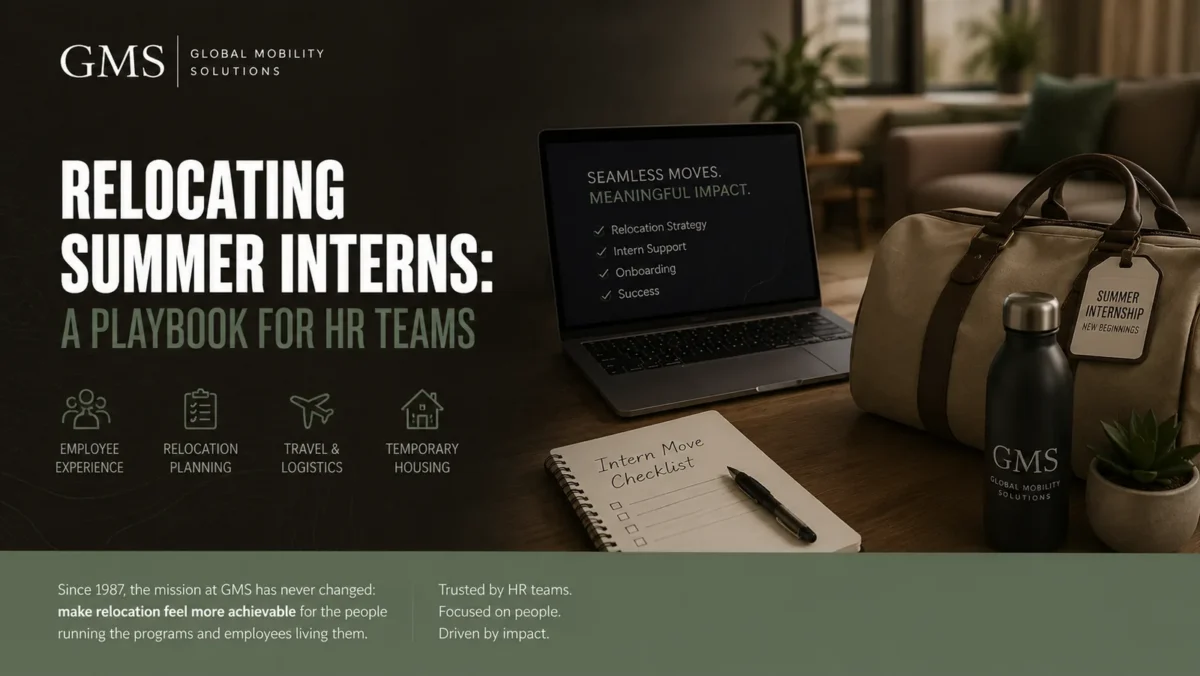
Relocating Summer Interns: A Playbook for HR Teams

Why Employee Relocation Experience Matters in 2026

Summer internship programs have become one of the most competitive parts of talent acquisition, and for many companies, that competition now extends beyond the office walls of headquarters. Interns are being recruited nationally, sometimes internationally, and increasingly expect the same kind of relocation support that full-time new hires receive. Yet most companies still treat intern relocation as an afterthought, cobbled together with a stipend and a list of nearby Airbnbs rather than a real program.

That gap is a missed opportunity. A well-run intern relocation program does more than get a student from campus to your office. It shapes their first impression of your company, influences whether they accept a full-time offer later, and signals to future candidates that you take talent seriously enough to support them properly.

Why Intern Relocation Deserves Its Own Policy?

Treating intern relocation as a scaled-down version of your standard employee policy usually backfires. Interns have a different set of needs and a much shorter timeline. A software engineer relocating with a family needs home sale assistance and school search support. A 20-year-old moving for a 10-week internship needs affordable temporary housing, a fast move-in date, and clear guidance on what is and is not covered.

Companies that build a dedicated intern policy typically structure it around three pillars: housing, a defined stipend or reimbursement structure, and logistics support that does not require the intern to become a part-time travel agent. Getting these right early prevents the two most common intern relocation complaints: confusion about what is covered and housing falling through days before the start date.

Housing Is Where Most Intern Programs Break Down

Traditional corporate housing contracts are built for 30-day-plus stays and often carry minimums that do not fit a 10- or 12-week internship. Some companies solve this by partnering directly with local universities or extended-stay providers near their offices; others use a managed housing benefit similar to what they offer full-time relocating employees, just scaled to a shorter term.

Whichever model you choose, the housing decision should happen well before the intern’s start date. A temporary living strategy that balances cost control and comfort matters just as much for a 10-week intern as it does for a full relocation, arguably more, since interns rarely have the flexibility or local knowledge to solve housing problems on their own.

Building the Onboarding Experience Around the Move

An intern who lands in a new city with no orientation beyond a first-day badge photo is starting at a disadvantage compared to one who has a clear runway: housing confirmed, a point of contact for logistics questions, and a rough sense of the city before day one. Programs that craft an effective relocation orientation for their full-time hires can adapt much of the same structure for interns, just compressed into the first week rather than the first month.

This matters more than it might seem. Interns who feel logistically supported spend less time worrying about their apartments and more time proving themselves on the job, which is ultimately the program’s entire point from the company’s perspective.

What Should Actually Be Covered?

There is no universal standard for intern relocation benefits, but the programs that work well tend to include a few consistent elements: a housing stipend or direct-billed housing, a one-time travel allowance to and from the assignment, and a small settling-in allowance for essentials like bedding or transportation. Some companies also cover a security deposit directly rather than reimbursing it, since asking a college student to front a deposit on 5,000 miles of relocation can be a genuine barrier to accepting the offer.

Whatever the package looks like, it should mirror what companies already build into new hire relocation packages at a smaller scale rather than being invented from scratch. Interns talk to each other, and to future candidates, so consistency across cohorts matters more than most HR teams initially expect.

Managing Interns as a Group, Not One-Off Cases

If your internship program brings in more than a handful of students each summer, the relocation logistics start to resemble a scaled-down group move more than a series of individual cases. Batching housing arrangements, orientation sessions, and travel logistics across a cohort saves significant coordination time compared to managing each intern’s move independently, and it gives HR a single program to refine year over year instead of reinventing the process every summer.

For companies bringing in interns from outside the US, the logistics become even more complex. Visa timing, currency for stipends, and international shipping limitations all come into play, and those cases benefit from the same international relocation framework used for full assignments, scaled appropriately for a short-term stay.

Measuring Whether the Program Is Working

The clearest signal of a successful intern relocation program is conversion, how many interns accept a full-time offer, and how many of those who accept actually show up in year one having had a positive experience the summer before. Housing complaints, late reimbursements, and confusing policy language are the kinds of small frictions that quietly erode an otherwise strong internship experience, and they are almost always fixable once someone is actually tracking them.

Companies serious about this should treat their intern relocation data the way they would any other retention metric: reviewed after each cohort, compared year over year, and adjusted based on what interns actually report rather than what HR assumes is working.

The Budget Conversation Nobody Wants to Have

Finance teams tend to push back on intern relocation spend harder than they push back on full employee relocation, largely because the return is less obvious on paper. A director relocating for a permanent role has an easy business case. A 20-year-old moving for 10 weeks does not, at least not until you connect the dots to conversion and cost per hire.

The way to win this conversation is with numbers, not sentiment. Track what it costs to source, interview, and fly out candidates for your internship program in the first place, then compare that to the incremental cost of a modest housing and travel benefit. In most cases, the relocation spend is a small fraction of what the company already invested getting that intern to the offer stage, and losing them over a housing problem the company could have solved for a few thousand dollars is the more expensive outcome.

It also helps to frame intern relocation as a full-time hiring pipeline cost rather than an internship program line item. If a meaningful share of your entry-level hires come through the internship pipeline, the relocation budget for interns is really an early installment on your new-grad hiring budget, just paid a year ahead of schedule.

Common Mistakes That Undermine an Otherwise Good Program

A few patterns show up again and again in intern relocation programs that underperform. The first is inconsistent communication: interns receiving different information from different people about what is covered, when reimbursements arrive, and who to call when something goes wrong. A single point of contact, even if that person is juggling other responsibilities, eliminates most of this friction.

The second is treating reimbursement as an afterthought. College students and recent grads often do not have the credit limit or cash flow to front several thousand dollars in moving and housing costs and wait weeks for reimbursement. Direct billing for housing, or a reimbursement turnaround measured in days rather than a full pay cycle, removes a real barrier that has nothing to do with whether the intern is a good fit for the role.

The third mistake is failing to survey interns about the relocation experience specifically, separate from their survey about the internship itself. A student can rate their day-to-day work experience highly while still having had a genuinely stressful housing situation that colors how they remember the summer. Asking about the two separately surfaces problems that a single combined survey tends to bury.

Why Companies Underestimate How Much This Matters to Candidates?

Intern relocation support rarely comes up as a dealbreaker in exit interviews or declined-offer conversations, mostly because students weighing a summer internship rarely feel entitled to push back on housing terms the way a full-time hire negotiating a signing bonus might. That silence can be misleading. Interns compare notes constantly, across cohorts, across companies, and increasingly on public forums where a poorly handled housing situation becomes part of a company’s reputation among the exact talent pool it is trying to recruit from for full-time roles a year later.

Getting to a version of this comparison story is more expensive than most HR teams realize. A single summer with disorganized housing logistics does not just affect that year’s cohort; it shapes what next year’s applicant pool has already heard before they even apply.

Getting the Program Off the Ground

Most companies do not need to build an intern relocation program from nothing. The building blocks- housing logistics, a defined benefits structure, and orientation support- already exist in how you manage full employee relocations. The work is in scaling those pieces down to fit a shorter timeline and a different kind of hire.

If your internship program has outgrown a spreadsheet and a stipend policy, talk to a GMS relocation consultant about building a structure that fits your cohort size and budget, whether that is 5 interns or 500.

Categories
Corporate Relocation Global Relocation Relocation Technology

5 Practical Ways to Improve Your Employee Relocation Experience

Why Employee Relocation Experience Matters in 2026

Employee relocation plays a direct role in how organizations execute their business strategy. It impacts whether employees accept assignments, how quickly they become productive, and how effectively skills and knowledge are transferred across locations. While many companies already offer structured corporate relocation services and global mobility services, the real opportunity today is improving how those programs are experienced by employees. The most effective organizations are not necessarily adding more benefits or increasing spend. Instead, they are making targeted improvements that increase clarity, confidence, and consistency throughout the relocation process.

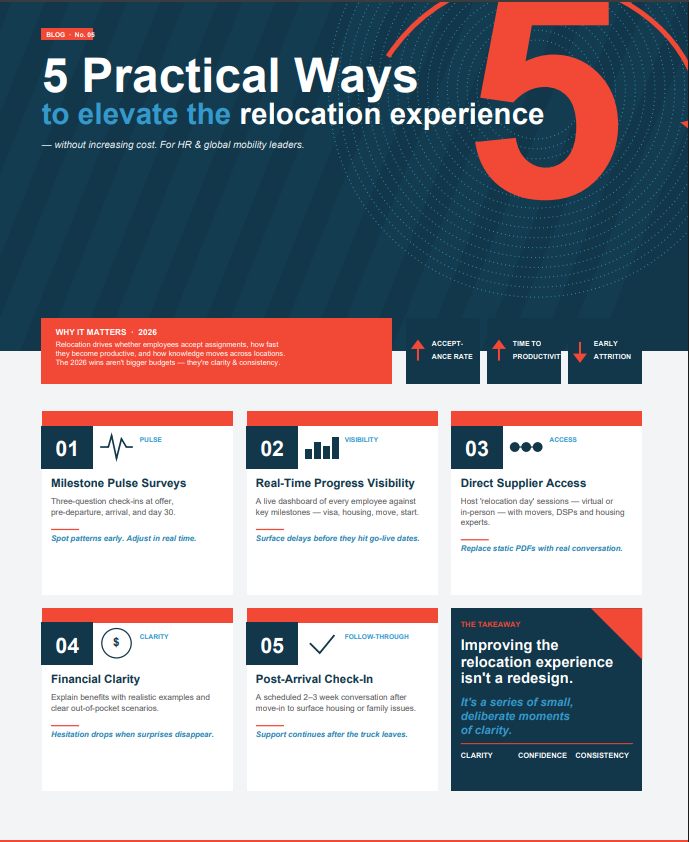
One of the most impactful ways to improve the relocation experience is to introduce simple pulse surveys across key milestones. Rather than waiting until the end of a move, leading programs are gathering feedback at critical points such as offer acceptance, pre-departure, arrival, and the first 30 days in the new location. These surveys are intentionally short, often no more than three questions, focused on understanding how confident employees feel, whether they feel supported, and what would make their experience smoother. This approach allows organizations to identify patterns early and make small adjustments in real time. Over time, these insights lead to measurable improvements in employee satisfaction, relocation acceptance rates, and overall program effectiveness.

Another area that consistently drives better outcomes is visibility into the relocation process. When employees and internal teams have a clear understanding of where each relocation stands, it reduces uncertainty and allows for faster decision-making. Data visibility is not just an operational benefit; it has a direct impact on business performance. When organizations can see delays, risks, or bottlenecks early, they can take action before those issues affect start dates, productivity, or project timelines. While sophisticated platforms exist, even a simple, well-structured dashboard using existing data can provide meaningful insight. The key is to create a clear, real-time view of each employee’s progress against key milestones. Organizations can also work closely with their relocation management company or speak with their GMS representative to explore tools like the MyRelocation portal, which provides 24/7 access to real-time relocation data, alerts, and status updates in one centralized view.

Creating Confidence Through Access, Clarity, and Support

Beyond visibility, one of the most effective ways to improve employee experience is to reduce uncertainty before the move even begins. Many organizations are finding success by creating opportunities for employees to engage directly with relocation suppliers. Hosting structured “relocation day” sessions, either virtually or in person, allows employees to meet moving companies, destination service providers, and housing experts in a more interactive setting. Instead of relying on static documents, employees can ask questions, explore scenarios, and gain a clearer understanding of what to expect. This direct access builds confidence and helps employees make decisions more quickly, which ultimately supports faster transitions and smoother relocations.

Financial clarity is another major driver of employee confidence. Even when strong employee benefits are in place, uncertainty around cost can create hesitation. Employees are often less concerned with the total value of the package and more concerned with unexpected expenses or financial exposure during the move. Improving how benefits are explained, providing realistic examples, and clearly outlining potential out-of-pocket scenarios can significantly improve acceptance rates. This is particularly important in programs that use capped or point-based structures, where flexibility exists but may not always feel transparent to the employee. When employees understand what to expect, they are more likely to engage fully in the relocation process.

Finally, the relocation experience should extend beyond the physical move. Many organizations see a drop in support after the employee arrives, even though this is often when the most important adjustments are taking place. A simple post-arrival check-in, scheduled two to three weeks after move-in, can have a meaningful impact. This conversation helps identify early challenges related to housing, commuting, or family adjustment, allowing organizations to resolve issues before they affect performance or satisfaction. It also reinforces that the company remains invested in the employee’s success beyond the logistics of the move.

Final Thought

Improving employee relocation experience does not require a full redesign of your program. Small, focused actions such as introducing milestone-based feedback, increasing visibility into relocation progress, creating direct access to support, and improving financial clarity can significantly enhance outcomes. In today’s environment, global mobility services and corporate relocation services are not just operational tools. They are part of how organizations retain talent, develop leaders, and ensure that business-critical roles are filled effectively and on time. The organizations that focus on experience are ultimately the ones that see stronger performance, faster productivity, and more successful long-term assignments.

5 employee experience info graphic

Most Frequently Asked Questions about Employee Relocation Experience

What is an employee relocation experience?

Employee relocation experience refers to the full journey an employee goes through when moving for work, from the initial decision to relocate through to settling into their new role and environment. This includes communication, logistics, support, and how confidently the employee can navigate each stage of the move.

Key business indicators:

Time to productivity after relocation
Relocation completion timelines
Employee satisfaction scores during relocation
Assignment success rate

Why is employee relocation experience important for businesses?

A strong relocation experience helps protect the company’s investment in talent. It improves acceptance rates for relocation offers, reduces early attrition, and supports faster integration into the new role. It also ensures that business-critical positions are filled without unnecessary delay and that employees can contribute effectively from the start.

Key business outcomes:

Higher relocation acceptance rate
Reduced early attrition (first 12 months)
Faster time to full productivity
Improved retention of high-performing employees
More effective transfer of skills across locations

How can companies improve relocation experience without increasing cost?

Organizations can improve relocation experience by focusing on clarity, visibility, and timing rather than adding new benefits. Simple changes such as introducing milestone-based pulse surveys, improving communication, and providing better access to relocation information can significantly improve employee confidence and overall experience.

Practical actions:

Use short pulse surveys at key relocation milestones
Improve visibility into relocation progress (dashboard or portal)
Provide clear, upfront communication on benefits and expectations
Offer direct access to relocation support and suppliers
What role do global mobility services play in employee experience?

Global mobility services and corporate relocation services provide the structure and coordination needed to manage employee moves effectively. They ensure that logistics are handled properly, timelines are maintained, and employees receive the support they need throughout the relocation process.

Operational impact:

Improved relocation timeline management
Better coordination across vendors and stakeholders
Reduced disruption to business operations
Consistent employee support across locations
How does relocation impact talent retention and leadership development?

Relocation is a key tool for retaining and developing talent. Employees who are given opportunities to move and grow within the organization are more likely to stay engaged and committed. At the same time, relocation helps build leadership capability by exposing employees to new markets, teams, and business environments.

Strategic outcomes:

Increased retention of high-potential employees
Stronger leadership pipeline
Greater internal mobility vs external hiring
Enhanced global business capability

How can organizations track relocation progress effectively?

Tracking relocation progress requires clear visibility into where each employee is in the relocation process. This includes key milestones such as visa status, housing, move dates, and start dates. Having this visibility allows organizations to identify risks early and ensure alignment with business timelines.

Key tracking metrics:

Milestone completion rates (visa, housing, move)
On-time start date achievement
Relocation delays and risk flags
Employee status by relocation stage

Categories
Choosing a Relocation Company Corporate Relocation Domestic Relocation Global Mobility Relocation Technology

3 Ways Your Relocation Program Gets Smarter Starting Next Week

Global Mobility Solutions continues to invest in how modern global mobility programs are delivered—ensuring that operational excellence is supported by clear data, strong cost control, and reliable financial visibility. As part of that continued focus, GMS is launching its partnership with Daycos. This collaboration enhances how corporate relocation services, supplier activity, and financial outcomes are connected across every stage of the relocation lifecycle.

For organizations managing global mobility services across multiple regions, vendors, and policy structures, the challenge is no longer execution alone. It is visibility, alignment, and the ability to make informed decisions in real time. This is where the partnership delivers immediate value

1. A clearer connection between relocation activity and cost

In many relocation management company models, operational delivery and financial reporting exist in separate workflows. Moves are executed efficiently, but cost visibility often depends on delayed reporting cycles, invoice reconciliation, and manual validation.

Global Mobility Solutions has built its reputation on delivering consistent, high-quality international relocation services. With the addition of Daycos, that capability is extended through a more connected view of operational and financial data.

As relocation services are delivered—whether household goods shipments, destination services, or broader relocation assistance—those activities are aligned more directly with cost validation and reporting. This allows clients to better understand how program activity translates into financial outcomes. Instead of relying solely on end-of-month or end-of-quarter reporting, mobility teams gain a more continuous view of their programs. This supports stronger forecasting, improved budget management, and more accurate tracking of cost drivers across corporate relocation programs.

For organizations operating at scale, this level of visibility strengthens alignment between HR, finance, and procurement, ensuring that relocation spend is both transparent and well understood.

2. Audit and compliance are integrated into program delivery

Audit and compliance are essential to any well-managed global mobility relocation program. As programs expand across regions and suppliers, maintaining consistency and accuracy becomes increasingly complex. Through this partnership, Global Mobility Solutions enhances its ability to integrate audit and compliance directly into the relocation process.

Operational activity, supplier services, and financial validation are aligned within a structured workflow. This enables a more consistent approach to invoice review, cost verification, and policy compliance across all relocation activities. Rather than functioning as a separate, end-of-process task, audit becomes part of how the program operates day to day. This reduces reliance on manual reconciliation, minimizes discrepancies, and improves the overall efficiency of program management.

For clients working with relocation management companies or overseeing international relocation services, this approach provides greater confidence that financial data reflects actual service delivery. It also supports stronger compliance with internal policies and external requirements. At the same time, it creates a more streamlined experience across teams, reducing the administrative burden often associated with managing supplier invoices and financial reporting.

3. Better data leads to better relocation decisions

One of the most valuable outcomes of a connected relocation program is the ability to turn data into actionable insight. By strengthening the link between operational delivery and financial reporting, Global Mobility Solutions enables clients to gain a clearer understanding of their global mobility programs. This includes improved visibility into cost drivers, supplier performance, and overall program trends.

These insights support more effective global mobility consulting, allowing organizations to refine policies, optimize vendor selection, and improve program efficiency over time.

GMS also continues to apply disciplined cost management practices across its corporate relocation services, including centralized coordination and structured workflows that reduce unnecessary spend. Group booking strategies across air, hotel, and ground transportation further enhance cost efficiency, providing access to negotiated rates, flexible terms, and additional value while maintaining a high standard of employee experience.

For mobility teams, this means less time spent managing fragmented data and more time focused on strategic priorities—supporting employees, improving program design, and aligning mobility with broader business goals. This enhancement is supported by the combined scale and experience of both organizations.

Daycos brings over 47 years of experience in the relocation industry, supporting more than 300,000 shipments annually, managing approximately $2 billion in relocation-related charges, and processing over 500,000 invoices each year. Its platform supports more than 10.2 million documents and connects a global network of suppliers and service providers.

Together with Global Mobility Solutions—serving clients in more than 140 countries as a leading global mobility provider—this partnership strengthens the delivery of relocation services through a more integrated and data-driven approach.

Frequently Asked Questions about Global Mobility Services and Relocation

What is a global mobility provider?
A global mobility provider manages corporate relocation, international assignments, and employee movement across regions. Global Mobility Solutions delivers these services across 140+ countries, supporting companies with relocation planning, execution, and compliance.

How do corporate relocation services control costs?
Corporate relocation services control costs through policy management, supplier coordination, and data visibility. With Daycos integrated into Global Mobility Solutions, companies gain clearer insight into relocation spend and improved cost alignment across services.

What makes a relocation management company effective?
An effective relocation management company combines operational expertise with strong financial oversight. This includes managing suppliers, ensuring service quality, and providing transparent reporting on relocation activity and cost.

How do global mobility services support employees?
Global mobility services provide relocation assistance, housing support, travel coordination, and destination services. These services ensure employees can transition smoothly while maintaining productivity and engagement.

Why is visibility important in international relocation services?
Visibility allows companies to track costs, monitor supplier performance, and ensure compliance with relocation policies. It also helps mobility teams make better decisions and improve overall program efficiency.

Categories
Corporate Relocation Employee Development Global Mobility Talent Management Talent Mobility

Relocation as a Strategic Workforce Lever

A Workforce Decision That’s Getting More Attention

As organizations continue to expand across regions and markets, one workforce decision is coming into sharper focus: Do we bring in external talent — or redeploy the leaders we already have? Research from institutions like Wharton and Deloitte continues to highlight the advantages of internal mobility. Organizations that redeploy proven talent often experience faster operational readiness, stronger cultural continuity, and more stable early performance. At the same time, these benefits only materialize when employees are willing to relocate — making corporate relocation services and global mobility services an important part of the equation.

Why Internal Mobility Is Gaining Ground

External hiring will always play an important role. It brings fresh perspective, new networks, and specialized expertise. At the same time, it often comes with a period of adjustment. New hires may take longer to reach full productivity and can introduce more variability early in their tenure. Research shows that external hires may also carry higher compensation expectations and increased early attrition risk. In contrast, internal mobility allows organizations to build on what already exists — established knowledge, cultural alignment, and leadership familiarity. This is why many companies are increasingly viewing international relocation services not just as logistical support, but as a way to strengthen workforce continuity.

Looking Beyond Hiring Costs & WHy Mobility matters More in Expansion Environments

When evaluating workforce decisions, it’s easy to focus on direct hiring costs. But the broader picture is more nuanced. Replacing a role can carry significant indirect costs — from lost productivity and onboarding time to cultural integration and early turnover risk. In many cases, these factors can exceed the initial hiring expense. This is where global mobility services play a different role. By enabling internal redeployment, organizations can often reduce disruption, maintain momentum, and preserve institutional knowledge.

The value of internal mobility becomes even more apparent during periods of growth. Expansion introduces pressure — not just to hire, but to execute quickly, maintain consistency, and build leadership capability across locations. In these environments, stability often becomes more important than experimentation. Relocating experienced internal leaders helps address this directly. They bring operational fluency, established relationships, and a clear understanding of how the organization works — all of which support smoother execution. This is where corporate relocation services and international relocation services become more than support functions. They enable organizations to move with confidence and speed.

The Role of Employee Participation & How Benefit Structure Influences Mobility

Even the strongest mobility strategy depends on one key factor: employee willingness to relocate. Data shows that relocation decisions are influenced by a combination of financial, personal, and market factors — including housing conditions, perceived financial impact, and overall support from the employer. When financial uncertainty increases, participation can decline. And when participation declines, organizations may find themselves relying more heavily on external hiring, which can introduce additional cost and variability. This is why relocation design — particularly around areas like homesale support — plays such an important role in shaping workforce outcomes.

Relocation benefits are not just about cost — they influence behavior. For example, when homesale support is structured in a way that creates financial unpredictability for employees, it can reduce confidence in the relocation process. This may lead to lower acceptance rates, particularly among experienced or repeat movers. On the other hand, more structured and predictable approaches can improve employee confidence and reduce variability for both the employee and the organization. In this way, corporate relocation services become closely tied to employee benefits strategy, influencing not just cost, but participation and workforce stability.

A More Integrated Way to Evaluate Mobility & Shifting the convresation

When internal relocation and external hiring are viewed side by side, a more complete picture begins to emerge. Internal relocation often supports faster ramp-up, stronger cultural alignment, and lower early attrition risk. External hiring can introduce new capabilities, but may require more time to stabilize. Neither approach is inherently better — but they serve different purposes. The opportunity for organizations is to evaluate these options together, rather than in isolation, and to consider how global mobility services support broader workforce strategy.

As mobility continues to evolve, many organizations are beginning to look at relocation through a wider lens. Instead of focusing only on cost, the conversation is expanding to include:

  • Workforce continuity
  • Participation trends
  • Speed to productivity
  • Total workforce deployment cost

This creates a more balanced perspective — one that reflects both operational efficiency and business impact.

Final Thoughts

Internal mobility is not simply a relocation decision. It is a workforce continuity strategy. When supported by well-designed global mobility services, corporate relocation services, and international relocation services, it allows organizations to deploy talent more effectively, maintain stability during growth, and support long-term leadership development. In 2026, the organizations that approach mobility this way are not just managing moves — they are strengthening how their workforce performs and evolves.

At GMS, we continue to see how aligning relocation strategy with workforce planning creates stronger outcomes across stability, speed, and leadership continuity.

Categories
Business Services Choosing a Relocation Company Corporate Relocation Corporate relocation tips Global Mobility Global Relocation Global Relocation Challenges Global Relocation Tips Global Relocation Trends Relocation Challenges Relocation Policy Review Relocation Programs Talent Management Talent Mobility

Global Mobility ROI Gaining New Attention

A Shift in How Global Mobility Services Are Being Viewed

Global mobility is stepping into a new level of visibility, as organizations place greater focus on how global mobility services and corporate relocation services support business growth and workforce strategy.

Across organizations, HR and mobility leaders are increasingly part of broader conversations — not just about moving employees, but about how mobility connects to employee benefits, talent strategy, and long-term organizational priorities. At the same time, expectations are evolving. There’s growing interest in understanding not only what relocation costs, but what it enables across the business.

As explored in the GMS Mobility ROI Playbook, this shift is creating an opportunity to view mobility through a more complete lens — one that aligns global mobility services with measurable business outcomes.

Expanding the Role of Corporate Relocation Services

For many organizations, corporate relocation services have traditionally been measured through operational metrics such as cost management, policy alignment, and vendor performance. These remain essential and reflect strong program discipline.

What’s emerging now is a more expanded perspective. In many cases, a relocation — whether delivered through corporate relocation services or international relocation services — supports a much broader business objective. It may enable market entry, maintain continuity for a key client, or ensure that a critical role is filled at the right time. When these outcomes are included in the conversation, mobility becomes easier to align with business priorities and demonstrate its full value.

How Global Mobility Services Support Business Priorities

Every relocation decision is tied to a business need. Whether it’s supporting expansion, strengthening a team, or building leadership capability, global mobility services play a central role in how organizations execute their strategy.

The playbook frames this clearly: mobility can be viewed as a strategic investment — one that supports growth, productivity, and long-term performance. For many organizations, international relocation services are no longer just logistical support. They are becoming integrated into how companies deliver employee benefits, manage global talent, and maintain competitive advantage across markets.

A Practical Way to Think About Mobility Impact

Rather than trying to measure everything at once, many organizations are focusing on a few areas where global mobility services naturally create impact. One of the most visible is growth. Placing the right talent in the right location can support expansion, strengthen regional performance, and accelerate key initiatives.

Mobility also expands access to talent. Through corporate relocation services, organizations are no longer limited by geography when identifying the best candidate for a role. Timing is another important factor. The ability to move quickly — and support employees in reaching productivity sooner — helps maintain momentum across projects and business operations.

Over time, mobility also contributes to leadership development. Experience gained through international relocation services continues to be one of the most effective ways to build capability and prepare future leaders.

Getting Started with Mobility ROI Measurement

Taking a more outcome-focused approach doesn’t require a complete redesign of your program. Many organizations are beginning with a small set of metrics that connect mobility to business performance. These may include time to productivity after relocation, retention of relocated employees, or performance in regions supported by mobility.

The key is consistency. Tracking these elements over time — and aligning them with HR, finance, and business leaders — creates a clearer and more complete picture of how global mobility services contribute to organizational success. As the playbook highlights, structured measurement helps translate mobility activity into meaningful business insight.

What Strong Global Mobility Programs Share

Organizations that are advancing their mobility programs are not necessarily making dramatic changes. Instead, they are gradually expanding how corporate relocation services and global mobility services are understood internally.

They continue to manage operations effectively while also highlighting outcomes such as growth support, talent access, and employee experience. This balanced approach helps mobility align more closely with broader business goals while reinforcing its role as part of a company’s overall employee benefits and talent strategy.

Final Thoughts

Whether through corporate relocation services, international relocation services, or broader global mobility services, mobility continues to play an important role in how organizations grow, adapt, and support their people. What’s changing in 2026 is the opportunity to make that impact more visible — in a way that connects clearly to business outcomes, talent strategy, and employee experience.

The GMS Mobility ROI Playbook explores this approach in more detail, offering practical ways to align global mobility services with measurable business outcomes and long-term value.

Categories
Corporate Relocation Employee Development Job Seekers

Why Offering the Best Employee Benefits Is a Competitive Advantage in 2026

Employee Retention Strategies Speak Volumes about a Company

In today’s evolving workforce, offering competitive salaries in the hiring process is no longer enough to attract and retain top talent. Employees now value strong benefits packages. These packages support their finances, lifestyle, flexibility, and long-term career growth. 

Employees now value strong benefits packages.  These packages support their finances, lifestyle, flexibility, and long-term career growth. For organizations looking to stay competitive in 2026 and beyond, investing in strong employee benefits is no longer optional; it’s essential.

At the core of this shift is a growing emphasis on the overall employee retention strategies. Candidates are evaluating employers based on how well they support work-life balance, career mobility, and personal needs. Companies that offer robust benefits are better positioned to stand out in a crowded hiring market and to improve retention and engagement among existing employees.

An Employee Benefit That Gets Overlooked

One of the most impactful and often underutilized benefits is corporate relocation benefits. As businesses expand into new markets and adopt more flexible workplace strategies, the need to move talent efficiently has become increasingly important. A well-structured relocation assistance program enables companies to access a broader talent pool, rather than being limited by geography. It also demonstrates a commitment to employee success by easing the financial and logistical burden of moving.

Corporate relocation benefits can include everything from temporary housing and home sale assistance to destination services and miscellaneous expense allowances. When executed effectively, these programs reduce employee stress and help them focus on their new role more quickly. This not only improves productivity but also enhances the employer’s overall perception

Other Benefits to Keep in Mind

Beyond relocation, leading organizations are building benefits packages that reflect modern workforce expectations. This includes flexible work arrangements, mental health support, professional development opportunities, and personalized benefits that cater to diverse employee needs. The goal is to create a holistic approach that supports employees at every stage of their journey.

From a business perspective, the return on investment is clear. Companies that prioritize employee benefits often see lower turnover, higher engagement, and stronger employer branding. In contrast, organizations that fail to evolve risk losing top talent to competitors who offer more comprehensive support.

Ultimately, offering the best possible benefits is about more than just perks; it’s about creating a workplace where employees feel valued, supported, and empowered to succeed. HR teams should already be focused on talent attraction strategies. Incorporating strategic benefits like relocation assistance not only strengthens talent acquisition efforts but also reinforces a company’s commitment to growth and mobility.

As the competition for talent intensifies, companies that invest in their people will lead.

Categories
Corporate Relocation Corporate relocation tips Relocation Policy Review

5 Benefits of Corporate Relocation Benchmarking

What Are the Benefits of Benchmarking relocation policies?

It’s an unfortunate commonality that many businesses create relocation policies and benefits, only to keep them for years without revisiting them. Some companies may provide exceptions to their policies on a case-by-case basis for new hires, but in the end, failing to renew or check these policies could cost companies thousands of dollars. 


That is why it is important to benchmark relocation benefits every 12 to 18 months. There are many benefits to staying on top of corporate relocation benchmarking to make sure policies are competitive against peers and competitors. Using relocation benchmarking data can help ensure that transferees have the best possible relocation experience. Here are five benefits of using benchmarking numbers to update relocation programs annually. 

1. Identify Cost Savings and Enhancements

Reviewing how other companies design corporate relocation programs can point out areas where a company can achieve significant cost savings. Taking time to review policies can help highlight parts of the company’s relocation benefits that can be enhanced. Obtaining multiple quotes for services can help save costs and keep your program competitive. These quotes can be obtained across multiple services, such as HHG, visa, and corporate housing. In some cases, you may discover your relocation management company (RMC) does not have an independent vendor network, preventing them from shopping around for the best deals on services. 


Using relocation benchmarking data to learn about new and updated regulations can help avoid penalties and costs arising from tax, legal, or immigration issues. The application of technology to processes such as reporting and reimbursement can help save time and money.

2. Ensure Industry Competitiveness

For companies to attract and retain the best talent in their industry, their relocation policies must offer employees a competitive edge compared to their peers. A relocation benchmark will show how industry competitors design their mobility benefits. A company can adjust policies to maintain an advantage and use them as leverage in the offer phase. 


If an employee is fielding multiple offers for jobs that require a move, the tiebreaker is often the relocation package. Checking relocation policies yearly can assure that you offer the best relocation benefits in your sector to entice new hires to accept your offer.

3. Learn About New, Innovative Ideas

Companies and industries evolve to respond to the dynamic workforce, changes in the regulatory environment, and increasing employee expectations. When major changes occur, your mobility solutions and relocation policies should address them. A good relocation management company will use mobility technology to its advantage to help the moving employee. Companies and employees can use relocation technology platforms to stay informed throughout the relocation process and to increase communication speed among the employee, company, and RMC. It also provides more visibility into reimbursement numbers. 


That being said, it is important to benchmark relocation policies to ensure that there isn’t mobility technology out there that could save time or money when relocating employees.

4. Educate Internal Stakeholders

Most successful companies recognize that several departments and functions interact with their employee’s relocation process. Internal stakeholders from diverse areas, such as legal, finance, and human resources, can learn how the transferee interacts with each department, what their needs are, and what the best practices are related to each function. Involving internal stakeholders in the policy benchmarking process ensures their understanding of policy guidelines and knowledge of how the company’s policies stack up against those of other companies in the same industry. This helps provide for a smoother relocation process for the transferee, as less will be lost in translation during the hiring process.

5. Maintain Alignment Objectives

Many companies that relocate employees regularly have multiple locations across the country, sometimes even worldwide. This is why those companies need to ensure communication of corporate plans and objectives, keeping the entire company up to date. A company’s relocation policy benchmarking should incorporate policies that affect all employee levels, regardless of geography, so that local objectives align with corporate objectives. Knowing that certain areas might have plans for future expansion helps all departments prepare to respond accordingly to employee relocation needs.

Need Help Benchmarking Relocation Policies?

Is your program competitive? Global Mobility Solutions has benchmarked over 1,000 relocation policies spanning 27 unique industries.

GMS provides comprehensive benchmarking services of your policies against industry best practices, while also showcasing what others in your industry are doing. This data has been an important tool in helping companies create and renew their relocation policies.


Our team can help write competitive, cost-saving policies by staying on top of numbers across numerous industries for benchmarking. We strive to keep our relocation benchmarking data up to date.


If it’s been more than 18 months since your company reviewed its relocation policies, now is the time to contact GMS for benchmarking data to ensure your policies are the best they can be.

What's happening in your industry? Request a Courtesy Benchmark report

At GMS, we make it a priority to know how talent mobility is changing in each major industry. What are the best practices? How are other companies changing their programs to retain a competitive edge? Your Mobility Pro will be in touch within 1 business day to help answer your questions and benchmark your industry.

Categories
Corporate Relocation Domestic Relocation Global Mobility Global Relocation Trends Relocation Technology

Best Tools for Managing Corporate Move Logistics in 2026: Software, Automation & Destination Services That Actually Work

Why Corporate Move Logistics Require Better Tools in 2026

Corporate relocation has become far more complex than simply coordinating a moving truck and booking temporary housing. In 2026, companies managing domestic and international relocations must navigate rising housing costs, global compliance requirements, hybrid work policies, and employee experience expectations.

Without the right tools, HR and mobility teams often struggle with fragmented communication, inconsistent vendor coordination, and limited visibility into relocation costs. Modern relocation management software and automation tools are solving these problems by centralizing logistics, tracking expenses, and improving collaboration across stakeholders.

At the same time, technology alone isn’t enough. The most effective relocation programs combine software platforms, automation, and destination services to ensure employees receive both operational support and human guidance during their move.

Employee Relocation Portals

Employee experience has become one of the biggest differentiators in corporate relocation programs. Dedicated relocation portals give relocating employees a single place to access move-related information, documents, and services.

For example, platforms like MyRelocation™, developed by Global Mobility Solutions, allow employees to view relocation benefits, timelines, destination information, and support resources from any device.

The advantages of employee relocation portals include:

  • Centralized relocation timelines and tasks

  • Real-time updates on move progress

  • Digital document management

  • Local destination information

  • Improved communication with relocation managers

By providing employees with clear visibility into their move, companies can significantly reduce stress, increase acceptance rates for relocation assignments, and improve the overall experience.

Workflow Automation Tools

Automation is quickly becoming one of the most important technologies in relocation management. In many companies, relocation logistics once required dozens of manual tasks—emails, spreadsheets, approvals, and vendor coordination.

Workflow automation tools now streamline these processes by automatically triggering actions based on relocation milestones.

Common automation capabilities include:

  • Service order creation

  • Automated vendor notifications

  • Task assignment and deadlines

  • Document routing and approvals

  • Automated invoicing and reporting

Automation also ensures that every relocation follows the company’s policy guidelines while reducing administrative burden on HR teams.

Expense Tracking and Cost Management Platforms

One of the biggest challenges in corporate relocation is managing and forecasting costs. Housing allowances, shipping, temporary accommodation, and tax considerations can quickly create budget overruns if they aren’t tracked carefully.

Modern relocation technology addresses this challenge through:

  • Automated expense reporting

  • Real-time reimbursement tracking

  • Budget forecasting tools

  • Compliance monitoring

  • Financial reporting dashboards

AI-powered expense management tools can even analyze historical relocation data to predict future costs and identify opportunities to optimize relocation budgets.

These insights help HR leaders make smarter decisions about relocation policies and vendor partnerships.

Destination Services and Local Expertise

While technology is critical, relocation success ultimately depends on how well employees adjust to their new location. That’s where destination services play a vital role.

Destination services typically include:

  • Area orientation and neighborhood tours

  • Home-finding assistance

  • School searches

  • Local transportation guidance

  • Cultural and community integration support

Relocation providers often assign destination specialists who work directly with employees to help them understand housing options, cost-of-living factors, commuting routes, and community resources.

These services significantly improve relocation outcomes by helping employees and their families settle into their new environment faster and with less stress.

Integrated Communication and Relocation Management Tools

Corporate relocations involve many stakeholders:

  • HR and global mobility teams

  • relocation management companies

  • real estate agents

  • moving companies

  • destination service providers

  • the relocating employee

Without centralized communication, coordination quickly becomes inefficient.

Modern relocation management tools integrate messaging, task tracking, and document sharing to keep everyone involved in the relocation process aligned.

Common collaboration features include:

  • centralized communication channels

  • shared checklists and timelines

  • vendor coordination dashboards

  • real-time status updates

By replacing scattered emails and spreadsheets with a unified platform, organizations can drastically improve operational efficiency and transparency.

What Do the Best Relocation Programs Have in Common?

Organizations with the most successful relocation programs typically follow a similar approach:

  1. Technology-enabled workflows
    Global mobility technoloy streamline logistics and automates administrative work.
  2. Data-driven decision making
    Advanced reporting tools provide insights into relocation costs, employee satisfaction, and program performance.
  3. Human support through destination services
    Local experts guide employees through housing searches, community integration, and settling-in services.
  4. A centralized coordination model
    Having a single point of contact ensures consistent communication and support throughout the relocation journey.

When these elements work together, companies can reduce relocation failures, control costs, and deliver a better experience for relocating employees.

How GMS Combines Technology and Human Expertise

Technology is transforming corporate relocation—but it works best when paired with experienced relocation professionals.

At Global Mobility Solutions, relocation programs combine:

  • advanced relocation management technology

  • personalized talent mobility coaching

  • global supplier networks

  • comprehensive destination services

Through tools like MyRelocation™ and dedicated relocation specialists, GMS helps organizations manage corporate move logistics efficiently while ensuring employees receive the guidance they need during every stage of the moving process.

TAKE THE NEXT STEP IN YOUR CAREER