

Categories
Corporate Relocation Global Relocation Relocation Technology

5 Practical Ways to Improve Your Employee Relocation Experience

Why Employee Relocation Experience Matters in 2026

Employee relocation plays a direct role in how organizations execute their business strategy. It impacts whether employees accept assignments, how quickly they become productive, and how effectively skills and knowledge are transferred across locations. While many companies already offer structured corporate relocation services and global mobility services, the real opportunity today is improving how those programs are experienced by employees. The most effective organizations are not necessarily adding more benefits or increasing spend. Instead, they are making targeted improvements that increase clarity, confidence, and consistency throughout the relocation process.

One of the most impactful ways to improve the relocation experience is to introduce simple pulse surveys across key milestones. Rather than waiting until the end of a move, leading programs are gathering feedback at critical points such as offer acceptance, pre-departure, arrival, and the first 30 days in the new location. These surveys are intentionally short, often no more than three questions, focused on understanding how confident employees feel, whether they feel supported, and what would make their experience smoother. This approach allows organizations to identify patterns early and make small adjustments in real time. Over time, these insights lead to measurable improvements in employee satisfaction, relocation acceptance rates, and overall program effectiveness.

Another area that consistently drives better outcomes is visibility into the relocation process. When employees and internal teams have a clear understanding of where each relocation stands, it reduces uncertainty and allows for faster decision-making. Data visibility is not just an operational benefit; it has a direct impact on business performance. When organizations can see delays, risks, or bottlenecks early, they can take action before those issues affect start dates, productivity, or project timelines. While sophisticated platforms exist, even a simple, well-structured dashboard using existing data can provide meaningful insight. The key is to create a clear, real-time view of each employee’s progress against key milestones. Organizations can also work closely with their relocation management company or speak with their GMS representative to explore tools like the MyRelocation portal, which provides 24/7 access to real-time relocation data, alerts, and status updates in one centralized view.

Creating Confidence Through Access, Clarity, and Support

Beyond visibility, one of the most effective ways to improve employee experience is to reduce uncertainty before the move even begins. Many organizations are finding success by creating opportunities for employees to engage directly with relocation suppliers. Hosting structured “relocation day” sessions, either virtually or in person, allows employees to meet moving companies, destination service providers, and housing experts in a more interactive setting. Instead of relying on static documents, employees can ask questions, explore scenarios, and gain a clearer understanding of what to expect. This direct access builds confidence and helps employees make decisions more quickly, which ultimately supports faster transitions and smoother relocations.

Financial clarity is another major driver of employee confidence. Even when strong employee benefits are in place, uncertainty around cost can create hesitation. Employees are often less concerned with the total value of the package and more concerned with unexpected expenses or financial exposure during the move. Improving how benefits are explained, providing realistic examples, and clearly outlining potential out-of-pocket scenarios can significantly improve acceptance rates. This is particularly important in programs that use capped or point-based structures, where flexibility exists but may not always feel transparent to the employee. When employees understand what to expect, they are more likely to engage fully in the relocation process.

Finally, the relocation experience should extend beyond the physical move. Many organizations see a drop in support after the employee arrives, even though this is often when the most important adjustments are taking place. A simple post-arrival check-in, scheduled two to three weeks after move-in, can have a meaningful impact. This conversation helps identify early challenges related to housing, commuting, or family adjustment, allowing organizations to resolve issues before they affect performance or satisfaction. It also reinforces that the company remains invested in the employee’s success beyond the logistics of the move.

Final Thought

Improving employee relocation experience does not require a full redesign of your program. Small, focused actions such as introducing milestone-based feedback, increasing visibility into relocation progress, creating direct access to support, and improving financial clarity can significantly enhance outcomes. In today’s environment, global mobility services and corporate relocation services are not just operational tools. They are part of how organizations retain talent, develop leaders, and ensure that business-critical roles are filled effectively and on time. The organizations that focus on experience are ultimately the ones that see stronger performance, faster productivity, and more successful long-term assignments.
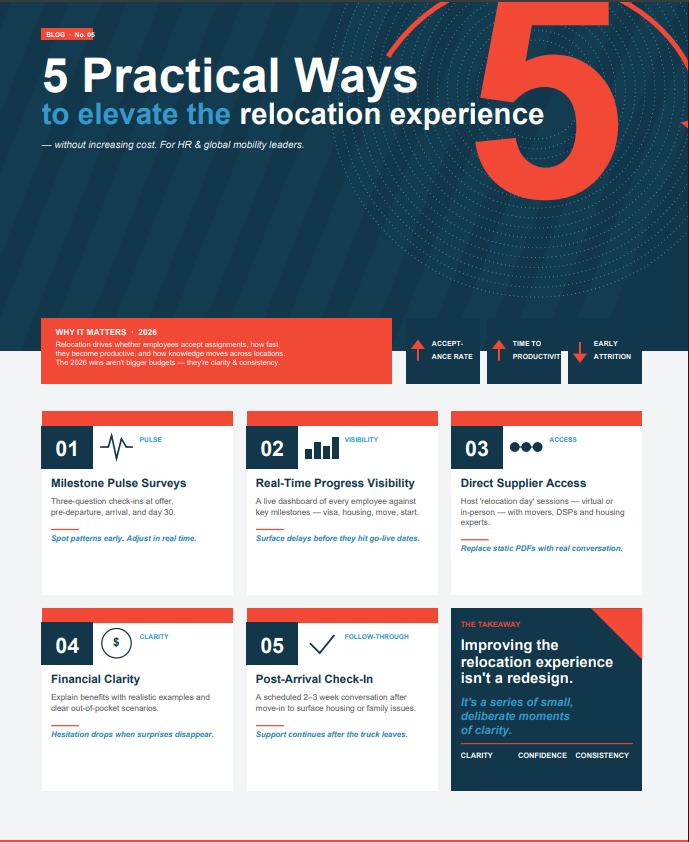
5 employee experience info graphic

Most Frequently Asked Questions about Employee Relocation Experience

What is an employee relocation experience?

Employee relocation experience refers to the full journey an employee goes through when moving for work, from the initial decision to relocate through to settling into their new role and environment. This includes communication, logistics, support, and how confidently the employee can navigate each stage of the move.

Key business indicators:

Time to productivity after relocation
Relocation completion timelines
Employee satisfaction scores during relocation
Assignment success rate

Why is employee relocation experience important for businesses?

A strong relocation experience helps protect the company’s investment in talent. It improves acceptance rates for relocation offers, reduces early attrition, and supports faster integration into the new role. It also ensures that business-critical positions are filled without unnecessary delay and that employees can contribute effectively from the start.

Key business outcomes:

Higher relocation acceptance rate
Reduced early attrition (first 12 months)
Faster time to full productivity
Improved retention of high-performing employees
More effective transfer of skills across locations

How can companies improve relocation experience without increasing cost?

Organizations can improve relocation experience by focusing on clarity, visibility, and timing rather than adding new benefits. Simple changes such as introducing milestone-based pulse surveys, improving communication, and providing better access to relocation information can significantly improve employee confidence and overall experience.

Practical actions:

Use short pulse surveys at key relocation milestones
Improve visibility into relocation progress (dashboard or portal)
Provide clear, upfront communication on benefits and expectations
Offer direct access to relocation support and suppliers
What role do global mobility services play in employee experience?

Global mobility services and corporate relocation services provide the structure and coordination needed to manage employee moves effectively. They ensure that logistics are handled properly, timelines are maintained, and employees receive the support they need throughout the relocation process.

Operational impact:

Improved relocation timeline management
Better coordination across vendors and stakeholders
Reduced disruption to business operations
Consistent employee support across locations
How does relocation impact talent retention and leadership development?

Relocation is a key tool for retaining and developing talent. Employees who are given opportunities to move and grow within the organization are more likely to stay engaged and committed. At the same time, relocation helps build leadership capability by exposing employees to new markets, teams, and business environments.

Strategic outcomes:

Increased retention of high-potential employees
Stronger leadership pipeline
Greater internal mobility vs external hiring
Enhanced global business capability

How can organizations track relocation progress effectively?

Tracking relocation progress requires clear visibility into where each employee is in the relocation process. This includes key milestones such as visa status, housing, move dates, and start dates. Having this visibility allows organizations to identify risks early and ensure alignment with business timelines.

Key tracking metrics:

Milestone completion rates (visa, housing, move)
On-time start date achievement
Relocation delays and risk flags
Employee status by relocation stage


Categories
Choosing a Relocation Company Corporate Relocation Domestic Relocation Global Mobility Relocation Technology

3 Ways Your Relocation Program Gets Smarter Starting Next Week

Global Mobility Solutions continues to invest in how modern global mobility programs are delivered—ensuring that operational excellence is supported by clear data, strong cost control, and reliable financial visibility. As part of that continued focus, GMS is launching its partnership with Daycos. This collaboration enhances how corporate relocation services, supplier activity, and financial outcomes are connected across every stage of the relocation lifecycle.

For organizations managing global mobility services across multiple regions, vendors, and policy structures, the challenge is no longer execution alone. It is visibility, alignment, and the ability to make informed decisions in real time. This is where the partnership delivers immediate value

1. A clearer connection between relocation activity and cost

In many relocation management company models, operational delivery and financial reporting exist in separate workflows. Moves are executed efficiently, but cost visibility often depends on delayed reporting cycles, invoice reconciliation, and manual validation.

Global Mobility Solutions has built its reputation on delivering consistent, high-quality international relocation services. With the addition of Daycos, that capability is extended through a more connected view of operational and financial data.

As relocation services are delivered—whether household goods shipments, destination services, or broader relocation assistance—those activities are aligned more directly with cost validation and reporting. This allows clients to better understand how program activity translates into financial outcomes. Instead of relying solely on end-of-month or end-of-quarter reporting, mobility teams gain a more continuous view of their programs. This supports stronger forecasting, improved budget management, and more accurate tracking of cost drivers across corporate relocation programs.

For organizations operating at scale, this level of visibility strengthens alignment between HR, finance, and procurement, ensuring that relocation spend is both transparent and well understood.

2. Audit and compliance are integrated into program delivery

Audit and compliance are essential to any well-managed global mobility relocation program. As programs expand across regions and suppliers, maintaining consistency and accuracy becomes increasingly complex. Through this partnership, Global Mobility Solutions enhances its ability to integrate audit and compliance directly into the relocation process.

Operational activity, supplier services, and financial validation are aligned within a structured workflow. This enables a more consistent approach to invoice review, cost verification, and policy compliance across all relocation activities. Rather than functioning as a separate, end-of-process task, audit becomes part of how the program operates day to day. This reduces reliance on manual reconciliation, minimizes discrepancies, and improves the overall efficiency of program management.

For clients working with relocation management companies or overseeing international relocation services, this approach provides greater confidence that financial data reflects actual service delivery. It also supports stronger compliance with internal policies and external requirements. At the same time, it creates a more streamlined experience across teams, reducing the administrative burden often associated with managing supplier invoices and financial reporting.

3. Better data leads to better relocation decisions

One of the most valuable outcomes of a connected relocation program is the ability to turn data into actionable insight. By strengthening the link between operational delivery and financial reporting, Global Mobility Solutions enables clients to gain a clearer understanding of their global mobility programs. This includes improved visibility into cost drivers, supplier performance, and overall program trends.

These insights support more effective global mobility consulting, allowing organizations to refine policies, optimize vendor selection, and improve program efficiency over time.

GMS also continues to apply disciplined cost management practices across its corporate relocation services, including centralized coordination and structured workflows that reduce unnecessary spend. Group booking strategies across air, hotel, and ground transportation further enhance cost efficiency, providing access to negotiated rates, flexible terms, and additional value while maintaining a high standard of employee experience.

For mobility teams, this means less time spent managing fragmented data and more time focused on strategic priorities—supporting employees, improving program design, and aligning mobility with broader business goals. This enhancement is supported by the combined scale and experience of both organizations.

Daycos brings over 47 years of experience in the relocation industry, supporting more than 300,000 shipments annually, managing approximately $2 billion in relocation-related charges, and processing over 500,000 invoices each year. Its platform supports more than 10.2 million documents and connects a global network of suppliers and service providers.

Together with Global Mobility Solutions—serving clients in more than 140 countries as a leading global mobility provider—this partnership strengthens the delivery of relocation services through a more integrated and data-driven approach.

Frequently Asked Questions about Global Mobility Services and Relocation

What is a global mobility provider?
A global mobility provider manages corporate relocation, international assignments, and employee movement across regions. Global Mobility Solutions delivers these services across 140+ countries, supporting companies with relocation planning, execution, and compliance.

How do corporate relocation services control costs?
Corporate relocation services control costs through policy management, supplier coordination, and data visibility. With Daycos integrated into Global Mobility Solutions, companies gain clearer insight into relocation spend and improved cost alignment across services.

What makes a relocation management company effective?
An effective relocation management company combines operational expertise with strong financial oversight. This includes managing suppliers, ensuring service quality, and providing transparent reporting on relocation activity and cost.

How do global mobility services support employees?
Global mobility services provide relocation assistance, housing support, travel coordination, and destination services. These services ensure employees can transition smoothly while maintaining productivity and engagement.

Why is visibility important in international relocation services?
Visibility allows companies to track costs, monitor supplier performance, and ensure compliance with relocation policies. It also helps mobility teams make better decisions and improve overall program efficiency.

Total Rewards ’26


April 19


April 22

John from GMS will be attending Total Rewards ’26, WorldatWork’s premier conference, taking place April 19–22, 2026, in San Antonio, Texas. This immersive event brings together total rewards, compensation, benefits, and HR professionals for more than 100 expert-led sessions, hands-on workshops, and curated networking opportunities designed to spark bold ideas and real impact. Attendees will explore the latest strategies and innovations shaping the future of work, connect with peers from across industries, and engage in meaningful conversations that drive professional growth and practical solutions.

John Fernandez

View Organizer Website

MiRC – February Meeting

February 25 All day

Meet up with Mike at the MiRC February Meeting to connect with fellow mobility professionals and exchange insights on today’s evolving relocation landscape. With deep industry experience and a people-first approach, Mike is always open to meaningful conversations around building more flexible, effective mobility programs. If you’re attending MiRC, be sure to schedule time to meet with Mike and start a conversation that could move your program forward.

Categories
Global Mobility Global Relocation Trends Immigration Rules United States Economy Visas and International Travel

Preparing for California’s AB 692: Key Compliance Steps for Employers and Mobility Teams

California’s AB 692 is set to significantly impact how employers structure repayment agreements, especially those tied to training, relocation benefits, and visa sponsorship. To stay compliant and avoid costly legal issues, employers and global mobility teams should begin reviewing internal policies now.

Below are the essential steps organizations should take to prepare:

Audit All Existing Repayment Agreements

Conduct a full review of any agreements that require employees to repay training costs, relocation expenses, or visa-related fees. Identifying outdated or non-compliant documents is the first step toward AB 692 readiness.

Create Separate, Standalone Agreements

AB 692 prohibits repayment clauses from being buried inside employment contracts.
Employers must provide clear, independent repayment agreements that include:

  • A mandatory five-business-day review period

  • Transparent terms and repayment timelines

  • No coercion or pressure to sign immediately

Update Repayment Terms to Meet AB 692 Rules

Repayment provisions must now be:

  • Interest-free
  • Prorated over time
  • Limited to a maximum of two years

These changes ensure that repayment obligations are fair and compliant with California’s new standards.

Review and Revise Mobility Policies

Relocation and visa reimbursement policies should be evaluated to ensure they do not include unenforceable repayment clauses. This provides mobility guidelines, assignment letters, and relocation program documentation.

Train HR, Mobility, and Talent Teams

Teams responsible for relocation, immigration, or global mobility must understand the new rules. Providing training ensures compliant administration and clear communication with employees considering an assignment or relocation.

Explore Alternative Retention Strategies

Since AB 692 restricts how repayment agreements can be used, employers may need to adopt new retention strategies. Consider:

  • Retention bonuses

  • Deferred compensation or benefits

  • Performance-based incentives

All of these can support employee commitment while remaining compliant with AB 692.

By taking proactive steps now, organizations can protect themselves from legal risk and maintain efficient, employee-focused mobility programs.

What AB 692 Means for Employees Who Relocate or Go on Assignment

AB 692 provides employees with expanded protections when participating in employer-sponsored training, relocation programs, or visa sponsorship. Employees can expect:

  • No unexpected repayment demands for relocation or visa costs if they leave a role early.

  • Clear, standalone repayment agreements—not clauses hidden within employment contracts.

  • Fair and limited repayment terms, including prorated repayment and a two-year cap.

Overall, the law promotes employee mobility and career flexibility, reducing the financial penalties that once discouraged employees from taking new opportunities. Employees should carefully review any agreement presented and ask questions if the terms seem unclear, inconsistent, or burdensome.

Final Thoughts on AB 692 and Repayment Agreements

California’s AB 692 is reshaping the way organizations handle repayment agreements tied to relocation, training, and mobility benefits. While the legislation strengthens employee rights and transparency, it also challenges employers to modernize their policies ahead of the January 2026 compliance deadline.

At Global Mobility Solutions (GMS), we are closely monitoring every shift in the mobility landscape—from relocation policies and visa regulations to complex immigration trends. Our team continually analyzes new legislation, such as AB 692, to help organizations stay compliant, proactive, and fully prepared.

As AB 692 and other regulatory changes redefine global mobility, GMS ensures our clients remain informed, compliant, and confident as they navigate the road ahead.

Categories
Corporate Relocation Corporate relocation tips Domestic Relocation Domestic Relocation Challenges Domestic Relocation Tips Global Mobility Global Relocation Global Relocation Challenges Global Relocation Tips Household Goods Relocation Best Practices Relocation Challenges Relocation Management

Best Practices for Relocation: Multiple Bids for Household Goods Moves

Is your RMC helping keep relocation costs in check by taking multiple bids?

It is no secret that competition leads to various benefits, including significant savings for the end user. We have seen the opposite when a company monopolizes a product. Having one choice has never worked out well for consumers. The same applies to corporate relocation and household goods moves.

Many relocation management companies (RMCs) are either owned by or affiliated with van line companies. Therefore, when a client company wants to move its employees, the employees do not have a choice of van lines. The RMC and the van line know that the transferee is at their mercy concerning price, scheduling, and customer service.

However, some RMCs use a multiple-bid process to ensure that transferees get the best price and service. There are some significant benefits to having van lines compete for the relocation business:

  • It encourages the providers to “sharpen their pencils” to provide the lowest reasonable cost
  • It ensures adherence to a company’s relocation policy guidelines
  • It is a way to eliminate any service day surprises

This is all accomplished by having at least two carriers meet with the transferee to create estimates based on the amount that needs to be moved, what requires special handling, and where it needs to be relocated. Then, the RMC audits the estimates to look for inconsistencies, for example:

  • Do the pickup and delivery dates correspond with the move?
  • Does one company estimate more crates than another?
  • Does one company show specialty items that the other company may have missed?
  • How close are the estimated prices?
  • Auditing the bids ensures an apples-to-apples understanding of the van line options and helps weed out potential overages.

    Every carrier knows that its goal is to secure the business. As a result, it offers honest and precise quotes without extra costs. Several relocation policies involving moving companies also come with a maximum estimate guarantee. This helps ensure the relocation process follows industry standards and offers the most suitable solution.

Companies that utilize a multiple-bid process save an average of $1,547 per move! This breaks down to an average of $1,473 to $1,604 for household goods movement and $175 to $289 for car shipments per move.

Although cost is necessary, the experience of the person being transferred is also crucial. Allowing them to meet with various moving companies will help them feel more involved in the moving process. Sometimes, the person being transferred can select the moving company they prefer. 

Even if an estimate is slightly higher than another, if it falls within a certain percentage (based on the client company’s relocation policy) of the lower bid, a transferee may select the more expensive carrier if he or she feels more comfortable with that specific household goods mover. This promotes an overall positive experience because transferees are happier when they think they are heard throughout the relocation process. We all know that happy employees are more productive.

GMS Can Help Companies Save

Global Mobility Solutions (GMS) was the first to introduce the “Freedom of Choice” approach in relocation services. By implementing industry best practices and offering various options from different providers, GMC has helped client companies and their employees reduce costs for services such as moving household goods and obtaining mortgages. GMS is dedicated to creating innovative workforce mobility programs to simplify and enhance the relocation process for clients and their staff.

This innovative method reduces business costs and provides employees with greater autonomy and flexibility during their relocation. By empowering employees to select the services that best suit them, GMS ensures that each person feels appreciated and supported throughout the relocation process. This personalized strategy results in a seamless employee transition and a more streamlined company relocation process. With GMS at the helm of forward-thinking workforce mobility initiatives, businesses can save costs while ensuring employees enjoy a positive and hassle-free relocation journey.

Ready to Calculate YOur Program Savings? Request Access Now!

Are you ready to calculate your potential relocation program savings? Request access to our easy-to-use Relocation Cost Savings Calculator. Your Mobility Pro will grant your access request within 1 business day.

Categories
Corporate Relocation Domestic Relocation Domestic Relocation Trends Global Mobility Global Relocation Global Relocation Challenges Global Relocation Tips Global Relocation Trends

Addressing data protection and security issues in your global mobility initiative

Learn why data privacy is essential for relocation management companies

Ransomware, phishing, hacking, malware, botnets, viruses, spyware, and worms are some cybersecurity threats we face today. One doesn’t need to be an IT expert to recognize that data security risks are significant in our digital age. With personal information now crucial for businesses, conversations on data privacy and protection have moved from technical departments to executive meetings. As companies handle increasing amounts and worth of data, the associated risks also escalate.

The European Union’s General Data Protection Regulation (GDPR) is a widely recognized and established security standard that mandates companies safeguard individuals’ personal information and privacy in the EU and data related to transactions within EU countries. Failure to comply with these regulations can result in hefty financial penalties, fines, and considerable harm to a business’s reputation.

How can you ensure you stay ahead of these challenges?

As your traveling employees move globally, they anticipate that you and your service providers will safeguard their personal information. Organizations have an obligation to their workforce to ensure the protection of sensitive and private data. This duty involves collaborating with reliable partners and vendors who emphasize data privacy and security in their practices. 

Below are five data privacy processes we consider essential for your company, partners, and vendors.

  1. Conduct Regular Risk Assessments: It’s crucial to evaluate the potential risks associated with data handling regularly. This involves identifying vulnerabilities in your systems and processes and assessing your partners’ security measures. By understanding where the risks lie, you can take proactive steps to mitigate them.
  2. Implement Strong Data Encryption: Protecting sensitive information through encryption is a fundamental practice. Ensure that both your company and your vendors use robust encryption methods for data at rest and in transit. This adds an extra layer of security, making it much harder for unauthorized individuals to access personal information.
  3. Establish Clear Data Access Policies: Define who has access to personal data and under what circumstances. This should include strict guidelines on data sharing and handling. Ensure all employees and partners are trained on these policies to prevent unauthorized access and potential breaches.
  4. Regularly Update Software and Systems: Keeping your software and systems up to date is essential for protecting against vulnerabilities. Ensure your company and vendors are committed to regular updates and patches. This helps to close security gaps that cybercriminals could exploit.
  5. Create an Incident Response Plan: Despite best efforts, breaches can still occur. Having a well-defined incident response plan in place is vital. This plan should outline the steps to take in the event of a data breach, including how to notify affected individuals and regulatory bodies. Regularly review and practice this plan to ensure everyone knows their role in the event of an incident.

Implementing these essential data privacy processes can significantly reduce non-compliance risk and protect employees’ personal information. Remember, data privacy is not just a legal obligation; it’s a commitment to your employees and their trust in your organization.

GMS Takes Data Privacy Serious for Global Mobility Programs

Regardless of whether you are collaborating with a relocation management firm or overseeing your mobility program internally, it is essential to pose these two critical inquiries:

Has your mobility program been committed clearly to data privacy and protection over the past six months?

Does your organization or relocation provider adhere to the trust services principles outlined in a SOC 2 certification?

If your response to either question is “No,” it is crucial to reassess your data security and compliance measures. Global Mobility Solutions (GMS) is one of the few relocation companies holding SOC 2 certification. Contact GMS today to discover how we safeguard your information and data throughout your relocation management program. You can call us at 800.617.1904 or 480.922.0700 for more information.

Our cloud-based relocation technology is designed to help you streamline your company’s relocation management.

Categories
Global Mobility Global Relocation Global Relocation Tips Relocation Best Practices

10 Documents Needed for International Relocation

Moving abroad for a new position? 10 important documents to bring with you

Relocating internationally for a new job can be exciting, but like a domestic move, an international move can prove stressful, and the paperwork may seem never-ending. If you and your family are preparing to move abroad, you might be gathering any essential documents you need to get started in your new destination. 

If your company provides relocation benefits, they can help alleviate some of the stress and hardships of moving. Furthermore, your relocation benefits may include working with a relocation management company that will provide you with a counselor who can coach you through the global mobility process and keep you on track.

Working with a relocation management company (RMC) for international relocation has several advantages. They can help you navigate the relocation process, assist with your visa application, arrange for household goods shipping, provide destination services, and even help buy or sell a house or property. A good RMC will ensure you obtain or collect the paperwork and documents necessary to start a job in a foreign country. Here is a list of some of the critical documents you should start to collect now so that you are prepared for your move:

1) Passport

While this may seem like an apparent document to include, obtaining a passport can be a lengthy process that can take weeks to months to complete, it is vital to start the passport application process as early as possible to ensure time works well for the moving employee and their family members. A government-issued passport certifies identity and citizenship. For example, evidence of US citizenship, a valid ID, and an official passport photo are all needed when applying for this document.

2) Birth Certificate

If you need help remembering where a copy of your birth certificate is, it can take weeks to months to obtain. This document is vital when trying to relocate internationally, as many people use it as their proof of citizenship when applying for a passport and other important official documents. The time needed to obtain a copy of your birth certificate can have a domino effect on obtaining any other documents that depend on it.

3) Visa

A visa is a travel document that allows travelers to remain in a designated country for a specific amount of time and for a specific type of visit (tourism, short-term, residency, etc). When undergoing a corporate-sponsored relocation, oftentimes your RMC will provide visa and immigration assistance.

4) Work Permit

A work permit allows the relocating employee to legally work in their host country. Companies that provide employees with relocation benefits should have the work permit application process included in their relocation policies. A reliable RMC can ensure that the transferee obtains the appropriate work permit in a timely manner.

5) Social Security Cards

Another document that should already be handy while filing for other documents on this list, a social security card should be kept in a safe place throughout your time abroad. Like your birth certificate, a Social Security Card is commonly used as proof of identification to obtain additional official documents.

6) Medical Records

Healthcare systems around the world differ on many levels, but it is recommended that you ask your current healthcare provider to hand over any medical records that a new doctor should be made aware of. You will want to ask for your dental records as well. You can provide these records to your new doctor at your destination to provide them with information on your medications or past procedures. Immunization records for all family members should be present as well as many countries require various vaccinations for entry.

7) Pet Vaccination Records

If you are traveling with a pet, be sure to contact your veterinarian for all necessary pet vaccination records. These documents might be needed for allowing pets on planes or public transportation to the new destination, as well as crating or doggy daycares. Some countries require specialized tests for entry, such as rabies, and may even require a quarantine period. Additionally, if you are moving into a condo or apartment, the complex might ask for vaccination records of your pets.

8) Marriage Certificate

A marriage certificate is an important document that can come into play for citizenship and tax purposes. Each country has different tax laws, so it would be a good idea to have the certificate on hand in case you need to prove your tax filing status.

9) School Records

If moving internationally with children, ask their current school to provide an in-depth portfolio of their educational records. This will help when enrolling your kids into their new school. It could also help your kids’ application process if they are applying to a private school or getting set for college in their new home country.

10) Living Will

While everyone hopes this one will not come into play, if any of the relocating family members have a living will, it would be a good idea to know where a copy is at all times. Wills are meant to help give clarity and closure in the event of a death. Additionally, wills can give guidance to doctors and healthcare professionals who are treating the family member. 

Keep Important Documents Safe During International Relocation

These documents are some of the most important things for moving and life. Do not ship these documents with your other household goods when preparing these for the move. They should be physically kept with you, preferably in a protective folder safely stored in a carry-on when flying. Once at your new destination, store them in a secure file cabinet or fire-proof safe so they can remain organized and safe at all times while also accessible. It is always a good idea to make copies of each document if you need to provide physical copies for numerous applications or other reasons. The secure digital storage of scanned documents is also worth consideration.

Additionally, consider creating a checklist of all your important documents, including passports, birth certificates, medical records, and financial statements. A checklist will help ensure that everything gets noticed during your move.

When you arrive at your new home, take a moment to review your documents and make sure everything is in order. If you notice anything missing, you can take steps to replace it as soon as possible.

It’s also wise to inform relevant parties of your change of address. This includes banks, insurance companies, and any subscriptions you may have. Keeping your information current will help prevent any disruptions in service or communication.
Remember to keep your important documents easily accessible, especially during the first few weeks after your move. You may need to refer to them for various tasks, such as setting up utilities or enrolling your children in school. By staying organized and proactive, you can make your transition to your new home much smoother.

Work with GMS for the Documents Needed for International Relocation

If your organization is relocating employees internationally, working with an RMC that specializes in international mobility programs can be a big help. GMS has been helping employees and their families relocate around the globe since 1987. Our team of relocation experts will guide your relocating employees in gathering the critical documents necessary for the appropriate visas and permits needed for moving internationally. Reach out today if you have any questions regarding the global mobility process. 

At GMS, we pride ourselves on our commitment to excellence and customer satisfaction. We aim to make your international move seamless, allowing you to focus on settling into your new home and embracing the adventure ahead. Don’t hesitate to contact us for more information or to get started on your relocation journey today!

We're Here to Help! Request a Courtesy Visa Program Consultation

Properly managing a visa and immigration program involves meticulous coordination, precise communication, and worldwide interaction with government agencies, corporate personnel, and relocating employees.

At GMS, we provide you with peace of mind in knowing your mobility program is fully compliant and being managed by the best in the industry.

Request a no-pressure, courtesy consultation from a GMS Mobility Pro. We’ll be in touch within 1 business day.

Categories
Relocation Management

5 Questions to ask in a Relocation Services Proposal

Here are some key points to bring up when seeking relocation management services

In a competitive hiring market, companies see firsthand how hard it can be to obtain and retain top candidates in their industry. Human resources teams in numerous industries offer great hiring incentive programs to find the most qualified applicant to fill the vacant spot. One of the best incentives to offer is a relocation package.

A qualified local candidate might fill that hole just fine when hiring for a position. But what if there are no qualified local applicants? Only fielding applications from locally based people can pigeonhole the hiring process for each position. But if the hiring manager can negotiate with employees globally, then it opens up the options for getting the right talent in the right seat. 

When offering relocation services, the best route is to work with a qualified and highly reputable relocation management company (RMC). Many companies understand that working with an RMC will provide their employees and families with a seamless relocation process. 

Hence, they seek pricing and bids from multiple RMCs to ensure they are getting the best price. However, determining how to choose a qualified RMC can be challenging for a company that does not fully understand the talent mobility process. Therefore, these questions will help identify those with the most experience and best relocation management services.

1. Overview of the Company/General Company Information

RMCs should provide information about their principals, organizational structure, and account managers. The company’s history will give insight into its growth and industry relationships. Third parties and business partners used as vendors should be fully noted. However, the critical note to walk away from here is to find out who and how many points of contact the relocating employee will have during the process. 

Relocating a family is not easy. The last thing a moving employee wants is to not know who to contact at all times. Please verify with the RMCs that each transferee will have a go-to account manager or relocation expert they can contact at all times.

2. Relocation Services and Supplies

There is no one-size-fits-all relocation package. Every company will have different needs depending on the number of employees they relocate, the timelines they have to relocate them, and the number of talent transfers they perform each year. That’s why companies that are vetting RMCs should find out about the relocation services offered and whether those services can be tailored to their needs. 

Consider this question as a detailed menu of what the RMC will provide. Look for information related to specific areas, including:

  • Policy Counseling
  • Expense Administration
  • Cost Projections
  • Household Goods Moving Services
  • Temporary Housing
  • Home Marketing Assistance
  • Guaranteed Buyout/Amended Value Sale Program – Home Sale Assistance
  • Buyer Value Option Program – Home Sale Assistance
  • Home Inventory Management
  • Home Finding/Purchase Assistance
  • Mortgage Assistance
  • Rental Assistance
  • Property Management
  • Spouse/Partner Assistance

3. Quality Assurance/Customer Service

This section should include good information on customer retention rates, complaint resolution processes, communication methods, and all reporting and tracking systems available to the company and its relocating employees. In addition, the RMC should note how they account for order delivery, planning, and revisions to shipments.

Website services and information technology solutions related to customer service should be described in detail. Look for a company that provides a robust solution that can easily integrate into your company’s current systems. True innovators should speak to their experience and history within the relocation industry.

4. Transition Process and Projected Relocation Timeline

In this section, the RMC should describe the transition from the pre-decision services to the final destination, including the technology setup and rollout of the talent mobility program. It should also describe the staffing structure for account services, including one-on-one services. The company should outline its support staff process, regular hours of operation, response times, and hierarchy to escalate issues.

5. What Sets Them Apart From Competitors?

The RMC should describe the main advantages that companies and employees will achieve by selecting their firm to provide relocation services. Several distinct advantages should be described in detail, and the RMC’s value proposition on each point should be clearly defined. At least three references who can speak to their experiences working with the RMC should also be supplied.

GMS Checks All These Boxes

At Global Mobility Solutions (GMS), we not only provide unbeatable relocation management services but are also innovators in the talent mobility industry. For example, in the early 1990s, GMS was the first relocation company to register as a .com, created the first online interactive tools and calculators, and revolutionized the entire relocation industry. 

GMS continues to set the industry pace as the pioneer in innovation and technology solutions with its proprietary MyRelocation™ technology platform. Therefore, this allows GMS to provide clients with an ideal platform with fully integrated information technology solutions for their relocation programs. 

At GMS, we take pride in providing award-winning relocation services to companies across numerous industries. We would love to have one of our expert team members walk you through your current relocation policies. From there, we can decide the best route to help get your employees from point A to point B. With over 30 years of experience in the relocation and real estate industry, our team of relocation coaches strives to make the moving process as seamless as possible. 

We're Here to Help! Request a Courtesy Consultation

Are you ready to talk to a Mobility Pro? Learn how GMS can optimize your mobility program, enhance your policies to meet today’s unique challenges, receive an in-depth industry benchmark, or simply ask us a question. Your Mobility Pro will be in touch within 1 business day for a no-pressure, courtesy consultation.

Categories
Corporate Relocation Corporate relocation tips Domestic Relocation Domestic Relocation Challenges Domestic Relocation Tips

Keeping the Human Touch in the Relocation Process

GMS Keeps Human Contact During the Entire Relocation Process

Accepting a new job in a new state or country can be exciting. But everyone knows that before getting to the new destination and settling into your new home and work scene, there is much work to do to make the move happen. Global Mobility Solutions (GMS) understands that a lot has to happen for you and your family to relocate seamlessly. For over 30 years, our expert team has been assisting in getting new employees from point A to point B. 

Our relocation services model can be molded to fit any employee’s needs. From start to finish, GMS assists you with whatever you need help with for a successful move. GMS is a relocation management company that holds a prominent position nationwide and is renowned for its exceptional client service. GMS Coaches must possess many crucial personal qualities and interpersonal abilities to deliver such high-quality service. We also significantly emphasize keeping a human touch in the relocation process. The team at GMS understands, better than anyone, that moving can be tricky, and when you need help, the last thing you want is to pick up the phone only to get stuck pressing buttons while listening to machines.  

In a day and age when so many companies are utilizing AI technology and automation systems to answer calls and emails, GMS believes that what sets us apart is that you can speak with a human for any stage of your move when you work with us. While we do use relocation technology to our advantage, we do not make that the only form of communication from our global mobility coaches to transferees. 

You won’t have to navigate through a maze of automated options when you reach out to us. Instead, you’ll be greeted by a friendly voice on the other end. Our team of global mobility coaches is here to listen to your concerns, answer your questions, and provide personalized guidance tailored to your specific needs.

Effective communication is the key to a successful move. That’s why we go beyond relying solely on technology. While we utilize advanced relocation tools to streamline certain aspects of the process, we understand that nothing can replace the empathy and understanding that comes from speaking with a natural person. 

Our goal is to make your move as smooth and stress-free as possible, and we know that starts with clear and compassionate communication.

So, when you reach out to us, know you’re not just getting a robotic response. You’re getting a team of dedicated professionals who genuinely care about your well-being and are committed to providing the support you need. Let us be your trusted partner in navigating the complexities of relocation, and together, we’ll make your move a success.

Whether you’re in the early stages of planning your move or facing unexpected challenges, our team is here to support you. We will work closely with you to create a customized relocation plan that addresses all your requirements and ensures a seamless transition to your new destination.

At GMS, we value the trust our clients place in us, and we strive to exceed their expectations at every step. So, when you choose to work with us, you can rest assured that you’ll have a dedicated team of professionals by your side, ready to provide the personalized assistance you deserve.

Don’t let the stress of moving weigh you down. Contact GMS today, and let us take care of the logistics while you focus on starting your new chapter with peace of mind. 

We're Here to Help! Request a Courtesy Consultation

Are you ready to talk to a Mobility Pro? Learn how GMS can optimize your mobility program, enhance your policies to meet today’s unique challenges, receive an in-depth industry benchmark, or simply ask us a question. Your Mobility Pro will be in touch within 1 business day for a no-pressure, courtesy consultation.

Looking for something?