


Categories
Corporate Relocation Employee Development Global Mobility Talent Management Talent Mobility

Relocation as a Strategic Workforce Lever

A Workforce Decision That’s Getting More Attention

As organizations continue to expand across regions and markets, one workforce decision is coming into sharper focus: Do we bring in external talent — or redeploy the leaders we already have? Research from institutions like Wharton and Deloitte continues to highlight the advantages of internal mobility. Organizations that redeploy proven talent often experience faster operational readiness, stronger cultural continuity, and more stable early performance. At the same time, these benefits only materialize when employees are willing to relocate — making corporate relocation services and global mobility services an important part of the equation.

Why Internal Mobility Is Gaining Ground

External hiring will always play an important role. It brings fresh perspective, new networks, and specialized expertise. At the same time, it often comes with a period of adjustment. New hires may take longer to reach full productivity and can introduce more variability early in their tenure. Research shows that external hires may also carry higher compensation expectations and increased early attrition risk. In contrast, internal mobility allows organizations to build on what already exists — established knowledge, cultural alignment, and leadership familiarity. This is why many companies are increasingly viewing international relocation services not just as logistical support, but as a way to strengthen workforce continuity.

Looking Beyond Hiring Costs & WHy Mobility matters More in Expansion Environments

When evaluating workforce decisions, it’s easy to focus on direct hiring costs. But the broader picture is more nuanced. Replacing a role can carry significant indirect costs — from lost productivity and onboarding time to cultural integration and early turnover risk. In many cases, these factors can exceed the initial hiring expense. This is where global mobility services play a different role. By enabling internal redeployment, organizations can often reduce disruption, maintain momentum, and preserve institutional knowledge.

The value of internal mobility becomes even more apparent during periods of growth. Expansion introduces pressure — not just to hire, but to execute quickly, maintain consistency, and build leadership capability across locations. In these environments, stability often becomes more important than experimentation. Relocating experienced internal leaders helps address this directly. They bring operational fluency, established relationships, and a clear understanding of how the organization works — all of which support smoother execution. This is where corporate relocation services and international relocation services become more than support functions. They enable organizations to move with confidence and speed.

The Role of Employee Participation & How Benefit Structure Influences Mobility

Even the strongest mobility strategy depends on one key factor: employee willingness to relocate. Data shows that relocation decisions are influenced by a combination of financial, personal, and market factors — including housing conditions, perceived financial impact, and overall support from the employer. When financial uncertainty increases, participation can decline. And when participation declines, organizations may find themselves relying more heavily on external hiring, which can introduce additional cost and variability. This is why relocation design — particularly around areas like homesale support — plays such an important role in shaping workforce outcomes.

Relocation benefits are not just about cost — they influence behavior. For example, when homesale support is structured in a way that creates financial unpredictability for employees, it can reduce confidence in the relocation process. This may lead to lower acceptance rates, particularly among experienced or repeat movers. On the other hand, more structured and predictable approaches can improve employee confidence and reduce variability for both the employee and the organization. In this way, corporate relocation services become closely tied to employee benefits strategy, influencing not just cost, but participation and workforce stability.

A More Integrated Way to Evaluate Mobility & Shifting the convresation

When internal relocation and external hiring are viewed side by side, a more complete picture begins to emerge. Internal relocation often supports faster ramp-up, stronger cultural alignment, and lower early attrition risk. External hiring can introduce new capabilities, but may require more time to stabilize. Neither approach is inherently better — but they serve different purposes. The opportunity for organizations is to evaluate these options together, rather than in isolation, and to consider how global mobility services support broader workforce strategy.

As mobility continues to evolve, many organizations are beginning to look at relocation through a wider lens. Instead of focusing only on cost, the conversation is expanding to include:

  • Workforce continuity
  • Participation trends
  • Speed to productivity
  • Total workforce deployment cost

This creates a more balanced perspective — one that reflects both operational efficiency and business impact.

Final Thoughts

Internal mobility is not simply a relocation decision. It is a workforce continuity strategy. When supported by well-designed global mobility services, corporate relocation services, and international relocation services, it allows organizations to deploy talent more effectively, maintain stability during growth, and support long-term leadership development. In 2026, the organizations that approach mobility this way are not just managing moves — they are strengthening how their workforce performs and evolves.

At GMS, we continue to see how aligning relocation strategy with workforce planning creates stronger outcomes across stability, speed, and leadership continuity.

Categories
Choosing a Relocation Company Global Mobility Global Relocation Tips Global Relocation Trends Relocation Management Talent Management

Common Employee Relocation Packages

A Look at Typical Relocation Packages

Relocation packages, also known as relocation benefits, are policies and support that companies offer employees transferring to a location for a position. Each company will have different needs when it comes to relocation benefits, and it can be challenging for companies to determine exactly what should be covered in these policies and what employees should be responsible for on their own. 

To ensure the selected applicant receives a strong and appealing offer, providing a comprehensive and competitive relocation package for relocating employees is highly advisable. When crafting a relocation package, companies typically consider several key components to make the transition as smooth as possible for their employees.

By offering a well-rounded relocation package, companies ease the transition for their employees and demonstrate their commitment to supporting their workforce. This can lead to increased employee satisfaction, decreased turnover, and a more positive company culture. As businesses continue to adapt to a global workforce, investing in comprehensive relocation benefits will remain a crucial strategy for attracting and retaining top talent.

Companies can typically tailor relocation programs to each hiring situation. Some companies choose to have their HR department handle employee transfers. Still, if the company wants to be consistent with its relocation packages on each hire, using a reliable relocation management company is probably a good idea.

What Does A Standard Relocation Package Include?

Most relocation policies outline some form of reimbursement or coverage for many of the everyday expenses associated with moving. Relocation benefits often include full packing and unpacking services and a quality and reliable moving company to get the employee’s household goods from point A to point B. 

In addition to moving expenses, home sale assistance is another common benefit offered to transferees. This can include selling programs that utilize vetted real estate agents specializing in relocation to help ensure a quicker and more prosperous home sale for the relocating employee. 

Specific policies might support employees who need to terminate their rental agreements prematurely, helping them manage any associated penalties. Additionally, the relocation package may encompass house-hunting trips. This implies that the employer could finance one or two visits for the relocating employee to explore their future neighborhood and inspect various houses or apartments before making a decision.

Corporate housing options, also known as temporary housing, are typically included in most relocation policies. This provides the employee with a temporary accommodation after they’ve relocated to find a permanent home in their new location, allowing them to start on their desired start date for the position without delay. 

Many companies also offer transportation coverage or reimbursement as part of their relocation packages. This might cover airfare for the employee and their family or expenses for driving across state lines. In some instances, companies may also cover the employee’s transportation costs for their vehicle.

What Expenses Are Typically Covered During Relocation?

While not an exhaustive list, the following are common relocation costs for which many companies provide support to their relocating employees:

  • Corporate housing options 
  • Household goods transportation (HHG)
  • Storage facility (temporary storage of the HHG shipment
  • Miscellaneous expense allowance
  • Home sale costs
  • Spousal employment assistance
  • Travel-related costs, such as airfare, meals, and hotel nights

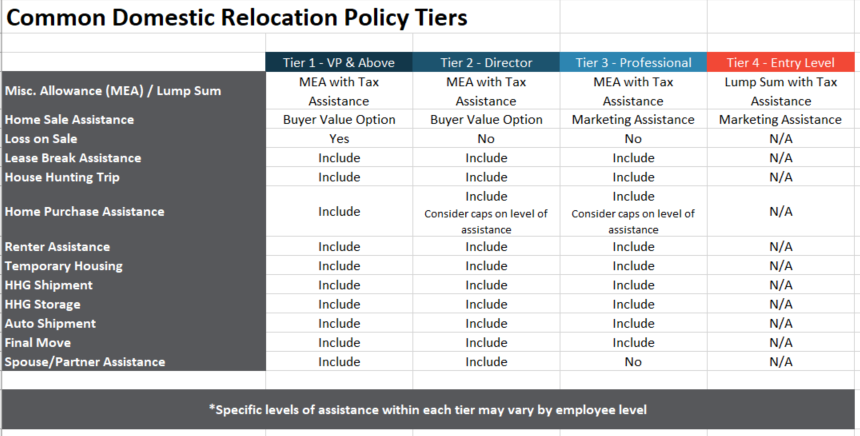
As every company has different goals and objectives for its relocation program, many-tiered relocation policies offer various levels of support for each employee. 

Here is a breakdown of the most common U.S. domestic relocation policy tiers per GMS research:

chart of relocation policy tiers

What Types Of Employees Receive Relocation Packages?

This aspect will depend upon the company’s need for each position and the importance of getting that employee to the new location. The best practice for relocation programs is to build a tiered system based on employee level. 

These tiers are commonly built around entry-level employees, professionals, directors, and vice presidents. Additionally, many companies offer executive relocation packages to cover the costs of relocation for most executive-level employees. Some companies may also provide international relocation packages for employees relocating globally.

Common Methods to Address Costs in Relocation Packages

Different policy tiers within your relocation program may require different strategies for covering your employee’s relocation costs. It is essential to understand the advantages and disadvantages of these standard methods.

Direct Billing: The relocation management company manages the procurement, organization, and direct payment to the service providers involved in your employee’s relocation. They review, combine, and forward the invoices to you for settlement. Although this approach may be pricier, it guarantees that your employee maximizes their benefits and reaches their new location promptly, alleviating any concerns about the expenses associated with the move. 

Expense Reimbursement: The employee pays for moving expenses upfront, and the company issues a reimbursement check at the end of the process. While not generally intended to cover an employee’s entire move (few families have the cash to pay tens of thousands of dollars for a move), reimbursements are commonly used for miscellaneous expenses as outlined in the company’s relocation policy. Typically, reimbursements are used for items such as travel costs or other related items.

Lump Sum: Unlike an expense reimbursement, a lump sum is commonly used as the primary financial benefit to a relocating employee. In a lump sum policy, a set amount of money is given upfront to the employee to handle the moving expenses as they see fit. 

Generally provided to entry-level or lower-level employees, the lump sum is typically the only relocation benefit offered. While the lump sum is seen as an excellent cost control tool for companies, it places additional burdens on employees, as they are left to manage their move independently. This is in addition to the lump sum, which is typically considered taxable income. Employees who receive their relocation benefits as a lump sum should note the payment for tax purposes. Employers should consider adding a tax gross-up to the lump sum to help mitigate the effects of the income tax on the employee’s benefit.

Ready to Set Up Relocation Packages for Employees?

Partnering with Global Mobility Solutions (GMS) ensures that your company offers comprehensive, cost-effective, and employee-centric relocation packages. GMS provides a tailored approach that aligns with your unique organizational needs, offering flexibility. This model allows you to select from a network of top-tier service providers or integrate your preferred partners, ensuring a customized experience for each relocation. Their expertise in managing all aspects of the relocation process—from pre-decision assessments to destination services—reduces risks, enhances employee satisfaction, and improves retention rates.

By leveraging GMS’s industry-leading MyRelocation® technology platform, your company can streamline relocation management, track expenses, and provide real-time support to transferees. This comprehensive support facilitates smoother transitions for employees and strengthens your employer brand by demonstrating a commitment to employee well-being. With over 30 years of experience and a global presence in over 140 countries, GMS has an expert team equipped to handle the complexities of workforce mobility, enabling your company to attract and retain top talent anywhere in the world.

We're Here to Help! Request a Courtesy Consultation

Are you ready to talk to a Mobility Pro? Learn how GMS can optimize your mobility program, enhance your policies to meet today’s unique challenges, receive an in-depth industry benchmark, or simply ask us a question. Your Mobility Pro will be in touch within 1 business day for a no-pressure, courtesy consultation.

Categories
Domestic Relocation Domestic Relocation Tips Domestic Relocation Trends Household Goods Relocation Best Practices Relocation Policy Review Relocation Programs

Lump Sum Relocation Packages: What are the Advantages? What are the Disadvantages?

What are lump sum relocation packages?

Global Mobility Solutions recently surveyed its clients to determine the impact of lump sum relocation packages on their organizations. Industry trends arising this year are having a direct effect on transferees. Often, these trends become visible through business intelligence and data analytics.

Lump sum relocation packages are a specific amount of money that employers offer to transferees or new hires. This money replaces relocation benefits such as household goods moves, culture and language training, or home-finding assistance. Employers expect employees to receive a lump sum payment to manage their relocation process.

Advantages of Lump Sum Relocation Packages

The advantages of lump sum relocation packages relate to helping employers simplify the process. The main benefit is that employers and their mobility managers have fewer complications around relocation support. Providing support during an employee’s relocation is reduced to answering questions about when the lump sum funds will be available. Additionally, lump sum packages allow employees greater flexibility in how they choose to spend the money. Instead of being tied to specific services, employees can allocate funds according to their unique needs and preferences. For instance, some may prioritize hiring professional movers, while others might opt for temporary housing or travel expenses. This autonomy can lead to a more personalized and satisfying relocation experience.

Lump sum packages also encourage employees to take responsibility for their relocation. With a set amount of money, employees must plan and budget their expenses wisely. This can foster a sense of ownership over the relocation process as they make decisions that best suit their circumstances. It can also lead to more thoughtful planning as employees weigh the pros and cons of different options.

Budgeting and Forecasting

Another simplification for employers revolves around budgeting and forecasting. Instead of working to understand the actual costs of hiring new employees or transferring employees from one location to another, the budget process is tied to a number that is applied across the board based on tiers in the relocation program. An executive homeowner with a family relocating from Duluth, MN, to New York, NY, is given the same lump sum payment as another executive renter relocating from Las Vegas, NV, to Fort Wayne, IN. The renter will pocket a significant amount of money. However, the homeowner will not have enough funds to move their family.

Disadvantages of Lump Sum Relocation Packages

Lump-sum relocation packages make administration and budgeting more accessible for employers. However, there are several disadvantages employers are beginning to see in their organizations. First among these disadvantages is that many lump sum payments do not adequately cover all of an employee’s relocation costs. GMS’ 2019 Lump Sum Survey shows that employees spend more, sometimes significantly more, on their relocation than their lump sum payment. This includes:

  • 61 % of homeowners reported spending more
  • 50% of renters reported spending more

Employee Dissatisfaction

Ultimately, more than half of relocating employees need more lump sum cash to cover expenses. Naturally, this results in a higher level of dissatisfaction with the organization’s lump-sum relocation packages. Overall, dissatisfaction with lump sum payments follows these patterns:

  • 58% of homeowners reporting dissatisfaction
  • 53% of renters reporting dissatisfaction

Loss of Control

A significant disadvantage is the employer’s loss of control over spending budget dollars. Lump sum relocation packages disbursed directly to employees may result in company funds being spent on non-relocation expenses, including cars, televisions, vacations, or other items. Funds spent on non-relocation costs do not support the successful relocation of the employee. As a result, the relocation may be at a higher risk of failure. 

Additionally, this lack of oversight can lead to inconsistencies in how employees utilize their relocation funds. Some may prioritize essential moving expenses, such as hiring professional movers or securing temporary housing, while others might allocate their budgets toward personal indulgences. This disparity can create a sense of inequity among employees, as those who spend wisely may still face challenges in their relocation process. In contrast, others may find themselves financially comfortable but unprepared for the logistical aspects of moving.


Moreover, the unpredictability of lump-sum payments can complicate the relocation experience. Employees may underestimate the true costs associated with moving, leading to financial strain when unexpected expenses arise. For instance, last-minute repairs on a home, increased transportation costs, or the need for additional storage can quickly deplete the funds, leaving employees feeling stressed and unsupported.

To address these issues, organizations might consider offering more structured relocation packages that balance flexibility and support. For example, a tiered approach could allow employees to access funds based on specific needs, prioritizing essential relocation expenses while giving them autonomy over their choices. This way, companies can maintain better control over their budgets while enhancing employee satisfaction and reducing the risk of relocation failure.
Ultimately, a thoughtful approach to relocation packages can foster a more positive employee experience, leading to smoother transitions and greater overall satisfaction with the organization’s support. By recognizing the complexities of relocation and adapting their strategies accordingly, employers can create a win-win situation that benefits both the company and its employees.

Inefficiencies

Many GMS clients achieve significant spending reductions with relocation programs that follow industry best practices. A major GMS client recently conducted an in-depth study of their relocation program expenses. This client learned that if their organization moved to a lump sum program, they might increase their relocation program expenses by 40%. In other words, by following industry best practices, this client keeps relocation budget dollars that otherwise would have been spent on inefficient lump-sum relocation packages. Any GMS client can achieve the same reduction in relocation costs through:

  1. Benchmarking their relocation policy to industry best practices
  2. Efficient relocation program operation
  3. Providing support to transferees that they need
  4. Using business intelligence and data analytics to understand the actual costs of their relocation program
  5. Utilizing a competitive vendor network of relocation service providers

What Does This Mean?

Companies that offer lump sum relocation packages could save a significant amount of budget by following industry best practices. Lump sum payments let employers simplify their internal support, budgeting, and forecasting processes. However, this simplification may cost employers up to 40% or more of their relocation budget. It also results in over half of transferees reporting dissatisfaction with their relocation packages.

What Should Employers Do About Lump Sum Relocation Packages?

Employers with transferees or new hires who are recent college graduates, individual contributors, or new to their professional careers may be the best candidates for lump sum relocation packages. These employees are often renters and may not have a significant amount of household goods to move to a new location. Also, they tend not to require a significant investment in talent acquisition, as they compete for lower-tier positions.

Industry best practice is to provide a range of benefits for employers who have new hires and transferees at higher tiers. Employees at higher tiers often require a significant investment in talent acquisition. Benefits that help ensure successful relocations also result in higher employee satisfaction.

Conclusion

GMS’ team of corporate relocation experts has helped thousands of our clients understand how to create relocation policies that attract and retain talent. Our team can help your company provide the best experience for transferees and new hires with lump-sum relocation packages.

GMS was the first relocation company to register as a .com. The company also created the first online interactive tools and calculators and revolutionized the relocation industry. GMS continues to set the industry pace as the pioneer in innovation and technology solutions with its proprietary MyRelocation™ technology platform.

Global Mobility Solutions is proud to be named and ranked #1 Overall and #1 in Quality of Service by HRO Today’s 2019 Baker’s Dozen Customer Satisfaction Survey.

Contact our experts online to discuss how your company can leverage lump sum relocation packages for new hires and transferees, or call us at 800.617.1904 or 480.922.0700 today.

We're Here to Help! Request a Courtesy Consultation

Are you ready to talk to a Mobility Pro? Learn how GMS can optimize your mobility program, enhance your policies to meet today’s unique challenges, receive an in-depth industry benchmark, or simply ask us a question. Your Mobility Pro will be in touch within 1 business day for a no-pressure, courtesy consultation.

Categories
Corporate Relocation Global Relocation Global Relocation Tips Relocation Best Practices Visas and International Travel

Company Relocation Policy Checklist for 2024

Things to keep in mind when reviewing Relocation policies

Offering relocation benefits to new or promoted employees is a great way to ensure that your company can hire the most qualified candidate for the position. As the new year is now upon us, HR managers should start to review their company’s relocation policies. Most relocation assistance companies recommend checking and renewing policies annually, usually in Q4. As the global mobility industry sees continuous change over time, reviewing policies at least once per year helps ensure that the relocation policies offered are still competitive within your industry, and ensure cost efficiencies are adapted to your current business environment. 

Whether you are going out to bid for a new relocation company or just want to ensure that your relocation policies are above the standard, use this 2024 relocation policy checklist to ensure all of the joint pain points are met.

Our recommendations for global mobility planning cover both short-term and long-term initiatives. Here is the 2024 relocation checklist:

Short-Term Assignment Policy Review Points

  1. Identify all instances relating to immediate and upcoming needs for your relocating employees, including visas, work permits, immigration status changes, and cross-border travel. Determine appropriate action plans for each case.
  2. Document policy exceptions relating to the pandemic. Consider adjusting the company relocation policy or adding an addendum to account for the effects of the pandemic and other major relocation disruptions.
  3. Review all assignments that were placed on hold during 2022 and 2023. Determine if they are still critical to corporate objectives for 2024. If yes, implement a talent acquisition plan.
  4. Examine all data sources and information flows for integrity and accuracy. Form a relocation integration program project team to Identify instances that can be automated with effective relocation advanced programming interfaces (APIs).
  5. Identify current short-term assignments that can be further extended in support of corporate objectives. This will reduce costs relating to repatriation and re-assignment.

Long-Term Assignment Policy Review Points

  1. Determine areas in the relocation process where the company owes a higher duty of care than previously expected. Examples include programs and costs relating to transferees unable to return to their original locations due to pandemic-cause restrictions.
  2. Correlate talent acquisition and management programs to ensure consistency in achieving objectives across the company.
  3. Leverage virtual relocation solutions that enhance the transferee’s experience and provide added value to the company.
  4. Focus on process simplification and cost reduction. Use the lessons from 2020’s expanded virtual relocation solutions to modify your company relocation policy to adopt new technologies and procedures.
  5. Look to future corporate initiatives to determine appropriate company relocation policies, plans, and budgets. Ensure alignment with company objectives relating to growth, expansions, mergers, acquisitions, and divestitures.

Get in Touch with GMS for More Helpful 2022 Tips

At GMS, we understand that each company runs differently, meaning everyone will have different needs regarding relocation benefits. Our team has been helping companies construct some of the most competitive relocation packages for over 25 years. With 2024 now here, it’s time to ensure all your bases regarding relocation are covered. GMS recommends that clients thoroughly review their company relocation policy every 12 to 18 months. Following all the impacts of the COVID-19 pandemic on relocation, this review is critically important to ensure your company can respond effectively for regulatory, tax, and reporting purposes.

If you found this company relocation policy checklist useful, please refer to our Knowledge Base for more helpful blogs, case studies, and industry news. If you want to continue success with your employee relocation program and relocation packages, please feel free to reach out to Global Mobility Solutions for all your corporate relocation needs. 

We're Here to Help! Request a Courtesy Consultation

Are you ready to talk to a Mobility Pro? Learn how GMS can optimize your mobility program, enhance your policies to meet today’s unique challenges, receive an in-depth industry benchmark, or simply ask us a question. Your Mobility Pro will be in touch within 1 business day for a no-pressure, courtesy consultation.

Categories
Domestic Relocation Domestic Relocation Tips Global Relocation Global Relocation Tips Relocation Programs

Benefits of Pre-Decision Services

What Are Pre-Decision Services? Learn more about the relocation process, starting with pre-decision services

Global Mobility Solutions (GMS) is the original pioneer of the benefits of pre-decision services. Our clients know that partnering with us at the start of the relocation process helps identify the markers of a successful relocation and greatly enhances transferee productivity. Our wide range of services allows clients to identify those employees who are the best fit for the assignment. Relocation technologies and systems let clients manage employee relocation programs with ease.

Among the many services GMS offers, candidate assessments have become critical for clients to assess expectations, skills, qualities, and financial and family issues impacting relocation success. Clients should examine candidate circumstances to identify prospects likely to succeed. For the candidate, pre-decision services provide valuable information they can use to determine, including helpful information about the cost of living, housing markets, school reports, and moving expenses.

Candidates indicate that community searches and tours benefit them in understanding the new location and helping them select areas best suited to their needs.

There are several benefits of pre-decision services for both the client and the candidate:

Benefits of Pre-Decision Services for the Client

  • Increase job acceptance ratios
  • Budget accuracy
  • Eliminate the risk of non-acceptance
  • Streamline orientation to the new location
  • Minimal policy exceptions
  • Identify candidate concerns and issues
  • Cost savings

Benefits of Pre-Decision Services for the Candidate

  • Personal support and attention from industry professionals
  • Thorough orientation tours for families
  • Expert counsel and assistance regarding all aspects and impacts of relocation
  • Support services for spouses and partners

Systems and Processes

Our relocation experts have created systems and processes to help clients manage their Global and North America relocation programs quickly and efficiently. We provide high-touch customer service, policy expertise, benchmarking, and flexible reporting options. Clients succeed most with a customized, right-fit relocation program designed to meet their unique requirements. Employees and their families expect a broad range of services to help them during their relocation process. Our pre-decision services help clients and employees throughout the relocation process and help ensure successful relocations.

Get Pre-Decision Services from GMs

The benefits of pre-decision services to clients and candidates serve to ensure successful relocations. The corporate relocation experts at GMS have the knowledge and expertise to help your company assess candidates for assignments and provide your employees with the best relocation experience. Contact our team of experts to discuss how we can implement pre-decision services in your company’s relocation process.

We're Here to Help! Request a Courtesy Consultation

Are you ready to talk to a Mobility Pro? Learn how GMS can optimize your mobility program, enhance your policies to meet today’s unique challenges, receive an in-depth industry benchmark, or simply ask us a question. Your Mobility Pro will be in touch within 1 business day for a no-pressure, courtesy consultation.

Categories
Global Relocation Global Relocation Tips Global Relocation Trends Relocation Best Practices Relocation Programs

What Are The Benefits of Outsourcing Global Relocation Programs?

learn why your company should work with a relocation management company for talent mobility

What are the benefits of outsourcing global relocation programs? For companies that have steady moving needs, there are many benefits to outsourcing this strategic function. Most learn they need to gain the knowledge and experience to manage talent mobility with in-house resources effectively. Outsourcing this critical activity provides them access to the industry’s best practices and thought leadership that will help their company’s international relocation program achieve success with virtually all relocation assignments.

There are five distinct benefits clients can gain from outsourcing their global relocation services with a trusted relocation management company (RMC):

Cost Management

For most clients, managing relocation costs is one of the most important reasons driving their choice to outsource relocation. 71% of companies working on relocation in-house need to be made aware of their total internal operating expenses. A lack of knowledge of the actual costs of relocation prevents the company from understanding how to utilize resources efficiently. They also cannot gain the most benefit from their global relocation program. A solution that provides full expense tracking and reporting is one of the top features clients seek as they consider outsourcing their global relocation program so that costs can be fully identified and reviewed for budgetary impact and program performance.

Savings With Outsourcing Global Relocation Programs

Outsourcing global relocation services should allow clients to obtain more significant cost savings. Some RMCs are not independent. As a result, they often do not seek multiple bids for household goods shipments and other services. An independent RMC provides clients with several opportunities to receive and review bids on services, and this helps keep costs lower than other RMCs that don’t seek competitive bids.

Compliance

Transferees and their families often have questions about tax issues, visa applications, and other reporting requirements related to their global relocation assignment. To avoid putting the client’s company at risk for providing incorrect or insufficient guidance and advice, outsourcing global mobility management can provide expert guidance on unique relocation needs to help transferees find the right solution and help clients avoid any risks related to transferee requests.

Program Enhancements Through Outsourcing Global Relocation Programs

In-house programs only sometimes provide enhancements such as pre-decision tools, candidate assessments, auto lease programs, home purchase programs, and other value-added services. Choosing to outsource relocation services provides access to these services. Transferees and their families highly value these relocation program enhancements. Additional valued services include community tours, language training, outplacement services, school reports, and moving cost estimates.

Focus on Their Core Competencies

Working with an RMC lets human resources, compensation, benefits, and recruiting professionals focus on their core competencies. As a result, they can provide the best service in these business areas. In turn, experts at an RMC give the client’s international relocation program the best service. Choosing an RMC with the knowledge and experience to manage their entire program provides peace of mind and assurance that costs will be managed effectively, relocations will be successful, and transferees and their families will be satisfied with their experiences.

Work with the Best Global Relocation Service Provider

Global Mobility Solutions (GMS) has been helping customers get their employees from point A to point B since 1987. Our wide range of services and expert relocation specialists give your company the opportunity to get the package they need. GMS will assist your company put together a global relocation plan that makes sense for your company and employees, all while staying within a realistic budget. If you are ready to discuss more about our offerings, please set up a free consultation with one of our business development managers, by filling out this form. We look forward to working with you!

We're Here to Help! Request a Courtesy Consultation

Are you ready to talk to a Mobility Pro? Learn how GMS can optimize your mobility program, enhance your policies to meet today’s unique challenges, receive an in-depth industry benchmark, or simply ask us a question. Your Mobility Pro will be in touch within 1 business day for a no-pressure, courtesy consultation.

Categories
Corporate Relocation Corporate relocation tips Domestic Relocation Domestic Relocation Tips

What Should be Included in New-Hire Relocation Packages?

What does an employee relocation package typically include?

There are numerous approaches to take when putting together employee relocation packages, but in the end, every company is trying to do the same thing; that is, to find the perfect middle ground on relocation benefits that don’t blow the company’s budget while also being lucrative enough to attract the right candidate for the open position. 

It’s not uncommon for a company to try to construct relocation policies on their own before realizing they are in over their head and need the assistance of a relocation management company (RMC). RMCs give insight and can provide statistics and studies that help companies form relocation packages that land in that happy middle ground mentioned before. 

But even working with an RMC, it can be hard to know what should be included in talent mobility options offered to newly hired employees. So here’s a look at some of the common aspects that should be covered in relocation packages:

House-Hunting Trips

That’s why it is recommended that companies cover at least one or two house-hunting trips. These trips allow employees to scoop out their new destination and view some homes with a specialized relocation agent. Employees can also check out some schools for their kids.

Temporary Housing

Temporary housing, also known as corporate housing, is usually given from 14 to 90 days. This can help the employee transition to the moving process. There are a few different factors that require a new-hired employee to need corporate housing. The most common is if the relocating employee’s new home isn’t ready. Another common is if the employee could not purchase a place to live within the timeframe given. 

RMCs can help companies set up corporate housing leases with apartment complexes or townhome owners so that it is affordable for the company and extremely helpful for the transferee.

Family and Spousal Support

It’s not always just the employee moving, and it can be their whole family. Language and spousal career support add some family assistance benefits to relocation packages. Language training is an obvious one for those who are relocating internationally with kids. Giving them the resources to learn a new language can help them in school. 

And the transferee’s spouse may have to leave their job when the relocation occurs. This is why it can be beneficial for the family if the relocation policies include career services such as help with the job hunt and resume review assistance.

Real Estate Assistance

Employees’ main stress points about relocating are selling and buying a home. Real estate transactions can take weeks or months, making it a scary process when the move takes place in a short period. Any reputable RMC would recommend relocating employees with some home buying and selling programs. 

Three of the most used real estate assistance programs RMCs refer to are Direct Reimbursement, Buyer Value Option (BVO), and Guaranteed Purchase Offer (GPO). Of course, each will have different advantages depending on the transferee’s needs. But giving the new-hired employee some help in either buying or selling their home can help assure they can get to their new destination promptly.

Shipping of Household Goods

When people think about the relocation process, it is the only part that comes to mind but moving a transferee’s household goods is a crucial stage so it should not be overlooked. Packing, moving, and storing the employee’s furniture and belongings should be done by a reliable moving professional who can provide a great price. Every transferee’s nightmare is that the movers will not show up on the right day or their stuff will get broken. 

Any knowledgeable RMC will get multiple quotes from moving companies for the transferee. This way there are options to assure both the company and the employee are being taken care of for costs and customer service.

How Much Should Companies Spend on Relocation Packages?

That is the age-old question that is hard to answer. Too many variables must be reviewed before a realistic quote can be given on how relocation costs should be allocated. Some variables on this include number of relocations per year, distance on the moves, what relocation services the company is willing to cover, and visa and immigration services needed? 

One of the best ways to keep relocation costs under control is to update relocation policies every 12 to 16 months at a minimum. Service prices change so much that if companies are not updating their relocation packages, they could be spending unnecessary money or in some cases, they might not be spending enough money, forcing qualified candidates to walk away from the job.

GMS Will Help Put Together the Best Relocation Package

Global Mobility Solutions (GMS) is the industry leader in employee relocation. Our expert team has been assisting companies put together comprehensive and competitive relocation packages for 30-plus years. We listen to your needs and then tailor relocation policies that best suit those needs at a cost-efficient price so that you can get your employees from point A to point B in a seamless transition. In addition, we will make sure that all the relocation services you need are included in all new hire’s offer letters.

GMS strives to be the best in customer service, so we will assign a relocation coach to each of your employees to help in the relocation process every step. If you’re ready to hear more about how GMS can help, contact us today to schedule a free consultation. And to get other questions you may have about talent mobility answered, check out our Knowledge Base.

We're Here to Help! Request a Courtesy Consultation

Are you ready to talk to a Mobility Pro? Learn how GMS can optimize your mobility program, enhance your policies to meet today’s unique challenges, receive an in-depth industry benchmark, or simply ask us a question. Your Mobility Pro will be in touch within 1 business day for a no-pressure, courtesy consultation.

Categories
Choosing a Relocation Company Relocation Management Relocation Policy Review Relocation Programs Relocation Technology

Performing a Security Assessment on Your Relocation Management Company

There are a lot of moving parts when it comes to the relocation process. Many vendors and suppliers are involved in getting the transferee from point A to point B. With that being said, there is a great deal of information and personal info that has to be shared across all parties. But what are relocation management companies (RMC) doing to keep transferee’s info safe? 

Most companies understand the importance of performing a security assessment on their data and operational systems. In many industries, specific standards require a security assessment on a regular basis to maintain compliance. Often these standards require the company perform a security assessment on any supplier that may receive company data. Specific control areas in a security assessment may include:

  • Information Security Management
  • Physical Security
  • Network Security Management
  • Platform Security
  • Remote and Mobile Access
  • Change Control
  • Identity and Access Management
  • Application Security

A security assessment will often include a request to receive a copy of the company’s Business Continuity Plan (BCP). A company’s BCP should cover several elements related to security issues surrounding a company’s data and operational systems. In the event of an unplanned disruption or other emergency situation, the BCP will indicate how the company’s operations will recover and proceed.

Different Types of Regulations and Requirements

Sarbanes-Oxley Act

The Sarbanes-Oxley Act came into effect in 2002. Sarbanes-Oxley is a United States federal law. This law set new or expanded requirements for all U.S. public company boards, management, and public accounting firms. As a result, the law requires that a company’s top management must individually certify the accuracy of financial information. Much of a company’s financial information is heavily dependent on technology and associated data security controls that must be part of a compliance review as noted in Section 404 of the Act. The law provides for harsher penalties for fraudulent financial activity. Also, Sarbanes-Oxley requires a stronger oversight role for boards of directors, and greater independence of outside financial statement auditors.

International Organization for Standardization

The International Organization for Standardization (ISO) creates and publishes International Standards that provide guidance and clear specifications to ensure a company’s products, materials, processes, and services are appropriate for their purposes. ISO publications include standards for Quality Management, Environmental Sustainability and Protection, and Management Performance.

General Data Protection Regulation

The European Union’s General Data Protection Regulation governs the processing of an EU resident’s personal data by an individual, a company, or an organization of personal data. This pertains to entities that do business within the region, or that provide services to individuals in the region. The rule provides people with more control over their personal data. For example, websites that collect data on visitors must let visitors know this. These websites must give visitors the option to opt out of such collection. Many additional laws have been passed in response to this new regulation, to provide local guidance on compliance. For example, in the United Kingdom, the Data Protection Act 2018 is a national law that complements the European Union’s General Data Protection Regulation.

TRUSTe Privacy Certification Standards

TRUSTe Privacy Certification Standards assist companies in establishing and maintaining strong privacy management practices. Compliance with TRUSTe demonstrates a company’s commitment to privacy protection in their online properties, customer and employee data management practices, and/or applicable regulatory frameworks.

For these and many other national, international, and industry regulations or requirements, a security assessment is necessary to ensure compliance. Companies that work with a Relocation Management Company (RMC) need to perform a security assessment of the RMC’s data and operational systems. Global Mobility Solutions’ team of global relocation experts believe the following 5 tips are essential to ensure an RMC’s compliance to a company’s security assessment.

5 Helpful Tips for Performing a Security Assessment on your RMC

1. Be Sure to Review the RMC’s Risk Rating and Access to Data During the Security Assessment

Your RMC should have a risk rating. The rating depends upon the likelihood of an event occurring. It also depends on the impact severity that might arise if the event does occur. You should determine whether the RMC has limited or full access to data. Important data fields to review for risk during a security assessment include:

  • Employee Name and Home Address
  • Employee Phone Numbers and Email Address
  • Family Member Contact Information
  • Social Security Numbers
  • Bank Name and Account Numbers
  • Logistic Information Related to Relocations
  • Travel Information Including Dates and Locations

2. Questionnaire Submission to RMC

Your company should have a document with several questions that will indicate the RMC’s compliance to important points in a security assessment. Provide sufficient time for the RMC to complete the questionnaire. The RMC will need to work with their Information Technology department to provide answers to many of these questions. Provide a contact from your company that can answer any questions the RMC may have related to the document’s specific points.

3. Share Results of the Initial Security Assessment

Once the initial security assessment is complete, share the results with your RMC. Offer to work with the RMC to remediate any areas that require attention to ensure compliance. Partnering with the RMC helps ensure the solution fully addresses your company’s requirements. Note the specific regulatory requirements that your company must meet to help the RMC understand how they might reach compliance.

4. Share Results of the Final Security Assessment

Be sure to indicate all control gaps. Note all categories that require submission of a formal remediation plan. Include specific dates and timelines critical for maintaining your company’s compliance to specific regulations. Provide guidance to the RMC on how to create and submit a remediation plan that will meet your company’s requirements.

5. Set Periodic Reviews for the Security Assessment

Working with the RMC, set a timeline for periodic reviews. Depending on your company’s specific regulatory compliance requirements, a security assessment may need to occur by date or by change in activity level. For example, if your company requests the RMC perform an additional service that requires sharing additional employee data, a review should be set to confirm the most recent security assessment is still valid.

GMS is the Industry Leader for Relocation Technology and Security

Global Mobility Solutions’ (GMS) team of global relocation experts has helped thousands of our clients understand how to conduct an effective security assessment on an RMC. We can help your company create and implement a security assessment to ensure compliance to all of your organization’s regulatory requirements.

GMS was the first relocation company to register as a “.com.” The company also created the first online interactive tools and calculators, and revolutionized the entire relocation industry. GMS continues to set the industry pace as the pioneer in innovation and technology solutions with its proprietary MyRelocation® technology platform.

Global Mobility Solutions is proud to be named and ranked #1 Overall, and #1 in Quality of Service by HRO Today’s 2019 Baker’s Dozen Customer Satisfaction Survey.

New SafeRelo™ COVID-19 Knowledge Portal

GMS recently launched its new SafeRelo™ COVID-19 Knowledge Portal featuring a number of helpful resources including:

  • Curated selection of news and articles specific to managing relocation programs and issues relating to COVID-19
  • Comprehensive guide to national, international, and local online sources for current data
  • Program/Policy Evaluation (PPE) Tool for instant relocation policy reviews

Learn best practices from Global Mobility Solutions, the relocation industry and technology experts who are dedicated to keeping you informed and connected. Contact our experts online or give us a call at 800.617.1904 or 480.922.0700 today.

We're Here to Help! Request a Courtesy Consultation

Are you ready to talk to a Mobility Pro? Learn how GMS can optimize your mobility program, enhance your policies to meet today’s unique challenges, receive an in-depth industry benchmark, or simply ask us a question. Your Mobility Pro will be in touch within 1 business day for a no-pressure, courtesy consultation.

Categories
Domestic Relocation Domestic Relocation Challenges Domestic Relocation Tips Domestic Relocation Trends Global Relocation Global Relocation Challenges Global Relocation Tips Global Relocation Trends Relocation Policy Review Relocation Programs

Relocation Policy Review: Anticipating Changes and Challenges

Why Companies should review their Relocation Policies?

It is important, and highly recommended, that companies review their relocation policies at the start of each year. This will help your company remain at the forefront of your industry, ahead of your competitors, and in line with best practice recommendations. Most companies are not completely immune to global forces, market changes, and unique challenges such as the COVID-19 global pandemic. Often these issues directly impact employees on international assignments.

There are several reasons why companies need relocation benefits. Often, relocation perks are used for hiring a recruit for an open position. Other times, companies may use relocation to transfer knowable employees to different job sites or as part of a development program offered through the company when promoting an existing employee. But no matter the reason, all sizes of company who offer talent mobility should have their relocation policies reviewed with some regularity. Here is a breakdown of why relocation policy review is important:


Address Strategic Objectives in Your Relocation Policy Review

Growing companies often have strategic plans that guide activities and investments. Many of these plans lay out specific goals and actions. For example, a company that wants to grow into a new market might leverage their relocation policy review in several ways to achieve this goal. This may include investigating the services of an International Professional Employer Organization (PEO). PEOs can help a company establish a presence in a new market within a very short timeframe and with no direct investment. As a result, companies can focus on achieving strategic objectives and responding nimbly to market changes. In return, the company saves time, effort, and resources. Also, the overall costs of service fees and financing international employees’ payroll are significantly lower than the cost of establishing a foreign entity.

Cost Reductions and Process Improvements Can Be Found

Relocation Management Companies (RMCs) with extensive industry knowledge and experience can help identify cost reductions. There may be several areas that offer cost reduction opportunities during a relocation policy review. Also, the mobility industry often changes rapidly in response to needs, preferences, and regulations. As a result, knowledgeable RMCs can easily identify and share new ideas for cost reductions.

RMCs are often drivers in the mobility industry for process improvements. Technology can lead to dramatic increases in productivity. For example, a Relocation API can replace many time-consuming data entry tasks and responsibilities. In turn, valuable resources are freed up to focus on critical business and department issues.

Maintaining Your Company’s Competitive Market Position

Every relocation policy review should include and reference benchmarking studies. These studies should show what your company’s industry competitors are providing in their policies. Your company should have information to know whether its relocation policy provides benefits that at least match the competition. A thorough relocation policy review can help identify areas that need to change in order to maintain your organization’s competitive position.

Ensures Company Policy Remains Compliant

National and international regulations can frequently change. Constant changes in visa requirements, immigration, tax laws, health recommendations, and other regulations directly impact relocation programs and employees. Conducting a relocation policy review helps your company learn what is changing, what may change in the future, and how to adjust your relocation policy accordingly. The review also provides information that your company can share with internal company stakeholders and employees who utilize the policy.

When Should Relocation Benefits Be Reviewed?

Companies should arrange a relocation policy review about every 12 months. As markets and global dynamic forces change at an ever faster pace, transferees are often some of the first employees to face direct impacts. As a result, the company’s relocation policy should be current and provide industry-leading solutions. This will result in greater employee satisfaction, and enhance talent acquisition and retention efforts.

GMS’ team of global relocation experts has helped thousands of our clients with their relocation policy review. Our mobility consulting team understands the dynamic nature of the corporate relocation market. GMS provides expert guidance for relocation policies, as a result, our team ensures that our clients’ transferees receive immediate assistance as required, clients remain competitive, their relocation programs maximize efficiencies, and they can leverage several cost reduction opportunities.

GMS was the first relocation company to register as a .com. The company also created the first online interactive tools and calculators, and revolutionized the entire relocation industry. GMS continues to set the industry pace as the pioneer in innovation and technology solutions with its proprietary MyRelocation® technology platform.

To schedule your relocation policy review or to receive an industry-specific policy benchmarking overview, contact our experts online or give us a call at 800.617.1904 or 480.922.0700 today.

We're Here to Help! Request a Courtesy Consultation

Are you ready to talk to a Mobility Pro? Learn how GMS can optimize your mobility program, enhance your policies to meet today’s unique challenges, receive an in-depth industry benchmark, or simply ask us a question. Your Mobility Pro will be in touch within 1 business day for a no-pressure, courtesy consultation.

Categories
Buy a Home Corporate Relocation Domestic Relocation Relocation Management Relocation Programs Talent Mobility

Relocation Home Sale Programs: BVO, GPO, or Direct Reimbursement

Keep your Program Competitive with Home Sale Assistance Benefits

When a new or existing employee accepts a position in a different location and is willing to move, some of the main concerns they will have right off the bat are real estate concerns. Selling their current home, then buying a new house in the new city can cause anxiety. But if the company relocating the employee offers benefits with home sale assistance or real estate sale programs, it can make the relocation process much easier for both the employee and the company. 


One of the most sought-after benefits to include in relocation packages is a home sale program. In basic terms, relocation home sale programs offer assistance to homeowners so that they can quickly move to their new city for the desired start date. While each relocation management company (RMC) will have different terms on their offered real estate programs, most usually include payments to cover real estate commissions and closing costs. Again, each home selling assistance program is different so it will depend on the seller’s/buyer’s situation on what can and cannot be covered or reimbursed. The type of program offered also depends on your company’s specific relocation policies and the level of support you offer to your relocating employees. Direct Reimbursement, Buyer Value Option (BVO), and Guaranteed Purchase Offer (GPO) are three of the most commonly offered relocation home sale programs. Here is a breakdown of each:

Direct Reimbursement

In most cases, this might be the simplest home sale assistance program for the company and the most involved for the employee. Under a typical direct reimbursement program, the employee is responsible for the sale and closing of their own home. This means they have to hire their own real estate agent and list the home (however many RMCs, like GMS, offer comprehensive home marketing assistance to help sell the property quickly and for top dollar). Once the property sale is complete, the employee then goes through the employer’s process of submitting expenses to be later reimbursed – generally these expenses cover the cost of the agent’s commission, closing costs, and the miscellaneous fees associated with selling a home.


With direct reimbursement, the payment to the employee is viewed by the IRS as income and is subject to income tax. This can result in the employee receiving a reduced overall amount of support due to their unique tax situation. However, If the employer is offering the employee tax gross-up options, this could help offset the amount of tax dollars that the employee is having to pay, providing them with an elevated level of financial assistance.

Buyer Value Option (BVO)

Known as a 3-party transaction, the Buyer Value Option program can seem a little confusing to those who are not in the industry. Under a BVO home sale assistance program the employee lists their home for sale until a competitive outside offer is received. Then, the RMC will purchase the home from the employee based on a set sales contract amount. The RMC will then immediately sell the property to the outside buyer. Unlike the single transaction reimbursement program, this option has two transactions. 


The main reason companies choose to offer BVOs in their relocation program has to do with the tax benefits, tax protection, and the reduced overall costs of this program. Under a Direct Reimbursement program (as described above), if the employee were to sell the home directly to the buyer, without the RMC middleman, then the IRS would view the reimbursement of expenses to the employee as taxable income. Companies help to offset this by grossing up the reimbursement, which drives up the total cost.


Under the advantageous BVO program, the home sale is tax-protected, occurs between the RMC/Company and the buyer, and no reimbursement or gross-up to the employee is required as the company pays the selling expenses. This reduces the tax liability for both the employee and their new company. The BVO home sale assistance program also helps cover the cost of the real estate broker’s commission and closing costs on the home sale. Lastly, the expense of an appraisal is mitigated, as the price of the home is driven by the offer received in the market.

Guaranteed Purchase Offer (GPO)

Sometimes called a Guaranteed Buyout (GBO), the GPO home selling assistance program is a popular one because it gives the moving employee a guaranteed home sale. Under this program, the employee lists the property for a set amount of days (typically 60-120 days) to try to sell on their own. If their home is not sold in the allotted time frame, the RMC/Company will then purchase the home from the employee, allowing them to move on to their ultimate destination without the stress of selling their property. The property then goes into the RMC/Company’s inventory and is now their responsibility to sell.


If the employee does get a qualified offer from a buyer within the specified timeframe, then the sale is completed similar to the BVO program (often called an Amended Value under these circumstances), where the RMC buys the home from the employee then sells it to the buyer for tax purposes. Again, making for two home sale transactions. 


The major difference between the Guaranteed Purchase Offer program and the BVO is that in a GPO program, an appraisal is completed on the property to establish a fair market value of the property to establish the purchase offer price. 

Choosing the Right Relocation Home Sale Program

Global Mobility Solutions has been helping relocating employees since 1987. Our team is always on hand to help your organization develop competitive and cost-effective home sale assistance programs. Reach out to us today with any questions regarding direct reimbursement programs, BVOs, or GPO. Our team is more than happy to help your company come up with the best relocation home sale programs possible to assist with meeting your talent acquisition objectives and improve the overall relocation experience for your transferees and their families.

Ready to Calculate YOur Program Savings? Request Access Now!

Are you ready to calculate your potential relocation program savings? Request access to our easy-to-use Relocation Cost Savings Calculator. Your Mobility Pro will grant your access request within 1 business day.

Looking for something?