


Categories
Corporate Relocation Global Relocation Relocation Technology

5 Practical Ways to Improve Your Employee Relocation Experience

Why Employee Relocation Experience Matters in 2026

Employee relocation plays a direct role in how organizations execute their business strategy. It impacts whether employees accept assignments, how quickly they become productive, and how effectively skills and knowledge are transferred across locations. While many companies already offer structured corporate relocation services and global mobility services, the real opportunity today is improving how those programs are experienced by employees. The most effective organizations are not necessarily adding more benefits or increasing spend. Instead, they are making targeted improvements that increase clarity, confidence, and consistency throughout the relocation process.

One of the most impactful ways to improve the relocation experience is to introduce simple pulse surveys across key milestones. Rather than waiting until the end of a move, leading programs are gathering feedback at critical points such as offer acceptance, pre-departure, arrival, and the first 30 days in the new location. These surveys are intentionally short, often no more than three questions, focused on understanding how confident employees feel, whether they feel supported, and what would make their experience smoother. This approach allows organizations to identify patterns early and make small adjustments in real time. Over time, these insights lead to measurable improvements in employee satisfaction, relocation acceptance rates, and overall program effectiveness.

Another area that consistently drives better outcomes is visibility into the relocation process. When employees and internal teams have a clear understanding of where each relocation stands, it reduces uncertainty and allows for faster decision-making. Data visibility is not just an operational benefit; it has a direct impact on business performance. When organizations can see delays, risks, or bottlenecks early, they can take action before those issues affect start dates, productivity, or project timelines. While sophisticated platforms exist, even a simple, well-structured dashboard using existing data can provide meaningful insight. The key is to create a clear, real-time view of each employee’s progress against key milestones. Organizations can also work closely with their relocation management company or speak with their GMS representative to explore tools like the MyRelocation portal, which provides 24/7 access to real-time relocation data, alerts, and status updates in one centralized view.

Creating Confidence Through Access, Clarity, and Support

Beyond visibility, one of the most effective ways to improve employee experience is to reduce uncertainty before the move even begins. Many organizations are finding success by creating opportunities for employees to engage directly with relocation suppliers. Hosting structured “relocation day” sessions, either virtually or in person, allows employees to meet moving companies, destination service providers, and housing experts in a more interactive setting. Instead of relying on static documents, employees can ask questions, explore scenarios, and gain a clearer understanding of what to expect. This direct access builds confidence and helps employees make decisions more quickly, which ultimately supports faster transitions and smoother relocations.

Financial clarity is another major driver of employee confidence. Even when strong employee benefits are in place, uncertainty around cost can create hesitation. Employees are often less concerned with the total value of the package and more concerned with unexpected expenses or financial exposure during the move. Improving how benefits are explained, providing realistic examples, and clearly outlining potential out-of-pocket scenarios can significantly improve acceptance rates. This is particularly important in programs that use capped or point-based structures, where flexibility exists but may not always feel transparent to the employee. When employees understand what to expect, they are more likely to engage fully in the relocation process.

Finally, the relocation experience should extend beyond the physical move. Many organizations see a drop in support after the employee arrives, even though this is often when the most important adjustments are taking place. A simple post-arrival check-in, scheduled two to three weeks after move-in, can have a meaningful impact. This conversation helps identify early challenges related to housing, commuting, or family adjustment, allowing organizations to resolve issues before they affect performance or satisfaction. It also reinforces that the company remains invested in the employee’s success beyond the logistics of the move.

Final Thought

Improving employee relocation experience does not require a full redesign of your program. Small, focused actions such as introducing milestone-based feedback, increasing visibility into relocation progress, creating direct access to support, and improving financial clarity can significantly enhance outcomes. In today’s environment, global mobility services and corporate relocation services are not just operational tools. They are part of how organizations retain talent, develop leaders, and ensure that business-critical roles are filled effectively and on time. The organizations that focus on experience are ultimately the ones that see stronger performance, faster productivity, and more successful long-term assignments.
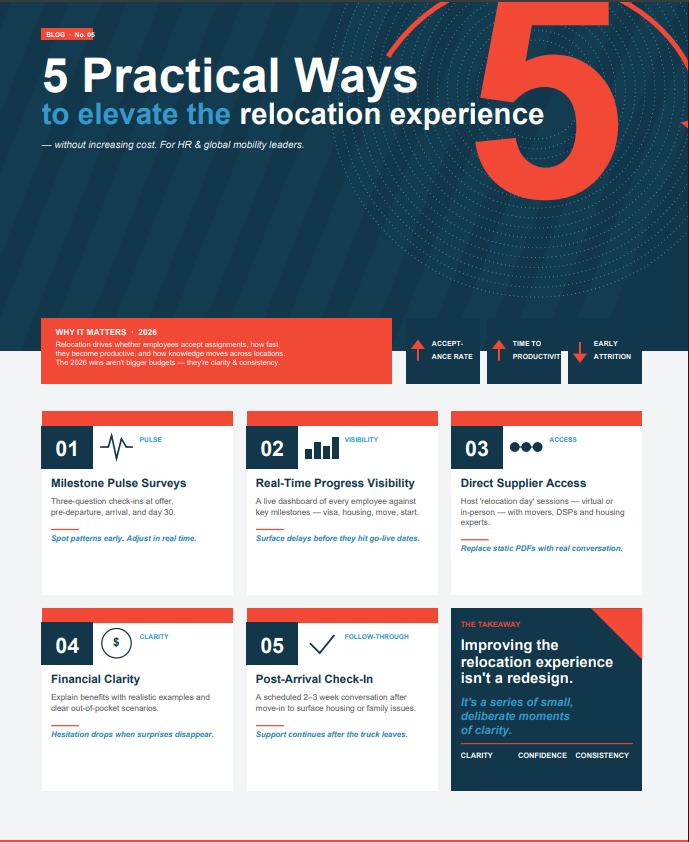
5 employee experience info graphic

Most Frequently Asked Questions about Employee Relocation Experience

What is an employee relocation experience?

Employee relocation experience refers to the full journey an employee goes through when moving for work, from the initial decision to relocate through to settling into their new role and environment. This includes communication, logistics, support, and how confidently the employee can navigate each stage of the move.

Key business indicators:

Time to productivity after relocation
Relocation completion timelines
Employee satisfaction scores during relocation
Assignment success rate

Why is employee relocation experience important for businesses?

A strong relocation experience helps protect the company’s investment in talent. It improves acceptance rates for relocation offers, reduces early attrition, and supports faster integration into the new role. It also ensures that business-critical positions are filled without unnecessary delay and that employees can contribute effectively from the start.

Key business outcomes:

Higher relocation acceptance rate
Reduced early attrition (first 12 months)
Faster time to full productivity
Improved retention of high-performing employees
More effective transfer of skills across locations

How can companies improve relocation experience without increasing cost?

Organizations can improve relocation experience by focusing on clarity, visibility, and timing rather than adding new benefits. Simple changes such as introducing milestone-based pulse surveys, improving communication, and providing better access to relocation information can significantly improve employee confidence and overall experience.

Practical actions:

Use short pulse surveys at key relocation milestones
Improve visibility into relocation progress (dashboard or portal)
Provide clear, upfront communication on benefits and expectations
Offer direct access to relocation support and suppliers
What role do global mobility services play in employee experience?

Global mobility services and corporate relocation services provide the structure and coordination needed to manage employee moves effectively. They ensure that logistics are handled properly, timelines are maintained, and employees receive the support they need throughout the relocation process.

Operational impact:

Improved relocation timeline management
Better coordination across vendors and stakeholders
Reduced disruption to business operations
Consistent employee support across locations
How does relocation impact talent retention and leadership development?

Relocation is a key tool for retaining and developing talent. Employees who are given opportunities to move and grow within the organization are more likely to stay engaged and committed. At the same time, relocation helps build leadership capability by exposing employees to new markets, teams, and business environments.

Strategic outcomes:

Increased retention of high-potential employees
Stronger leadership pipeline
Greater internal mobility vs external hiring
Enhanced global business capability

How can organizations track relocation progress effectively?

Tracking relocation progress requires clear visibility into where each employee is in the relocation process. This includes key milestones such as visa status, housing, move dates, and start dates. Having this visibility allows organizations to identify risks early and ensure alignment with business timelines.

Key tracking metrics:

Milestone completion rates (visa, housing, move)
On-time start date achievement
Relocation delays and risk flags
Employee status by relocation stage


Categories
Choosing a Relocation Company Corporate Relocation Domestic Relocation Global Mobility Relocation Technology

3 Ways Your Relocation Program Gets Smarter Starting Next Week

Global Mobility Solutions continues to invest in how modern global mobility programs are delivered—ensuring that operational excellence is supported by clear data, strong cost control, and reliable financial visibility. As part of that continued focus, GMS is launching its partnership with Daycos. This collaboration enhances how corporate relocation services, supplier activity, and financial outcomes are connected across every stage of the relocation lifecycle.

For organizations managing global mobility services across multiple regions, vendors, and policy structures, the challenge is no longer execution alone. It is visibility, alignment, and the ability to make informed decisions in real time. This is where the partnership delivers immediate value

1. A clearer connection between relocation activity and cost

In many relocation management company models, operational delivery and financial reporting exist in separate workflows. Moves are executed efficiently, but cost visibility often depends on delayed reporting cycles, invoice reconciliation, and manual validation.

Global Mobility Solutions has built its reputation on delivering consistent, high-quality international relocation services. With the addition of Daycos, that capability is extended through a more connected view of operational and financial data.

As relocation services are delivered—whether household goods shipments, destination services, or broader relocation assistance—those activities are aligned more directly with cost validation and reporting. This allows clients to better understand how program activity translates into financial outcomes. Instead of relying solely on end-of-month or end-of-quarter reporting, mobility teams gain a more continuous view of their programs. This supports stronger forecasting, improved budget management, and more accurate tracking of cost drivers across corporate relocation programs.

For organizations operating at scale, this level of visibility strengthens alignment between HR, finance, and procurement, ensuring that relocation spend is both transparent and well understood.

2. Audit and compliance are integrated into program delivery

Audit and compliance are essential to any well-managed global mobility relocation program. As programs expand across regions and suppliers, maintaining consistency and accuracy becomes increasingly complex. Through this partnership, Global Mobility Solutions enhances its ability to integrate audit and compliance directly into the relocation process.

Operational activity, supplier services, and financial validation are aligned within a structured workflow. This enables a more consistent approach to invoice review, cost verification, and policy compliance across all relocation activities. Rather than functioning as a separate, end-of-process task, audit becomes part of how the program operates day to day. This reduces reliance on manual reconciliation, minimizes discrepancies, and improves the overall efficiency of program management.

For clients working with relocation management companies or overseeing international relocation services, this approach provides greater confidence that financial data reflects actual service delivery. It also supports stronger compliance with internal policies and external requirements. At the same time, it creates a more streamlined experience across teams, reducing the administrative burden often associated with managing supplier invoices and financial reporting.

3. Better data leads to better relocation decisions

One of the most valuable outcomes of a connected relocation program is the ability to turn data into actionable insight. By strengthening the link between operational delivery and financial reporting, Global Mobility Solutions enables clients to gain a clearer understanding of their global mobility programs. This includes improved visibility into cost drivers, supplier performance, and overall program trends.

These insights support more effective global mobility consulting, allowing organizations to refine policies, optimize vendor selection, and improve program efficiency over time.

GMS also continues to apply disciplined cost management practices across its corporate relocation services, including centralized coordination and structured workflows that reduce unnecessary spend. Group booking strategies across air, hotel, and ground transportation further enhance cost efficiency, providing access to negotiated rates, flexible terms, and additional value while maintaining a high standard of employee experience.

For mobility teams, this means less time spent managing fragmented data and more time focused on strategic priorities—supporting employees, improving program design, and aligning mobility with broader business goals. This enhancement is supported by the combined scale and experience of both organizations.

Daycos brings over 47 years of experience in the relocation industry, supporting more than 300,000 shipments annually, managing approximately $2 billion in relocation-related charges, and processing over 500,000 invoices each year. Its platform supports more than 10.2 million documents and connects a global network of suppliers and service providers.

Together with Global Mobility Solutions—serving clients in more than 140 countries as a leading global mobility provider—this partnership strengthens the delivery of relocation services through a more integrated and data-driven approach.

Frequently Asked Questions about Global Mobility Services and Relocation

What is a global mobility provider?
A global mobility provider manages corporate relocation, international assignments, and employee movement across regions. Global Mobility Solutions delivers these services across 140+ countries, supporting companies with relocation planning, execution, and compliance.

How do corporate relocation services control costs?
Corporate relocation services control costs through policy management, supplier coordination, and data visibility. With Daycos integrated into Global Mobility Solutions, companies gain clearer insight into relocation spend and improved cost alignment across services.

What makes a relocation management company effective?
An effective relocation management company combines operational expertise with strong financial oversight. This includes managing suppliers, ensuring service quality, and providing transparent reporting on relocation activity and cost.

How do global mobility services support employees?
Global mobility services provide relocation assistance, housing support, travel coordination, and destination services. These services ensure employees can transition smoothly while maintaining productivity and engagement.

Why is visibility important in international relocation services?
Visibility allows companies to track costs, monitor supplier performance, and ensure compliance with relocation policies. It also helps mobility teams make better decisions and improve overall program efficiency.

Categories
Corporate Relocation Employee Development Global Mobility Talent Management Talent Mobility

Relocation as a Strategic Workforce Lever

A Workforce Decision That’s Getting More Attention

As organizations continue to expand across regions and markets, one workforce decision is coming into sharper focus: Do we bring in external talent — or redeploy the leaders we already have? Research from institutions like Wharton and Deloitte continues to highlight the advantages of internal mobility. Organizations that redeploy proven talent often experience faster operational readiness, stronger cultural continuity, and more stable early performance. At the same time, these benefits only materialize when employees are willing to relocate — making corporate relocation services and global mobility services an important part of the equation.

Why Internal Mobility Is Gaining Ground

External hiring will always play an important role. It brings fresh perspective, new networks, and specialized expertise. At the same time, it often comes with a period of adjustment. New hires may take longer to reach full productivity and can introduce more variability early in their tenure. Research shows that external hires may also carry higher compensation expectations and increased early attrition risk. In contrast, internal mobility allows organizations to build on what already exists — established knowledge, cultural alignment, and leadership familiarity. This is why many companies are increasingly viewing international relocation services not just as logistical support, but as a way to strengthen workforce continuity.

Looking Beyond Hiring Costs & WHy Mobility matters More in Expansion Environments

When evaluating workforce decisions, it’s easy to focus on direct hiring costs. But the broader picture is more nuanced. Replacing a role can carry significant indirect costs — from lost productivity and onboarding time to cultural integration and early turnover risk. In many cases, these factors can exceed the initial hiring expense. This is where global mobility services play a different role. By enabling internal redeployment, organizations can often reduce disruption, maintain momentum, and preserve institutional knowledge.

The value of internal mobility becomes even more apparent during periods of growth. Expansion introduces pressure — not just to hire, but to execute quickly, maintain consistency, and build leadership capability across locations. In these environments, stability often becomes more important than experimentation. Relocating experienced internal leaders helps address this directly. They bring operational fluency, established relationships, and a clear understanding of how the organization works — all of which support smoother execution. This is where corporate relocation services and international relocation services become more than support functions. They enable organizations to move with confidence and speed.

The Role of Employee Participation & How Benefit Structure Influences Mobility

Even the strongest mobility strategy depends on one key factor: employee willingness to relocate. Data shows that relocation decisions are influenced by a combination of financial, personal, and market factors — including housing conditions, perceived financial impact, and overall support from the employer. When financial uncertainty increases, participation can decline. And when participation declines, organizations may find themselves relying more heavily on external hiring, which can introduce additional cost and variability. This is why relocation design — particularly around areas like homesale support — plays such an important role in shaping workforce outcomes.

Relocation benefits are not just about cost — they influence behavior. For example, when homesale support is structured in a way that creates financial unpredictability for employees, it can reduce confidence in the relocation process. This may lead to lower acceptance rates, particularly among experienced or repeat movers. On the other hand, more structured and predictable approaches can improve employee confidence and reduce variability for both the employee and the organization. In this way, corporate relocation services become closely tied to employee benefits strategy, influencing not just cost, but participation and workforce stability.

A More Integrated Way to Evaluate Mobility & Shifting the convresation

When internal relocation and external hiring are viewed side by side, a more complete picture begins to emerge. Internal relocation often supports faster ramp-up, stronger cultural alignment, and lower early attrition risk. External hiring can introduce new capabilities, but may require more time to stabilize. Neither approach is inherently better — but they serve different purposes. The opportunity for organizations is to evaluate these options together, rather than in isolation, and to consider how global mobility services support broader workforce strategy.

As mobility continues to evolve, many organizations are beginning to look at relocation through a wider lens. Instead of focusing only on cost, the conversation is expanding to include:

  • Workforce continuity
  • Participation trends
  • Speed to productivity
  • Total workforce deployment cost

This creates a more balanced perspective — one that reflects both operational efficiency and business impact.

Final Thoughts

Internal mobility is not simply a relocation decision. It is a workforce continuity strategy. When supported by well-designed global mobility services, corporate relocation services, and international relocation services, it allows organizations to deploy talent more effectively, maintain stability during growth, and support long-term leadership development. In 2026, the organizations that approach mobility this way are not just managing moves — they are strengthening how their workforce performs and evolves.

At GMS, we continue to see how aligning relocation strategy with workforce planning creates stronger outcomes across stability, speed, and leadership continuity.

Categories
Business Services Choosing a Relocation Company Corporate Relocation Corporate relocation tips Global Mobility Global Relocation Global Relocation Challenges Global Relocation Tips Global Relocation Trends Relocation Challenges Relocation Policy Review Relocation Programs Talent Management Talent Mobility

Global Mobility ROI Gaining New Attention

A Shift in How Global Mobility Services Are Being Viewed

Global mobility is stepping into a new level of visibility, as organizations place greater focus on how global mobility services and corporate relocation services support business growth and workforce strategy.

Across organizations, HR and mobility leaders are increasingly part of broader conversations — not just about moving employees, but about how mobility connects to employee benefits, talent strategy, and long-term organizational priorities. At the same time, expectations are evolving. There’s growing interest in understanding not only what relocation costs, but what it enables across the business.

As explored in the GMS Mobility ROI Playbook, this shift is creating an opportunity to view mobility through a more complete lens — one that aligns global mobility services with measurable business outcomes.

Expanding the Role of Corporate Relocation Services

For many organizations, corporate relocation services have traditionally been measured through operational metrics such as cost management, policy alignment, and vendor performance. These remain essential and reflect strong program discipline.

What’s emerging now is a more expanded perspective. In many cases, a relocation — whether delivered through corporate relocation services or international relocation services — supports a much broader business objective. It may enable market entry, maintain continuity for a key client, or ensure that a critical role is filled at the right time. When these outcomes are included in the conversation, mobility becomes easier to align with business priorities and demonstrate its full value.

How Global Mobility Services Support Business Priorities

Every relocation decision is tied to a business need. Whether it’s supporting expansion, strengthening a team, or building leadership capability, global mobility services play a central role in how organizations execute their strategy.

The playbook frames this clearly: mobility can be viewed as a strategic investment — one that supports growth, productivity, and long-term performance. For many organizations, international relocation services are no longer just logistical support. They are becoming integrated into how companies deliver employee benefits, manage global talent, and maintain competitive advantage across markets.

A Practical Way to Think About Mobility Impact

Rather than trying to measure everything at once, many organizations are focusing on a few areas where global mobility services naturally create impact. One of the most visible is growth. Placing the right talent in the right location can support expansion, strengthen regional performance, and accelerate key initiatives.

Mobility also expands access to talent. Through corporate relocation services, organizations are no longer limited by geography when identifying the best candidate for a role. Timing is another important factor. The ability to move quickly — and support employees in reaching productivity sooner — helps maintain momentum across projects and business operations.

Over time, mobility also contributes to leadership development. Experience gained through international relocation services continues to be one of the most effective ways to build capability and prepare future leaders.

Getting Started with Mobility ROI Measurement

Taking a more outcome-focused approach doesn’t require a complete redesign of your program. Many organizations are beginning with a small set of metrics that connect mobility to business performance. These may include time to productivity after relocation, retention of relocated employees, or performance in regions supported by mobility.

The key is consistency. Tracking these elements over time — and aligning them with HR, finance, and business leaders — creates a clearer and more complete picture of how global mobility services contribute to organizational success. As the playbook highlights, structured measurement helps translate mobility activity into meaningful business insight.

What Strong Global Mobility Programs Share

Organizations that are advancing their mobility programs are not necessarily making dramatic changes. Instead, they are gradually expanding how corporate relocation services and global mobility services are understood internally.

They continue to manage operations effectively while also highlighting outcomes such as growth support, talent access, and employee experience. This balanced approach helps mobility align more closely with broader business goals while reinforcing its role as part of a company’s overall employee benefits and talent strategy.

Final Thoughts

Whether through corporate relocation services, international relocation services, or broader global mobility services, mobility continues to play an important role in how organizations grow, adapt, and support their people. What’s changing in 2026 is the opportunity to make that impact more visible — in a way that connects clearly to business outcomes, talent strategy, and employee experience.

The GMS Mobility ROI Playbook explores this approach in more detail, offering practical ways to align global mobility services with measurable business outcomes and long-term value.

2026 HR Conference


March 12

All day

Meet up with Mike at the 2026 HR Conference to connect with HR and mobility leaders navigating today’s evolving workforce challenges. With a people-first mindset and deep global mobility experience, Mike welcomes conversations around building scalable, employee-centered programs. If you’re attending the conference, make time to meet with Mike and explore ideas that can help move your organization forward.

Categories
Global Mobility Global Relocation Immigration Rules Relocation Programs Talent Mobility Visas and International Travel

Employee Visa and Immigration Trends for 2026

What Global Mobility Teams Need to Know

As global workforces continue to expand and companies increasingly rely on international talent, staying ahead of visa and immigration trends is essential for smooth employee mobility. In 2026, organizations that proactively adapt to shifting regulations and emerging mobility patterns will have a competitive advantage in attracting and retaining top talent.

Digital Immigration Processes Continue to Grow

The trend toward digital-first immigration processes is set to accelerate in 2026. Many governments are expanding online visa applications, e-permit systems, and digital tracking systems, thereby reducing processing times and paperwork. Global mobility teams should ensure employees are aware of online portals, electronic submission requirements, and potential automation tools to streamline compliance.

Rising Demand for Remote Work Visas

Remote and hybrid work arrangements are here to stay. Countries are introducing specialized visas for remote workers and digital nomads, allowing employees to work abroad legally without relocating permanently. In 2026, mobility teams will need to factor remote work visas into workforce planning, balancing talent mobility with tax, legal, and compliance considerations.

Increased Scrutiny on Compliance and Immigration Risk

Governments are tightening regulations to prevent overstays, tax underpayment, or unauthorized employment. For companies relocating employees internationally, compliance risk management will be more critical than ever. Organizations should partner with experienced immigration providers and implement robust tracking systems to avoid penalties and ensure timely visa renewals.

Talent Shortages Drive Visa Flexibility

With global talent shortages in tech, healthcare, and other key industries, countries are updating visa policies to attract skilled workers. Expect faster processing times for specialized visas, priority handling for in-demand roles, and streamlined pathways for permanent residency in some regions. Companies will need to stay informed of these opportunities to remain competitive in global recruitment.

Focus on Employee Experience

Beyond compliance, employee experience remains a key driver of mobility success. Streamlined visa processes, clear communication, and proactive support can significantly reduce relocation stress. In 2026, integrating immigration services with overall relocation programs will be critical for employee satisfaction and retention.

How GMS Can Help with Visa and Immigration Needs

At GMS, we stay ahead of global visa and immigration trends so your mobility program runs smoothly, whether for domestic or international transfers. Our expert team helps your employees navigate complex regulations, ensuring a seamless relocation experience while keeping your organization compliant.

Contact us today for a consultation on enhancing your 2026 mobility strategy.

Categories
Corporate Relocation Corporate relocation tips Domestic Relocation Domestic Relocation Challenges Domestic Relocation Tips Global Mobility Global Relocation Global Relocation Challenges Global Relocation Tips Household Goods Relocation Best Practices Relocation Challenges Relocation Management

Best Practices for Relocation: Multiple Bids for Household Goods Moves

Is your RMC helping keep relocation costs in check by taking multiple bids?

It is no secret that competition leads to various benefits, including significant savings for the end user. We have seen the opposite when a company monopolizes a product. Having one choice has never worked out well for consumers. The same applies to corporate relocation and household goods moves.

Many relocation management companies (RMCs) are either owned by or affiliated with van line companies. Therefore, when a client company wants to move its employees, the employees do not have a choice of van lines. The RMC and the van line know that the transferee is at their mercy concerning price, scheduling, and customer service.

However, some RMCs use a multiple-bid process to ensure that transferees get the best price and service. There are some significant benefits to having van lines compete for the relocation business:

  • It encourages the providers to “sharpen their pencils” to provide the lowest reasonable cost
  • It ensures adherence to a company’s relocation policy guidelines
  • It is a way to eliminate any service day surprises

This is all accomplished by having at least two carriers meet with the transferee to create estimates based on the amount that needs to be moved, what requires special handling, and where it needs to be relocated. Then, the RMC audits the estimates to look for inconsistencies, for example:

  • Do the pickup and delivery dates correspond with the move?
  • Does one company estimate more crates than another?
  • Does one company show specialty items that the other company may have missed?
  • How close are the estimated prices?
  • Auditing the bids ensures an apples-to-apples understanding of the van line options and helps weed out potential overages.

    Every carrier knows that its goal is to secure the business. As a result, it offers honest and precise quotes without extra costs. Several relocation policies involving moving companies also come with a maximum estimate guarantee. This helps ensure the relocation process follows industry standards and offers the most suitable solution.

Companies that utilize a multiple-bid process save an average of $1,547 per move! This breaks down to an average of $1,473 to $1,604 for household goods movement and $175 to $289 for car shipments per move.

Although cost is necessary, the experience of the person being transferred is also crucial. Allowing them to meet with various moving companies will help them feel more involved in the moving process. Sometimes, the person being transferred can select the moving company they prefer. 

Even if an estimate is slightly higher than another, if it falls within a certain percentage (based on the client company’s relocation policy) of the lower bid, a transferee may select the more expensive carrier if he or she feels more comfortable with that specific household goods mover. This promotes an overall positive experience because transferees are happier when they think they are heard throughout the relocation process. We all know that happy employees are more productive.

GMS Can Help Companies Save

Global Mobility Solutions (GMS) was the first to introduce the “Freedom of Choice” approach in relocation services. By implementing industry best practices and offering various options from different providers, GMC has helped client companies and their employees reduce costs for services such as moving household goods and obtaining mortgages. GMS is dedicated to creating innovative workforce mobility programs to simplify and enhance the relocation process for clients and their staff.

This innovative method reduces business costs and provides employees with greater autonomy and flexibility during their relocation. By empowering employees to select the services that best suit them, GMS ensures that each person feels appreciated and supported throughout the relocation process. This personalized strategy results in a seamless employee transition and a more streamlined company relocation process. With GMS at the helm of forward-thinking workforce mobility initiatives, businesses can save costs while ensuring employees enjoy a positive and hassle-free relocation journey.

Ready to Calculate YOur Program Savings? Request Access Now!

Are you ready to calculate your potential relocation program savings? Request access to our easy-to-use Relocation Cost Savings Calculator. Your Mobility Pro will grant your access request within 1 business day.

Categories
Corporate Relocation Corporate relocation tips Domestic Relocation Domestic Relocation Tips Household Goods Relocation Best Practices Relocation Management

Best Practice for Relocation: Multiple Bids for Mortgage Services

Learn how a multiple-bid process can keep relocation costs in check

Very few people will walk into a car dealership, point to a vehicle, and say, “Let’s sign a contract.” Most of us will compare the prices offered by a few area dealerships. When the salespeople know that they have competition, they begin reducing the vehicle’s initial cost.

However, many relocation management companies (RMCs) either own or are owned by mortgage companies. Therefore, when a client company wants to move its employees, the employees do not have a choice of lenders. The RMC and the mortgage lender know that the transferee is at their mercy concerning price, scheduling, and customer service.

Some RMCs use a multiple-bid process to ensure that transferees are getting the best price and service. There are some significant benefits to going through an RMC and having their mortgage lenders compete for relocation business:

Lenders are motivated to offer competitive rates and minimal closing costs. They are willing to be flexible with their approval criteria for individuals referred by an RMC. These borrowers can access special discounts and mortgage programs exclusive to RMC referrals. To ensure the best deal, at least three lenders submit bids for the borrower to compare mortgage estimates. These estimates are based on the borrower’s financial capacity, loan amount compared to property value, and the terms of available mortgage programs. This process is considered a standard practice for optimal results.

Each lender understands that its objective is to win the business. Therefore, they provide mortgage estimates that are fair and accurate with relatively no cushion to the costs.

Helping Keep Relocation Costs in Check

When utilizing multiple bids for mortgage services, transferees save an average of .32% on their mortgage rate. What does this mean for transferees? The lower rate will allow transferees to explore more options, such as larger houses, better neighborhoods, or simply enjoying the monthly savings.

With multiple lenders providing bids, transferees can compare and choose the best mortgage rate. This saves them money in the long run and gives them the flexibility to consider different housing options that may have been out of reach with a higher mortgage rate. Ultimately, this process helps keep relocation costs in check and allows transferees to make the most of their new living situation. With the potential savings on their mortgage rate, transferees can focus on settling into their new home and community without the added financial stress.

While cost is essential, so is the transferee’s experience. Allowing the transferee to meet with multiple mortgage lenders will engage him or her more in the relocation process. This promotes an overall good experience because transferees tend to be happier if they feel that they are being heard throughout the relocation process. And we all know that happy employees are productive employees.

GMS Offers Companies Freedom of Choice

Global Mobility Solutions (GMS) pioneered the “Freedom of Choice” model in relocation. By providing multiple bids for an array of providers, client companies and their transferees have saved money on services like household goods movement and mortgage loans. GMS continues innovating best-practice workforce mobility programs to make relocations easy and practical for clients and their employees.


This unique approach gives companies more control over their relocation budget and ensures that transferees have options that best suit their needs. By offering freedom of choice, GMS can tailor relocation packages to fit the specific requirements of each individual or family, making the entire process more personalized and efficient. This not only saves the company money but also helps reduce stress and uncertainty for the transferee, leading to a smoother transition and a more positive experience overall. With GMS leading the way in innovative relocation solutions, companies can trust that their employees will be cared for during the relocation process.

What's happening in your industry? Request a Courtesy Benchmark report

At GMS, we make it a priority to know how talent mobility is changing in each major industry. What are the best practices? How are other companies changing their programs to retain a competitive edge? Your Mobility Pro will be in touch within 1 business day to help answer your questions and benchmark your industry.

Categories
Domestic Relocation Domestic Relocation Tips Domestic Relocation Trends Household Goods Relocation Best Practices Relocation Policy Review Relocation Programs

Lump Sum Relocation Packages: What are the Advantages? What are the Disadvantages?

What are lump sum relocation packages?

Global Mobility Solutions recently surveyed its clients to determine the impact of lump sum relocation packages on their organizations. Industry trends arising this year are having a direct effect on transferees. Often, these trends become visible through business intelligence and data analytics.

Lump sum relocation packages are a specific amount of money that employers offer to transferees or new hires. This money replaces relocation benefits such as household goods moves, culture and language training, or home-finding assistance. Employers expect employees to receive a lump sum payment to manage their relocation process.

Advantages of Lump Sum Relocation Packages

The advantages of lump sum relocation packages relate to helping employers simplify the process. The main benefit is that employers and their mobility managers have fewer complications around relocation support. Providing support during an employee’s relocation is reduced to answering questions about when the lump sum funds will be available. Additionally, lump sum packages allow employees greater flexibility in how they choose to spend the money. Instead of being tied to specific services, employees can allocate funds according to their unique needs and preferences. For instance, some may prioritize hiring professional movers, while others might opt for temporary housing or travel expenses. This autonomy can lead to a more personalized and satisfying relocation experience.

Lump sum packages also encourage employees to take responsibility for their relocation. With a set amount of money, employees must plan and budget their expenses wisely. This can foster a sense of ownership over the relocation process as they make decisions that best suit their circumstances. It can also lead to more thoughtful planning as employees weigh the pros and cons of different options.

Budgeting and Forecasting

Another simplification for employers revolves around budgeting and forecasting. Instead of working to understand the actual costs of hiring new employees or transferring employees from one location to another, the budget process is tied to a number that is applied across the board based on tiers in the relocation program. An executive homeowner with a family relocating from Duluth, MN, to New York, NY, is given the same lump sum payment as another executive renter relocating from Las Vegas, NV, to Fort Wayne, IN. The renter will pocket a significant amount of money. However, the homeowner will not have enough funds to move their family.

Disadvantages of Lump Sum Relocation Packages

Lump-sum relocation packages make administration and budgeting more accessible for employers. However, there are several disadvantages employers are beginning to see in their organizations. First among these disadvantages is that many lump sum payments do not adequately cover all of an employee’s relocation costs. GMS’ 2019 Lump Sum Survey shows that employees spend more, sometimes significantly more, on their relocation than their lump sum payment. This includes:

  • 61 % of homeowners reported spending more
  • 50% of renters reported spending more

Employee Dissatisfaction

Ultimately, more than half of relocating employees need more lump sum cash to cover expenses. Naturally, this results in a higher level of dissatisfaction with the organization’s lump-sum relocation packages. Overall, dissatisfaction with lump sum payments follows these patterns:

  • 58% of homeowners reporting dissatisfaction
  • 53% of renters reporting dissatisfaction

Loss of Control

A significant disadvantage is the employer’s loss of control over spending budget dollars. Lump sum relocation packages disbursed directly to employees may result in company funds being spent on non-relocation expenses, including cars, televisions, vacations, or other items. Funds spent on non-relocation costs do not support the successful relocation of the employee. As a result, the relocation may be at a higher risk of failure. 

Additionally, this lack of oversight can lead to inconsistencies in how employees utilize their relocation funds. Some may prioritize essential moving expenses, such as hiring professional movers or securing temporary housing, while others might allocate their budgets toward personal indulgences. This disparity can create a sense of inequity among employees, as those who spend wisely may still face challenges in their relocation process. In contrast, others may find themselves financially comfortable but unprepared for the logistical aspects of moving.


Moreover, the unpredictability of lump-sum payments can complicate the relocation experience. Employees may underestimate the true costs associated with moving, leading to financial strain when unexpected expenses arise. For instance, last-minute repairs on a home, increased transportation costs, or the need for additional storage can quickly deplete the funds, leaving employees feeling stressed and unsupported.

To address these issues, organizations might consider offering more structured relocation packages that balance flexibility and support. For example, a tiered approach could allow employees to access funds based on specific needs, prioritizing essential relocation expenses while giving them autonomy over their choices. This way, companies can maintain better control over their budgets while enhancing employee satisfaction and reducing the risk of relocation failure.
Ultimately, a thoughtful approach to relocation packages can foster a more positive employee experience, leading to smoother transitions and greater overall satisfaction with the organization’s support. By recognizing the complexities of relocation and adapting their strategies accordingly, employers can create a win-win situation that benefits both the company and its employees.

Inefficiencies

Many GMS clients achieve significant spending reductions with relocation programs that follow industry best practices. A major GMS client recently conducted an in-depth study of their relocation program expenses. This client learned that if their organization moved to a lump sum program, they might increase their relocation program expenses by 40%. In other words, by following industry best practices, this client keeps relocation budget dollars that otherwise would have been spent on inefficient lump-sum relocation packages. Any GMS client can achieve the same reduction in relocation costs through:

  1. Benchmarking their relocation policy to industry best practices
  2. Efficient relocation program operation
  3. Providing support to transferees that they need
  4. Using business intelligence and data analytics to understand the actual costs of their relocation program
  5. Utilizing a competitive vendor network of relocation service providers

What Does This Mean?

Companies that offer lump sum relocation packages could save a significant amount of budget by following industry best practices. Lump sum payments let employers simplify their internal support, budgeting, and forecasting processes. However, this simplification may cost employers up to 40% or more of their relocation budget. It also results in over half of transferees reporting dissatisfaction with their relocation packages.

What Should Employers Do About Lump Sum Relocation Packages?

Employers with transferees or new hires who are recent college graduates, individual contributors, or new to their professional careers may be the best candidates for lump sum relocation packages. These employees are often renters and may not have a significant amount of household goods to move to a new location. Also, they tend not to require a significant investment in talent acquisition, as they compete for lower-tier positions.

Industry best practice is to provide a range of benefits for employers who have new hires and transferees at higher tiers. Employees at higher tiers often require a significant investment in talent acquisition. Benefits that help ensure successful relocations also result in higher employee satisfaction.

Conclusion

GMS’ team of corporate relocation experts has helped thousands of our clients understand how to create relocation policies that attract and retain talent. Our team can help your company provide the best experience for transferees and new hires with lump-sum relocation packages.

GMS was the first relocation company to register as a .com. The company also created the first online interactive tools and calculators and revolutionized the relocation industry. GMS continues to set the industry pace as the pioneer in innovation and technology solutions with its proprietary MyRelocation™ technology platform.

Global Mobility Solutions is proud to be named and ranked #1 Overall and #1 in Quality of Service by HRO Today’s 2019 Baker’s Dozen Customer Satisfaction Survey.

Contact our experts online to discuss how your company can leverage lump sum relocation packages for new hires and transferees, or call us at 800.617.1904 or 480.922.0700 today.

We're Here to Help! Request a Courtesy Consultation

Are you ready to talk to a Mobility Pro? Learn how GMS can optimize your mobility program, enhance your policies to meet today’s unique challenges, receive an in-depth industry benchmark, or simply ask us a question. Your Mobility Pro will be in touch within 1 business day for a no-pressure, courtesy consultation.

Categories
Global Mobility Global Relocation Global Relocation Challenges Global Relocation Tips Global Relocation Trends Talent Management Talent Mobility Visas and International Travel

Global Talent Shortage Can Be Mitigated With Global Relocation

Learn how offering relocation benefits can help hire top talent

It’s no secret that your company must set itself apart from the competition if you want top talent for job openings. What factors can put your company above the rest when hiring for vacant positions?

Offering relocation benefits to those who have to move for the job could be a great way to lure top talent. But just how much does the offering of global relocation packages help persuade candidates to your side?

Korn Ferry’s study “Global Talent Crunch” highlights the skilled talent shortage impacting countries and specific industries worldwide. Many countries are already facing a skilled talent shortage across several industries. The study examines the talent shortage issue across twenty major developed and developing countries, including:

  • Americas: Brazil, Mexico, United States
  • EMEA: France, Germany, Netherlands, Russia, Saudi Arabia, South Africa, United Arab Emirates, United Kingdom
  • Asia Pacific: Australia, China, India, Indonesia, Japan, Malaysia, Singapore, Thailand

Which industries are most at risk due to talent shortage?

The financial and business services industries are the most at risk due to talent shortage. According to the study, these industries could be facing a shortage of nearly 11 million workers by 2030, with about $1.3 trillion negative impact. Across the globe, technological advancement is at risk due to a skilled talent shortage of over 4 million Technology, Media, and Telecommunications (TMT) workers by 2030. Additionally, manufacturing will have a surplus of workers through 2023, quickly becoming a skilled talent shortage of nearly 8 million workers by 2030.

Which countries are most at risk due to talent shortage?

The greatest vulnerability to talent scarcity lies in advanced nations. France and Germany in Europe and Japan in Asia encounter the highest levels of risk. The United States and Australia also confront a significant deficit in skilled personnel, with the US anticipating a staggering loss of approximately $1.8 trillion in yearly earnings by 2030. Conversely, India stands alone among the countries examined, as it remains in possession of an excess of skilled talent until 2030.

What should employers expect?

Employers should expect to find it increasingly difficult to recruit and hire in several countries and industries. Those with plans to expand into new markets should consider this as they develop their hiring plans and corporate objectives.

Employers finding difficulties hiring and recruiting for positions in specific countries and industries should consider highlighting their relocation program’s benefits in their recruiting materials. The healthcare industry has been facing a critical talent shortage for several years. Healthcare employers have responded in several ways, including:

  1. Providing Exceptional Candidate Experiences
  2. Using Data to Enhance Recruiting
  3. Recruiting for Cultural Fit
  4. Creating a Superior Employer Brand
  5. Speeding the Process to Keep Candidates Engaged

Relocation Management Companies (RMCs) are ideal sources for information on global candidate recruitment and relocation. Pre-Decision Services are critical for employers as they provide valuable information about a candidate’s ability to accept a position and be successful. Assessment data can be paired with structured interview questions to understand better the candidate’s interests, goals, and motivations.

Contact GMS for More Resources

The team of professionals at Global Mobility Solutions (GMS) specializes in assisting companies with corporate relocation, creating effective relocation programs that can successfully appeal to and maintain skilled employees. By implementing industry-leading strategies, our team can help your company design a relocation program that enhances your ability to attract and retain new employees and alleviate the challenges of a talent shortage. 

GMS became the inaugural relocation firm to become a registered .com. Additionally, they developed the initial digital tools and calculators, which significantly changed the relocation sector. GMS persists in leading the industry by introducing pioneering innovations and technological solutions through their exclusive MyRelocation™ technology platform.

Contact our experts online to discuss your company’s relocation program needs.

We're Here to Help! Request a Courtesy Consultation

Are you ready to talk to a Mobility Pro? Learn how GMS can optimize your mobility program, enhance your policies to meet today’s unique challenges, receive an in-depth industry benchmark, or simply ask us a question. Your Mobility Pro will be in touch within 1 business day for a no-pressure, courtesy consultation.

Looking for something?