

Categories
Corporate Relocation

International PEO vs. Traditional Global Assignment: Which Fits Your Company?

Companies expanding into a new country usually land on one of two paths: hire through an International PEO, or send an existing employee on a formal global assignment. These solve different problems, and choosing the wrong one tends to show up later as either unnecessary cost or unnecessary risk. Here’s how the two actually compare.

Two Different Ways to Put Talent in a New Country

An International PEO is built for hiring new, local talent in a country where your company doesn’t yet have a legal entity. A traditional global assignment is built for relocating an existing employee, someone already on your payroll, into a new country to fill a specific role, often for a defined period of time. The starting point for each is different: PEO answers “how do we legally hire someone here,” while a global assignment answers “how do we move someone we already employ, there.”

That distinction drives almost every other difference between the two approaches.

What International PEO Actually Does

An International PEO acts as the legal employer of record in the target country, handling payroll, tax withholding, benefits administration, and compliance with local labor law, while your company retains control over the employee’s day-to-day work and responsibilities. This bypasses the need to establish a legal entity before you can legally employ someone in that market.

The PEO also absorbs classification risk. If a worker who should legally be classified as a full-time employee is instead treated as a contractor, many countries impose significant fines and penalties on the hiring company. An International PEO manages this classification correctly from the start, which matters most in countries with aggressive labor enforcement.

What a Traditional Global Assignment Actually Does

A traditional global assignment keeps the employee on your existing payroll and legal structure, typically because your company already has an entity in the destination country or is willing to navigate the tax and legal complexity of employing someone across borders directly. Each assignee gets a dedicated Global Assignment Manager who handles a comprehensive needs assessment, coordinates visa and immigration paperwork, and acts as the single point of accountability for every service involved in the move, from pre-assignment planning through the employee’s eventual repatriation.

This path is built around continuity. The employee doesn’t change employers, their tenure and benefits carry over, and the assignment is typically structured with a defined start and end date tied to a specific business objective, like opening a new office or transferring specialized expertise to a growing market.

Cost Comparison: Entity Setup vs. Service Fees

Cost is often the first thing that pushes companies toward one option or the other, and the numbers aren’t close. Establishing a foreign legal entity typically costs around $20,000 upfront, with annual maintenance running several times that once you factor in local accounting, legal compliance, and administrative overhead. An International PEO replaces that with a service fee plus the cost of the employee’s payroll, which more than halves the total cost of operating in a new market, especially for a company testing whether a market is worth a long-term investment.

A traditional global assignment carries different cost drivers. Because the employee remains on your existing payroll and often relocates with family, the costs show up in relocation services, housing, schooling, and the assignment premium many companies pay to make an international move worthwhile for the employee. These costs tend to be justified by what the assignment accomplishes, transferring institutional knowledge or leadership capability into a new market, rather than compared directly against entity setup costs, since the two solve different problems.

Speed to Market

International PEO is built for speed. Because there’s no entity to establish, companies can typically begin operating and legally employing workers within days rather than months. This matters most when a company needs to test a market opportunity quickly or respond to a time-sensitive business need without committing to the months-long process of entity formation.

A global assignment moves on a different timeline entirely. Visa and immigration processing alone can take weeks or months depending on the destination country, and that’s before accounting for the relocation logistics of moving an employee and potentially their family. Companies that need talent in a new market within days should generally look toward PEO; companies planning an assignment with a longer lead time have more flexibility here.

Compliance and Misclassification Risk

Both approaches carry compliance obligations, but they sit in different places. With International PEO, the compliance burden largely transfers to the PEO itself, since they’re the legal employer responsible for correct classification, tax withholding, and adherence to local labor law. This is particularly valuable in markets where labor law enforcement is aggressive and misclassification penalties are steep.

With a traditional global assignment, compliance responsibility stays with your company, particularly around visa and immigration requirements, which have grown more complex as more countries tighten enforcement and introduce new visa categories for different types of international workers. A Global Assignment Manager helps navigate this, but the underlying legal responsibility doesn’t shift the way it does with a PEO arrangement.

Employee Experience: PEO vs. Assignment

For the employee, these two paths feel meaningfully different. A worker hired through an International PEO is typically a new local hire, not someone being uprooted from an existing role, so there’s no relocation stress, no family disruption, and no adjustment to living in an unfamiliar country. The PEO arrangement is largely invisible to them; they experience it as a normal job with a local employer.

An employee on a traditional global assignment experiences something much bigger: uprooting a household, often relocating a spouse and children, adjusting to a new culture and sometimes a new language, all while taking on new job responsibilities in an unfamiliar market. This is exactly why assignment support tends to be so comprehensive, covering everything from cultural training to school searches to home finding, since the personal disruption is real and directly affects whether the assignment succeeds.

When International PEO Is the Better Fit

International PEO tends to make the most sense when a company is testing a new market without committing to a long-term presence, hiring local talent rather than relocating existing employees, or needing to move quickly without the lead time entity formation requires. It’s also a strong fit for companies uncertain whether a market will pan out, since exiting a PEO arrangement is far simpler and less expensive than unwinding a legal entity.

When a Traditional Global Assignment Is the Better Fit

A traditional assignment fits better when the goal is transferring specific institutional knowledge, leadership capability, or specialized expertise that can’t easily be hired locally. It also makes sense when a company already has an established entity in the destination country, or when the assignment is tied to a strategic initiative, like launching a new office or leading a market entry, that benefits from having a trusted internal employee physically present rather than a newly hired local team.

Can You Use Both?

These aren’t mutually exclusive. Many companies use International PEO to establish an initial local presence and test a market, then transition to direct hiring or send an assignee once the business case for a long-term presence is clear. Others run both simultaneously, using PEO for local hires while sending a small number of assignees to lead the operation during its early stages. The right combination depends on how quickly the company needs to move and how much long-term commitment the market justifies.

Getting Started

If you’re weighing whether International PEO or a traditional global assignment fits your company’s expansion plans, the answer usually comes down to whether you’re hiring new local talent or relocating someone you already employ, and how much certainty you have about committing to that market long-term. Contact GMS to talk through which approach fits your specific expansion goals.


Categories
Blog Career Services Global Mobility Global Relocation

Group Moves 101: Planning a Multi-Employee Relocation Without Chaos

Relocating one employee is manageable with a checklist and a good relocation coach. Relocating twenty, fifty, or two hundred employees at once is a different problem entirely, and the standard playbook for individual moves tends to fall apart under that kind of volume. This is a practical breakdown of what makes a group move different, where the process tends to break down, and how to plan one without it turning into a fire drill for your HR team.

What Counts as a Group Move?

A group move is generally defined as relocating ten or more employees from the same origin to the same destination, usually for the same business reason. Mergers, office consolidations, plant closures, and new location launches are the most common triggers. What separates a group move from a batch of individual relocations isn’t just the headcount, it’s that every employee is operating on the same timeline, competing for the same local resources like housing inventory and moving crews, and reacting to the same company-wide announcement at the same time.

That shared timeline is exactly what creates the chaos if the planning doesn’t account for it. An individual relocation can absorb a delayed home sale or a slow moving company without much ripple effect. A group move can’t, because thirty families hitting the same rental market or the same moving company’s calendar in the same 60-day window will surface capacity problems that a single relocation never would.

Why Group Moves Break Down Without a Plan

The most common failure point isn’t logistics, it’s sequencing. Companies that treat a group move like ten individual moves happening in parallel tend to discover too late that they needed centralized vendor negotiation, a shared communication timeline, and a single point of coordination across the whole group. By the time that becomes obvious, employees have already started making decisions independently, which is much harder to walk back than to prevent.

The second common failure is underestimating how much the group dynamic itself affects acceptance. When one employee hears a rumor about the move before an official announcement, or sees a colleague get better terms through a side negotiation, it spreads through the group fast. Individual relocations don’t have this problem because there’s no peer group comparing notes.

Building a Group Move Policy Before You Announce Anything

The policy needs to exist before the announcement goes out, not get drafted in response to employee questions after the fact. A group move policy should define benefit tiers consistently across the group, establish a single relocation partner or vendor network rather than letting employees each choose their own providers, and set a realistic timeline that accounts for local housing and moving capacity at the destination.

This is also where pre-decision groundwork matters even for employees who aren’t candidates in the traditional sense. Running needs assessments and cost estimates across the group before the announcement gives HR a realistic budget and flags employees with unusual circumstances, like a home sale that’s likely to be difficult or a family situation that needs special accommodation, before those become last-minute surprises.

Budgeting for Multiple Relocations at Once

Group move budgets need to account for scale effects that don’t show up in a single relocation’s cost estimate. Moving thirty families into the same destination city at the same time can push up local temporary housing rates, strain a single moving company’s crew availability, and increase real estate agent workload beyond what a normal market absorbs without friction.

Companies that negotiate group rates with movers, temporary housing providers, and real estate partners ahead of time tend to avoid the worst of this. Companies that let each employee independently book services at market rate often end up paying more in aggregate than a coordinated group rate would have cost, on top of dealing with availability problems that a single point of coordination could have solved by staggering move dates or pre-booking capacity.

Coordinating Destination Support at Scale

Every consideration that applies to an individual employee’s destination support still applies in a group move, but multiplied across dozens of families arriving in the same city within a short window. Home finding assistance, temporary housing, and school searches all need to happen in parallel rather than sequentially, which means the relocation partner needs enough local capacity and enough relocation coaches assigned to the group to actually deliver individualized attention rather than a generic, one-size-fits-all package.

This is also where the group dynamic can work in the company’s favor. A coordinated destination package, area tours, and even shared orientation sessions can build a sense of community among the relocating employees before they’ve even arrived, which tends to ease the adjustment period once the group actually settles in.

Technology's Role in Managing a Group Move

Managing a group move on spreadsheets and email threads becomes unmanageable fast once the headcount climbs into double digits. A platform like MyRelocation® gives HR a single dashboard to track every relocation in the group simultaneously, rather than checking in individually with dozens of employees to see where each one stands. Real-time reporting and mobile access matter more here than in a single relocation, since HR needs to spot which employees are falling behind schedule across the whole group, not just track one move from start to finish.

This visibility also helps with the sequencing problem mentioned earlier. If the dashboard shows that ten employees are all trying to close on home purchases in the same three-week window, that’s a signal to check in with the temporary housing and moving vendors before it becomes a capacity crunch, rather than discovering it after complaints start coming in.

Common Pitfalls to Avoid

A few mistakes show up repeatedly in group moves that otherwise had reasonable planning behind them. Companies sometimes involve senior leadership too late in the process, after the policy and timeline are already set, which leads to last-minute changes that ripple through the whole group. Others use non-vetted or unfamiliar suppliers under pressure to move fast, which introduces quality and reliability risk exactly when consistency matters most. And some underestimate how early planning needs to start, assuming a group move can be compressed into the same timeline as an individual relocation simply because the announcement date is fixed.

The most effective group moves tend to share a few traits: senior leadership involved early, a qualified vendor network locked in before the announcement, and measurable objectives like acceptance rate and budget adherence tracked throughout rather than assessed only after the fact.

Getting Started with a Group Move

If your company has a group relocation on the horizon, whether from a merger, a facility consolidation, or a new location launch, the planning window matters more than almost anything else in determining whether the move goes smoothly. Waiting until the announcement is imminent to start building a policy and vendor network tends to produce exactly the chaos this piece is meant to help you avoid.

If you’re in the early stages of planning a multi-employee relocation, contact GMS to talk through what a coordinated group move plan could look like for your organization.

Categories
Blog Global Mobility Global Relocation Global Relocation Challenges Global Relocation Tips Home Purchase

Destination Services Explained: Temporary Living, Home Finding, and More

“Destination services” gets used as a catch-all term in relocation, which makes it hard to know exactly what’s included until you’re the one managing a move. Temporary housing, home finding, lease assistance, mortgage support, and family services all fall under this umbrella, but each one solves a different problem at a different point in the relocation timeline. This piece breaks down what each service actually covers and how they work together once a transferee arrives at their new location.

What Are Destination Services?

Destination services are the set of benefits that support a transferee after they’ve accepted a relocation offer and arrive in their new city, as opposed to pre-decision services, which happen before an offer is finalized. Where pre-decision services help a candidate evaluate whether a move makes sense, destination services help them actually settle in once the decision has been made.

A dedicated relocation coach typically coordinates these services on the employee’s behalf, connecting them with vetted local partners rather than leaving them to research movers, real estate agents, and rental companies on their own in an unfamiliar city.

Temporary Living: Bridging the Gap Between Homes

Temporary living, also called corporate housing or short-term housing, covers the gap between a transferee’s arrival and the day they move into a permanent home. Most temporary housing runs in 30, 60, or 90-day increments, though emergency situations sometimes require faster placement.

Traditional Temporary Housing vs. Short-Term Rentals

It’s tempting to assume a short-term rental platform can cover this need at a lower cost, but traditional corporate housing through a relocation partner typically includes protections that individual rental listings don’t, such as guaranteed availability, consistent quality standards, and a property management team that resolves maintenance issues quickly. For companies relocating employees regularly, that reliability matters more than the marginal cost difference, especially when a transferee’s family is displaced and stress levels are already high.

Home Finding Assistance: Matching Employees to the Right Neighborhood

Once a transferee has a sense of their new city, home finding assistance connects them with a relocation-certified local real estate agent who understands both the market and the specific needs of a relocating family. This typically includes an area tour, customized resource materials about neighborhoods and communities, and professional counseling to help the employee understand tradeoffs between commute time, school districts, and housing costs.

Home finding support can start at two different points. Some companies offer it pre-hire, letting a candidate explore neighborhoods before formally accepting an offer, while others provide it post-offer once the move is confirmed. Which stage makes more sense depends on how much flexibility the company wants to give candidates during the decision process versus after they’ve committed.

Nationwide Lease Program: Renting Without the Friction

For transferees who plan to rent rather than buy, a nationwide lease program removes much of the friction that comes with apartment hunting in an unfamiliar market. This usually includes a dedicated rental counselor who delivers apartment profiles, schedules tours, and negotiates lease terms on the employee’s behalf.

The financial incentives built into these programs tend to matter as much as the convenience. Waived deposits, elimination of lease cancellation penalties, and reduced monthly rates are common benefits that an employee negotiating on their own would be unlikely to secure, simply because they lack the volume leverage a relocation partner has with property management companies.

Mortgage Assistance for Employees Buying in Their New City

Employees purchasing a home in their destination city face a different set of obstacles, mainly around financing timelines and market unfamiliarity. Mortgage assistance connects transferees with established mortgage providers who can deliver pre-approval results quickly, removing the hesitation that comes with buying in a market the employee doesn’t know well.

This typically includes access to a mortgage calculator for estimating monthly payments and interest, along with identification of special mortgage programs that might apply to the relocation. For employees who have never bought a home outside their current city, having this guidance available upfront often makes the difference between confidently making an offer and losing a property to a buyer who moved faster.

Family Assistance: Supporting Spouses, Partners, and Kids

A relocation rarely affects just the transferee. Spouses and partners often have to restart a job search in a new city, and children need to adjust to new schools and social environments. Family assistance addresses this directly, typically through career counseling and employment market research for the relocating spouse or partner, along with acclimation services and, when needed, counseling or stress management support for other family members.

Companies sometimes treat family support as a nice-to-have rather than a core relocation benefit, but it tends to have an outsized effect on whether a relocation actually succeeds. An employee who is professionally settled but whose spouse can’t find work, or whose kids are struggling to adjust, is far more likely to consider leaving the role within the first year.

Virtual Destination Services: When In-Person Isn't an Option

Not every transferee can visit their destination city in person before committing to a home or neighborhood. Virtual destination services fill that gap using live video tours, webinar-style presentations, or recorded walkthroughs that let employees explore neighborhoods and evaluate housing options remotely.

This isn’t just a workaround for tight timelines. Some transferees genuinely prefer buying or renting sight-unseen once they’ve had a thorough virtual tour, and offering this option gives companies more flexibility when a relocation needs to move faster than an in-person visit would allow.

How Destination Services Fit into the Broader Relocation Timeline

Destination services don’t operate in isolation. They pick up where pre-decision work leaves off, and they’re usually supported by the same relocation technology that tracks the rest of the move. A platform like MyRelocation® lets transferees track their home finding progress, temporary housing dates, and lease or mortgage status in one place, while giving HR visibility into where each relocation stands without needing to check in manually.

This continuity matters most when a transferee is juggling multiple destination services at once, such as temporary housing while a home purchase is finalized. Without a single point of coordination, these overlapping timelines are where relocations tend to get stressful for the employee and harder for HR to track.

Getting Started with Destination Services

If your company’s relocation policy currently treats destination support as a single line item rather than a set of distinct services, it’s worth reviewing which of these pieces your current program actually includes. Temporary housing, home finding, lease assistance, mortgage support, and family services each address a different failure point in a relocation, and gaps in any one of them tend to show up as employee frustration or delayed settling-in timelines.

If you’re evaluating what destination support should look like for your workforce, contact GMS to talk through your program’s current coverage and where it might need to expand.

Categories
Blog Domestic Relocation Global Mobility Global Relocation Relocation Challenges

Pre-Decision Services: How to Screen Candidates Before You Commit

By the time a company extends a relocation offer, it has already spent significant time and money finding the right candidate. What often gets skipped is a step that happens before that offer goes out: screening whether the move itself is realistic for the candidate, and whether the company has an accurate picture of what it will cost. Pre-decision services exist to close that gap, and for HR teams and recruiters, understanding what this stage covers can prevent a lot of downstream cost and frustration.

What Are Pre-Decision Services?

Pre-decision services are the assessments, cost estimates, and informational resources a relocation management company provides before a candidate accepts an offer, not after. Instead of finalizing a relocation package and hoping it fits, pre-decision services let both the company and the candidate understand the real scope of a move while there is still room to adjust the offer or address concerns.

This stage matters because relocation decisions rarely come down to salary alone. A candidate weighing a move is also weighing school quality, cost of living differences, spousal career continuity, and whether they can sell their current home without taking a loss. Screening for these factors early gives HR a much clearer read on whether an offer is likely to be accepted, and what it will actually cost if it is.

Why Screen Before You Commit to a Relocation Offer?

Skipping pre-decision screening does not eliminate these factors. It just means the company discovers them after the offer has already gone out, usually when the candidate hesitates, negotiates for more, or declines outright. At that point, the company has spent recruiting budget on a candidate who may not move, or has committed to a relocation package built on assumptions rather than data.

Companies that build screening into the hiring process tend to see higher offer acceptance rates and shorter time to acceptance, since candidates are making a decision with real information rather than guesswork. It also gives HR a defensible cost estimate to work from instead of a rough policy-tier number that may not reflect the candidate’s actual situation.

What a Pre-Decision Screening Process Actually Covers

A structured pre-decision process typically works through several layers of assessment before an offer is finalized.

Needs Assessment and Policy Review

A dedicated relocation coach reviews the company’s relocation policy against the candidate’s specific situation, flagging special needs, family circumstances, or visa and immigration requirements that a generic policy might not address. This step surfaces problems early, before they turn into a mid-move complication.

Cost Estimates and Salary Comparison

Rather than relying on a flat policy-tier number, this step produces a cost estimate customized to the candidate’s actual relocation, including tax calculations where relevant. A salary comparison also shows how the candidate’s compensation will hold up against the cost structure of the destination market, which matters more to candidates than a raw salary number on its own.

Cost of Living and City Data

Data tables covering cost of living, housing, transportation, and per diem rates for the destination area give the candidate a realistic picture of what daily life will cost, rather than leaving them to guess based on outdated assumptions about a city they may have never visited.

Family and Household Considerations

School quality, language needs, and cultural adjustment factor heavily into whether a candidate with a family will accept an offer. Providing school reports and destination information upfront addresses concerns before they become a reason to decline.

Home Sale Feasibility

For homeowners, a broker market analysis estimates local market conditions and the likely time to sell, which affects both the candidate’s confidence in the move and the company’s understanding of what home sale support the offer may need to include.

Building Pre-Decision Screening into Your Hiring Process

None of this needs to slow down a hiring timeline. Most pre-decision assessments run in parallel with the final stages of interviewing, so by the time an offer is ready to go out, HR already has the cost estimate, the candidate’s flagged concerns, and a realistic read on acceptance likelihood. Candidate expense management can also be handled during this window, with interview-related costs billed directly rather than reimbursed after the fact, which reduces friction for the candidate during a stage where they have not yet committed to anything.

What Happens After Screening: From Estimate to Offer Letter

Once the screening is complete, the next step is translating that data into an offer the candidate can actually evaluate. This is where a well-constructed relocation offer letter matters, since it needs to reflect the specific findings from the screening process rather than a generic policy summary. A pre-decision debrief typically wraps up this stage, giving HR, recruiters, and hiring managers a clear rundown of what was assessed and what the resulting offer should include.

Why This Stage Matters More Than It Looks

It is easy to treat pre-decision work as an optional add-on rather than a core part of the hiring process, especially under time pressure to close a candidate. But candidates who go through a structured screening process tend to report higher engagement once they arrive at the new location, since many of the unknowns that create hesitation were addressed before they ever accepted the offer. For HR teams, this translates into fewer declined offers, more accurate budgeting, and less time spent managing surprises after a candidate has already signed.

Getting Started with Pre-Decision Services

Building pre-decision screening into your hiring process does not require overhauling your existing recruitment workflow. It typically runs alongside your final interview stages, using tools like MyRelocation® to track the assessment and keep the candidate connected to a dedicated coach throughout. For a full look at what’s included, GMS’s pre-decision services cover everything from needs assessments to home sale feasibility, most of it at no added cost to your program.

If you are building or refining a screening process for relocating candidates, contact GMS to talk through what pre-decision support could look like for your hiring pipeline.

Categories
Blog Business Services Career Services Corporate Relocation Corporate relocation tips Domestic Relocation Domestic Relocation Challenges Global Mobility Global Relocation

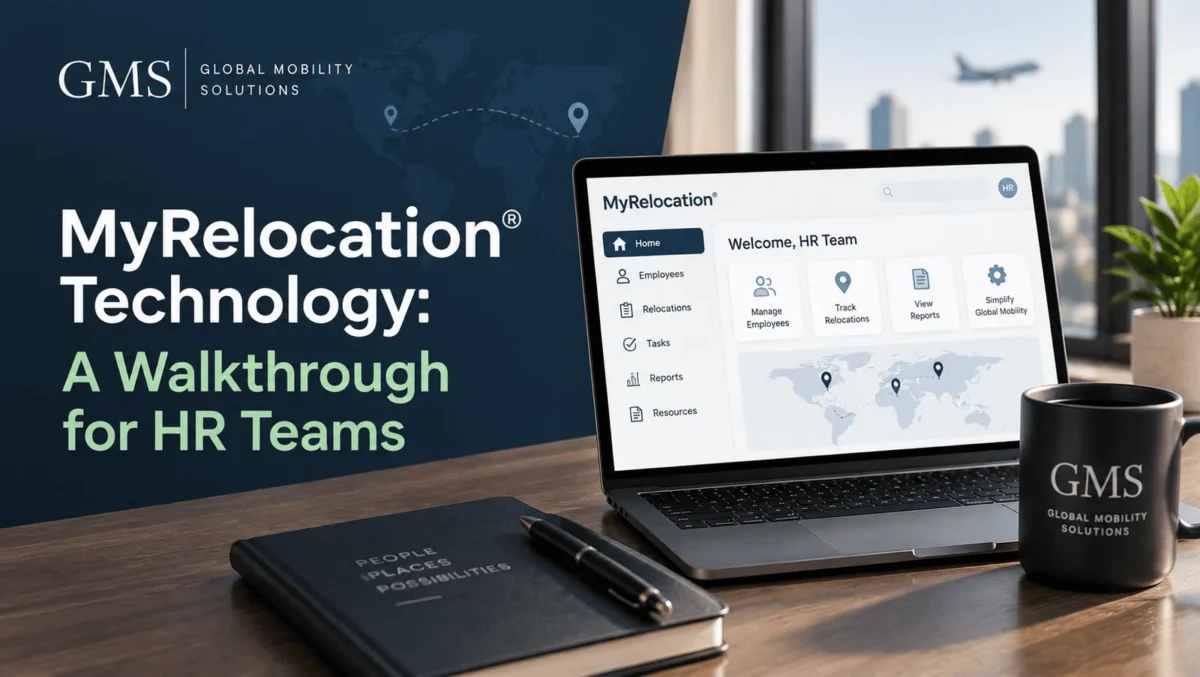
MyRelocation® Technology: A Walkthrough for HR Teams

Evaluating relocation technology is rarely straightforward. Most platforms promise dashboards, reporting, and self-service tools, but HR teams comparing vendors need to know what those features actually look like day to day, not just what a sales page claims. This walkthrough breaks down what GMS’s MyRelocation® platform includes and how each piece fits into the daily work of managing a mobility program.

What Is MyRelocation®?

MyRelocation® is the cloud-based technology platform behind Global Mobility Solutions’ relocation programs. It gives HR teams and transferees a shared system for tracking a move from initiation through completion, replacing the scattered spreadsheets, email threads, and phone calls that still define relocation management at companies without a dedicated platform.

The platform is built around two audiences at once. Transferees get a self-service dashboard to manage their own move, while HR and mobility teams get reporting and oversight tools to manage the program as a whole. That dual design is worth noting during a vendor evaluation, since a platform that only serves one side of the relationship tends to create bottlenecks on the other.

Core Features HR Teams Should Know

Employee Self-Service Dashboard

Transferees log in to view initiated services, track progress on each one, and submit expenses directly through the platform instead of routing paperwork through HR. This alone tends to reduce the volume of status-check emails that land in an HR inbox during an active relocation.

Direct Connection to a Relocation Coach

Rather than routing questions through a general support line, transferees can connect directly with their assigned relocation coach inside the platform. This keeps communication centralized in one place instead of scattered across email and phone calls, which matters most when a transferee has a time-sensitive question about a benefit or deadline.

Expense Tracking and Payment History

Employees submit expenses online and can track payment history without needing to call and ask where a reimbursement stands. For HR teams, this reduces the manual reconciliation work that comes with paper receipts and email-based expense reports.

Access to Guides, Tools, and Calculators

The platform also gives transferees access to relocation guides and calculators, including cost-of-living and mortgage tools, so they can plan their move without needing to search for that information independently or call their coach for basic figures.

MyRelocation® Analytics: Turning Program Data into Decisions

For HR and mobility teams managing the program at scale, MyRelocation® Analytics is where the platform’s reporting depth shows up. It gives a customizable, cross-filterable view of program performance, from a historical high-level summary down to the individual services a single transferee is using on an active assignment.

This level of detail matters for two reasons. First, it lets teams spot trends, such as which benefits get underused or which relocation types run over budget most often, without waiting for a quarterly report to surface the pattern. Second, it supports the kind of policy benchmarking that GMS recommends doing every twelve to eighteen months, since program data that is easy to pull and filter makes benchmarking a routine task rather than a quarterly scramble.

The financial reporting side of the platform supports over 200 custom reports on demand, which covers most of what an HR or finance team needs without requesting a custom build from IT or a vendor’s support team.

How MyRelocation® Supports the HR Team, Not Just the Transferee

It’s easy to frame relocation technology as an employee-facing convenience, but the reporting and coordination tools matter just as much for the HR side of the relationship. A single point of coordination, paired with dashboard visibility into every active move, means HR doesn’t have to chase status updates across a dozen open relocations at once.

This also shows up in how GMS structures accountability. Every transferee gets a certified relocation coach as a single point of contact, which keeps communication centralized instead of splitting across multiple departments or vendors. For HR teams evaluating platforms, this pairing of dedicated human support with a shared technology layer tends to matter more in practice than any single dashboard feature, since it determines how escalations actually get resolved.

What to Look for When Evaluating Relocation Technology

HR teams comparing relocation platforms during a vendor evaluation should look past the feature list and ask a few practical questions. Is the transferee-facing portal intuitive enough that a first-time mover can use it without training? Does the reporting layer update in real time, or does it require a manual pull? Can the platform scale from a handful of annual relocations to several hundred without a system change?

These questions come up often enough in general relocation FAQs that they’re worth raising directly with any vendor during a demo, rather than assuming the answer based on a product page.

Getting Started with MyRelocation®

For HR teams currently managing relocations through spreadsheets, email chains, or a legacy system that hasn’t kept pace with the rest of their HR tech stack, MyRelocation® is worth a closer look. The platform’s technology suite covers the full lifecycle of a move, from the transferee-facing MyRelocation® dashboard to program-wide analytics and reporting, with MyRelocation® OnDemand available for lump sum and fast-moving populations.

If your team is in the middle of a technology evaluation or simply wants to see how the platform handles your specific relocation volume, contact GMS to schedule a walkthrough with a Mobility Pro.

Categories
Blog Business Services Choosing a Relocation Company Corporate Relocation Corporate relocation tips Domestic Relocation

Lump Sum Relocation: What It Covers and Who It’s Best For

When a company needs to move an employee quickly and without a lot of administrative overhead, a lump sum relocation package is often the first option on the table. It is simple to explain, easy to budget, and gives the employee control over how the money gets spent. But simple does not always mean effective, and a lump sum that looks generous on paper can fall short once real moving costs come in.

Understanding what a lump sum relocation package actually covers, and which employees and situations it fits best, helps HR and mobility teams decide when this approach makes sense and when a more managed option will serve the transferee better.

What Is a Lump Sum Relocation Package?

A lump sum relocation package is a fixed amount of money an employer gives a transferee to cover the costs of moving. Instead of the company coordinating movers, temporary housing, and travel on the employee’s behalf, the employee receives the funds directly and decides how to allocate them across the services they need.

This approach shifts both the responsibility and the flexibility onto the employee. There is no relocation management company negotiating rates or auditing vendor invoices on the company’s side unless the employer has built that support into the program, as Global Mobility Solutions does through its lump sum management services. Employees choose their own moving company, decide how long to stay in temporary housing, and manage their own timeline within the funds provided.

What Lump Sum Relocation Typically Covers

Every company sets its own policy, but most lump sum amounts are built to address a similar set of core relocation expenses.

Household Goods and Moving Costs

The largest portion of most lump sum budgets goes toward packing, transporting, and unpacking household goods. This includes hiring a moving company, renting a truck for a self-managed move, or shipping belongings when the distance requires it.

Temporary Housing and Travel

Lump sum funds commonly cover short-term housing while the employee searches for a permanent home, along with airfare, mileage, or other travel costs tied to house-hunting trips and the actual move.

Home Sale and Home Finding Support

Some lump sum policies factor in a contribution toward closing costs, real estate commissions, or lease-breaking penalties, though this varies significantly by employer and is often where lump sum amounts fall short compared to a fully managed home sale benefit.

Miscellaneous and Incidental Expenses

Utility deposits, driver’s license and vehicle registration updates, pet transportation, and other smaller costs typically come out of the same pool of funds, which is part of why lump sum amounts can disappear faster than employees expect.

Tax Implications of Lump Sum Payments

Since the Tax Cuts and Jobs Act eliminated the moving expense deduction for most employees, lump sum relocation payments are generally treated as taxable income. That means an employee who receives $10,000 does not actually have $10,000 to spend once federal, state, and payroll taxes are withheld. Depending on the employee’s tax bracket, a meaningful portion of the payment can disappear before a single moving box is packed.

Some employers address this by grossing up the payment, adding extra funds to offset the tax liability so the employee ends up with the intended amount available for moving costs. Others leave the gross up out of the budget entirely, which is one of the more common reasons employees report that their lump sum did not stretch as far as expected. Companies building or revising a lump sum policy should decide upfront whether gross up is included, since it changes both the true cost of the benefit and the employee’s experience of it.

How Lump Sum Relocation Works in Practice

Once the employer sets the amount, usually based on distance, family size, or job level, the funds are distributed to the employee either as a direct payment or through a platform that allows for more controlled disbursement. Employees then research and book their own vendors, submit receipts if reimbursement is required, and manage their moving timeline independently.

This is where outcomes tend to diverge. Employees who have relocated before, or who have the time to research movers and negotiate pricing, often make the lump sum stretch further. Employees moving for the first time frequently underestimate costs, overspend early in the process, and end up covering a gap out of pocket. GMS built its MyRelocation OnDemand platform specifically to close that gap, giving lump sum transferees access to a vetted supplier network and cost guidance instead of leaving them to figure it out alone.

Who Lump Sum Relocation Is Best For

Lump sum programs are not a poor fit across the board. They work well in specific circumstances, and recognizing those situations helps companies apply the approach where it actually benefits both the business and the employee.

Early Career and Entry Level Transferees

Employees relocating for a first job or an entry level role typically have fewer possessions, simpler moves, and lower overall costs. A lump sum gives them flexibility without the company needing to manage a full-service program for a move that does not require one.

Companies Prioritizing Simplicity Over Customization

Organizations that relocate a small number of employees per year, or that want to avoid the administrative work of managing vendor relationships and expense audits, often prefer the predictability of a flat payment. It reduces the internal workload even if it shifts more responsibility to the employee.

Short-Distance or Low-Complexity Moves

When a relocation involves a shorter distance, no home sale, and minimal logistical complexity, the gap between what a lump sum covers and what a fully managed program would cost tends to be smaller, making the lump sum approach a reasonable match for the situation.

Employees Moving Within a Comparable Cost of Living Market

When the origin and destination markets have similar housing and moving costs, it is easier to set a lump sum amount that realistically covers the move. Wide cost-of-living gaps, particularly moves into major metro areas, make it much harder to land on a fair number, which increases the odds that the employee absorbs a shortfall.

Where Lump Sum Programs Fall Short

Lump sum relocation tends to struggle with senior transferees, homeowners, families with school-age children, and international moves, where the number of moving parts increases and the margin for error grows along with it. A GMS client study found that switching to a lump sum program actually increased relocation program expenses by 40 percent once inefficiencies were factored in, which points to a real cost tradeoff behind the perceived simplicity.

Companies weighing this tradeoff often look at a managed cap program as a middle ground, since it keeps a fixed budget while adding policy counseling and vendor support that a straight lump sum does not include. Our breakdown of the pros and cons of lump sum relocation packages goes further into where these programs succeed and where they tend to create friction for both the transferee and the company.

There is also a retention cost that rarely shows up in the initial budget. Transferees who feel unsupported during a stressful move, especially one involving a home sale or a move with school-age children, are more likely to view the experience negatively regardless of how much money they received. That perception can affect how willing an employee is to accept a future relocation, which matters for companies that rely on mobility to fill leadership pipelines or specialized roles.

How GMS Supports Lump Sum Relocation Programs

Rather than treating lump sum as a hands-off benefit, GMS structures lump sum relocation programs that still give employees access to a network of vetted providers, policy guidance from a dedicated relocation coach, and payment options that reduce the burden of tracking receipts and managing reimbursements. This keeps the flexibility that makes lump sum attractive while addressing the gaps that cause frustration for transferees managing a move on their own for the first time.

For companies with a broader corporate relocation program, lump sum can also work alongside other benefit tiers rather than serving as the only option available to transferees.

Is Lump Sum Relocation Right for Your Program?

Lump sum relocation earns its place in a mobility program when the move is straightforward and the employee has the bandwidth to manage it. It becomes a liability when applied to complex moves without the support to back it up. The right approach depends on transferee demographics, move complexity, and how much administrative involvement your team wants to take on.

If you are evaluating whether lump sum, managed cap, or a fully managed relocation benefit fits your workforce, contact GMS to talk through your program with a Mobility Pro.