

Categories
Choosing a Relocation Company Global Mobility Global Relocation Tips Global Relocation Trends Relocation Management Talent Management

Common Employee Relocation Packages

A Look at Typical Relocation Packages

Relocation packages, also known as relocation benefits, are policies and support that companies offer employees transferring to a location for a position. Each company will have different needs when it comes to relocation benefits, and it can be challenging for companies to determine exactly what should be covered in these policies and what employees should be responsible for on their own. 

To ensure the selected applicant receives a strong and appealing offer, providing a comprehensive and competitive relocation package for relocating employees is highly advisable. When crafting a relocation package, companies typically consider several key components to make the transition as smooth as possible for their employees.

By offering a well-rounded relocation package, companies ease the transition for their employees and demonstrate their commitment to supporting their workforce. This can lead to increased employee satisfaction, decreased turnover, and a more positive company culture. As businesses continue to adapt to a global workforce, investing in comprehensive relocation benefits will remain a crucial strategy for attracting and retaining top talent.

Companies can typically tailor relocation programs to each hiring situation. Some companies choose to have their HR department handle employee transfers. Still, if the company wants to be consistent with its relocation packages on each hire, using a reliable relocation management company is probably a good idea.

What Does A Standard Relocation Package Include?

Most relocation policies outline some form of reimbursement or coverage for many of the everyday expenses associated with moving. Relocation benefits often include full packing and unpacking services and a quality and reliable moving company to get the employee’s household goods from point A to point B. 

In addition to moving expenses, home sale assistance is another common benefit offered to transferees. This can include selling programs that utilize vetted real estate agents specializing in relocation to help ensure a quicker and more prosperous home sale for the relocating employee. 

Specific policies might support employees who need to terminate their rental agreements prematurely, helping them manage any associated penalties. Additionally, the relocation package may encompass house-hunting trips. This implies that the employer could finance one or two visits for the relocating employee to explore their future neighborhood and inspect various houses or apartments before making a decision.

Corporate housing options, also known as temporary housing, are typically included in most relocation policies. This provides the employee with a temporary accommodation after they’ve relocated to find a permanent home in their new location, allowing them to start on their desired start date for the position without delay. 

Many companies also offer transportation coverage or reimbursement as part of their relocation packages. This might cover airfare for the employee and their family or expenses for driving across state lines. In some instances, companies may also cover the employee’s transportation costs for their vehicle.

What Expenses Are Typically Covered During Relocation?

While not an exhaustive list, the following are common relocation costs for which many companies provide support to their relocating employees:

  • Corporate housing options 
  • Household goods transportation (HHG)
  • Storage facility (temporary storage of the HHG shipment
  • Miscellaneous expense allowance
  • Home sale costs
  • Spousal employment assistance
  • Travel-related costs, such as airfare, meals, and hotel nights

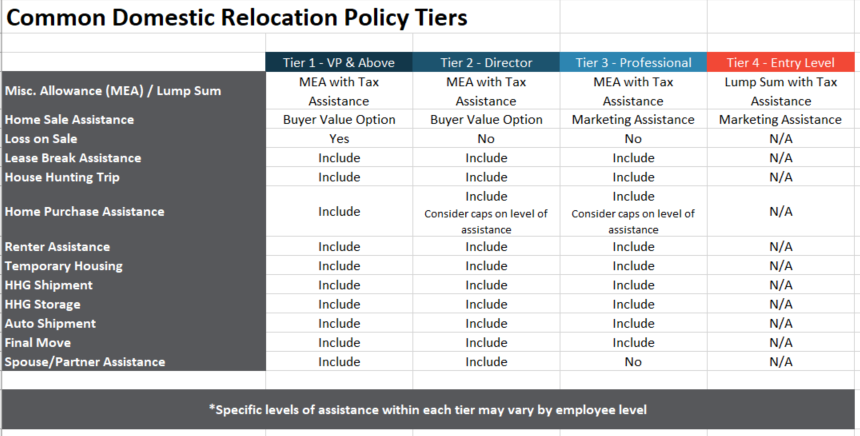
As every company has different goals and objectives for its relocation program, many-tiered relocation policies offer various levels of support for each employee. 

Here is a breakdown of the most common U.S. domestic relocation policy tiers per GMS research:

chart of relocation policy tiers

What Types Of Employees Receive Relocation Packages?

This aspect will depend upon the company’s need for each position and the importance of getting that employee to the new location. The best practice for relocation programs is to build a tiered system based on employee level. 

These tiers are commonly built around entry-level employees, professionals, directors, and vice presidents. Additionally, many companies offer executive relocation packages to cover the costs of relocation for most executive-level employees. Some companies may also provide international relocation packages for employees relocating globally.

Common Methods to Address Costs in Relocation Packages

Different policy tiers within your relocation program may require different strategies for covering your employee’s relocation costs. It is essential to understand the advantages and disadvantages of these standard methods.

Direct Billing: The relocation management company manages the procurement, organization, and direct payment to the service providers involved in your employee’s relocation. They review, combine, and forward the invoices to you for settlement. Although this approach may be pricier, it guarantees that your employee maximizes their benefits and reaches their new location promptly, alleviating any concerns about the expenses associated with the move. 

Expense Reimbursement: The employee pays for moving expenses upfront, and the company issues a reimbursement check at the end of the process. While not generally intended to cover an employee’s entire move (few families have the cash to pay tens of thousands of dollars for a move), reimbursements are commonly used for miscellaneous expenses as outlined in the company’s relocation policy. Typically, reimbursements are used for items such as travel costs or other related items.

Lump Sum: Unlike an expense reimbursement, a lump sum is commonly used as the primary financial benefit to a relocating employee. In a lump sum policy, a set amount of money is given upfront to the employee to handle the moving expenses as they see fit. 

Generally provided to entry-level or lower-level employees, the lump sum is typically the only relocation benefit offered. While the lump sum is seen as an excellent cost control tool for companies, it places additional burdens on employees, as they are left to manage their move independently. This is in addition to the lump sum, which is typically considered taxable income. Employees who receive their relocation benefits as a lump sum should note the payment for tax purposes. Employers should consider adding a tax gross-up to the lump sum to help mitigate the effects of the income tax on the employee’s benefit.

Ready to Set Up Relocation Packages for Employees?

Partnering with Global Mobility Solutions (GMS) ensures that your company offers comprehensive, cost-effective, and employee-centric relocation packages. GMS provides a tailored approach that aligns with your unique organizational needs, offering flexibility. This model allows you to select from a network of top-tier service providers or integrate your preferred partners, ensuring a customized experience for each relocation. Their expertise in managing all aspects of the relocation process—from pre-decision assessments to destination services—reduces risks, enhances employee satisfaction, and improves retention rates.

By leveraging GMS’s industry-leading MyRelocation® technology platform, your company can streamline relocation management, track expenses, and provide real-time support to transferees. This comprehensive support facilitates smoother transitions for employees and strengthens your employer brand by demonstrating a commitment to employee well-being. With over 30 years of experience and a global presence in over 140 countries, GMS has an expert team equipped to handle the complexities of workforce mobility, enabling your company to attract and retain top talent anywhere in the world.

We're Here to Help! Request a Courtesy Consultation

Are you ready to talk to a Mobility Pro? Learn how GMS can optimize your mobility program, enhance your policies to meet today’s unique challenges, receive an in-depth industry benchmark, or simply ask us a question. Your Mobility Pro will be in touch within 1 business day for a no-pressure, courtesy consultation.

Categories
Corporate Relocation Corporate relocation tips Domestic Relocation Domestic Relocation Challenges Domestic Relocation Tips Global Mobility Global Relocation Global Relocation Challenges Global Relocation Tips Household Goods Relocation Best Practices Relocation Challenges Relocation Management

Best Practices for Relocation: Multiple Bids for Household Goods Moves

Is your RMC helping keep relocation costs in check by taking multiple bids?

It is no secret that competition leads to various benefits, including significant savings for the end user. We have seen the opposite when a company monopolizes a product. Having one choice has never worked out well for consumers. The same applies to corporate relocation and household goods moves.

Many relocation management companies (RMCs) are either owned by or affiliated with van line companies. Therefore, when a client company wants to move its employees, the employees do not have a choice of van lines. The RMC and the van line know that the transferee is at their mercy concerning price, scheduling, and customer service.

However, some RMCs use a multiple-bid process to ensure that transferees get the best price and service. There are some significant benefits to having van lines compete for the relocation business:

  • It encourages the providers to “sharpen their pencils” to provide the lowest reasonable cost
  • It ensures adherence to a company’s relocation policy guidelines
  • It is a way to eliminate any service day surprises

This is all accomplished by having at least two carriers meet with the transferee to create estimates based on the amount that needs to be moved, what requires special handling, and where it needs to be relocated. Then, the RMC audits the estimates to look for inconsistencies, for example:

  • Do the pickup and delivery dates correspond with the move?
  • Does one company estimate more crates than another?
  • Does one company show specialty items that the other company may have missed?
  • How close are the estimated prices?
  • Auditing the bids ensures an apples-to-apples understanding of the van line options and helps weed out potential overages.

    Every carrier knows that its goal is to secure the business. As a result, it offers honest and precise quotes without extra costs. Several relocation policies involving moving companies also come with a maximum estimate guarantee. This helps ensure the relocation process follows industry standards and offers the most suitable solution.

Companies that utilize a multiple-bid process save an average of $1,547 per move! This breaks down to an average of $1,473 to $1,604 for household goods movement and $175 to $289 for car shipments per move.

Although cost is necessary, the experience of the person being transferred is also crucial. Allowing them to meet with various moving companies will help them feel more involved in the moving process. Sometimes, the person being transferred can select the moving company they prefer. 

Even if an estimate is slightly higher than another, if it falls within a certain percentage (based on the client company’s relocation policy) of the lower bid, a transferee may select the more expensive carrier if he or she feels more comfortable with that specific household goods mover. This promotes an overall positive experience because transferees are happier when they think they are heard throughout the relocation process. We all know that happy employees are more productive.

GMS Can Help Companies Save

Global Mobility Solutions (GMS) was the first to introduce the “Freedom of Choice” approach in relocation services. By implementing industry best practices and offering various options from different providers, GMC has helped client companies and their employees reduce costs for services such as moving household goods and obtaining mortgages. GMS is dedicated to creating innovative workforce mobility programs to simplify and enhance the relocation process for clients and their staff.

This innovative method reduces business costs and provides employees with greater autonomy and flexibility during their relocation. By empowering employees to select the services that best suit them, GMS ensures that each person feels appreciated and supported throughout the relocation process. This personalized strategy results in a seamless employee transition and a more streamlined company relocation process. With GMS at the helm of forward-thinking workforce mobility initiatives, businesses can save costs while ensuring employees enjoy a positive and hassle-free relocation journey.

Ready to Calculate YOur Program Savings? Request Access Now!

Are you ready to calculate your potential relocation program savings? Request access to our easy-to-use Relocation Cost Savings Calculator. Your Mobility Pro will grant your access request within 1 business day.

Categories
Buy a Home Global Mobility Home Purchase Relocation Best Practices

What to Do When Corporate Housing Prices Are Too High

Looking at Short-term Housing Options

Corporate housing, also referred to as temporary housing, is a common benefit included in relocation policies. Corporate housing is a short-term housing option for transferees who might not have an established home available in their new destination. Typically available in 14-, 30-, 60-, or 90-day increments, temporary housing provides a transitional period for those relocating to a new location. Most temporary housing units come fully furnished, with kitchenettes, and are pet-friendly. 

Corporate housing may seem straightforward: a company covers temporary accommodations for employees while their permanent living arrangements are being sorted out. But what if finding long-term housing takes longer than anticipated? Or if the cost of corporate housing in the new location is significantly higher than budgeted? Are employees left to fend for themselves in finding a place to live?

While the specific answers to these questions will depend on the company’s relocation policies, many transferees may ask about Airbnb, VRBO, and other short-term rental options. Some companies may approve this idea and offer reimbursement packages for short-term rentals to employees who are relocating. However, there are some downsides to consider for companies that allow their employees these options, rather than covering the expenses for corporate housing. Those temporary housing options don’t offer the same coverage and come with more risk.  Additionally, it could ultimately result in the company incurring more expenses in the long run. Here is a breakdown of why the use of Airbnb and VRBO could potentially backfire on companies relocating their employees.

Potential Overpayment

When working with a relocation consultant on policies for transferring employees, corporate housing pricing is typically broken down to a per-employee, per-night basis. When third-party solutions are used (like Airbnb), and employees are allowed to seek their short-term housing options, many companies provide a predetermined amount of support. The amount provided may exceed the level of support needed by the employee for suitable accommodations, leading to overpayment by the company. In the end, the company might not be getting as good of a deal as it could be. 

In this scenario, the company could find that employees are pocketing the difference between their temporary housing allowance and the actual cost of accommodations. If an employee sees in the relocation policy that they qualify for a $X amount of benefits, then they can book something cheaper but still claim the entire amount and retain the balance. 

This type of support may also put some employees in tougher spots than others when it comes to finding affordable options. The flat level of support provided may not be enough to cover the cost of reasonable temporary living accommodations.

On the other hand, if your relocation program has corporate housing units that have been pre-selected and pre-approved, your expenses will be easier to anticipate, and you can ensure that you are offering the appropriate level of assistance to your transferees.

Billing Could Become a Nightmare

Companies that allow employees to use their relocation benefits for their housing could also end up in a billing nightmare. Many companies’ policies are not written to address the unique challenges that come with employees booking their accommodations through third-party housing providers. Without established limits and a streamlined expense reimbursement policy, an HR or accounting team may need to process numerous third-party vendors who utilize different billing methods. This could also result in the accounting department having to spend more time cutting reimbursement checks to each employee. 

One solution to address this issue is to have employees use company-approved corporate housing units that already have a direct billing arrangement in place. This ensures a more streamlined program when relocation specialists are already knowledgeable about the temporary housing options available.

Risk Considerations and Lack of Quality Control

Companies need their employees to have sufficient housing accommodations while relocating and starting their new positions. Allowing individual employees to book their third-party housing might expose them and your company to unnecessary risk. If an employee uses Airbnb or another company’s rental, there is no guarantee that the living accommodations will be clean, safe, or reparable at any given moment. 

For example, with a corporate housing apartment, if something were to go wrong, the company would have an established contract with the corporate housing company that covers items such as repairs. This provides for timely repairs or the replacement of malfunctioning equipment as soon as possible. With a third-party rental that the employee chooses, there is no way for your company to guarantee timely repairs or replacements contractually. This places more risk on the employee and your organization and is not likely to be covered in the employee’s relocation policy. The last thing a transferee needs to deal with while relocating for a company is the issue of where they are staying.

Additional examples of risk exposure that may arise through the use of vacation-style rentals include:

  • Property safety inspections
  • Lack of appropriate safety equipment (such as door/window locks and fire extinguishers)
  • No safety plans for documents in the event of a fire or natural disaster
  • Challenges around property insurance

Lastly, with third-party rentals, there may be little to no established check-in process. This can lead to complaints related to customer service or quality, as employees might be left scrambling if the check-in process goes awry. If the employee shows up at the rental unit and the unit is not sufficient, or they are told it is no longer available, it will put the employee in a challenging situation where they are left to their own devices.

The workaround for this pain point is to have transferees utilize corporate housing units approved by the company, where a predictable direct billing relationship already exists. Additionally, a more consistently applied program is made possible when the relocation specialists working with your transferees are already familiar with your temporary housing providers.

GMS Can Provide Your Employees With Suitable Corporate Housing

Airbnb and other rental companies like it are an excellent option for those seeking a vacation.  However, for companies that relocate multiple people annually for business purposes, this might not be the best option. Working with a qualified corporate relocation company, such as GMS, policies can be implemented to ensure your employees have suitable temporary housing units ready for them upon arrival in their new town or city. Contact us today online if you are prepared to start looking at corporate housing solutions for your relocation program or have any questions about temporary housing for your relocating employees.

We're Here to Help! Request a Courtesy Consultation

Are you ready to talk to a Mobility Pro? Learn how GMS can optimize your mobility program, enhance your policies to meet today’s unique challenges, receive an in-depth industry benchmark, or simply ask us a question. Your Mobility Pro will be in touch within 1 business day for a no-pressure, courtesy consultation.

Categories
Corporate relocation tips Domestic Relocation Global Mobility Global Relocation Global Relocation Tips Global Relocation Trends Relocation Programs

The Essential Role of a Relocation Coach in the Domestic Relocation Process

Learn how relocation management companies coach employees through their move

Domestic relocation refers to moving from one location to another within the same country. This can involve moving to a new city for a job, transitioning to a larger home, or simply seeking a change of scenery. While exciting, relocation can also be a daunting task filled with numerous challenges. Individuals often face logistical hurdles, emotional stress, and the need to adapt to a new environment. 

This is where the role of a relocation coach becomes invaluable. A relocation coach is a trained professional who guides individuals and families through the complexities of moving. They provide personalized support, helping clients navigate everything from packing and logistics to settling into their new community. Working with a relocation management company enhances this experience, as these organizations specialize in streamlining the relocation process and offering a range of services tailored to meet each client’s unique needs.

Why Do You Need a Relocation Coach?

Having a relocation coach can significantly ease the stress associated with moving. A relocation coach takes the time to understand each client’s specific needs and concerns. They create a customized plan that addresses individual circumstances, ensuring no detail is overlooked.
Relocation coaches are well-versed in the details of moving. They can provide valuable insights about neighborhoods, schools, and local amenities, helping clients make informed decisions about their new homes.

Moving can be an emotional rollercoaster. An experienced coach offers support and encouragement, helping clients cope with the anxiety and uncertainty that often accompany a significant life change.

A certified coach can save clients time and effort. Coaches can handle logistics, recommend reliable moving companies, and assist with paperwork, allowing clients to focus on other essential aspects of their move.

The Benefits of Working with a Relocation Management Company

Relocation management companies (RMCs) play a crucial role in domestic relocation. They work alongside relocation coaches to provide comprehensive services that facilitate a smooth transition. RMCs coordinate various services, including packing, transportation, and storage. This ensures that all aspects of the move are organized and executed efficiently. For companies relocating employees, these firms help develop policies that align with organizational goals. This includes determining what benefits to offer and how to support employees.

How a Relocation Coach and Management Company Work Together

A relocation coach is crucial in the overall process by working closely with the relocation management company. Together, they create a cohesive plan that addresses every detail of the move. The coach acts as a personal guide for the employee, providing support and resources, while the management company handles logistics and administrative tasks. This partnership ensures that all aspects of the relocation are synchronized, minimizing confusion and maximizing efficiency.

Every domestic relocation assignment is unique, and the relocation coach and the management company understand the importance of tailoring their services to meet specific needs. They collaborate to assess the individual circumstances of the employee or the company, considering factors such as family dynamics, job requirements, and personal preferences. By customizing the relocation plan, they can address potential challenges proactively, ensuring a smoother transition for everyone involved.

The combined efforts of a relocation coach and a management company lead to a more efficient and positive relocation experience. With their expertise and support, employees feel more confident and prepared for the changes ahead. This enhances employee satisfaction and boosts productivity as they settle into new roles and environments. Ultimately, a well-executed relocation process fosters a sense of belonging and stability, which is essential for both the individual and the organization.

Why Choose Global Mobility Solutions?

Global Mobility Solutions (GMS) is a trusted partner in domestic relocation, offering extensive experience and expertise in relocation management and coaching services. With years of industry knowledge, GMS Mobility understands the unique challenges of relocating employees. Their dedicated team is committed to providing personalized support tailored to each individual’s needs, ensuring a smooth transition.

One key advantage of choosing GMS Mobility is its comprehensive approach. They assist with the logistics of moving and focus on the emotional and psychological aspects of relocation. By offering coaching services, GMS Mobility helps employees navigate the uncertainties of moving to a new location, address concerns, and provide resources that empower them to adapt quickly.

Ultimately, choosing GMS Mobility means investing in a seamless relocation experience that prioritizes employee well-being. By partnering with GMS Mobility, organizations can enhance employee satisfaction, reduce turnover, and create a more engaged workforce ready to thrive in their new environment.

We're Here to Help! Request a Courtesy Consultation

Are you ready to talk to a Mobility Pro? Learn how GMS can optimize your mobility program, enhance your policies to meet today’s unique challenges, receive an in-depth industry benchmark, or simply ask us a question. Your Mobility Pro will be in touch within 1 business day for a no-pressure, courtesy consultation.

Categories
Corporate Relocation Corporate relocation tips Domestic Relocation Global Mobility Global Relocation

Navigating the Future: Is Your Relocation Program Aligned with Gen Z Expectations?

In today’s rapidly changing workforce, understanding the preferences of Generation Z (Gen Z) is more important than ever. Born between 1997 and 2012, this group has distinct views on work, personal fulfillment, and workplace culture. As they enter the job market, their unique expectations are influencing how organizations approach employee relocation.

To attract and retain top talent from this generation, it’s essential to examine whether your current relocation services align with their values and needs. This generation is also highly tech-savvy, having grown up in a digital world, which shapes their expectations for communication and collaboration. As such, organizations must adapt their relocation programs to meet these evolving demands.

As Generation Z continues to shape the workforce, organizations must adapt their relocation programs to meet the expectations of this generation. By embracing flexibility, leveraging technology, prioritizing mental health, and committing to sustainability, companies can create a relocation experience that resonates with this dynamic generation. Ultimately, aligning your relocation services with Gen Z values not only enhances employee satisfaction but also strengthens your organization’s ability to attract and retain top talent in a competitive job market.

Understanding Gen Z's Core Values

A strong desire for authenticity and meaningful experiences characterizes Gen Z. They tend to avoid superficial interactions and appreciate transparency, inclusivity, and social responsibility. If your relocation program does not embody these values, your company may struggle to attract and retain young talent.

For instance, a survey showed that 70% of Gen Z individuals prefer to work for companies dedicated to social causes. Highlighting sustainability in relocation practices or promoting community engagement can resonate with their desire for a sense of purpose.

Tech-Savvy Solutions

Having grown up with technology, Gen Z expects seamless digital experiences in their professional lives. When considering relocation programs, they are drawn to innovative solutions that enhance efficiency and productivity.

For example, offering virtual reality tours of potential housing or the new workplace can simplify the decision-making process. Additionally, a relocation management system that includes a mobile app for budget tracking and real-time communication can streamline processes. A study by the Global Mobility Association found that companies utilizing tech tools in their relocation efforts saw a 35% increase in employee satisfaction.

Flexibility and Personalization

As work becomes more adaptable, Gen Z expects personalized experiences that meet their unique needs. A rigid, one-size-fits-all approach to relocation will not attract this cohort.

To improve your program, consider providing customizable options, such as:

  • Flexible timelines for relocation
  • Housing assistance tailored to individual preferences
  • Support for a young family relocation needs

Additionally, offering resources for remote work setups can help ease the transition for employees who may prefer this model after relocating.

The Importance of Community and Connection

Although often viewed as individualistic, Gen Z values community and connection above all else. Relocation programs should incorporate initiatives fostering a sense of belonging.

Offering opportunities for local networking events and mentorship in new areas can help new employees feel welcome and integrated. Community service projects can also create strong connections and resonate with Gen Z’s desire to make a positive impact on society. Studies show that 80% of Gen Z believe it’s essential to work for organizations that care about their communities.

Financial Support in the Age of Uncertainty

Gen Z has entered the job market during a period of economic instability, making financial security a crucial priority. Several factors, including fluctuating job markets, rising inflation rates, and the lingering effects of global events such as the COVID-19 pandemic characterize the economic instability faced by Gen Z. These conditions have resulted in a challenging environment for job seekers, with many traditional career paths undergoing transformation and new industries emerging at an unprecedented rate. As a result, Gen Z individuals are often compelled to adopt a more pragmatic approach to their careers, prioritizing roles that offer not only competitive salaries but also benefits that contribute to long-term financial well-being, such as relocation services.

Relocation programs should address financial aspects like:

  • Relocation reimbursement policies
  • First-time homeowner programs
  • Cost-of-living evaluations

Providing these resources will not only address Gen Z’s immediate concerns but also foster loyalty by demonstrating that their financial needs are being prioritized.

Mental Health and Well-Being Considerations

Mental health is a top priority for Gen Z, as many seek supportive work environments that foster well-being. During relocation, they value programs acknowledging emotional needs.

Incorporating mental health resources, such as access to counseling services or wellness workshops, can significantly enhance satisfaction. Tools that promote stress relief, such as yoga sessions or mindfulness apps, can help ease transitions and improve overall well-being.

The Green Factor

Gen Z is increasingly aware of environmental issues. They gravitate towards brands that prioritize sustainability.

To appeal to this demographic, consider integrating eco-friendly practices into your relocation program. This includes offering:

  • Sustainable transportation options
  • Housing assistance that promotes local and organic choices
  • Green moving supplies

Demonstrating a commitment to sustainability can align your organization’s values with those of Gen Z and foster deeper loyalty.

Embracing Gen Z's Future

To successfully engage with Gen Z, organizations must align their relocation programs with the expectations of this generation. Authenticity, innovative tech solutions, personalized experiences, community connections, financial transparency, mental health support, and sustainability are key areas to focus on.

By implementing these strategies, companies will not only attract top talent from the younger workforce but also create a supportive and engaging environment that fosters loyalty and satisfaction.

Is your relocation program prepared for the future? Embrace these insights to lead the way in providing an enriching transition for the next generation of talent.

To discuss your relocation needs and receive a complimentary program and policy review to ensure your program aligns with the talent you are trying to attract, please contact GMS today.

We're Here to Help! Request a Courtesy Consultation

Are you ready to talk to a Mobility Pro? Learn how GMS can optimize your mobility program, enhance your policies to meet today’s unique challenges, receive an in-depth industry benchmark, or simply ask us a question. Your Mobility Pro will be in touch within 1 business day for a no-pressure, courtesy consultation.

Categories
Global Mobility Global Relocation Global Relocation Challenges Global Relocation Tips Global Relocation Trends

Why It’s Important to Work with International Tax-Knowledgeable RMC

When it comes to employee relocation, taxes play a huge role

Companies that undertake employee relocations, whether domestic or international, are acutely aware of the complex nature of tax handling. Transferees moving from one state to another often grapple with the intricacies of filing for their new state. Similarly, individuals moving to a new country often need expert guidance to navigate the local tax system. 

Working with a relocation management company (RMC) with relocation tax specialists on staff can give your employees significant advantages in the relocation process. Relocation tax specialists are well-versed in the tax laws and regulations for employee relocations. 

They can provide valuable advice on tax planning, compliance, and optimization strategies to ensure that your employees are not only in compliance with tax laws but also taking advantage of any available tax benefits. By working with a tax-knowledgeable RMC, you can help your employees avoid costly mistakes and minimize their tax liabilities during the relocation process.

Furthermore, international tax-knowledgeable RMCs can also assist with tax equalization and tax protection policies, which are essential for ensuring that your employees are not unfairly burdened by tax implications resulting from their relocation. These policies help to ensure that employees are not disadvantaged financially due to tax differences between their home and host locations.

International Tax Compliance

Whether moving abroad permanently or for a temporary job, it’s crucial to understand that any expenses related to the relocation could raise tax concerns in both the country you’re leaving and the one you’re moving to. This highlights the need to carefully track potential tax liabilities from relocation payments to ensure accurate tax filings in your previous and new locations.

American citizens are obligated to report their worldwide income for tax purposes, regardless of where it was earned, in addition to complying with tax regulations in the country they are currently residing in. Even when an individual moves out of the United States, they must submit a US Federal Income tax return. Thankfully, the US offers a foreign tax credit that can offset the tax liability of the employee, potentially resulting in no taxes owed to the US government or a minimal amount. However, employers need to consider implementing tax equalization policies for employees moving abroad. This ensures that employees pay taxes similar to what they would in their home country, with the employer covering any differences in tax liabilities.

Work with the Best Full-Service RMC

Global Mobility Solutions (GMS) works with some of the best tax professionals in the relocation industry. For international and domestic assignments, GMS works with your employees from the very start to ensure we can make the relocation process as seamless as possible. Our expert team is willing to listen to your needs and then help you develop relocation programs that will help your employees, including tax needs. 

Contact us today to set up a free consultation with one of our business development managers.

We're Here to Help! Request a Courtesy Visa Program Consultation

Properly managing a visa and immigration program involves meticulous coordination, precise communication, and worldwide interaction with government agencies, corporate personnel, and relocating employees.

At GMS, we provide you with peace of mind in knowing your mobility program is fully compliant and being managed by the best in the industry.

Request a no-pressure, courtesy consultation from a GMS Mobility Pro. We’ll be in touch within 1 business day.

Categories
Corporate Relocation Domestic Relocation Domestic Relocation Challenges Employee Development Global Mobility Global Relocation

The Role of Mobility Consulting in Modern Businesses

Successful relocations involve logistics and setting employees up for success in a new location. This is where mobility consulting in modern businesses gains immense value. Mobility consulting addresses each stage of relocation with a hands-on approach, seeing that nothing is overlooked and every employee’s needs are fully met. Mobility consultants are there to navigate complex visa procedures, coordinate housing, and even provide local support. As a result of their dedication and expertise, businesses save on costs, reduce employee stress, and ensure that talent is ready to thrive from day one. Let’s dive deeper into how mobility consulting transforms relocation into a strategic asset for businesses and employees.

What is Mobility Consulting?

Mobility consulting refers to the specialized services that help businesses manage employee relocations effectively.

Mobility consultants work with organizations to develop tailored relocation policies aligning with company goals and employee needs.

These experts bring a wealth of knowledge to the table, covering:

  •       Legal compliance
  •       Tax implications
  •       Cultural training
  •       Local market insights
  •       etc.

Their role is crucial in today’s global workforce, where companies often face diverse regulations and employee expectations.

Benefits of Mobility Consulting for Businesses

Mobility consulting brings several benefits that can significantly enhance your relocation strategy.

Enhanced Efficiency

Mobility consultants streamline the relocation process, allowing your HR team to focus on strategic initiatives rather than getting bogged down in logistical details. With their expertise, relocations can be completed more quickly and smoothly, minimizing employee downtime.

Cost Reduction

Navigating relocations without expert guidance can lead to unexpected expenses. Mobility consultants help identify cost-saving opportunities, such as negotiating better rates with service providers and optimizing relocation packages to fit within budget constraints.

Improved Employee Experience

A positive relocation experience sets the tone for an employee’s new role. Mobility consultants ensure employees receive personalized support, from finding suitable housing to connecting them with local resources. By handling these details, you can make it easier on your employees during a potentially stressful time and boost employee morale and retention.

Increased Flexibility

As business needs change, so do relocation requirements. Mobility consultants offer flexible solutions that can adapt to different circumstances, whether short-term assignments or permanent moves.

The Role of Mobility Consulting in Modern Businesses: Where Does It Make an Impact?

Mobility consulting plays a massive role in several areas of the relocation process, offering targeted support that makes relocations easier to bear.

Here’s a closer look at the areas where mobility consulting has a direct impact.

Workforce Mobility

Mobility consultants develop strategies that cater to the needs of a mobile workforce. They create frameworks that ensure each relocation aligns with your company’s policies while addressing the needs of each employee. By focusing on mobility as a business strategy, consultants help companies respond swiftly to new market opportunities.

Mobile App Development

Mobility consultants also often assist with implementing digital tools and mobile apps that allow employees to track their relocation progress, access essential resources, and receive updates in real-time. This technology-driven approach improves transparency and enhances the overall relocation experience for employees.

Data Security and Compliance

Relocating employees often involves handling sensitive information, which requires strict adherence to data protection regulations. Mobility consultants ensure that every part of the relocation process complies with local and international laws, protecting the company and its employees.

Integration with Existing Systems

Seamless integration between relocation processes and existing HR and payroll systems is required to avoid administrative bottlenecks. Mobility consultants help ensure that the systems used in relocation are aligned with your current infrastructure, helping track costs, monitor progress, and keep everything running smoothly. This integration also improves data accuracy and allows for better analysis of relocation metrics, which supports future decision-making.

The Main Takeaway

Mobility consulting in modern businesses provides the expertise needed to mitigate the complexities of employee relocations. Mobility consultants turn relocations into strategic advantages by enhancing efficiency, reducing costs, and improving employee experiences. As you consider your relocation strategy, remember that investing in mobility consulting simplifies logistics and sets your employees up for success in their new roles. Embrace this valuable resource, and watch your business thrive in new markets.

Categories
Corporate Relocation Domestic Relocation Domestic Relocation Trends Global Mobility Global Relocation Global Relocation Challenges Global Relocation Tips Global Relocation Trends

Addressing data protection and security issues in your global mobility initiative

Learn why data privacy is essential for relocation management companies

Ransomware, phishing, hacking, malware, botnets, viruses, spyware, and worms are some cybersecurity threats we face today. One doesn’t need to be an IT expert to recognize that data security risks are significant in our digital age. With personal information now crucial for businesses, conversations on data privacy and protection have moved from technical departments to executive meetings. As companies handle increasing amounts and worth of data, the associated risks also escalate.

The European Union’s General Data Protection Regulation (GDPR) is a widely recognized and established security standard that mandates companies safeguard individuals’ personal information and privacy in the EU and data related to transactions within EU countries. Failure to comply with these regulations can result in hefty financial penalties, fines, and considerable harm to a business’s reputation.

How can you ensure you stay ahead of these challenges?

As your traveling employees move globally, they anticipate that you and your service providers will safeguard their personal information. Organizations have an obligation to their workforce to ensure the protection of sensitive and private data. This duty involves collaborating with reliable partners and vendors who emphasize data privacy and security in their practices. 

Below are five data privacy processes we consider essential for your company, partners, and vendors.

  1. Conduct Regular Risk Assessments: It’s crucial to evaluate the potential risks associated with data handling regularly. This involves identifying vulnerabilities in your systems and processes and assessing your partners’ security measures. By understanding where the risks lie, you can take proactive steps to mitigate them.
  2. Implement Strong Data Encryption: Protecting sensitive information through encryption is a fundamental practice. Ensure that both your company and your vendors use robust encryption methods for data at rest and in transit. This adds an extra layer of security, making it much harder for unauthorized individuals to access personal information.
  3. Establish Clear Data Access Policies: Define who has access to personal data and under what circumstances. This should include strict guidelines on data sharing and handling. Ensure all employees and partners are trained on these policies to prevent unauthorized access and potential breaches.
  4. Regularly Update Software and Systems: Keeping your software and systems up to date is essential for protecting against vulnerabilities. Ensure your company and vendors are committed to regular updates and patches. This helps to close security gaps that cybercriminals could exploit.
  5. Create an Incident Response Plan: Despite best efforts, breaches can still occur. Having a well-defined incident response plan in place is vital. This plan should outline the steps to take in the event of a data breach, including how to notify affected individuals and regulatory bodies. Regularly review and practice this plan to ensure everyone knows their role in the event of an incident.

Implementing these essential data privacy processes can significantly reduce non-compliance risk and protect employees’ personal information. Remember, data privacy is not just a legal obligation; it’s a commitment to your employees and their trust in your organization.

GMS Takes Data Privacy Serious for Global Mobility Programs

Regardless of whether you are collaborating with a relocation management firm or overseeing your mobility program internally, it is essential to pose these two critical inquiries:

Has your mobility program been committed clearly to data privacy and protection over the past six months?

Does your organization or relocation provider adhere to the trust services principles outlined in a SOC 2 certification?

If your response to either question is “No,” it is crucial to reassess your data security and compliance measures. Global Mobility Solutions (GMS) is one of the few relocation companies holding SOC 2 certification. Contact GMS today to discover how we safeguard your information and data throughout your relocation management program. You can call us at 800.617.1904 or 480.922.0700 for more information.

Our cloud-based relocation technology is designed to help you streamline your company’s relocation management.

Categories
Global Mobility Global Relocation Global Relocation Tips Relocation Best Practices

10 Documents Needed for International Relocation

Moving abroad for a new position? 10 important documents to bring with you

Relocating internationally for a new job can be exciting, but like a domestic move, an international move can prove stressful, and the paperwork may seem never-ending. If you and your family are preparing to move abroad, you might be gathering any essential documents you need to get started in your new destination. 

If your company provides relocation benefits, they can help alleviate some of the stress and hardships of moving. Furthermore, your relocation benefits may include working with a relocation management company that will provide you with a counselor who can coach you through the global mobility process and keep you on track.

Working with a relocation management company (RMC) for international relocation has several advantages. They can help you navigate the relocation process, assist with your visa application, arrange for household goods shipping, provide destination services, and even help buy or sell a house or property. A good RMC will ensure you obtain or collect the paperwork and documents necessary to start a job in a foreign country. Here is a list of some of the critical documents you should start to collect now so that you are prepared for your move:

1) Passport

While this may seem like an apparent document to include, obtaining a passport can be a lengthy process that can take weeks to months to complete, it is vital to start the passport application process as early as possible to ensure time works well for the moving employee and their family members. A government-issued passport certifies identity and citizenship. For example, evidence of US citizenship, a valid ID, and an official passport photo are all needed when applying for this document.

2) Birth Certificate

If you need help remembering where a copy of your birth certificate is, it can take weeks to months to obtain. This document is vital when trying to relocate internationally, as many people use it as their proof of citizenship when applying for a passport and other important official documents. The time needed to obtain a copy of your birth certificate can have a domino effect on obtaining any other documents that depend on it.

3) Visa

A visa is a travel document that allows travelers to remain in a designated country for a specific amount of time and for a specific type of visit (tourism, short-term, residency, etc). When undergoing a corporate-sponsored relocation, oftentimes your RMC will provide visa and immigration assistance.

4) Work Permit

A work permit allows the relocating employee to legally work in their host country. Companies that provide employees with relocation benefits should have the work permit application process included in their relocation policies. A reliable RMC can ensure that the transferee obtains the appropriate work permit in a timely manner.

5) Social Security Cards

Another document that should already be handy while filing for other documents on this list, a social security card should be kept in a safe place throughout your time abroad. Like your birth certificate, a Social Security Card is commonly used as proof of identification to obtain additional official documents.

6) Medical Records

Healthcare systems around the world differ on many levels, but it is recommended that you ask your current healthcare provider to hand over any medical records that a new doctor should be made aware of. You will want to ask for your dental records as well. You can provide these records to your new doctor at your destination to provide them with information on your medications or past procedures. Immunization records for all family members should be present as well as many countries require various vaccinations for entry.

7) Pet Vaccination Records

If you are traveling with a pet, be sure to contact your veterinarian for all necessary pet vaccination records. These documents might be needed for allowing pets on planes or public transportation to the new destination, as well as crating or doggy daycares. Some countries require specialized tests for entry, such as rabies, and may even require a quarantine period. Additionally, if you are moving into a condo or apartment, the complex might ask for vaccination records of your pets.

8) Marriage Certificate

A marriage certificate is an important document that can come into play for citizenship and tax purposes. Each country has different tax laws, so it would be a good idea to have the certificate on hand in case you need to prove your tax filing status.

9) School Records

If moving internationally with children, ask their current school to provide an in-depth portfolio of their educational records. This will help when enrolling your kids into their new school. It could also help your kids’ application process if they are applying to a private school or getting set for college in their new home country.

10) Living Will

While everyone hopes this one will not come into play, if any of the relocating family members have a living will, it would be a good idea to know where a copy is at all times. Wills are meant to help give clarity and closure in the event of a death. Additionally, wills can give guidance to doctors and healthcare professionals who are treating the family member. 

Keep Important Documents Safe During International Relocation

These documents are some of the most important things for moving and life. Do not ship these documents with your other household goods when preparing these for the move. They should be physically kept with you, preferably in a protective folder safely stored in a carry-on when flying. Once at your new destination, store them in a secure file cabinet or fire-proof safe so they can remain organized and safe at all times while also accessible. It is always a good idea to make copies of each document if you need to provide physical copies for numerous applications or other reasons. The secure digital storage of scanned documents is also worth consideration.

Additionally, consider creating a checklist of all your important documents, including passports, birth certificates, medical records, and financial statements. A checklist will help ensure that everything gets noticed during your move.

When you arrive at your new home, take a moment to review your documents and make sure everything is in order. If you notice anything missing, you can take steps to replace it as soon as possible.

It’s also wise to inform relevant parties of your change of address. This includes banks, insurance companies, and any subscriptions you may have. Keeping your information current will help prevent any disruptions in service or communication.
Remember to keep your important documents easily accessible, especially during the first few weeks after your move. You may need to refer to them for various tasks, such as setting up utilities or enrolling your children in school. By staying organized and proactive, you can make your transition to your new home much smoother.

Work with GMS for the Documents Needed for International Relocation

If your organization is relocating employees internationally, working with an RMC that specializes in international mobility programs can be a big help. GMS has been helping employees and their families relocate around the globe since 1987. Our team of relocation experts will guide your relocating employees in gathering the critical documents necessary for the appropriate visas and permits needed for moving internationally. Reach out today if you have any questions regarding the global mobility process. 

At GMS, we pride ourselves on our commitment to excellence and customer satisfaction. We aim to make your international move seamless, allowing you to focus on settling into your new home and embracing the adventure ahead. Don’t hesitate to contact us for more information or to get started on your relocation journey today!

We're Here to Help! Request a Courtesy Visa Program Consultation

Properly managing a visa and immigration program involves meticulous coordination, precise communication, and worldwide interaction with government agencies, corporate personnel, and relocating employees.

At GMS, we provide you with peace of mind in knowing your mobility program is fully compliant and being managed by the best in the industry.

Request a no-pressure, courtesy consultation from a GMS Mobility Pro. We’ll be in touch within 1 business day.

Categories
Buy a Home Corporate Relocation Corporate relocation tips Global Mobility Home Purchase Relocation Challenges

The Benefits of a Preferred Relocation Real Estate Agent

Pros of Using a Preferred Relocation Real Estate Agent

If your current employer has offered you a new position in a different city or state, or if you are accepting a new job in a new location, you probably have dozens of questions about the relocation process and how it works. Like most relocating individuals, one of the most prominent questions is most likely the concern about selling your home. 

Many transferees who are getting ready to move (or those still weighing options with an offer) often wonder if they are on their own for selling their house or if the corporate relocation company their employer is partnering with will do that. Going a level deeper, those moving then wonder if they are in charge of hiring their real estate agent. 

The answer to that question is simple: you have the power. Many relocation policies offer support when it comes to home-selling assistance. If home selling assistance is one of your relocation benefits, it is an excellent idea to capitalize on that. Now the question becomes, should I use a friend or family member to sell my home or be assigned a specialized relocation real estate agent? While many transferees may want to go with the first option, allowing the relocation specialist to handle the sale might make more sense. Here’s why:

Using an Experienced Relocation Real Estate Agent

Many relocation companies urge the relocating employee to select an agent from their vetted real estate network. They can then guarantee that the agent is familiar with relocation policies and will know the nuances of the relocation process. This will ensure that the transferee maximizes their benefits by taking advantage of every aspect of the home-sale program. Transferees that stick with their company’s established home sale program commonly sell their homes more quickly, arrive at their destination less stressed, and are ready to work. 

Leveraging your company’s home sale program, your relocation company’s point of contact can coordinate the entire move process for you—from the relocation appraisal to the moving of your household goods and, finally, the end of the sale of your property. Additionally, relocation real estate companies will recommend multiple agents for you to interview before deciding, placing you in control.

Real estate agents who are not experienced with the relocation process might not be as active, know how to maximize savings and profits or understand how to utilize relocation benefits properly. If they need more understanding of how corporate relocation processes work, this will slow down the sale of your home.

Out-of-Network Fees

In addition to the valuable experience that a vetted relocation-specialized agent can provide, it is better to use a relocation company’s agent because many relocation companies charge sizable out-of-network or referral recovery fees when agents outside their networks are utilized. Many companies state in their relocation policies that using an authorized agent is mandatory to receive your benefits. In this case, you will not be able to benefit from specialized home sale programs designed to help you sell as quickly as possible, for as much as possible.

Get the Most Out Of Relocation Real Estate Benefits

Selling your home is just one of the first steps to take for a successful relocation for you and your family. That is why working with relocation specialists who know how to get you the best deal possible for your home is vital. If you have any questions about relocation real estate benefits or need to contact a vetted agent who can guide you through the process, don’t hesitate to contact us online today. One of our team members will reach out to assist you with your questions.

We're Here to Help! Request a Courtesy Consultation

Are you ready to talk to a Mobility Pro? Learn how GMS can optimize your mobility program, enhance your policies to meet today’s unique challenges, receive an in-depth industry benchmark, or simply ask us a question. Your Mobility Pro will be in touch within 1 business day for a no-pressure, courtesy consultation.

TAKE THE NEXT STEP IN YOUR CAREER