

Categories
Corporate Relocation Global Relocation Relocation Technology

5 Practical Ways to Improve Your Employee Relocation Experience

Why Employee Relocation Experience Matters in 2026

Employee relocation plays a direct role in how organizations execute their business strategy. It impacts whether employees accept assignments, how quickly they become productive, and how effectively skills and knowledge are transferred across locations. While many companies already offer structured corporate relocation services and global mobility services, the real opportunity today is improving how those programs are experienced by employees. The most effective organizations are not necessarily adding more benefits or increasing spend. Instead, they are making targeted improvements that increase clarity, confidence, and consistency throughout the relocation process.

One of the most impactful ways to improve the relocation experience is to introduce simple pulse surveys across key milestones. Rather than waiting until the end of a move, leading programs are gathering feedback at critical points such as offer acceptance, pre-departure, arrival, and the first 30 days in the new location. These surveys are intentionally short, often no more than three questions, focused on understanding how confident employees feel, whether they feel supported, and what would make their experience smoother. This approach allows organizations to identify patterns early and make small adjustments in real time. Over time, these insights lead to measurable improvements in employee satisfaction, relocation acceptance rates, and overall program effectiveness.

Another area that consistently drives better outcomes is visibility into the relocation process. When employees and internal teams have a clear understanding of where each relocation stands, it reduces uncertainty and allows for faster decision-making. Data visibility is not just an operational benefit; it has a direct impact on business performance. When organizations can see delays, risks, or bottlenecks early, they can take action before those issues affect start dates, productivity, or project timelines. While sophisticated platforms exist, even a simple, well-structured dashboard using existing data can provide meaningful insight. The key is to create a clear, real-time view of each employee’s progress against key milestones. Organizations can also work closely with their relocation management company or speak with their GMS representative to explore tools like the MyRelocation portal, which provides 24/7 access to real-time relocation data, alerts, and status updates in one centralized view.

Creating Confidence Through Access, Clarity, and Support

Beyond visibility, one of the most effective ways to improve employee experience is to reduce uncertainty before the move even begins. Many organizations are finding success by creating opportunities for employees to engage directly with relocation suppliers. Hosting structured “relocation day” sessions, either virtually or in person, allows employees to meet moving companies, destination service providers, and housing experts in a more interactive setting. Instead of relying on static documents, employees can ask questions, explore scenarios, and gain a clearer understanding of what to expect. This direct access builds confidence and helps employees make decisions more quickly, which ultimately supports faster transitions and smoother relocations.

Financial clarity is another major driver of employee confidence. Even when strong employee benefits are in place, uncertainty around cost can create hesitation. Employees are often less concerned with the total value of the package and more concerned with unexpected expenses or financial exposure during the move. Improving how benefits are explained, providing realistic examples, and clearly outlining potential out-of-pocket scenarios can significantly improve acceptance rates. This is particularly important in programs that use capped or point-based structures, where flexibility exists but may not always feel transparent to the employee. When employees understand what to expect, they are more likely to engage fully in the relocation process.

Finally, the relocation experience should extend beyond the physical move. Many organizations see a drop in support after the employee arrives, even though this is often when the most important adjustments are taking place. A simple post-arrival check-in, scheduled two to three weeks after move-in, can have a meaningful impact. This conversation helps identify early challenges related to housing, commuting, or family adjustment, allowing organizations to resolve issues before they affect performance or satisfaction. It also reinforces that the company remains invested in the employee’s success beyond the logistics of the move.

Final Thought

Improving employee relocation experience does not require a full redesign of your program. Small, focused actions such as introducing milestone-based feedback, increasing visibility into relocation progress, creating direct access to support, and improving financial clarity can significantly enhance outcomes. In today’s environment, global mobility services and corporate relocation services are not just operational tools. They are part of how organizations retain talent, develop leaders, and ensure that business-critical roles are filled effectively and on time. The organizations that focus on experience are ultimately the ones that see stronger performance, faster productivity, and more successful long-term assignments.
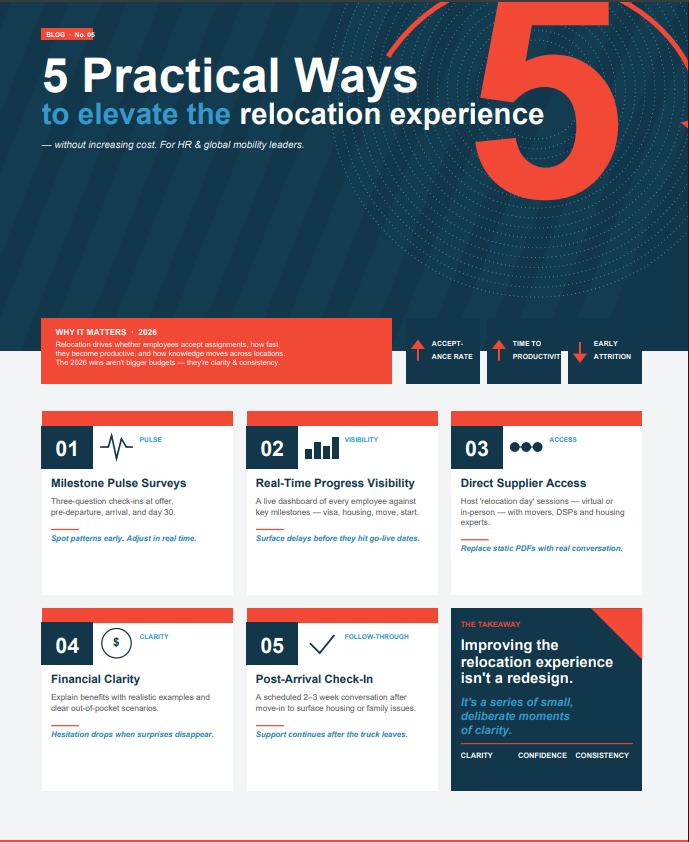
5 employee experience info graphic

Most Frequently Asked Questions about Employee Relocation Experience

What is an employee relocation experience?

Employee relocation experience refers to the full journey an employee goes through when moving for work, from the initial decision to relocate through to settling into their new role and environment. This includes communication, logistics, support, and how confidently the employee can navigate each stage of the move.

Key business indicators:

Time to productivity after relocation
Relocation completion timelines
Employee satisfaction scores during relocation
Assignment success rate

Why is employee relocation experience important for businesses?

A strong relocation experience helps protect the company’s investment in talent. It improves acceptance rates for relocation offers, reduces early attrition, and supports faster integration into the new role. It also ensures that business-critical positions are filled without unnecessary delay and that employees can contribute effectively from the start.

Key business outcomes:

Higher relocation acceptance rate
Reduced early attrition (first 12 months)
Faster time to full productivity
Improved retention of high-performing employees
More effective transfer of skills across locations

How can companies improve relocation experience without increasing cost?

Organizations can improve relocation experience by focusing on clarity, visibility, and timing rather than adding new benefits. Simple changes such as introducing milestone-based pulse surveys, improving communication, and providing better access to relocation information can significantly improve employee confidence and overall experience.

Practical actions:

Use short pulse surveys at key relocation milestones
Improve visibility into relocation progress (dashboard or portal)
Provide clear, upfront communication on benefits and expectations
Offer direct access to relocation support and suppliers
What role do global mobility services play in employee experience?

Global mobility services and corporate relocation services provide the structure and coordination needed to manage employee moves effectively. They ensure that logistics are handled properly, timelines are maintained, and employees receive the support they need throughout the relocation process.

Operational impact:

Improved relocation timeline management
Better coordination across vendors and stakeholders
Reduced disruption to business operations
Consistent employee support across locations
How does relocation impact talent retention and leadership development?

Relocation is a key tool for retaining and developing talent. Employees who are given opportunities to move and grow within the organization are more likely to stay engaged and committed. At the same time, relocation helps build leadership capability by exposing employees to new markets, teams, and business environments.

Strategic outcomes:

Increased retention of high-potential employees
Stronger leadership pipeline
Greater internal mobility vs external hiring
Enhanced global business capability

How can organizations track relocation progress effectively?

Tracking relocation progress requires clear visibility into where each employee is in the relocation process. This includes key milestones such as visa status, housing, move dates, and start dates. Having this visibility allows organizations to identify risks early and ensure alignment with business timelines.

Key tracking metrics:

Milestone completion rates (visa, housing, move)
On-time start date achievement
Relocation delays and risk flags
Employee status by relocation stage

Categories
Choosing a Relocation Company Corporate Relocation Domestic Relocation Global Mobility Relocation Technology

3 Ways Your Relocation Program Gets Smarter Starting Next Week

Global Mobility Solutions continues to invest in how modern global mobility programs are delivered—ensuring that operational excellence is supported by clear data, strong cost control, and reliable financial visibility. As part of that continued focus, GMS is launching its partnership with Daycos. This collaboration enhances how corporate relocation services, supplier activity, and financial outcomes are connected across every stage of the relocation lifecycle.

For organizations managing global mobility services across multiple regions, vendors, and policy structures, the challenge is no longer execution alone. It is visibility, alignment, and the ability to make informed decisions in real time. This is where the partnership delivers immediate value

1. A clearer connection between relocation activity and cost

In many relocation management company models, operational delivery and financial reporting exist in separate workflows. Moves are executed efficiently, but cost visibility often depends on delayed reporting cycles, invoice reconciliation, and manual validation.

Global Mobility Solutions has built its reputation on delivering consistent, high-quality international relocation services. With the addition of Daycos, that capability is extended through a more connected view of operational and financial data.

As relocation services are delivered—whether household goods shipments, destination services, or broader relocation assistance—those activities are aligned more directly with cost validation and reporting. This allows clients to better understand how program activity translates into financial outcomes. Instead of relying solely on end-of-month or end-of-quarter reporting, mobility teams gain a more continuous view of their programs. This supports stronger forecasting, improved budget management, and more accurate tracking of cost drivers across corporate relocation programs.

For organizations operating at scale, this level of visibility strengthens alignment between HR, finance, and procurement, ensuring that relocation spend is both transparent and well understood.

2. Audit and compliance are integrated into program delivery

Audit and compliance are essential to any well-managed global mobility relocation program. As programs expand across regions and suppliers, maintaining consistency and accuracy becomes increasingly complex. Through this partnership, Global Mobility Solutions enhances its ability to integrate audit and compliance directly into the relocation process.

Operational activity, supplier services, and financial validation are aligned within a structured workflow. This enables a more consistent approach to invoice review, cost verification, and policy compliance across all relocation activities. Rather than functioning as a separate, end-of-process task, audit becomes part of how the program operates day to day. This reduces reliance on manual reconciliation, minimizes discrepancies, and improves the overall efficiency of program management.

For clients working with relocation management companies or overseeing international relocation services, this approach provides greater confidence that financial data reflects actual service delivery. It also supports stronger compliance with internal policies and external requirements. At the same time, it creates a more streamlined experience across teams, reducing the administrative burden often associated with managing supplier invoices and financial reporting.

3. Better data leads to better relocation decisions

One of the most valuable outcomes of a connected relocation program is the ability to turn data into actionable insight. By strengthening the link between operational delivery and financial reporting, Global Mobility Solutions enables clients to gain a clearer understanding of their global mobility programs. This includes improved visibility into cost drivers, supplier performance, and overall program trends.

These insights support more effective global mobility consulting, allowing organizations to refine policies, optimize vendor selection, and improve program efficiency over time.

GMS also continues to apply disciplined cost management practices across its corporate relocation services, including centralized coordination and structured workflows that reduce unnecessary spend. Group booking strategies across air, hotel, and ground transportation further enhance cost efficiency, providing access to negotiated rates, flexible terms, and additional value while maintaining a high standard of employee experience.

For mobility teams, this means less time spent managing fragmented data and more time focused on strategic priorities—supporting employees, improving program design, and aligning mobility with broader business goals. This enhancement is supported by the combined scale and experience of both organizations.

Daycos brings over 47 years of experience in the relocation industry, supporting more than 300,000 shipments annually, managing approximately $2 billion in relocation-related charges, and processing over 500,000 invoices each year. Its platform supports more than 10.2 million documents and connects a global network of suppliers and service providers.

Together with Global Mobility Solutions—serving clients in more than 140 countries as a leading global mobility provider—this partnership strengthens the delivery of relocation services through a more integrated and data-driven approach.

Frequently Asked Questions about Global Mobility Services and Relocation

What is a global mobility provider?
A global mobility provider manages corporate relocation, international assignments, and employee movement across regions. Global Mobility Solutions delivers these services across 140+ countries, supporting companies with relocation planning, execution, and compliance.

How do corporate relocation services control costs?
Corporate relocation services control costs through policy management, supplier coordination, and data visibility. With Daycos integrated into Global Mobility Solutions, companies gain clearer insight into relocation spend and improved cost alignment across services.

What makes a relocation management company effective?
An effective relocation management company combines operational expertise with strong financial oversight. This includes managing suppliers, ensuring service quality, and providing transparent reporting on relocation activity and cost.

How do global mobility services support employees?
Global mobility services provide relocation assistance, housing support, travel coordination, and destination services. These services ensure employees can transition smoothly while maintaining productivity and engagement.

Why is visibility important in international relocation services?
Visibility allows companies to track costs, monitor supplier performance, and ensure compliance with relocation policies. It also helps mobility teams make better decisions and improve overall program efficiency.

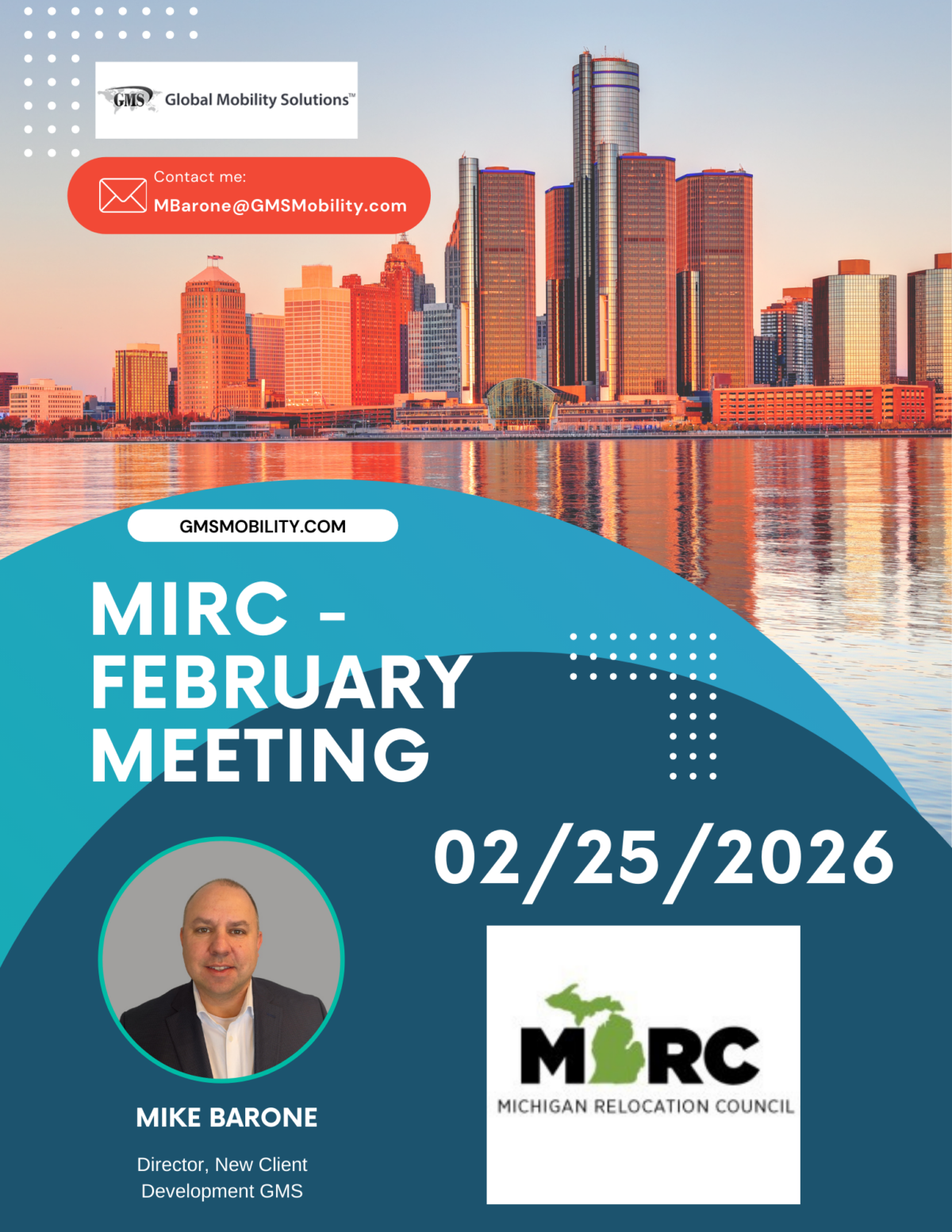
MiRC – February Meeting


February 25

All day

Meet up with Mike at the MiRC February Meeting to connect with fellow mobility professionals and exchange insights on today’s evolving relocation landscape. With deep industry experience and a people-first approach, Mike is always open to meaningful conversations around building more flexible, effective mobility programs. If you’re attending MiRC, be sure to schedule time to meet with Mike and start a conversation that could move your program forward.

Categories
Global Mobility Global Relocation Immigration Rules Relocation Programs Talent Mobility Visas and International Travel

Employee Visa and Immigration Trends for 2026

What Global Mobility Teams Need to Know

As global workforces continue to expand and companies increasingly rely on international talent, staying ahead of visa and immigration trends is essential for smooth employee mobility. In 2026, organizations that proactively adapt to shifting regulations and emerging mobility patterns will have a competitive advantage in attracting and retaining top talent.

Digital Immigration Processes Continue to Grow

The trend toward digital-first immigration processes is set to accelerate in 2026. Many governments are expanding online visa applications, e-permit systems, and digital tracking systems, thereby reducing processing times and paperwork. Global mobility teams should ensure employees are aware of online portals, electronic submission requirements, and potential automation tools to streamline compliance.

Rising Demand for Remote Work Visas

Remote and hybrid work arrangements are here to stay. Countries are introducing specialized visas for remote workers and digital nomads, allowing employees to work abroad legally without relocating permanently. In 2026, mobility teams will need to factor remote work visas into workforce planning, balancing talent mobility with tax, legal, and compliance considerations.

Increased Scrutiny on Compliance and Immigration Risk

Governments are tightening regulations to prevent overstays, tax underpayment, or unauthorized employment. For companies relocating employees internationally, compliance risk management will be more critical than ever. Organizations should partner with experienced immigration providers and implement robust tracking systems to avoid penalties and ensure timely visa renewals.

Talent Shortages Drive Visa Flexibility

With global talent shortages in tech, healthcare, and other key industries, countries are updating visa policies to attract skilled workers. Expect faster processing times for specialized visas, priority handling for in-demand roles, and streamlined pathways for permanent residency in some regions. Companies will need to stay informed of these opportunities to remain competitive in global recruitment.

Focus on Employee Experience

Beyond compliance, employee experience remains a key driver of mobility success. Streamlined visa processes, clear communication, and proactive support can significantly reduce relocation stress. In 2026, integrating immigration services with overall relocation programs will be critical for employee satisfaction and retention.

How GMS Can Help with Visa and Immigration Needs

At GMS, we stay ahead of global visa and immigration trends so your mobility program runs smoothly, whether for domestic or international transfers. Our expert team helps your employees navigate complex regulations, ensuring a seamless relocation experience while keeping your organization compliant.

Contact us today for a consultation on enhancing your 2026 mobility strategy.

Categories
Corporate Relocation Domestic Relocation Domestic Relocation Trends Global Mobility Global Relocation Global Relocation Challenges Global Relocation Tips Global Relocation Trends

Addressing data protection and security issues in your global mobility initiative

Learn why data privacy is essential for relocation management companies

Ransomware, phishing, hacking, malware, botnets, viruses, spyware, and worms are some cybersecurity threats we face today. One doesn’t need to be an IT expert to recognize that data security risks are significant in our digital age. With personal information now crucial for businesses, conversations on data privacy and protection have moved from technical departments to executive meetings. As companies handle increasing amounts and worth of data, the associated risks also escalate.

The European Union’s General Data Protection Regulation (GDPR) is a widely recognized and established security standard that mandates companies safeguard individuals’ personal information and privacy in the EU and data related to transactions within EU countries. Failure to comply with these regulations can result in hefty financial penalties, fines, and considerable harm to a business’s reputation.

How can you ensure you stay ahead of these challenges?

As your traveling employees move globally, they anticipate that you and your service providers will safeguard their personal information. Organizations have an obligation to their workforce to ensure the protection of sensitive and private data. This duty involves collaborating with reliable partners and vendors who emphasize data privacy and security in their practices. 

Below are five data privacy processes we consider essential for your company, partners, and vendors.

  1. Conduct Regular Risk Assessments: It’s crucial to evaluate the potential risks associated with data handling regularly. This involves identifying vulnerabilities in your systems and processes and assessing your partners’ security measures. By understanding where the risks lie, you can take proactive steps to mitigate them.
  2. Implement Strong Data Encryption: Protecting sensitive information through encryption is a fundamental practice. Ensure that both your company and your vendors use robust encryption methods for data at rest and in transit. This adds an extra layer of security, making it much harder for unauthorized individuals to access personal information.
  3. Establish Clear Data Access Policies: Define who has access to personal data and under what circumstances. This should include strict guidelines on data sharing and handling. Ensure all employees and partners are trained on these policies to prevent unauthorized access and potential breaches.
  4. Regularly Update Software and Systems: Keeping your software and systems up to date is essential for protecting against vulnerabilities. Ensure your company and vendors are committed to regular updates and patches. This helps to close security gaps that cybercriminals could exploit.
  5. Create an Incident Response Plan: Despite best efforts, breaches can still occur. Having a well-defined incident response plan in place is vital. This plan should outline the steps to take in the event of a data breach, including how to notify affected individuals and regulatory bodies. Regularly review and practice this plan to ensure everyone knows their role in the event of an incident.

Implementing these essential data privacy processes can significantly reduce non-compliance risk and protect employees’ personal information. Remember, data privacy is not just a legal obligation; it’s a commitment to your employees and their trust in your organization.

GMS Takes Data Privacy Serious for Global Mobility Programs

Regardless of whether you are collaborating with a relocation management firm or overseeing your mobility program internally, it is essential to pose these two critical inquiries:

Has your mobility program been committed clearly to data privacy and protection over the past six months?

Does your organization or relocation provider adhere to the trust services principles outlined in a SOC 2 certification?

If your response to either question is “No,” it is crucial to reassess your data security and compliance measures. Global Mobility Solutions (GMS) is one of the few relocation companies holding SOC 2 certification. Contact GMS today to discover how we safeguard your information and data throughout your relocation management program. You can call us at 800.617.1904 or 480.922.0700 for more information.

Our cloud-based relocation technology is designed to help you streamline your company’s relocation management.

Categories
Domestic Relocation Domestic Relocation Challenges Domestic Relocation Tips Domestic Relocation Trends Global Mobility Global Relocation

Complete Guide to Relocating with Children

Moving for work can be a stressful time; here’s a guide to help with your kids

Relocating for work can take time, whether within the same area or in a different city. And it can become even more intricate when you have young kids to consider. Your children compete for your focus during the entire procedure and may experience unease about the upcoming changes. However, it can be an easier transition if your employer provides relocation services for you and your family. 

Understanding how a relocation will impact your kids can assist you in getting ready for the changes and difficulties that lie ahead. We aim to provide you with helpful advice to make the transition easier. First and foremost, check with your relocation management company (RMC) to see what kind of family support services they provide for relocating employees. 

Moving can be just as stressful for children as it is for adults. According to a study published in the Journal of Personality and Social Psychology, the emotional impact of moving can have long-lasting effects on children’s mental well-being, which can persist into adulthood. This includes difficulties in forming social connections and a strong sense of identity. The consequences of moving can be particularly challenging for introverted or anxious children and those with rigid personalities, who may find it harder to make friends and develop a strong sense of self-worth.

How to Handle Relocating with Kids of All Ages

Many RMCs offer various family support services to help ease your children’s transition. These services include finding suitable schools or educational programs in the new location. It’s essential to ensure that your children’s education is not disrupted during the move, as this can further contribute to their stress and anxiety.

Additionally, some RMCs provide resources for finding extracurricular activities and clubs that align with your children’s interests. These activities can help them meet new friends and develop a sense of belonging in their new community. Whether joining a sports team, participating in art classes, or joining a scouting group, these activities can provide a much-needed sense of stability and routine during the relocation process.

Furthermore, RMCs may offer counseling services for children struggling with the emotional challenges of moving. Professional counselors can help children navigate their sadness, anxiety, or loneliness, providing them with the necessary tools to cope with the changes. These services can be invaluable in supporting your children’s mental well-being and helping them adjust to their new environment.

In addition to the services provided by the RMC, there are steps you can take as a parent to support your children during the relocation. Open and honest communication is vital. Sit down with your children and discuss the upcoming move, addressing their concerns or fears. Encourage them to express and validate their emotions, letting them know that it’s normal to feel a range of emotions during this time.

It’s also essential to involve your children in decision-making when possible. Allow them to have a say in the move, such as choosing their new room decor or exploring potential neighborhoods. This can help them feel a sense of control and ownership over the changes in their lives.

Lastly, try to explore the new community together as a family. Take walks around the neighborhood, visit local parks, and discover nearby attractions. Familiarizing yourselves with the new surroundings can help your children feel more comfortable and excited about their new home.

By utilizing the family support relocation services provided by your RMC and implementing these strategies, you can help alleviate some of the stress and challenges that come with relocating for your children. Remember, their emotional well-being is just as important as the logistics of the move, and by prioritizing their needs, you can ensure a smoother transition for the entire family.

GMS Makes It About the Whole FamilY

As a family moves more often, maintaining stability becomes increasingly crucial. It is vital to be well-prepared and actively engaged when relocating children, regardless of age. Children must be aware of the plan for the move, feel involved in the process, and have a positive anticipation towards the relocation.

When parents provide adequate assistance, relocating can benefit children, enhancing their self-assurance and nurturing their ability to interact with others.

Global Mobility Solutions (GMS) offers comprehensive assistance and tools for transferees and their families to guarantee smooth relocations. The team of experts at GMS specializes in corporate relocation. It can assist your company in evaluating potential candidates for assignments and providing top-notch relocation services for your employees and their loved ones.

Contact our team of professionals to explore how we can enhance your relocation support services. By providing inclusive relocation bundles, we guarantee that your company remains competitive in employment opportunities. Subsequently, we will help your employees achieve a smooth and effortless relocation experience.

We're Here to Help! Request a Courtesy Consultation

Are you ready to talk to a Mobility Pro? Learn how GMS can optimize your mobility program, enhance your policies to meet today’s unique challenges, receive an in-depth industry benchmark, or simply ask us a question. Your Mobility Pro will be in touch within 1 business day for a no-pressure, courtesy consultation.

Categories
Corporate Relocation Corporate relocation tips Domestic Relocation Challenges Domestic Relocation Tips Domestic Relocation Trends Global Relocation

How to Get Ready for a Relocation Assignment

Accepting an offer to relocate can be a great career move

Are you ready to take the leap and relocate for your career? Moving to a new workplace can be an exhilarating adventure, filled with opportunities for personal and professional growth. However, it can also be a daunting task that requires careful planning and execution. We will explore the exciting journey of relocating for work, offering valuable insights and tips to help you navigate this transition smoothly.

Relocating for work can be an exciting opportunity to explore new horizons and advance your career. However, it is essential to approach this transition with careful planning and preparation. Here are some valuable insights and tips to help you prepare for your relocation assignment.
Firstly, it is crucial to research and understand the new location thoroughly. Familiarize yourself with the local culture, cost of living, and any unique challenges that may arise. This will help you adjust more efficiently and make informed decisions.


Lastly, remember to take care of yourself throughout this transition. Moving can be physically and emotionally draining, so prioritize self-care. Stay connected with loved ones, maintain a healthy lifestyle, and give yourself time to adjust to the changes. Taking on that relocation assignment can open up numerous new opportunities for your career. You can navigate this transition smoothly and make the most of your career move by approaching it with careful planning, research, and a positive mindset. Here are some things to keep in mind:

Planning Your Move

Before diving headfirst into packing boxes and booking flights, starting with a well-thought-out plan is essential. Here are some critical steps to consider as you embark on this exciting journey.

Research Your New Destination

Begin by thoroughly researching your new location. Familiarize yourself with the local culture, cost of living, and job market. This will help you make informed decisions about your move and ensure a smoother transition.

Secure Housing and Budget Wisely

Finding a suitable place to live is a top priority. Start your search early and consider factors like proximity to your workplace, public transportation, and the neighborhood’s amenities, whether you’re renting or buying.

The journey of relocating for work can be costly, so create a relocation budget that includes moving expenses, housing costs, and any unforeseen expenses that may arise during the transition. Having a financial cushion will alleviate stress and help you settle in comfortably.

Network in Advance

Reach out to colleagues or industry contacts in your new city before your move. Networking can help you establish a support system and gain insights into your new work environment. Attend local professional events or join online forums and social media groups related to your industry in the new location.

Engaging with established professionals in the area can provide valuable information about job opportunities, local business culture, and even hidden gems in your new city. Building these connections in advance will ease your transition and set the stage for potential career growth in your new work environment.

Making the Move

With your plan in place for relocating for work, it’s time to start making the physical move. Here are some practical tips to help you relocate smoothly.

Declutter, Organize and Hire Professional Movers

Take this opportunity to declutter your belongings. Donate or sell items you no longer need to lighten your load and reduce moving costs. Consider hiring professional movers to handle the heavy lifting. They have the expertise to safely pack and transport your belongings, giving you more time to focus on other aspects of your move.

Pack Essentials Separately

Pack a separate bag with essential items like clothing, toiletries, important documents, and any items you’ll need immediately upon arrival. This will save you from digging through boxes during your first days in your new home.

Settling In

Once you’ve arrived at your new destination, it’s time to settle in and embrace your new surroundings. Here’s how to make the most of this exciting phase.

Explore Your New Community and Meet New People

Take the time to explore your new neighborhood and city. Visit local attractions, restaurants, and parks to get a feel for your surroundings. Don’t hesitate to leave your comfort zone and meet new people. Join local clubs, attend networking events, or use social media to connect with others in your industry or community.

Establish a Routine

Settling into a new job and location can be overwhelming. Establishing a daily routine can provide a sense of stability and help you adapt more quickly. A well-structured routine not only aids in acclimating to your new surroundings but also enhances productivity.

Start by setting aside time for essential activities such as exercise, meal planning, and rest. Allocate time for exploring your new city or engaging in hobbies you enjoy. This balanced approach ensures that your transition is not just about work but also about embracing your new location’s lifestyle opportunities.

Maintaining Work-Life Balance After a Relocation Assignment

Balancing your career and personal life is crucial when relocating for work. It can be vital if you are going through work-related stress, mental health issues, or addiction recovery. If this is the case, the effect of stress on your recovery can be triggering and hinder the process. Here are some tips to help you achieve that equilibrium:

Manage your time effectively: Prioritize your tasks and avoid overloading yourself with work. Managing your time effectively will allow you to make the most of your new surroundings while ensuring you have the necessary space to focus on your recovery journey.

Stay connected with loved ones: Relocating might mean leaving loved ones behind. Stay connected with them through regular calls, video chats, and visits to maintain your support system.

GMS can Guide You on the Journey of Relocating for Work

Accepting a relocation assignment for work can be a transformative experience that opens up new opportunities and horizons. While it may come with its fair share of challenges, careful planning, a positive attitude, and a willingness to adapt can make the journey manageable and truly exciting. So, take the leap, embrace the adventure, and watch your career and personal growth flourish in your new home. Your journey of relocating for work is a chapter waiting to be written, with endless possibilities.

Global Mobility Solutions (GMS) offers a wide range of career support and resources to transferees and their families to guarantee smooth relocations. Our team of corporate relocation specialists possesses the necessary knowledge and skills to assist your company in evaluating potential candidates for assignments. Moreover, we are dedicated to providing your employees and their loved ones with the best possible relocation experience. 

Contact our experts today to discuss how we can enhance your relocation assistance programs. By offering comprehensive relocation packages, we will ensure your company remains competitive regarding job offers. Additionally, we will guide your employees through a seamless relocation process.

We're Here to Help! Request a Courtesy Consultation

Are you ready to talk to a Mobility Pro? Learn how GMS can optimize your mobility program, enhance your policies to meet today’s unique challenges, receive an in-depth industry benchmark, or simply ask us a question. Your Mobility Pro will be in touch within 1 business day for a no-pressure, courtesy consultation.

Categories
Global Mobility Global Relocation Global Relocation Challenges Global Relocation Tips Global Relocation Trends Talent Management Talent Mobility Visas and International Travel

Global Talent Shortage Can Be Mitigated With Global Relocation

Learn how offering relocation benefits can help hire top talent

It’s no secret that your company must set itself apart from the competition if you want top talent for job openings. What factors can put your company above the rest when hiring for vacant positions?

Offering relocation benefits to those who have to move for the job could be a great way to lure top talent. But just how much does the offering of global relocation packages help persuade candidates to your side?

Korn Ferry’s study “Global Talent Crunch” highlights the skilled talent shortage impacting countries and specific industries worldwide. Many countries are already facing a skilled talent shortage across several industries. The study examines the talent shortage issue across twenty major developed and developing countries, including:

  • Americas: Brazil, Mexico, United States
  • EMEA: France, Germany, Netherlands, Russia, Saudi Arabia, South Africa, United Arab Emirates, United Kingdom
  • Asia Pacific: Australia, China, India, Indonesia, Japan, Malaysia, Singapore, Thailand

Which industries are most at risk due to talent shortage?

The financial and business services industries are the most at risk due to talent shortage. According to the study, these industries could be facing a shortage of nearly 11 million workers by 2030, with about $1.3 trillion negative impact. Across the globe, technological advancement is at risk due to a skilled talent shortage of over 4 million Technology, Media, and Telecommunications (TMT) workers by 2030. Additionally, manufacturing will have a surplus of workers through 2023, quickly becoming a skilled talent shortage of nearly 8 million workers by 2030.

Which countries are most at risk due to talent shortage?

The greatest vulnerability to talent scarcity lies in advanced nations. France and Germany in Europe and Japan in Asia encounter the highest levels of risk. The United States and Australia also confront a significant deficit in skilled personnel, with the US anticipating a staggering loss of approximately $1.8 trillion in yearly earnings by 2030. Conversely, India stands alone among the countries examined, as it remains in possession of an excess of skilled talent until 2030.

What should employers expect?

Employers should expect to find it increasingly difficult to recruit and hire in several countries and industries. Those with plans to expand into new markets should consider this as they develop their hiring plans and corporate objectives.

Employers finding difficulties hiring and recruiting for positions in specific countries and industries should consider highlighting their relocation program’s benefits in their recruiting materials. The healthcare industry has been facing a critical talent shortage for several years. Healthcare employers have responded in several ways, including:

  1. Providing Exceptional Candidate Experiences
  2. Using Data to Enhance Recruiting
  3. Recruiting for Cultural Fit
  4. Creating a Superior Employer Brand
  5. Speeding the Process to Keep Candidates Engaged

Relocation Management Companies (RMCs) are ideal sources for information on global candidate recruitment and relocation. Pre-Decision Services are critical for employers as they provide valuable information about a candidate’s ability to accept a position and be successful. Assessment data can be paired with structured interview questions to understand better the candidate’s interests, goals, and motivations.

Contact GMS for More Resources

The team of professionals at Global Mobility Solutions (GMS) specializes in assisting companies with corporate relocation, creating effective relocation programs that can successfully appeal to and maintain skilled employees. By implementing industry-leading strategies, our team can help your company design a relocation program that enhances your ability to attract and retain new employees and alleviate the challenges of a talent shortage. 

GMS became the inaugural relocation firm to become a registered .com. Additionally, they developed the initial digital tools and calculators, which significantly changed the relocation sector. GMS persists in leading the industry by introducing pioneering innovations and technological solutions through their exclusive MyRelocation™ technology platform.

Contact our experts online to discuss your company’s relocation program needs.

We're Here to Help! Request a Courtesy Consultation

Are you ready to talk to a Mobility Pro? Learn how GMS can optimize your mobility program, enhance your policies to meet today’s unique challenges, receive an in-depth industry benchmark, or simply ask us a question. Your Mobility Pro will be in touch within 1 business day for a no-pressure, courtesy consultation.

Categories
Corporate Relocation Corporate relocation tips Domestic Relocation Domestic Relocation Challenges Domestic Relocation Tips Domestic Relocation Trends Employee Development Relocation Technology

How Relocation Management Companies Leverage AI Technology

Learn how GMS leverages AI in their mobility programs

At Global Mobility Solutions (GMS), we view AI through a lens of practicality. We leverage predictive analytics and Artificial intelligence (AI) to learn, predicate, and automate our processes and improve the experience.

Few Relocation Management Companies (RMCs) fully understand the potential of AI and are in the process of discovery. However, some organizations leverage predictive analytics and defined algorithms to produce artificial intelligence specifically for relocation. These organizations gain valuable insights and automate operationally by incorporating predictive analytics and AI into their processes. Unlike many other RMCs, we fully recognize the immense potential of AI and related capabilities. 

By leveraging AI, we can streamline and optimize various tasks, such as assessing housing options, calculating costs, and managing logistics. This saves time and resources and ensures a more efficient and accurate relocation process. Additionally, AI enables us to provide personalized recommendations and solutions based on individual preferences and needs, further enhancing the overall customer experience.

With the integration of AI becoming increasingly prevalent in various industries, we anticipate that more RMCs will follow suit and adopt AI within the next 18 to 24 months. This shift towards automation and data-driven decision-making will undoubtedly revolutionize how relocation management is conducted, ultimately enhancing the overall experience for individuals and businesses undergoing the relocation process.

As companies continue to explore the potential of AI and predictive analytics, we are committed to staying at the forefront of technological advancements in the relocation industry. By embracing these innovative solutions, we aim to provide our clients with the most seamless and stress-free relocation experience possible.

How does this change the relocation industry?

Recognizing that every move is associated with data points concerning expenses, geographical consequences, procedures, service durations, and essential trends. Businesses can swiftly examine extensive volumes of data to comprehend the reasons behind events and anticipate future occurrences.

Artificial intelligence aids in the relocation process by anticipating possible problems before it begins and improving its predictions as the process unfolds. Moreover, AI provides customized recommendations that facilitate comprehensive relocation management. 

These recommendations include identifying relocation endeavors with a high risk, evaluating policies, estimating the overall duration and anticipated expenses, anticipating exceptional circumstances, adjusting milestones, issuing alerts, providing information about the destination, assessing authorization volume, forecasting performance, and more. Consequently, this leads to enhanced planning, execution, and cost-effectiveness.

Does AI help reduce relocation costs?

Although AI cannot replace the significance of human interaction in relocation, it will undoubtedly enhance the procedure and improve the overall experience. Incorporating AI in relocation management is predicted to decrease general expenses for numerous companies, mainly through adopting new AI technologies and integrating data in the relocation sector.

By incorporating AI in relocation management, companies can expect to see a reduction in overall expenses. It can significantly enhance the procedure and improve the overall experience. Companies can streamline operations and make more informed decisions by adopting new AI technologies and data integration in the relocation sector.

One of the key ways in which AI helps reduce relocation costs is through its ability to identify high-risk endeavors. By analyzing data and patterns, AI can pinpoint potential challenges and provide recommendations on how to mitigate them. This proactive approach allows companies to anticipate exceptional circumstances and adjust milestones accordingly, saving time and money.

Furthermore, AI can assist in evaluating policies and estimating the overall duration and anticipated expenses of relocation. By analyzing historical data and trends, AI algorithms can provide accurate cost estimates and timelines, allowing companies to plan and budget more effectively. This reduces the risk of unexpected expenses and ensures the relocation stays within the allocated budget.

In addition, AI can play a crucial role in providing information about the destination. AI algorithms can provide employees with valuable insights and recommendations by analyzing the cost of living, transportation, and local amenities. This helps employees make informed decisions and reduces the need for extensive research and costly mistakes.

Another way in which AI helps reduce relocation costs is by assessing authorization volume and forecasting performance. By analyzing data on employee authorizations and performance metrics, AI algorithms can identify areas of improvement and optimize resource allocation. This ensures that the relocation process is efficient and cost-effective, ultimately leading to significant savings for the company.

Connect with GMS to Learn More

In conclusion, while AI cannot replace human interaction in relocation, it is a valuable tool that can significantly enhance the process and reduce costs. By adopting new AI technologies and integrating data in the relocation sector, companies can improve planning, execution, and cost-effectiveness. With AI’s ability to identify high-risk endeavors, evaluate policies, estimate expenses, provide destination information, assess authorization volume, and forecast performance, companies can make more informed decisions and achieve successful relocations while minimizing costs.

GMS takes pride in being the relocation industry leader in technology. GMS’ relocation technology offers all the necessary tools for your employees. Movers can oversee and monitor their relocation process through the user-friendly dashboard of MyRelocation® technology. Staff members can stay informed about their benefits, communicate with their relocation advisor, and even stay updated on important dates. Our technology, which has received recognition, is a valuable and comprehensive resource for employees, thanks to its easy-to-use interface and user-friendly menu design and functionalities.

Contact us today to set up a free consultation.

MyRelocation Technology Logo

Our cloud-based MyRelocation® relocation technology is designed to help you streamline your company’s relocation management. Schedule a demo with a Mobility Pro for a no-pressure look at how our technology can help you.

Schedule a tech demo

Categories
Choosing a Relocation Company Corporate Relocation Corporate relocation tips Domestic Relocation Tips Global Relocation Global Relocation Challenges Global Relocation Tips

How To Craft An Effective Relocation Orientation Program For Employees

Here are some tips to help ease in newly relocated employees

When hiring new employees, it’s important to provide in-depth orientation programs for new hires so they can be onboarded efficiently. This is also important to consider when team members are relocated to a different site, especially if this involves a significant upheaval in their living circumstances.

To that end, here are some tips to follow to build a relocation-focused orientation program that works.

Aligning the Program with Company Culture and Values

One of the essential aspects of crafting an effective relocation orientation program is ensuring that it aligns seamlessly with your organization’s core values and distinctive company culture. This helps relocated employees quickly understand what defines their new work environment, facilitating a smooth transition into their roles.

To achieve this alignment, feature stories that showcase company traditions or events that exemplify your business ethos in written materials and multimedia presentations throughout the orientation process. Encourage participation from existing employees to share anecdotes about memorable experiences at work reflecting vital cultural elements, such as teamwork, innovation, or community engagement.

Moreover, provide clear guidelines on expected workplace behaviors while highlighting how they stem from foundational beliefs driving overall company objectives. Incorporating these cultural insights into every aspect of your relocation orientation program promotes faster integration and fosters more substantial commitment and loyalty among newcomers.

Leveraging Orientation Videos for Engaging Transitions

A well-produced and engaging orientation video is crucial to kickstart your employee relocation program. To create an impactful video, start by outlining the essential information that newly relocated employees need, such as company policies, support resources, documentation assistance, and brief introductions to coworkers or teams they will be working with.

To make the experience more enjoyable for employees while conveying important messages effectively, incorporate high-quality visuals and animations that capture their attention. 

Additionally, consider adding soothing background music to establish a relaxed atmosphere during this potentially overwhelming time in their lives. Some sources allow you to download royalty-free tunes perfectly suited for setting the desired ambiance within your orientation materials.

By combining valuable content with visually appealing presentations accompanied by pleasing sounds, you’ll lay a solid groundwork to set newcomers at ease, ultimately contributing to successful talent integration.

Facilitating Smooth Integration: Socializing & Networking Activities

While providing essential relocation information and resources is crucial, addressing the human aspect of moving also plays a vital role in successful employee transitions. Arranging socializing and networking events within your program can significantly aid newcomers’ ease into their new surroundings while making valuable personal and professional connections with colleagues.

Organize informal gatherings like team lunches or after-work outings to help break the ice between relocated employees and their co-workers. Such activities create opportunities for authentic interactions away from workplace pressures. Consider holding optional workshops focusing on common hobbies or sports so that employees bond over shared interests, which is an approach that naturally fosters camaraderie.

Additionally, arrange sessions where newcomers interact with representatives from different departments or divisions, illustrating cross-functional teamwork’s importance in achieving company objectives. By offering varied opportunities for interpersonal connection within the relocation orientation program, you’ll effectively pave the way toward mutual understanding among peers, thus establishing an inclusive environment primed for sustained collaboration and success.

Providing Comprehensive Information on Local Living Essentials

An effective relocation orientation program thoroughly addresses newcomers’ basic needs and concerns, helping them navigate the essentials of day-to-day life in their new location. Providing a guide, either in physical or digital form, can significantly relieve stress by offering ample resources for employees to settle into their new surroundings more comfortably.

Some essential contents to include within this guide may be:

  • Housing options: Advice on local neighborhoods that cater to different lifestyles and budgets and opportunities for temporary housing as needed.
  • Transportation: Information about public transport networks, parking facilities, or green commuting initiatives (if applicable).
  • Healthcare services: Details regarding nearby medical centers, hospitals, or pharmacies.
  • Childcare and schooling options: Insight on finding suitable schools, daycare centers, or student-support programs.
  • Grocery stores & dining spots: Recommendations for sourcing daily provisions from supermarkets and favorite restaurants within various budgets.

Setting Up Continuous Feedback Channels to Improve Relocation Experiences

To continually refine and enhance your relocation orientation program, establish open lines of communication for soliciting feedback from employees who have experienced the process firsthand.

Encourage honest responses via anonymous surveys or designated human resource personnel. Also, assess received feedback periodically to identify improvement areas, adjusting as needed within subsequent rollouts.

Ask Us for More Advice on Relocation Services

Now that you know what’s involved, you can start crafting your effective relocation orientation program today. Incorporating these eight essential elements ease employees’ transitions and creates a thriving and inclusive work environment. Enhancing the employee experience by developing a comprehensive support system that paves the way for success will pay dividends for individuals and the business.

If you need more information about employee relocation, contact us today. Global Mobility Solutions (GMS) has led the talent mobility industry since 1987; we utilize up-to-date relocation technology and an award-winning team of global mobility experts.

We're Here to Help! Request a Courtesy Consultation

Are you ready to talk to a Mobility Pro? Learn how GMS can optimize your mobility program, enhance your policies to meet today’s unique challenges, receive an in-depth industry benchmark, or simply ask us a question. Your Mobility Pro will be in touch within 1 business day for a no-pressure, courtesy consultation.

Looking for something?