

Categories
Corporate Relocation Domestic Relocation Domestic Relocation Tips Domestic Relocation Trends Global Mobility Global Relocation Global Relocation Tips Global Relocation Trends Relocation Best Practices

Pre-Decision and Best Practices for Global Mobility

Pre-decision Best Practices: Why do many companies have a 50% rate for assignment rejection? It is primarily because the potential transferees do not have a clear understanding of the destination location and the support available for their families.

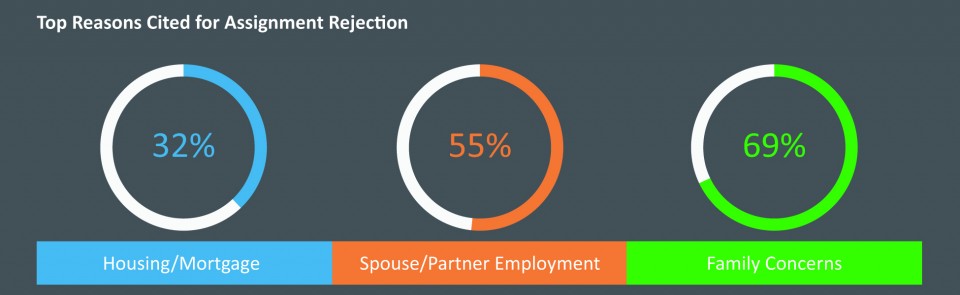
The top 3 reasons cited for rejecting relocation assignments are housing/mortgage concerns, trailing spouse/partner employment concerns, and overall family concerns. Pre-Decision Best Practices

Assignment rejection and failure can be very costly to a company. Firms spend an average of half a year’s salary in recruiting and training when onboarding a new employee. For high-level executives, the expense can be six to nine months of their salaries. However, according to the ERC, it can be as high as three-times an annual salary for international executives. If assignments are rejected, or fail after a move – which adds much more to the financial loss – companies must go through the expense of onboarding and training new staff.


How can companies ensure that they get the right people in the right place at the right time and for the right price?

The answer is to use pre-decision programs. Global Mobility Solutions (GMS) is the pre-decision pioneer and we continue to develop new, innovative features for pre-decision programs.

Although the number is growing, currently only 22 percent of companies around the world are utilizing pre-decision programs. However, when working with an RMC, nearly 60 percent choose to incorporate pre-decision into their mobility management solutions.

Employees decline relocation assignments due to housing, family, and spousal/partner employment concerns. Many firms had a 50% rate for assignment rejection. 32% housing/mortgage, 55% spouse/partner employment, 69% family issues. By using pre-decision, companies increase assignment acceptance, reduce failed relocations, save money, and project a progressive and employee-friendly image.

Going back to the reasons cited for assignment rejection, let’s see how the in-depth questioning and available services of pre-decision can address each of those concerns.


Housing

Candidates are interviewed to learn about community and lifestyle preferences. Candidates are presented with destination spotlights that highlight the cost of living and attractions of the assignment location. Area tours are arranged. Candidates are pre-approved by participating mortgage lenders. Candidates are provided with home selling and home buying assistance.

Spouse/Partner Employment

The pre-decision interview includes an employee’s spouse or partner. Pre-decision best practices programs offer a career assessment to develop an action plan that will help the spouse or partner adjust to the new location. This can include resume services, aggressive job searching, and more.

Family

Through the pre-decision interview process, the specific needs of the family are determined. To help candidates better understand the new location before moving, they are presented with school reports and detailed community information. Community tours are arranged so that transferees and their families can see schools, hospitals, and centers of culture and entertainment prior to moving.


The talent acquisition program manager of a large healthcare company said, “By using pre-decision to initiate relocations prior to the face-to-face interview, we know that transferees have arrived more quickly, have settled better, and stayed longer.”

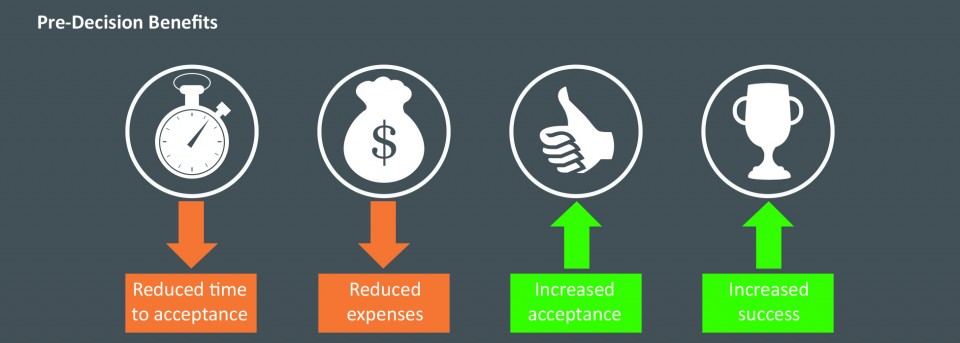
Benefits of utilizing pre-decision programs include reduced time to acceptance, reduced overall costs to the company, an increased acceptance rate, and an increase in successful assignments.

Because of how it engages relocation candidates and their families, increases assignment acceptance and success, and saves companies time and money, pre-decision best practices should be utilized when it comes to mobility management.

Learn more about how pre-decision programs can benefit both you and your transferees.


Categories
Corporate Relocation Global Mobility Global Relocation Global Relocation Tips Relocation Best Practices

Strategic Tax Reimbursement and Best Practices for Global Mobility

There are five steps you should employ when developing a global program for strategic tax reimbursement that balances the needs of both the company and employees with regard to managing tax costs:

  1. Strategically Align Company Objectives and Employee Values
  1. Consider Tax Impacts of Likely Host Locations
  1. Choose a Tax Reimbursement Method that Best Fits, for example:
  1. Tax Reimbursement Policy Design
  1. Tax Reimbursement Policy Launch & Implementation

By following the five-step process outlined, you can develop a global mobility program that keeps your company compliant, reduces tax burdens, and, by saving them money, demonstrates to your relocating employees how much you appreciate them. At Global Mobility Solution (GMS), we like to think that there is a sixth step – contacting an expert for help. Outsourcing your workforce mobility program provides an expert partner in relocation.

Workforce mobility consulting at Global Mobility Solutions means our consultants focus on reducing organizational costs and minimizing relocation timelines in order to increase assignment success. Our in depth consultation includes competitor benchmarking, policy analysis, and relocation evaluations.

Global Mobility Solutions will perform a full review of your existing policies, to ensure the goals of your organization are properly aligned with the policy. If necessary, we will write new or change existing relocation policies and coordinate the implementation of the changes. If no policy currently exists, GMS will work with you to determine what your relocation needs are and develop new policies that best fit them. Your dedicated account manager will advise and counsel you throughout the relationship to ensure your relocation policy is the most cost effective.

In order to reach an experienced relocation policy expert who can help your company plan for strategic tax reimbursement and best practices, please contact us now.

Categories
Corporate Relocation Corporate relocation tips Domestic Relocation Domestic Relocation Challenges Domestic Relocation Tips Global Mobility Global Relocation Global Relocation Challenges Relocation Challenges

5 Steps to a Successful Year-End Process

While most people are happily preparing for the holidays, you’re scrambling through the year-end reconciliation of all of your relocation expenses. Well, even though it’s only November, here is a gift that will help you not only navigate this year, but help you to have a successful year-end process for years to come.

Though many relocation managers might prefer battling crazed Black Friday crowds to year-end reporting, the process tends to go more smoothly when run by the relocation department. To maximize efficiency, be sure to utilize these five steps:

  1. Create a year-end checklist. A detailed checklist will help identify all of the information you need to accurately report year-end compensation. Your checklist should include due dates, responsible individuals and departments. Establishing the responsibility for reporting all of the relevant compensation data is an important component, and can include wages, imputed income, benefits, equity, taxes, and more. This year-end checklist will help you identify all the resources you will need to create a complete and accurate report. Your itemized checklist needs to include items such as early cutoff dates and all employees who will receive the tax filing services (employees on the tax eligibility list), as well as provide for the time needed for verification, approval and processing. A well-developed checklist will also set firm deadlines for the reporting and tax filings.
  1. Set up a year-end preparation call. When setting due dates, be cognizant of the vacation times made mandatory by some countries around the end of December. During the call, review your year-end checklist with all involved parties to ensure that they are aware of their role and due dates. Use this call as an opportunity to build understanding and develop relationships that will make year-end reporting easier in the future. If you have not already held a year-end preparation call, schedule one as soon as you finish reading the rest of this article!
  1. Verify all of your data! Accuracy is vital, especially when it comes to compensation reporting. Data such as addresses and tax ID numbers/Social Security numbers should be confirmed, as well as wages, benefits, sick and vacation time. Double-checking data prevents backtracking and costly errors down the line.
  1. Finalize your data. Make sure that the final payroll reports of the year have been included, plus any end-of-the-year benefits. Be sure to back up the program data again and be sure to save it in a secure location should it need to be referenced in the future.
  1. Get ready to submit your report. Double-check the deadlines for all the countries on your list and be prepared to provide specific data for each. Tax providers may ask for data for different assignee/transferee populations. Be sure to adhere to your year-end deadlines and, whenever possible, send the data ahead of time. Some international locations may have very tight turnaround times to make that final tax payment of the year.

As with anything, practice makes perfect. The more you follow these five steps, the easier year-end reporting will become for you and you can be confident of a successful year-end process.

Learn more about how to save time and money while managing your corporate relocations.

Categories
Corporate Relocation Domestic Relocation Global Relocation

3 Ways to Save with Global Mobility Programs

Save With Global Mobility Programs – The saying goes that it takes money to make money, and global mobility is no exception. Even though you understand that the talent you on-board or relocate will help your organization grow and prosper, getting the transferees from their origin to their destination locations can be expensive. Don’t be discouraged, there are several ways to save when creating your global mobility policies.


Use a tiered approach

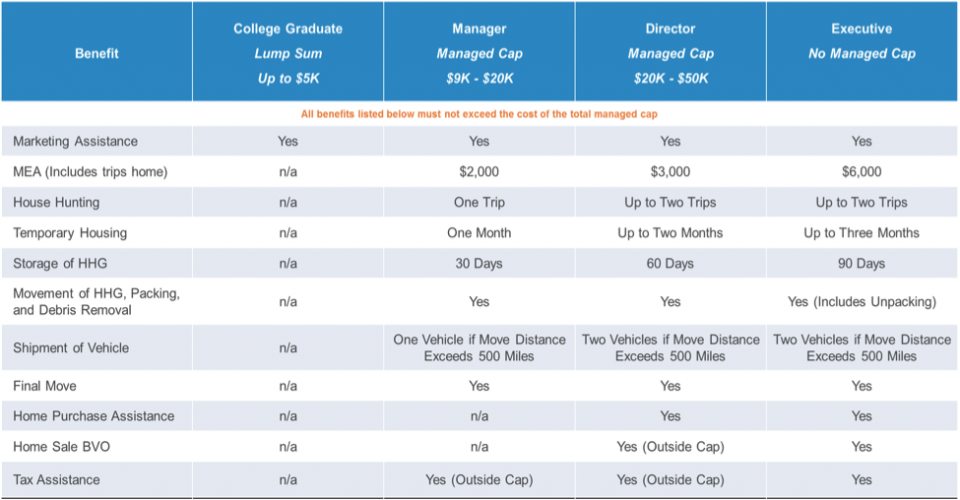
Not all employees are equal, therefore their relocation compensation shouldn’t be the same. It would make sense to pay the recent college graduate new hire substantially less than the amount awarded to a seasoned, executive-level employee. Additionally, not everyone requires the same amount of time to complete his or her move. Services can be tiered with regard to what they offer. For example, home-finding tours can be broken into half-day, one-day, or two-day options, then offered accordingly per your mobility policy. Tiered categories can be sorted by homeowners versus renters, or by how many school-age children a transferee has. Allowances for the shipping of household goods and vehicles can also be tiered based on the transferee’s position and distance to the destination location. It is very important to clearly state the various tiers in the company’s relocation policies. Tiered policies have been proven to reduce costs versus standard lump sum programs.

Below is an example of a tiered relocation policy based on position seniority:


Tiered-Policy-Sample global mobility programs


Bundle your services

As a company builds a relocation policy, it has many different services from which to choose – Pre-decision alone has over 30. By bundling various services together, such as home sale, household goods shipping, community tours, mortgage assistance, etc., companies can see significant savings. Typically, bundling can save companies up to 20% of what the services would cost individually.


Outsourcing

Lastly, by outsourcing mobility management needs to trusted, experienced, relocation experts, HR personnel can remain focused on department-specific tasks, such as enforcing company policies, finding new talent, and administering benefits and compensation. When expert mobility coaches guide transferees and their families through the relocation process, less calls are made to or by the human resources representatives. Generally, when working with a mobility management company, transferees arrive at their destinations happier, less stressed, and ready to work. In short, it saves sanity.


To learn more about the benefits of incorporating a mobility management company into your global mobility programs, please read Domestic Relocation Services and Global Relocation Services. You may also contact a GMS mobility specialist to get program details customized for your company’s specific needs.

Looking for something?