

Categories
Choosing a Relocation Company Global Mobility Global Relocation Tips Global Relocation Trends Relocation Management Talent Management

Common Employee Relocation Packages

A Look at Typical Relocation Packages

Relocation packages, also known as relocation benefits, are policies and support that companies offer employees transferring to a location for a position. Each company will have different needs when it comes to relocation benefits, and it can be challenging for companies to determine exactly what should be covered in these policies and what employees should be responsible for on their own. 

To ensure the selected applicant receives a strong and appealing offer, providing a comprehensive and competitive relocation package for relocating employees is highly advisable. When crafting a relocation package, companies typically consider several key components to make the transition as smooth as possible for their employees.

By offering a well-rounded relocation package, companies ease the transition for their employees and demonstrate their commitment to supporting their workforce. This can lead to increased employee satisfaction, decreased turnover, and a more positive company culture. As businesses continue to adapt to a global workforce, investing in comprehensive relocation benefits will remain a crucial strategy for attracting and retaining top talent.

Companies can typically tailor relocation programs to each hiring situation. Some companies choose to have their HR department handle employee transfers. Still, if the company wants to be consistent with its relocation packages on each hire, using a reliable relocation management company is probably a good idea.

What Does A Standard Relocation Package Include?

Most relocation policies outline some form of reimbursement or coverage for many of the everyday expenses associated with moving. Relocation benefits often include full packing and unpacking services and a quality and reliable moving company to get the employee’s household goods from point A to point B. 

In addition to moving expenses, home sale assistance is another common benefit offered to transferees. This can include selling programs that utilize vetted real estate agents specializing in relocation to help ensure a quicker and more prosperous home sale for the relocating employee. 

Specific policies might support employees who need to terminate their rental agreements prematurely, helping them manage any associated penalties. Additionally, the relocation package may encompass house-hunting trips. This implies that the employer could finance one or two visits for the relocating employee to explore their future neighborhood and inspect various houses or apartments before making a decision.

Corporate housing options, also known as temporary housing, are typically included in most relocation policies. This provides the employee with a temporary accommodation after they’ve relocated to find a permanent home in their new location, allowing them to start on their desired start date for the position without delay. 

Many companies also offer transportation coverage or reimbursement as part of their relocation packages. This might cover airfare for the employee and their family or expenses for driving across state lines. In some instances, companies may also cover the employee’s transportation costs for their vehicle.

What Expenses Are Typically Covered During Relocation?

While not an exhaustive list, the following are common relocation costs for which many companies provide support to their relocating employees:

  • Corporate housing options 
  • Household goods transportation (HHG)
  • Storage facility (temporary storage of the HHG shipment
  • Miscellaneous expense allowance
  • Home sale costs
  • Spousal employment assistance
  • Travel-related costs, such as airfare, meals, and hotel nights

As every company has different goals and objectives for its relocation program, many-tiered relocation policies offer various levels of support for each employee. 

Here is a breakdown of the most common U.S. domestic relocation policy tiers per GMS research:
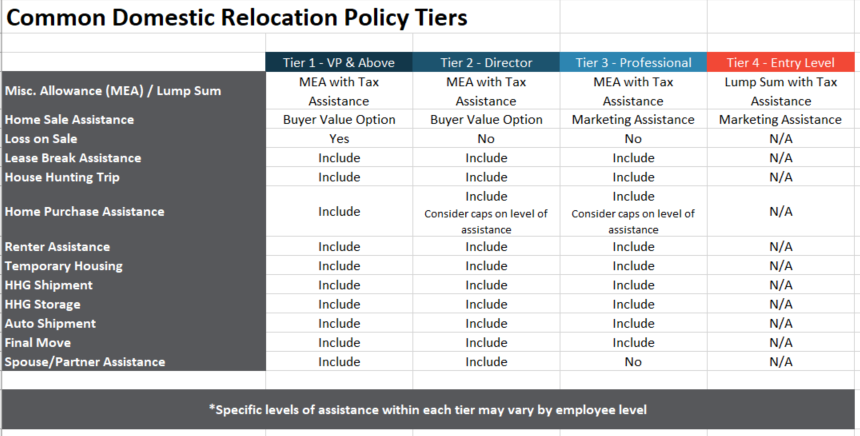
chart of relocation policy tiers

What Types Of Employees Receive Relocation Packages?

This aspect will depend upon the company’s need for each position and the importance of getting that employee to the new location. The best practice for relocation programs is to build a tiered system based on employee level. 

These tiers are commonly built around entry-level employees, professionals, directors, and vice presidents. Additionally, many companies offer executive relocation packages to cover the costs of relocation for most executive-level employees. Some companies may also provide international relocation packages for employees relocating globally.

Common Methods to Address Costs in Relocation Packages

Different policy tiers within your relocation program may require different strategies for covering your employee’s relocation costs. It is essential to understand the advantages and disadvantages of these standard methods.

Direct Billing: The relocation management company manages the procurement, organization, and direct payment to the service providers involved in your employee’s relocation. They review, combine, and forward the invoices to you for settlement. Although this approach may be pricier, it guarantees that your employee maximizes their benefits and reaches their new location promptly, alleviating any concerns about the expenses associated with the move. 

Expense Reimbursement: The employee pays for moving expenses upfront, and the company issues a reimbursement check at the end of the process. While not generally intended to cover an employee’s entire move (few families have the cash to pay tens of thousands of dollars for a move), reimbursements are commonly used for miscellaneous expenses as outlined in the company’s relocation policy. Typically, reimbursements are used for items such as travel costs or other related items.

Lump Sum: Unlike an expense reimbursement, a lump sum is commonly used as the primary financial benefit to a relocating employee. In a lump sum policy, a set amount of money is given upfront to the employee to handle the moving expenses as they see fit. 

Generally provided to entry-level or lower-level employees, the lump sum is typically the only relocation benefit offered. While the lump sum is seen as an excellent cost control tool for companies, it places additional burdens on employees, as they are left to manage their move independently. This is in addition to the lump sum, which is typically considered taxable income. Employees who receive their relocation benefits as a lump sum should note the payment for tax purposes. Employers should consider adding a tax gross-up to the lump sum to help mitigate the effects of the income tax on the employee’s benefit.

Ready to Set Up Relocation Packages for Employees?

Partnering with Global Mobility Solutions (GMS) ensures that your company offers comprehensive, cost-effective, and employee-centric relocation packages. GMS provides a tailored approach that aligns with your unique organizational needs, offering flexibility. This model allows you to select from a network of top-tier service providers or integrate your preferred partners, ensuring a customized experience for each relocation. Their expertise in managing all aspects of the relocation process—from pre-decision assessments to destination services—reduces risks, enhances employee satisfaction, and improves retention rates.

By leveraging GMS’s industry-leading MyRelocation® technology platform, your company can streamline relocation management, track expenses, and provide real-time support to transferees. This comprehensive support facilitates smoother transitions for employees and strengthens your employer brand by demonstrating a commitment to employee well-being. With over 30 years of experience and a global presence in over 140 countries, GMS has an expert team equipped to handle the complexities of workforce mobility, enabling your company to attract and retain top talent anywhere in the world.

We're Here to Help! Request a Courtesy Consultation

Are you ready to talk to a Mobility Pro? Learn how GMS can optimize your mobility program, enhance your policies to meet today’s unique challenges, receive an in-depth industry benchmark, or simply ask us a question. Your Mobility Pro will be in touch within 1 business day for a no-pressure, courtesy consultation.


Categories
Corporate Relocation Corporate relocation tips Domestic Relocation Domestic Relocation Challenges Domestic Relocation Tips Global Mobility Global Relocation Global Relocation Challenges Global Relocation Tips Household Goods Relocation Best Practices Relocation Challenges Relocation Management

Best Practices for Relocation: Multiple Bids for Household Goods Moves

Is your RMC helping keep relocation costs in check by taking multiple bids?

It is no secret that competition leads to various benefits, including significant savings for the end user. We have seen the opposite when a company monopolizes a product. Having one choice has never worked out well for consumers. The same applies to corporate relocation and household goods moves.

Many relocation management companies (RMCs) are either owned by or affiliated with van line companies. Therefore, when a client company wants to move its employees, the employees do not have a choice of van lines. The RMC and the van line know that the transferee is at their mercy concerning price, scheduling, and customer service.

However, some RMCs use a multiple-bid process to ensure that transferees get the best price and service. There are some significant benefits to having van lines compete for the relocation business:

  • It encourages the providers to “sharpen their pencils” to provide the lowest reasonable cost
  • It ensures adherence to a company’s relocation policy guidelines
  • It is a way to eliminate any service day surprises

This is all accomplished by having at least two carriers meet with the transferee to create estimates based on the amount that needs to be moved, what requires special handling, and where it needs to be relocated. Then, the RMC audits the estimates to look for inconsistencies, for example:

  • Do the pickup and delivery dates correspond with the move?
  • Does one company estimate more crates than another?
  • Does one company show specialty items that the other company may have missed?
  • How close are the estimated prices?
  • Auditing the bids ensures an apples-to-apples understanding of the van line options and helps weed out potential overages.

    Every carrier knows that its goal is to secure the business. As a result, it offers honest and precise quotes without extra costs. Several relocation policies involving moving companies also come with a maximum estimate guarantee. This helps ensure the relocation process follows industry standards and offers the most suitable solution.

Companies that utilize a multiple-bid process save an average of $1,547 per move! This breaks down to an average of $1,473 to $1,604 for household goods movement and $175 to $289 for car shipments per move.

Although cost is necessary, the experience of the person being transferred is also crucial. Allowing them to meet with various moving companies will help them feel more involved in the moving process. Sometimes, the person being transferred can select the moving company they prefer. 

Even if an estimate is slightly higher than another, if it falls within a certain percentage (based on the client company’s relocation policy) of the lower bid, a transferee may select the more expensive carrier if he or she feels more comfortable with that specific household goods mover. This promotes an overall positive experience because transferees are happier when they think they are heard throughout the relocation process. We all know that happy employees are more productive.

GMS Can Help Companies Save

Global Mobility Solutions (GMS) was the first to introduce the “Freedom of Choice” approach in relocation services. By implementing industry best practices and offering various options from different providers, GMC has helped client companies and their employees reduce costs for services such as moving household goods and obtaining mortgages. GMS is dedicated to creating innovative workforce mobility programs to simplify and enhance the relocation process for clients and their staff.

This innovative method reduces business costs and provides employees with greater autonomy and flexibility during their relocation. By empowering employees to select the services that best suit them, GMS ensures that each person feels appreciated and supported throughout the relocation process. This personalized strategy results in a seamless employee transition and a more streamlined company relocation process. With GMS at the helm of forward-thinking workforce mobility initiatives, businesses can save costs while ensuring employees enjoy a positive and hassle-free relocation journey.

Ready to Calculate YOur Program Savings? Request Access Now!

Are you ready to calculate your potential relocation program savings? Request access to our easy-to-use Relocation Cost Savings Calculator. Your Mobility Pro will grant your access request within 1 business day.

Categories
Corporate relocation tips Domestic Relocation Domestic Relocation Challenges Domestic Relocation Tips Global Relocation Tips Global Relocation Trends Relocation Best Practices Relocation Management

How Often is the Core-Flex Approach Used in Global Mobility?

GMS Breaks Down Everything You Need to Know about Core-Flex Relocation Packages

When moving for a new job, a company may provide relocation assistance to assist the employee with moving costs and make the moving process easier. Typically, larger companies will offer various relocation packages tailored to the employee’s position, the scope of the move, and whether family members are involved. One type of relocation policy that is gaining popularity among companies is the core-flex model. Core-flex relocation policies comprise a core section offering essential relocation benefits, along with a selection of flexible, optional benefits that can be chosen based on the employee’s specific needs.

Core-flex relocation programs do not grant employees complete freedom regarding moving costs, unlike typical lump-sum global mobility packages. However, core-flex options eliminate stress associated with relocating employees, such as the hassle of hiring suppliers, service quality issues, expenses, and tax overruns.

Are Core-Flex Relocation Packages Common?

Traditional and capped programs are commonly used in corporate relocation. Still, core-flex policies have become increasingly popular for their flexibility in meeting the varied needs of transferees while controlling costs. A recent benchmarking study and survey of transferees’ satisfaction with different programs revealed that traditional policies were the most satisfying, followed by capped and core-flex policies. Transferees who received a lump sum were the least satisfied. This highlights the importance of offering a range of options to accommodate the diverse needs of relocated employees.

Companies must prioritize the satisfaction of transferees during their relocation process. Happy transferees experience less stress during the transition and are more productive in their new location. Companies can expect improved critical thinking, problem-solving abilities, and reduced errors by ensuring transferees are content. Providing a relocation policy that meets the needs of transferees is the first step in achieving their satisfaction and success in the new location.

What Are Some Common Relocation Benefits?

A core-flex policy typically includes:

Core Benefits – All transferees are offered a comprehensive package of necessary benefits to support their move, including a Miscellaneous Expense Allowance (MEA), temporary accommodation, household goods shipping, and travel for the final move.

Flexible Benefits—Transferees can select from a range of benefits that suit their specific requirements and situations. These benefits may cover expenses such as a trip to find a new house, early lease termination, financial aid for renting at their new location, buying or selling a home, relocating pets and vehicles, storing household goods, and supporting spouses.

Does A Core-Flex Package Help or Burden the Relocation Process?

Companies can effectively control and forecast relocation costs by offering a combination of standard and personalized benefits. Core-flex policies aim to balance managing expenses and give employees the freedom to select benefits that suit their individual needs. Tailored support offerings can enhance the relocation process and boost employee retention rates.

By offering a core-flex package, companies can cater to the individual needs of their employees during the relocation process. This helps reduce the stress and burden associated with relocating to a new location, ensuring that employees feel supported and valued by their employers. The flexibility provided by core-flex policies allows employees to make choices that align with their specific circumstances, ultimately leading to a smoother transition and a more positive relocation experience. In the long run, this can contribute to higher employee satisfaction and retention rates, benefiting both the employee and the company. Overall, a core-flex package can be valuable in streamlining the relocation process and ensuring a successful outcome for all parties involved.

Categories
Buy a Home Global Mobility Home Purchase Relocation Best Practices

What to Do When Corporate Housing Prices Are Too High

Looking at Short-term Housing Options

Corporate housing, also referred to as temporary housing, is a common benefit included in relocation policies. Corporate housing is a short-term housing option for transferees who might not have an established home available in their new destination. Typically available in 14-, 30-, 60-, or 90-day increments, temporary housing provides a transitional period for those relocating to a new location. Most temporary housing units come fully furnished, with kitchenettes, and are pet-friendly. 

Corporate housing may seem straightforward: a company covers temporary accommodations for employees while their permanent living arrangements are being sorted out. But what if finding long-term housing takes longer than anticipated? Or if the cost of corporate housing in the new location is significantly higher than budgeted? Are employees left to fend for themselves in finding a place to live?

While the specific answers to these questions will depend on the company’s relocation policies, many transferees may ask about Airbnb, VRBO, and other short-term rental options. Some companies may approve this idea and offer reimbursement packages for short-term rentals to employees who are relocating. However, there are some downsides to consider for companies that allow their employees these options, rather than covering the expenses for corporate housing. Those temporary housing options don’t offer the same coverage and come with more risk.  Additionally, it could ultimately result in the company incurring more expenses in the long run. Here is a breakdown of why the use of Airbnb and VRBO could potentially backfire on companies relocating their employees.

Potential Overpayment

When working with a relocation consultant on policies for transferring employees, corporate housing pricing is typically broken down to a per-employee, per-night basis. When third-party solutions are used (like Airbnb), and employees are allowed to seek their short-term housing options, many companies provide a predetermined amount of support. The amount provided may exceed the level of support needed by the employee for suitable accommodations, leading to overpayment by the company. In the end, the company might not be getting as good of a deal as it could be. 

In this scenario, the company could find that employees are pocketing the difference between their temporary housing allowance and the actual cost of accommodations. If an employee sees in the relocation policy that they qualify for a $X amount of benefits, then they can book something cheaper but still claim the entire amount and retain the balance. 

This type of support may also put some employees in tougher spots than others when it comes to finding affordable options. The flat level of support provided may not be enough to cover the cost of reasonable temporary living accommodations.

On the other hand, if your relocation program has corporate housing units that have been pre-selected and pre-approved, your expenses will be easier to anticipate, and you can ensure that you are offering the appropriate level of assistance to your transferees.

Billing Could Become a Nightmare

Companies that allow employees to use their relocation benefits for their housing could also end up in a billing nightmare. Many companies’ policies are not written to address the unique challenges that come with employees booking their accommodations through third-party housing providers. Without established limits and a streamlined expense reimbursement policy, an HR or accounting team may need to process numerous third-party vendors who utilize different billing methods. This could also result in the accounting department having to spend more time cutting reimbursement checks to each employee. 

One solution to address this issue is to have employees use company-approved corporate housing units that already have a direct billing arrangement in place. This ensures a more streamlined program when relocation specialists are already knowledgeable about the temporary housing options available.

Risk Considerations and Lack of Quality Control

Companies need their employees to have sufficient housing accommodations while relocating and starting their new positions. Allowing individual employees to book their third-party housing might expose them and your company to unnecessary risk. If an employee uses Airbnb or another company’s rental, there is no guarantee that the living accommodations will be clean, safe, or reparable at any given moment. 

For example, with a corporate housing apartment, if something were to go wrong, the company would have an established contract with the corporate housing company that covers items such as repairs. This provides for timely repairs or the replacement of malfunctioning equipment as soon as possible. With a third-party rental that the employee chooses, there is no way for your company to guarantee timely repairs or replacements contractually. This places more risk on the employee and your organization and is not likely to be covered in the employee’s relocation policy. The last thing a transferee needs to deal with while relocating for a company is the issue of where they are staying.

Additional examples of risk exposure that may arise through the use of vacation-style rentals include:

  • Property safety inspections
  • Lack of appropriate safety equipment (such as door/window locks and fire extinguishers)
  • No safety plans for documents in the event of a fire or natural disaster
  • Challenges around property insurance

Lastly, with third-party rentals, there may be little to no established check-in process. This can lead to complaints related to customer service or quality, as employees might be left scrambling if the check-in process goes awry. If the employee shows up at the rental unit and the unit is not sufficient, or they are told it is no longer available, it will put the employee in a challenging situation where they are left to their own devices.

The workaround for this pain point is to have transferees utilize corporate housing units approved by the company, where a predictable direct billing relationship already exists. Additionally, a more consistently applied program is made possible when the relocation specialists working with your transferees are already familiar with your temporary housing providers.

GMS Can Provide Your Employees With Suitable Corporate Housing

Airbnb and other rental companies like it are an excellent option for those seeking a vacation.  However, for companies that relocate multiple people annually for business purposes, this might not be the best option. Working with a qualified corporate relocation company, such as GMS, policies can be implemented to ensure your employees have suitable temporary housing units ready for them upon arrival in their new town or city. Contact us today online if you are prepared to start looking at corporate housing solutions for your relocation program or have any questions about temporary housing for your relocating employees.

We're Here to Help! Request a Courtesy Consultation

Are you ready to talk to a Mobility Pro? Learn how GMS can optimize your mobility program, enhance your policies to meet today’s unique challenges, receive an in-depth industry benchmark, or simply ask us a question. Your Mobility Pro will be in touch within 1 business day for a no-pressure, courtesy consultation.

Looking for something?