

Categories
Relocation Challenges Relocation Management Relocation Policy Review Talent Management Talent Mobility

Top 5 Healthcare Industry Recruiting and Relocation Trends

The Healthcare Industry has been growing at an increasing pace over the past several years. Factors such as the implementation of the Affordable Care Act, an aging population, and technological advances all contribute to the ever-expanding demand for qualified healthcare employees. The US Bureau of Labor Statistics predicts that Healthcare will be the largest employment sector in the US economy by 2024.

Growth in the healthcare industry presents a number of difficulties for HR professionals. Filling positions quickly and effectively, creating a workplace that encourages employee engagement, ensuring smooth succession processes, and reducing employee turnover are some of these seemingly insurmountable challenges.

Increasing Retirement Rates

In addition to greater demand for services, the industry is facing rapidly increasing retirement rates for experienced employees. Especially in the nursing field, the impact of retirement will have a large impact on staffing levels. At least 55% of the RN workforce is over the age of 50 and quickly approaching retirement age. According to an American Association of the Colleges of Nursing (AACN) summary of reports, there will be a growing shortage of registered nurses across the country between 2009 and 2030. By 2025 the US is expected to experience a nursing shortage “twice as large as any nursing shortage experienced in this country since the mid-1960s” with the rapidly aging nursing workforce as the primary contributor.

The combination of increasing demand for employees and increasing rates of retirement creates an ever-widening talent gap in the healthcare industry. There are not enough employees to occupy new positions, nor are there enough employees to backfill positions that open due to retirement. As a result, at least 33% of hospitals have job vacancy rates greater than 10%. Clearly, traditional healthcare recruiting strategies are not able to fill positions at a fast enough pace to keep up with demand.

As a result of these changes, the following five trends in healthcare industry recruiting and relocation are emerging:

Top 5 Healthcare Industry Recruiting and Relocation Trends

1. Provide Exceptional Candidate Experiences

Healthcare industry recruiters must focus on keeping candidates happy and engaged in the recruitment process. Providing each candidate an exceptional experience is necessary to keep your organization as the candidate’s first choice in their employment search. The organization should conduct a review of the entire candidate experience, including the application process, interviews, job offers, relocation benefits, and onboarding procedures.

HR professionals should put themselves through each of these processes to see how their organization treats and responds to candidates. Successful recruiting programs treat candidates respectfully and make them feel highly valued. Candidates are more likely to choose to work for an employer that treats them well.

2. Use Data to Enhance Healthcare Industry Recruiting

Healthcare organizations must analyze the effectiveness of their recruiting activities. Knowing which efforts are working well, and which efforts are not, will help the organization identify what it needs to improve. For example, an organization may have a job advertising program in place within a journal or news network. If these programs are not providing qualified candidates that proceed to job offers and acceptances, the organization should consider redirecting those resources.

Conversely, if a partnership with a local university proves to be a good source of qualified candidates that proceed to employment, consider enhancing the program or creating additional partnerships. Think beyond current geographical boundaries; partnerships can easily generate candidate interest within international locales. Relocation Management Companies (RMCs) are ideal sources for information on global candidate recruitment and relocation.

3. Recruit for Cultural Fit

Healthcare organizations searching for qualified employees may be able to easily identify those with the requisite skills, education, and experience. However, healthcare is a unique industry in that it is so highly focused on personal interactions. Healthcare organizations looking to fill job vacancies at a pediatric practice would want candidates who enjoy working with children.

Pre-Decision Services are critical for healthcare organizations as they provide valuable information about a candidate’s ability to accept a position and be successful. Behavioral assessments can be a strong predictor for cultural fit. Healthcare organizations can easily identify candidates with the qualities that match their organizational culture. Assessment data can be paired with structured interview questions to better understand the candidate’s interests, goals, and motivations.

4. Create a Superior Healthcare Industry Employer Brand

Highly-skilled healthcare workers are in great demand. As a result, these workers can easily choose where they want to work and for which organization they prefer. Seventy-five percent of employees seeking new jobs consider an employer’s brand before applying for open positions. Consider how your healthcare organization’s brand appears to job seekers. Does it generate positive industry news? Are online reviews favorable from current employees as well as current customers? If the employer brand you find does not fill you with positive feelings, then you can be sure candidates are also experiencing this same feeling.

To create a successful employer brand and generate positive feeling among job seekers, healthcare organizations should find out from current employees whether the organization is one where people want to work. Also, research comments from employees and candidates on review websites and social media. Determine which issues are of concern and address them. This will help you ensure employees will perceive your organization as the brand you prefer it to be. Follow through by updating recruiting materials, websites, social media, job postings, emails, and other venues to be sure you amplify the correct employer brand and messages. Consider creating a branded career website with enhanced relocation program messages to welcome candidates to your organization.

5. Speed the Process to Keep Candidates Engaged

Qualified candidates are always seeking new opportunities, and your organization is always looking to hire. The quicker you help candidates move through the process, the more they will remain engaged and likely to consider your organization for employment.

According to the 2018 Recruiting Benchmark Report from Jobvite, the time to fill job vacancies in the healthcare industry is 38 days. At the same time, the industry has 21 applications per job, which is one of the lowest among industries. If several days or even weeks can be taken out of the process, the organization will benefit tremendously and experience lower job vacancy rates.

Conclusion

GMS’ team of corporate relocation experts have helped thousands of our clients develop relocation programs that attract and retain qualified employees. Our team can help your healthcare company by designing a relocation program that represents industry best practices. This will increase your company’s ability to attract and retain new employees.

GMS was the first relocation company to register as a “.com.” The company also created the first online interactive tools and calculators, and revolutionized the entire relocation industry. GMS continues to set the industry pace as the pioneer in innovation and technology solutions with its proprietary MyRelocation® technology platform.

Global Mobility Solutions is proud to be named and ranked #1 Overall, and #1 in Quality of Service by HRO Today’s 2019 Baker’s Dozen Customer Satisfaction Survey.

Contact our experts online to discuss your healthcare company’s relocation program needs, or give us a call at 800.617.1904 or 480.922.0700 today.


Request your complimentary relocation policy review

Categories
Domestic Relocation Global Relocation Relocation Management Relocation Technology

How to Choose Relocation Technology

There are many points to consider when it comes time to choose relocation technology for your company and transferees. The choice should provide information that is useful to companies for managing the relocation process, and be easy to use for transferees as they go through their relocation.

A good way to start determining how to choose relocation technology is to examine what is most important to departments that need information from the solution. Talk to internal stakeholders and document their most pressing data needs. Keep track of the topics and then create a chart to see if multiple departments have similar data needs. This is similar to creating a gap analysis, and will provide clarity and identity areas in need of attention.

With the gap analysis in hand, you can easily determine the parameters a relocation technology should provide. At a minimum, you should choose relocation technology that will provide the following:

Reports and Processes

  1. A full range of customizable reports to give all stakeholders information they need

Look for a relocation technology that provides advanced financial reporting and the ability to create custom reports on demand. Stakeholders will be able to design reports that provide the exact information they need to manage the process, whether it is expense accounting, benefit administration, or location-specific reporting for international residency compliance.

  1. Easy to use processes for transferees to access helpful information and report expenses

Choose relocation technology that has a good user interface. The interface should have easy to find options and menu choices that are quickly and easily understandable. Transferees on the go should be able to submit expenses quickly and anticipate fast reimbursements with a solution that has a built-in approval process.

Integration and Scalability

  1. Integration into company systems such as payroll and benefits

Relocation technology should be easily integrated into company systems to eliminate duplication of information and non-value added processes such as data rekeying. An integrated solution will utilize the same company data sources so information is based on company records and is instantly updated when company data is updated.

  1. Scalability so as your company grows, the solution can easily grow with your relocation program

A relocation technology should be scalable so you can add new transferees as needed. As your company grows, the relocation technology should accept new initiations easily and quickly. It should also have the ability to access resources and information on a global basis. This ensures that as your company’s needs and locations change, information is readily available to help transferees.

Security and Platform-Neutral

  1. Choose relocation technology with full data security and compliance

Any relocation technology must provide full data security and compliance to ensure the safe transmission of information. Look for a solution that provides encryption during use and controlled access. This ensures company and transferee information cannot be accessed, viewed, or compromised. The solution provider should have a publicized privacy policy. Their privacy policy should clearly define their responsibilities and the actions undertaken to ensure data security.

  1. A platform-neutral solution so users can access the technology from any device, anywhere

Choose relocation technology that is fully platform-neutral. This allows users to access the solution at a desktop, a tablet, a mobile phone, or a laptop without losing any functionality. This ensures users have the most flexibility in how they access the technology.

Conclusion

When you identify each stakeholder’s important parameters, you can easily choose relocation technology by identifying if the solution meets the minimum provisions noted above. The corporate relocation experts at Global Mobility Solutions (GMS) understand relocation technology and can help your company find a robust solution that not only meets identified parameters, but exceeds your expectations for functionality, service, and flexibility.

Contact our team of experts to discuss how we can help you choose relocation technology that provides everything your company and transferees need, or call us directly at 800.617.1904 or 480.922.0700 today.

Request a relocation technology demo

Categories
Domestic Relocation Domestic Relocation Tips Relocation Best Practices Relocation Management

What are the Top 3 Business Relocation Budget Tips?

With today’s digitally-driven business landscape, your business relocation budget might include relocating an operational arm or corporate headquarters to a different region. For some companies, it makes economic sense to move employees to other parts of the country or globe. However, although these moves often have the intention of boosting bottom-line revenue, relocation costs can add up quickly.

Keeping that in mind, here are the top three business relocation tips you can use to help save on corporate relocation budgets:

Get Estimates from Multiple Providers

Assuming that a business has already chosen a new market and a new office space, the logistical aspects of moving now come into play. Moving offices and employees is a massive undertaking, and it is important for a business to get the most value from the relocation. Obtain multiple estimates from reputable firms and determine the best option that fits your business relocation budget. Rates can often be negotiable; a Relocation Management Company that has experts in group move coordination on staff can leverage volume for better rates with van lines.

Understand Your Rights

The U.S. Department of Transportation’s Federal Motor Carrier Safety Administration outlines a number of rights and responsibilities that businesses are entitled to before, during and after their relocation. For instance, a van line must move a client’s belongings in a timely manner. The moving company must provide a written record called a reasonable dispatch service, and if there is a delay, the company must then prepare a written record of its amended date for delivery. Since your business relocation budget requires adherence to cost guidelines, it is important for companies to ensure the entire logistical process runs smoothly.

Work with a Relocation Management Company

Choose a Relocation Management Company that has expert knowledge and extensive experience in corporate relocation services. Corporate relocation programs provide companies and employees all of the resources and tools they need to ensure a smooth and successful relocation process, and to keep your business relocation budget within guidelines. Look for a company that provides ongoing employee support services, supplier management, relocation benefits, and expense management. Since your employees will be moving to the new location, you should be sure to provide a wealth of resources for them and their families so they feel confident in accepting their new assignments and enthusiastic about the company’s relocation.

Conclusion

The corporate relocation experts at Global Mobility Solutions (GMS) have the knowledge and expertise to help your company manage its business relocation budget and offer your employees the best relocation experience. Contact our team of experts to discuss how we can help your company’s business relocation budget stay within company guidelines, or call us directly at 800.617.1904 or 480.922.0700 today.

Categories
Choosing a Relocation Company Corporate Relocation Corporate relocation tips Domestic Relocation Domestic Relocation Tips Global Relocation Relocation Best Practices Relocation Management

Top 5 Reasons for Expedited Bidding

What is Expedited Bidding?

The Expedited Bidding Process (EBP) is not an abbreviated approach. It is a request for proposal (RFP) that, like a traditional RFP, demands complete and detailed answers from relocation management companies (RMC). However, through expedited bidding, a company’s purchasing department only sends RFPs to a small, select group of key RMCs.

The trend in utilizing an EBP for the outsourcing of relocation management is at an all-time high. Global Mobility Solutions consulting team’s recent study shows that EBP utilization is up more than 200% over the last year. Why are so many companies turning to expedited bidding when looking for a mobility management solution?

Buying Solutions, Not Widgets
Purchasing relocation management is not like sourcing for parts. Ensuring the right fit for the right reasons is key when purchasing employee-facing services.

Courtesy Mobility Consulting
Policy reviews, recommendations, program design, and policy development can be part of the process. This allows for an evaluation of the RMC experience, knowledge, and quality of consulting work.

Immediate Cost Savings
Competition often equates to implicit cost savings through no fee implementation, less administrative burden and time investment, improved fee structures, and reduced direct costs.

Quicker Program Implementation
90% of EBP implementations are completed within 22 days, allowing for immediate efficiencies and realized savings.

Full RFP Avoidance
Eliminates the administrative burden for the purchasing department and reduces the need for extensive resources when compared to a formal Request for Proposal method.

Modern Mobility Made Easy™

What this means for you and your relocating employees

The Global Mobility Solutions benchmarking study shows that companies utilizing an expedited bidding process achieve savings up to 61% over typical RFP costs. Expedited bidding is one of many ways that Global Mobility Solutions recommends to make choosing an RMC fast, easy, and cost-effective. Before you send your next RFP, Download the 28 Critical Questions to ask an RMC. For more information on EBPs, and to learn more about Global Mobility Solutions’ corporate relocation programs, contact us online or give us a call at 800.617.1904 today.

Download the 28 Critical Questions to ask an RMC when submitting an RFP

Categories
Corporate relocation tips Domestic Relocation Domestic Relocation Tips Global Mobility Global Relocation Global Relocation Tips Relocation Best Practices Relocation Management

5 Easy Steps for Year-End Relocation Expense Reporting

While most people are busy preparing for the holidays, you’re scrambling through the year-end reconciliation of your relocation expense data. Well, even though it’s only November, here is a gift that will help you navigate your year-end process this year and for years to come.

Though many relocation managers might prefer holiday gift shopping to year-end reporting, the process tends to go more smoothly when run by the relocation department. To maximize efficiency, be sure to follow these five steps:

1. Checklist

Create a year-end checklist. A detailed checklist will identify the information you need to accurately report year-end compensation. Your checklist should include due dates, responsible individuals, and departments. Establishing the responsibility for reporting relevant compensation data is critical and may include several components such as wages, imputed income, benefits, equity, and taxes. This year-end checklist will help you identify all the resources you need to create a complete and accurate report. Your itemized checklist should include items such as early cutoff dates, all employees who will receive the tax filing services (employees on the tax eligibility list), and provide for the time needed for verification, approval, and processing. A well-developed checklist will also set firm deadlines for reporting and tax filings.

2. Preparation Call

Set up a year-end preparation call. When setting due dates, remember the mandatory vacation times required by some countries toward the end of December. During the call, review your year-end checklist with all involved parties to ensure they are aware of their role and deadlines. Use this call as an opportunity to build understanding and develop relationships that will make year-end reporting easier in the future. If you have not already held a year-end preparation call, schedule one as soon as you finish reading the rest of this article!

3. Verify Data

Verify all of your data. Accuracy is vital, especially for compensation reporting. Data such as addresses and tax ID numbers/Social Security numbers should be confirmed, as well as wages, benefits, sick days, and vacation time. Verifying relocation expense data eliminates backtracking and costly errors.

4. Finalize Data

Finalize your relocation expense data. Make sure that the final payroll reports of the year have been included, plus any end-of-the-year benefits. Be sure to back up the program data again and save it in a secure location for easy future reference.

5. Submit Report

Get ready to submit your report. Double-check the deadlines for all the countries on your list and be prepared to provide specific data for each country. Tax providers may ask for data for different assignee/transferee populations. Be sure to adhere to your year-end deadlines and, whenever possible, send the data ahead of time. Some international locations may have very tight turnaround times to make that final tax payment of the year.

Modern Mobility Made Easy™

What this means for you and your relocating employees

As with anything, practice makes perfect. The more you follow these five steps, the easier your year-end reporting will become. Global Mobility Solutions – a leader in mobility management since 1987 – has expert relocation consultants who can help you quickly implement relocation policies custom-tailored for your needs, as well as expense reporting to make your year-end reconciliation easier. Request a professional audit of your year-end process.

Request your complimentary relocation program audit

Categories
Corporate Relocation Corporate relocation tips Domestic Relocation Tips Domestic Relocation Global Mobility Global Relocation Global Relocation Tips Relocation Management Relocation Best Practices

The Real Truth: Managed Cap vs. Lump Sum

Managed Cap vs Lump Sum – Key Things You Need to Consider As a mobility manager, lump sum payments might seem like the fastest and easiest method of providing your employees with the funds they need to move. However, when looking at managed cap vs lump sum, lump sum payments come with their own unique set of problems. Some of the challenges include:
  • Transferees often left alone in the relocation process
  • No cost controls and often budgetary overages
  • Limited process or service structure
  • Non-taxable benefits are lost
  • Frustrated transferees mean elevated HR involvement and escalations
Fortunately, a managed cap program alleviates many of the problems associated with a lump sum. It also provides:
  • The desired simplicity and predictability of a lump sum program
  • Enhanced employee tax benefits, resulting in more dollars for relocation.
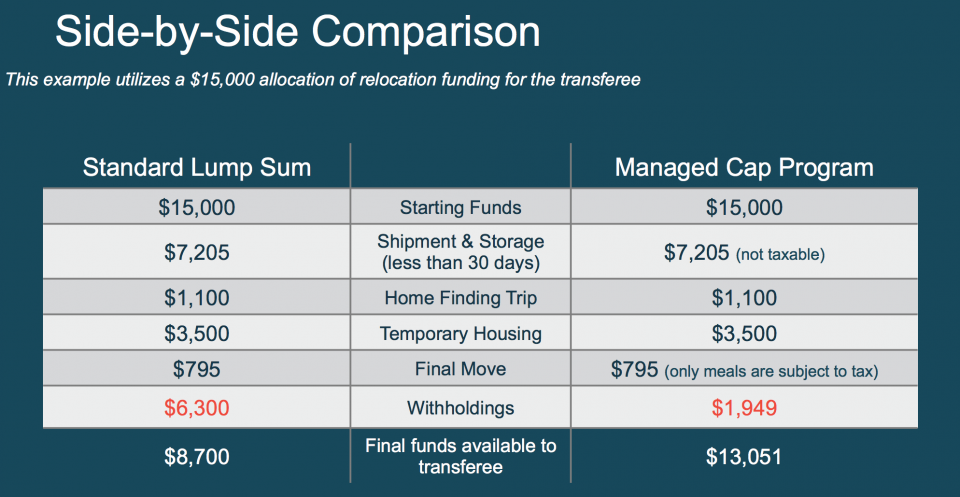
Let’s see the difference between a $15,000 lump sum payment and the same $15,000 from a managed cap program: GMS-Managed-Cap-vs-Lump-Sum-Chart

A Winning Scenario

The Managed Cap Program provides the transferee with $4,351 more for relocation services!


Modern Mobility Made Easy™

What this means for you and your relocating employees

A Managed Cap program will ensure that your transferees get the most out of their relocation dollars and that you will reduce the amount of administrative burden dealing with exceptions. Global Mobility Solutions – a leader in mobility management since 1987 – has expert relocation consultants who understand how a Managed Cap program can benefit you and your company. Contact Global Mobility Solutions and learn how we can quickly implement a managed cap program custom-tailored for your needs. Request-a-Demo
Categories
Corporate Relocation Corporate relocation tips Domestic Relocation Domestic Relocation Challenges Domestic Relocation Tips Global Mobility Global Relocation Global Relocation Challenges Global Relocation Tips Relocation Best Practices Relocation Challenges Relocation Management

Managing Mobility Costs

Department heads all over the globe are constantly asked to identify cost-saving opportunities within their departments. Human resources, employee mobility, talent acquisition, and procurement are no exceptions. As you scrutinize your budget, try utilizing these three steps to help better manage and ultimately reduce your relocation expenses:

Cost Estimates

Managing mobility costs starts with understanding what those expenses are. First estimate what costs should be involved with your vision of a successful mobility program. A cost estimate will provide you with a clear picture of the potential costs of individual relocation assignments. You can then use these cost estimates to correctly establish a budget prior to initiating any relocations.

One effective way to determine your cost estimates is by utilizing cost estimate technology. There are many software programs that by using the latest upgrades will help you:

  • Save time
  • Reduce human error
  • Ensure compliance

Policy Reviews

By reviewing your relocation policies, either internally or with an outside relocation management company (RMC), you will be able to identify cost-saving opportunities and eliminate expensive exceptions. When reviewing your mobility management policies, you should:

  • Do so in conjunction with cost
  • Benchmark against other companies within your industry
  • Leverage technology for key services (i.e. Virtual destination tours, online school reports, etc.)

Example:

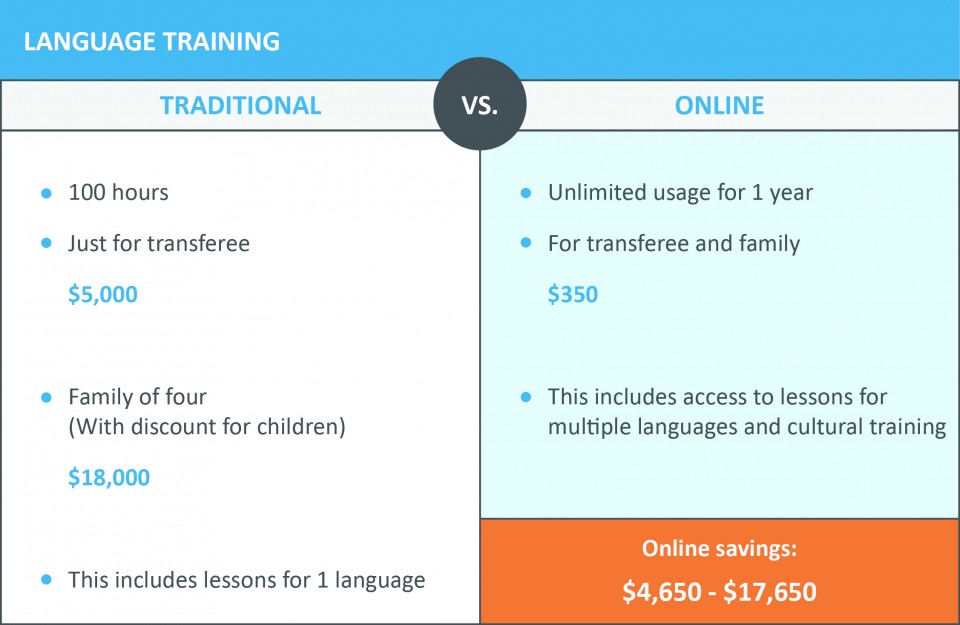
Using online language tools can reduce relocation costs by roughly $5,000 - $20,000.

Tracking and Reporting

Lastly, you want to ensure that you are continuously tracking all expenses and reporting any overages or savings. Get a detailed account of how your cost estimates match up with your actual spending. Then the whole process repeats itself. Once you have your data:

  • Take action – Make any necessary adjustments to your budget, policy, or both
  • Review – Go over the detailed reports to identify more cost-saving opportunities
  • Incorporate technology – Save time and money by offering key services online

Global Mobility Solutions (GMS) is an award-winning RMC and, since 1987, has been helping companies save time and money with regard to their corporate relocations. As a courtesy service, GMS will review your current relocation policies and provide expert feedback to ensure that your policies are competitive within your industry and to identify any cost-saving opportunities, so you can focus on managing mobility costs.

Click here for your free relocation policy review

Categories
Corporate Relocation Domestic Relocation Domestic Relocation Tips Domestic Relocation Trends Global Mobility Global Relocation Global Relocation Tips Global Relocation Trends Relocation Best Practices

Why Benchmark?

Relocations can generate a lot of excitement as companies eye the potential for increased revenue, organizational growth, and the development of their employees. It is important for those managing workforce mobility to know if their company’s relocation policies make sense in today’s evolving, global business environment. It is critical for all the stakeholders in employee relocation – talent acquisition, human resources, procurement, finance, legal, etc. – to fully understand the best practices to ensure that their policies are competitive, compliant, and effective.

Here are the top 5 reasons you should be reviewing your relocation program and policies:

  • To ensure competitiveness within your industry in order to attract and retain the best talent
  • To identify enhancement and cost-saving opportunities (i.e. process, service cost, exception reduction, etc.)
  • To maintain alignment with your overall mobility objectives across key disciplines
  • To educate internal stakeholders on current best practices and trends
  • To learn about innovative ideas for managing a changing workforce mobility environment

Policy Benchmarking Options

A best practice across all industries is to conduct program and policy reviews every 12 to 18 months, depending on an individual company’s relocation volume, size, and scale of programming. You can receive expert guidance and award-winning service by submitting a request for contact.

Categories
Corporate Relocation Corporate relocation tips Domestic Relocation Domestic Relocation Challenges Domestic Relocation Tips Global Mobility Global Relocation Global Relocation Challenges Relocation Challenges

5 Steps to a Successful Year-End Process

While most people are happily preparing for the holidays, you’re scrambling through the year-end reconciliation of all of your relocation expenses. Well, even though it’s only November, here is a gift that will help you not only navigate this year, but help you to have a successful year-end process for years to come.

Though many relocation managers might prefer battling crazed Black Friday crowds to year-end reporting, the process tends to go more smoothly when run by the relocation department. To maximize efficiency, be sure to utilize these five steps:

  1. Create a year-end checklist. A detailed checklist will help identify all of the information you need to accurately report year-end compensation. Your checklist should include due dates, responsible individuals and departments. Establishing the responsibility for reporting all of the relevant compensation data is an important component, and can include wages, imputed income, benefits, equity, taxes, and more. This year-end checklist will help you identify all the resources you will need to create a complete and accurate report. Your itemized checklist needs to include items such as early cutoff dates and all employees who will receive the tax filing services (employees on the tax eligibility list), as well as provide for the time needed for verification, approval and processing. A well-developed checklist will also set firm deadlines for the reporting and tax filings.
  1. Set up a year-end preparation call. When setting due dates, be cognizant of the vacation times made mandatory by some countries around the end of December. During the call, review your year-end checklist with all involved parties to ensure that they are aware of their role and due dates. Use this call as an opportunity to build understanding and develop relationships that will make year-end reporting easier in the future. If you have not already held a year-end preparation call, schedule one as soon as you finish reading the rest of this article!
  1. Verify all of your data! Accuracy is vital, especially when it comes to compensation reporting. Data such as addresses and tax ID numbers/Social Security numbers should be confirmed, as well as wages, benefits, sick and vacation time. Double-checking data prevents backtracking and costly errors down the line.
  1. Finalize your data. Make sure that the final payroll reports of the year have been included, plus any end-of-the-year benefits. Be sure to back up the program data again and be sure to save it in a secure location should it need to be referenced in the future.
  1. Get ready to submit your report. Double-check the deadlines for all the countries on your list and be prepared to provide specific data for each. Tax providers may ask for data for different assignee/transferee populations. Be sure to adhere to your year-end deadlines and, whenever possible, send the data ahead of time. Some international locations may have very tight turnaround times to make that final tax payment of the year.

As with anything, practice makes perfect. The more you follow these five steps, the easier year-end reporting will become for you and you can be confident of a successful year-end process.

Learn more about how to save time and money while managing your corporate relocations.

Categories
Corporate Relocation Domestic Relocation Domestic Relocation Tips

Reduce Relocation Expenses by Eliminating Gross-Ups

BVO Savings

The Buyer Value Option (BVO) program avoids the costly process of “grossing up” dollars used to pay for the commissions and closing costs on the sale of a transferee’s home, enabling a company to reduce relocation expenses.

Typically, the commissions and closing costs associated with the sale of a transferee’s home represent the majority of the total costs incurred during a relocation. Reimbursement to a transferee of these expenses is considered taxable compensation by federal and state authorities.

Most corporations use a form of tax assistance, known as gross-up, to help offset the tax impact felt by the transferee receiving reimbursement. The gross-up expense can add substantial costs.

Example:

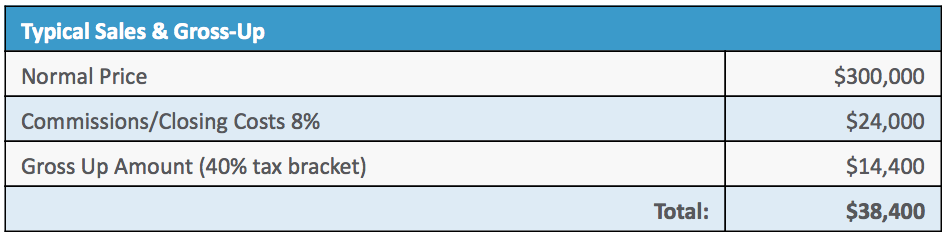
A transferee in the 40% tax bracket receiving a $24,000 home sale expense reimbursement will require around $39,900 in order to approximately cover the impact of income taxes being withheld and still net the $24,000 needed to cover the actual expenses.

Typical home sale with gross-up

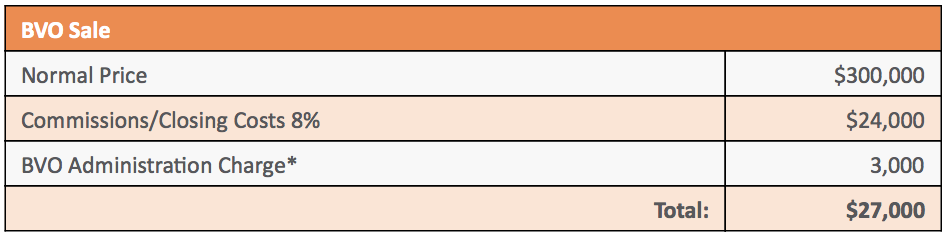
Home sale with BVO cost savings

Total Savings:                           $11,400

*Commissions and closing costs shown reflect a 6% commission and 2% closing costs. Actual costs, including BVO fee, may vary.

Once a transferee receives a valid offer to purchase from a 3rd party buyer, and after the relocation management company (RMC) has been able to verify that all contractual terms are customary, the transferee turns the sale of the home over to the RMC.

The RMC then purchases the home from the transferee and subsequently transfers the home to the 3rd party purchaser. All closing costs and realtor commissions are paid by the RMC and billed directly to the employer. Since the transferee never incurs any home sale expense, normal reimbursement of these expenses is not required.

Fast, Easy, and Economical

Once the origin home is turned over to the RMC, the transferee relinquishes all obligations including attending the actual closing. The RMC manages the entire sale and closing process on behalf of the transferee. The BVO program allows the transferee to move quickly, and focus on his or her new job and community. This is one more way of reducing both the stress and expenses associated with workforce mobility.

To learn more about BVOs or other relocation programs, please visit our contact page and an experienced Global Mobility Solutions relocation consultant will answer all of your questions.

TAKE THE NEXT STEP IN YOUR CAREER