Categories
Corporate Relocation Corporate relocation tips Domestic Relocation Tips Global Relocation Global Relocation Trends Relocation Best Practices Relocation Challenges Talent Mobility

Tax Gross-Up Explained

What HR Teams Need to Know to Avoid Costly Relocation Surprises

Employee relocation is an investment in talent, growth, and business continuity. But for many HR and talent mobility teams, one overlooked detail can quietly derail budgets and frustrate employees: taxes. Specifically, how relocation benefits are taxed — and whether your company uses a tax gross-up policy.

Without a clear gross-up strategy, well-intentioned relocation support can leave employees with unexpected tax bills and employers with higher-than-planned costs. Understanding how tax gross-ups work is critical for delivering a positive employee experience while protecting your relocation budget.

What Is a Tax Gross-Up?

A tax gross-up occurs when an employer increases a relocation payment to cover the income taxes an employee would owe on that benefit.

Because most relocation expenses, including moving services, temporary housing, and reimbursements, are taxable under current IRS rules, employees may owe federal, state, and payroll taxes on benefits intended to help them move. Without a gross-up, they effectively pay out of pocket to accept a relocation.

A gross-up ensures employees receive the intended net benefit after taxes. For example, if a relocation payment of $10,000 would result in $3,000 in taxes, the company adds additional funds so the employee still nets the full $10,000.

Why Gross-Ups Matter for HR Teams

At first glance, tax gross-ups might feel like a small accounting detail. In reality, they directly impact your program’s fairness, competitiveness, and cost predictability.

When employees discover relocation benefits are taxable after the fact, it can create frustration and damage trust. Instead of feeling supported, they feel penalized. This can hurt acceptance rates, engagement, and retention, especially in competitive talent markets.

For HR leaders, the financial risk is just as significant. If taxes aren’t modeled correctly, budgets can balloon quickly. A poorly planned policy may lead to last-minute exceptions, inconsistent practices, and unexpected expenses that disrupt forecasts.

A clear, proactive gross-up approach helps you avoid both employee dissatisfaction and financial surprises.

Which Relocation Benefits Are Taxable?

This is where many teams get tripped up. Under current U.S. tax law, most employer-paid relocation expenses are taxable income to the employee. Common taxable items include:

  • Household goods shipment

  • Temporary living expenses

  • Home sale assistance

  • Lease break fees

  • Travel reimbursements

  • Lump-sum allowances

The only common exception is certain qualified military moves. For corporate relocations, you should generally assume benefits are taxable unless confirmed otherwise by a tax professional.

Because so many categories are taxable, gross-ups often represent a significant portion of total relocation spend.

Common Gross-Up Methods

Not all gross-ups are handled the same way. The approach you choose affects both costs and administration.

Some organizations use a flat gross-up percentage. This is simple to manage but may over- or under-compensate depending on the employee’s tax bracket.

Others use a marginal or supplemental rate gross-up, applying a standard tax estimate (often around 22–30%). While easy to forecast, it may not fully cover higher-income employees.

The most precise method is a “true” or full gross-up, which calculates taxes based on the employee’s actual tax situation. This offers fairness and accuracy but requires more detailed payroll coordination.

Each method involves trade-offs between simplicity, equity, and budget control. Many HR teams partner with a relocation management company to model scenarios and determine the best fit.

The Hidden Cost of Getting It Wrong

Tax miscalculations don’t just create minor discrepancies. They can materially inflate program costs.

For example, if you gross up every expense without a strategy, you may increase total relocation costs by 30–40% or more. On the flip side, under-grossing can lead to employee complaints, reimbursement requests, or exceptions that undermine policy consistency.

Both scenarios erode trust — either with leadership or with employees.

A thoughtful tax strategy balances cost containment with employee support, rather than relying on reactive fixes.

Best Practices to Avoid Relocation Tax Surprises

Strong mobility programs treat tax planning as a core component, not an afterthought.

Start by clearly defining which benefits will be grossed up and which won’t. Consistency reduces confusion and prevents case-by-case exceptions.

Work closely with payroll and finance to forecast the full tax impact of each move. Including gross-ups in upfront budgeting gives you better control over spending.

Educate employees early. Transparent communication about what is taxable and how your company handles gross-ups helps set expectations and prevents unpleasant surprises.

Finally, consider leveraging relocation experts who understand compliance, reporting, and tax regulations. The right partner can help you streamline processes, automate calculations, and protect your program from costly mistakes.

The Bottom Line

Tax gross-ups may not be the most visible part of a relocation program, but they’re one of the most important. When handled strategically, they protect employees, support acceptance rates, and keep budgets predictable. When ignored, they create frustration, overspending, and unnecessary risk.

For HR and talent mobility teams, the goal is simple: deliver a seamless relocation experience without financial surprises. A clear, well-managed relocation tax gross-up policy is essential to making that happen.

If you’re unsure whether your current approach fully supports your workforce, contact Global Mobility Solutions. Our team will review your relocation policies and assist you in updating your talent mobility packages.

Categories
Corporate Relocation Domestic Relocation Global Mobility Global Relocation Global Relocation Trends

Global Mobility Trends Shaping Employee Relocation in 2026

As organizations continue to compete for top talent in an increasingly global marketplace, employee relocation programs are evolving faster than ever. In 2026, global mobility is no longer just about moving employees from Point A to Point B—it’s about creating seamless, data-driven, and employee-centric experiences that align with broader business goals. 

Understanding the global mobility trends shaping employee relocation trends in 2026 can help companies stay competitive, control costs, and improve employee satisfaction.

A Stronger Focus on Employee Experience

One of the most significant global mobility trends in 2026 is the shift toward employee-first relocation programs. Companies are recognizing that a positive relocation experience directly impacts productivity, retention, and engagement. 

Employees expect personalized support, clear communication, and flexibility throughout the relocation process. This includes tailored housing options, destination services, and ongoing support beyond the initial move. Mobility programs that prioritize experience over rigid policy structures are seeing higher assignment success rates and faster adjustment times.

Increased Use of Technology and Automation

Technology continues to transform global mobility programs in 2026. Automation, AI-powered tools, and self-service platforms are becoming standard components of modern relocation management. From AI-driven home search tools and virtual home tours to centralized client portals, technology is reducing administrative burden while increasing transparency. These tools give employees real-time access to timelines, documents, and support resources, while HR teams benefit from improved efficiency and reduced manual processes.

Data-Driven Decision Making in Mobility Programs

Data analytics is playing a larger role in shaping employee relocation strategies. In 2026, companies are leveraging mobility data to forecast costs, measure program effectiveness, and identify trends across regions and job roles. Predictive analytics help organizations anticipate challenges such as housing availability, cost-of-living fluctuations, and assignment risks. With better insights, global mobility teams can make informed decisions that balance employee needs with financial responsibility.

Cost Management and Budget Optimization

Rising housing costs, inflation, and economic uncertainty are pushing companies to rethink how they manage relocation budgets. Cost containment remains a top priority in 2026, but organizations are moving away from one-size-fits-all approaches. Instead, they are adopting flexible benefits models, tiered policies, and capped allowances that still support employees while maintaining financial control. Strategic vendor partnerships and transparent cost tracking are essential for optimizing relocation spend without compromising service quality.

Compliance, Risk Management, and Duty of Care

As global workforces expand, compliance and risk management have become critical elements of employee relocation. Immigration regulations, tax requirements, and data privacy laws continue to evolve, making it essential for companies to stay informed and proactive. 

In 2026, global mobility programs are placing greater emphasis on compliance support, secure document management, and duty-of-care initiatives. This ensures employees are protected while organizations minimize legal and financial risk.

Remote and Hybrid Work Influence on Relocation

Remote and hybrid work models are reshaping traditional relocation strategies. While not eliminating the need for relocation, flexible work arrangements are influencing assignment duration, location selection, and benefits offerings. Some companies are offering short-term assignments, commuter programs, or partial relocation support to align with hybrid roles. Global mobility teams in 2026 must be adaptable, creating policies that support both in-office and distributed workforces.

Sustainability and Responsible Relocation

Sustainability is becoming a growing priority in global mobility planning. Organizations are increasingly mindful of the environmental impact of employee relocation, from transportation emissions to the use of temporary housing. In 2026, companies are exploring greener relocation options, such as reduced shipment volumes, sustainable housing partners, and digital documentation. Responsible relocation practices not only support corporate sustainability goals but also resonate with environmentally conscious employees.

The Role of Strategic Mobility Partners

As relocation programs become more complex, companies are turning to experienced global mobility partners to navigate change. A trusted relocation management provider can offer expertise, technology, and scalable solutions that align with evolving business needs. In 2026, successful organizations view global mobility as a strategic function—one that supports talent acquisition, workforce planning, and long-term growth.

Categories
Corporate Relocation Domestic Relocation Domestic Relocation Trends Global Relocation Global Relocation Trends Household Goods Relocation Best Practices

Household Goods Shipment Trends for 2026

What HR and Corporate Mobility Teams Need to Know

As we move into 2026, the logistics landscape for household goods shipments continues to evolve rapidly, driven by shifts in technology, consumer expectations, sustainability priorities, and workforce mobility patterns. For companies managing employee relocations, staying ahead of these trends isn’t just smart — it’s essential. Understanding what’s shaping household goods shipments this year will help corporate mobility leaders design more efficient, cost-effective, and employee-centric relocation programs.

Digitalization and Real-Time Visibility Become Standard

One of the most significant trends in household goods shipments heading into 2026 is the widespread adoption of advanced digital tools and real-time tracking capabilities. Movers and logistics partners are transitioning from manual, paper-based processes to automated, cloud-based platforms that offer transparency throughout the relocation journey. This includes real-time shipment tracking, mobile access for employees, and digital documentation that improves communication and reduces administrative burden. 

For HR and mobility teams, this means better visibility into shipment status, fewer surprises, and a smoother experience for relocating employees. Workers today expect to see updates on their household goods movements — just as they track packages ordered online — and companies that meet these expectations improve employee satisfaction and trust.

Automation, AI, and Smarter Logistics Solutions

AI-driven route optimization and automated logistics systems are no longer “emerging” — they’re becoming essential elements of efficient household goods shipping in 2026. Algorithms help carriers predict demand, optimize routes, and adjust plans in response to weather, traffic, or capacity changes. 

These technologies reduce delivery times, cut operational costs, and enhance reliability — all factors that directly benefit corporate relocation programs. By partnering with relocation specialists who leverage automation and predictive analytics, companies can mitigate delays and make more accurate cost forecasts for moves of any size.

Sustainability Is a Priority — Not Just a Nice-to-Have

Sustainability continues to gain traction across logistics and relocation services. As employees become more environmentally conscious, they are increasingly interested in eco-friendly moving options. This trend extends to biodegradable packing materials, reusable containers, carbon offset programs, and fleets that use alternative or low-emission fuels.

For corporate mobility leaders, embracing sustainable shipment options isn’t only about meeting employee expectations — it can also elevate your employer brand and align your relocation program with broader ESG (Environmental, Social, Governance) goals. With more companies prioritizing sustainability in 2026, relocation policies that incorporate greener practices are likely to stand out in competitive talent markets.

Cost Pressures and Shipping Complexity Persist

Despite advances in technology and service delivery, cost pressures remain an ongoing concern for household goods shipments. Recent industry data shows that logistics expenses have continued to rise, driven by higher fuel rates, labor shortages, and global supply chain complexities.

This financial pressure emphasizes the importance of strategic planning, vendor negotiation, and risk management within corporate relocation programs. Companies that lock in predictable rates through long-term contracts or leverage the buying power of experienced relocation management partners can often neutralize unpredictable spikes in shipping costs.

Workforce Trends Shape Relocation Demand

Hybrid and remote work models, combined with evolving migration patterns such as increased moves to Sun Belt states and suburban/rural areas, are reshaping relocation demand. These demographic and workforce shifts influence the volume and type of household goods shipments that corporate mobility teams manage, particularly for long-distance and interstate moves. 

In 2026, HR leaders are tailoring relocation solutions to fit these novel mobility patterns — including flexible shipment options, personalized move support, and supplemental services such as storage and temporary housing — to better align with employee lifestyles and expectations.

Quality, Transparency, and Partner Selection Matter More Than Ever

Finally, as the industry continues to stabilize after years of pandemic-driven volatility, transparency in pricing and service quality is emerging as a major differentiator. With labor shortages, port delays, and carrier variability still affecting service levels, employers benefit from relocation partners that communicate clearly and manage vendor performance proactively. 

Choosing a relocation provider with robust tracking systems, consistent reporting, and strong supply-chain networks can reduce risk and improve the overall employee experience. Expert partners also help mobility teams anticipate challenges and pivot quickly when disruptions occur.

Working with an experienced relocation management company like Global Mobility Solutions helps companies leverage these trends strategically — from advanced technology integrations and cost-control strategies to seamless shipment execution and ongoing communication with relocating employees.

Stay ahead of household goods shipment trends in 2026 — contact GMS Mobility today to learn how we can support your relocation success.

Categories
Global Mobility Global Relocation Trends Immigration Rules United States Economy Visas and International Travel

Preparing for California’s AB 692: Key Compliance Steps for Employers and Mobility Teams

California’s AB 692 is set to significantly impact how employers structure repayment agreements, especially those tied to training, relocation benefits, and visa sponsorship. To stay compliant and avoid costly legal issues, employers and global mobility teams should begin reviewing internal policies now.

Below are the essential steps organizations should take to prepare:

Audit All Existing Repayment Agreements

Conduct a full review of any agreements that require employees to repay training costs, relocation expenses, or visa-related fees. Identifying outdated or non-compliant documents is the first step toward AB 692 readiness.

Create Separate, Standalone Agreements

AB 692 prohibits repayment clauses from being buried inside employment contracts.
Employers must provide clear, independent repayment agreements that include:

  • A mandatory five-business-day review period

  • Transparent terms and repayment timelines

  • No coercion or pressure to sign immediately

Update Repayment Terms to Meet AB 692 Rules

Repayment provisions must now be:

  • Interest-free
  • Prorated over time
  • Limited to a maximum of two years

These changes ensure that repayment obligations are fair and compliant with California’s new standards.

Review and Revise Mobility Policies

Relocation and visa reimbursement policies should be evaluated to ensure they do not include unenforceable repayment clauses. This provides mobility guidelines, assignment letters, and relocation program documentation.

Train HR, Mobility, and Talent Teams

Teams responsible for relocation, immigration, or global mobility must understand the new rules. Providing training ensures compliant administration and clear communication with employees considering an assignment or relocation.

Explore Alternative Retention Strategies

Since AB 692 restricts how repayment agreements can be used, employers may need to adopt new retention strategies. Consider:

  • Retention bonuses

  • Deferred compensation or benefits

  • Performance-based incentives

All of these can support employee commitment while remaining compliant with AB 692.

By taking proactive steps now, organizations can protect themselves from legal risk and maintain efficient, employee-focused mobility programs.

What AB 692 Means for Employees Who Relocate or Go on Assignment

AB 692 provides employees with expanded protections when participating in employer-sponsored training, relocation programs, or visa sponsorship. Employees can expect:

  • No unexpected repayment demands for relocation or visa costs if they leave a role early.

  • Clear, standalone repayment agreements—not clauses hidden within employment contracts.

  • Fair and limited repayment terms, including prorated repayment and a two-year cap.

Overall, the law promotes employee mobility and career flexibility, reducing the financial penalties that once discouraged employees from taking new opportunities. Employees should carefully review any agreement presented and ask questions if the terms seem unclear, inconsistent, or burdensome.

Final Thoughts on AB 692 and Repayment Agreements

California’s AB 692 is reshaping the way organizations handle repayment agreements tied to relocation, training, and mobility benefits. While the legislation strengthens employee rights and transparency, it also challenges employers to modernize their policies ahead of the January 2026 compliance deadline.

At Global Mobility Solutions (GMS), we are closely monitoring every shift in the mobility landscape—from relocation policies and visa regulations to complex immigration trends. Our team continually analyzes new legislation, such as AB 692, to help organizations stay compliant, proactive, and fully prepared.

As AB 692 and other regulatory changes redefine global mobility, GMS ensures our clients remain informed, compliant, and confident as they navigate the road ahead.

Categories
Corporate Relocation Corporate relocation tips Global Mobility Global Relocation Global Relocation Challenges Global Relocation Tips Global Relocation Trends

Why Flexibility Is the New Currency in Corporate Relocation Programs

In today’s fast-evolving global workforce, flexibility isn’t just a perk — it’s the new currency driving successful corporate relocation programs. As employee expectations shift and business priorities become more fluid, organizations are rethinking traditional relocation policies in favor of adaptable, personalized solutions that support both company goals and individual needs.

Flexibility has become a key differentiator in attracting and retaining top talent, optimizing budgets, and improving the overall relocation experience. Flexibility in relocation programs not only meets the diverse needs of employees but also enhances their overall experience. 

When employees feel that their personal situations are understood and accommodated, they are more likely to feel valued and engaged. This positive experience can lead to increased loyalty and productivity, ultimately benefiting the organization as a whole. Companies that prioritize employee experience in their global mobility programs often see a smoother transition, reduced stress, and quicker integration into new roles.

The New Reality of Workforce Mobility

The modern workforce is more diverse and distributed than ever before. Hybrid work, global hiring, and remote-first roles have redefined what it means to “relocate.” Today’s employees value autonomy, choice, and the ability to tailor their relocation experience around their unique lifestyles.

At the same time, organizations are balancing cost efficiency with talent engagement. A flexible relocation program allows companies to align mobility strategies with broader business goals — whether that’s accelerating global expansion, enhancing diversity, or responding to changing market conditions.

Why Flexibility Matters in Corporate Relocation

  1. Employees Expect Personalization
    No two relocations are the same. A recent trend across the mobility industry shows employees increasingly expect relocation benefits that adapt to their personal circumstances — whether they’re moving with a family, relocating internationally, or managing dual-career households.

    Flexible relocation programs empower employees with choice, offering customizable benefits like lump-sum allowances, tiered policy options, or menu-style packages. This personalization not only increases satisfaction but also ensures benefits are significant and relevant to each transferee.
  1. Businesses Need Agility to Compete
    Economic conditions, visa regulations, and housing markets can shift quickly. Organizations with rigid relocation policies risk being left behind. Flexible mobility programs help businesses stay agile, enabling HR and mobility teams to adjust benefits and budgets in response to regional trends, cost fluctuations, and strategic priorities.

    For example, companies can adjust housing assistance levels in high-cost cities or offer temporary remote work arrangements when relocation timing becomes challenging. This adaptability supports continuity while minimizing disruption.
  1. Flexibility Enhances Cost Control
    A common misconception is that flexibility increases costs — but the opposite is often true. With a well-structured policy framework, flexible relocation programs can reduce waste and optimize spending.

    When employees can select the benefits they value most, companies avoid overspending on services that may go unused. Plus, real-time data and analytics — like those provided by GMS’s mobility technology — give employers better visibility into cost drivers, helping fine-tune budgets and forecast future expenses more accurately.
  1. It Strengthens the Employee Experience
    Relocation is one of the most significant transitions in an employee’s career. A flexible approach communicates trust and empathy, showing employees that the organization recognizes their individual needs. This can lead to higher engagement, stronger performance, and a smoother onboarding process in the new location.

    From offering virtual settling-in assistance to providing flexible housing or travel options, every adaptable touchpoint contributes to a more positive experience — one that reinforces company culture and supports long-term retention.

Key Ways to Build Flexibility into Your Global Mobility Program

  1. Adopt a Core-Flex Policy Model
    Many organizations are embracing the core-flex model, which combines essential “core” benefits (like household goods shipment or visa support) with a flexible “menu” of optional benefits. This approach balances consistency and choice, ensuring compliance while maintaining employee autonomy.
  2. Leverage Technology for Smarter Mobility
    Modern relocation technology — such as the tools integrated within GMS’s platform — empowers HR teams to manage flexible benefits, track usage, and monitor satisfaction in real time. Automation and AI-driven insights make it easier to adapt programs as employee needs evolve.
  3. Partner with a Relocation Expert
    Working with an experienced relocation provider like GMS can help organizations implement flexible solutions efficiently and strategically. GMS offers policy benchmarking, program design, and data-driven recommendations to ensure mobility strategies remain competitive and compliant.

The Future of Relocation Is Built on Flexibility

As the workforce continues to evolve, flexibility will remain the foundation of successful mobility programs. It’s more than just a trend — it’s a strategic advantage that empowers employees, strengthens employer brands, and positions organizations for sustainable growth.

Companies that prioritize flexibility today will be better equipped to attract top talent, navigate uncertainty, and create relocation experiences that drive loyalty and success.

At Global Mobility Solutions, we help organizations design and deliver flexible relocation programs that meet the needs of today’s mobile workforce.

Learn more about how GMS can help your company embrace flexibility in relocation to get started.

We're Here to Help! Request a Courtesy Consultation

Are you ready to talk to a Mobility Pro? Learn how GMS can optimize your mobility program, enhance your policies to meet today’s unique challenges, receive an in-depth industry benchmark, or simply ask us a question. Your Mobility Pro will be in touch within 1 business day for a no-pressure, courtesy consultation.

Categories
Corporate Relocation Domestic Relocation Domestic Relocation Challenges Domestic Relocation Tips Global Mobility Global Relocation Global Relocation Tips Global Relocation Trends

What Companies Should Prioritize in Relocation Benefits for 2026

As the competition for top talent intensifies and employee expectations evolve, relocation benefits are no longer just a perk—they’re a critical component of employer value propositions. For companies planning for 2026, here are key trends and strategic considerations to ensure your relocation policies are attractive, cost-effective, and aligned with both employee needs and business goals.

1. Flexibility & Customization

One-size-fits-all relocation packages are increasingly outdated. Different roles, employee life stages, family situations, and locations necessitate varying levels of support. Some employees will prefer full reimbursement of expenses, while others may prefer a lump sum to manage their own move. Tailored packages can include options like:

  • Spousal job search assistance

  • Schooling or childcare assistance

  • Temporary housing or extended lodging

  • Phased or partial relocation (e.g., remote-first periods or hybrid commuting)

Flexibility enables companies to meet diverse needs, enhance satisfaction, and mitigate relocation declines.

2. Technology & Digital Support

Relocation logistics are complex, especially for global or long-distance moves. In 2026, technology will play a bigger role in simplifying and automating these processes:

  • Digital platforms or dashboards to track expenses, real-time status, and compliance.

  • Virtual tools, such as AR/VR for home tours, reduce travel and enable employees to begin settling in remotely.

  • AI for cost projections, moving vendor selection, and customizing policy options based on individual profiles.

2. Technology & Digital Support

With inflation, rising housing costs, and tighter budgets, companies must strike a balance between generosity and fiscal responsibility. Key levers include:

  • Lump-sum payments vs complete reimbursements. Many firms are shifting toward managed lump sums (where the employee gets a sum but works through a vetted relocation provider or uses approved services) to reduce the risk of misuse or under-support.

  • Clawback or repayment provisions: to protect the company if the employee leaves soon after relocating.

  • Adjusting for the cost of living and housing market changes in destination cities. Ensuring that the total compensation package reflects what it’s really going to cost employees to live in the new place

4. Employee & Family Well-Being

With inflation, rising housing costs, and tighter budgets, companies must strike a balance between generosity and fiscal responsibility. Key levers include:

  • Lump-sum payments vs complete reimbursements. Many firms are shifting toward managed lump sums (where the employee gets a sum but works through a vetted relocation provider or uses approved services) to reduce the risk of misuse or under-support.


  • Clawback or repayment provisions: to protect the company if the employee leaves soon after relocating.


  • Adjusting for the cost of living and housing market changes in destination cities. Ensuring that the total compensation package reflects what it’s really going to cost employees to live in the new place

5. Sustainability & Corporate Responsibility

The environmental impact of relocation is becoming an area of scrutiny. Forward-thinking companies in 2026 will factor in sustainability in policy design:

  • Using green moving practices (eco-friendly packing materials, lower emissions transport, minimizing waste).

  • Encouraging sustainable housing options and communities with good public transit, as well as energy-efficient buildings.

  • Aligning relocation policies with broader ESG goals can enhance employer branding and help meet stakeholder expectations.

6. Transparency & Clear Communication

Ambiguity kills trust. If relocation policies are confusing or hidden, employees may decline offers or leave prematurely. To maximize value:

  • Clearly define what is included: what counts as a relocation-eligible distance, what expenses are covered, and what timelines are expected.

  • Be upfront about things like tax implications, gross-ups, repayment obligations or clawbacks.

  • Provide clear procedural steps and contacts, including who to contact for specific tasks, how to obtain moving quotes, and the process for managing approvals.

7. Monitoring & Policy Review

What works today may not be sufficient in 2026. Companies should build in mechanisms to monitor and evolve their relocation programs:

  • Solicit feedback from employees who have relocated: what worked, what didn’t.

  • Track metrics: declines, retention after relocation, cost vs budget, impact on productivity, time to settle in.

  • Stay abreast of legal, immigration, tax, housing, and real estate regulation changes, especially for cross-border relocations or remote work policies.

Work with GMS for Relocation Benefits

Relocation benefits in 2026 will be judged not just by the dollars spent, but by how well they address flexibility, empathy, efficiency, and responsibility. For companies that get it right, these programs can be powerful tools to attract talent, cement loyalty, and project a modern, human-centred employer brand.

At GMS Mobility, we help you design and optimize relocation benefit programs that strike a balance between employee expectations and business strategy. If you’d like to explore how your relocation benefits stack up or how you can evolve them for the future, we’re here to assist.

We're Here to Help! Request a Courtesy Consultation

Are you ready to talk to a Mobility Pro? Learn how GMS can optimize your mobility program, enhance your policies to meet today’s unique challenges, receive an in-depth industry benchmark, or simply ask us a question. Your Mobility Pro will be in touch within 1 business day for a no-pressure, courtesy consultation.

Categories
Choosing a Relocation Company Global Mobility Global Relocation Tips Global Relocation Trends Relocation Management Talent Management

Common Employee Relocation Packages

A Look at Typical Relocation Packages

Relocation packages, also known as relocation benefits, are policies and support that companies offer employees transferring to a location for a position. Each company will have different needs when it comes to relocation benefits, and it can be challenging for companies to determine exactly what should be covered in these policies and what employees should be responsible for on their own. 

To ensure the selected applicant receives a strong and appealing offer, providing a comprehensive and competitive relocation package for relocating employees is highly advisable. When crafting a relocation package, companies typically consider several key components to make the transition as smooth as possible for their employees.

By offering a well-rounded relocation package, companies ease the transition for their employees and demonstrate their commitment to supporting their workforce. This can lead to increased employee satisfaction, decreased turnover, and a more positive company culture. As businesses continue to adapt to a global workforce, investing in comprehensive relocation benefits will remain a crucial strategy for attracting and retaining top talent.

Companies can typically tailor relocation programs to each hiring situation. Some companies choose to have their HR department handle employee transfers. Still, if the company wants to be consistent with its relocation packages on each hire, using a reliable relocation management company is probably a good idea.

What Does A Standard Relocation Package Include?

Most relocation policies outline some form of reimbursement or coverage for many of the everyday expenses associated with moving. Relocation benefits often include full packing and unpacking services and a quality and reliable moving company to get the employee’s household goods from point A to point B. 

In addition to moving expenses, home sale assistance is another common benefit offered to transferees. This can include selling programs that utilize vetted real estate agents specializing in relocation to help ensure a quicker and more prosperous home sale for the relocating employee. 

Specific policies might support employees who need to terminate their rental agreements prematurely, helping them manage any associated penalties. Additionally, the relocation package may encompass house-hunting trips. This implies that the employer could finance one or two visits for the relocating employee to explore their future neighborhood and inspect various houses or apartments before making a decision.

Corporate housing options, also known as temporary housing, are typically included in most relocation policies. This provides the employee with a temporary accommodation after they’ve relocated to find a permanent home in their new location, allowing them to start on their desired start date for the position without delay. 

Many companies also offer transportation coverage or reimbursement as part of their relocation packages. This might cover airfare for the employee and their family or expenses for driving across state lines. In some instances, companies may also cover the employee’s transportation costs for their vehicle.

What Expenses Are Typically Covered During Relocation?

While not an exhaustive list, the following are common relocation costs for which many companies provide support to their relocating employees:

  • Corporate housing options 
  • Household goods transportation (HHG)
  • Storage facility (temporary storage of the HHG shipment
  • Miscellaneous expense allowance
  • Home sale costs
  • Spousal employment assistance
  • Travel-related costs, such as airfare, meals, and hotel nights

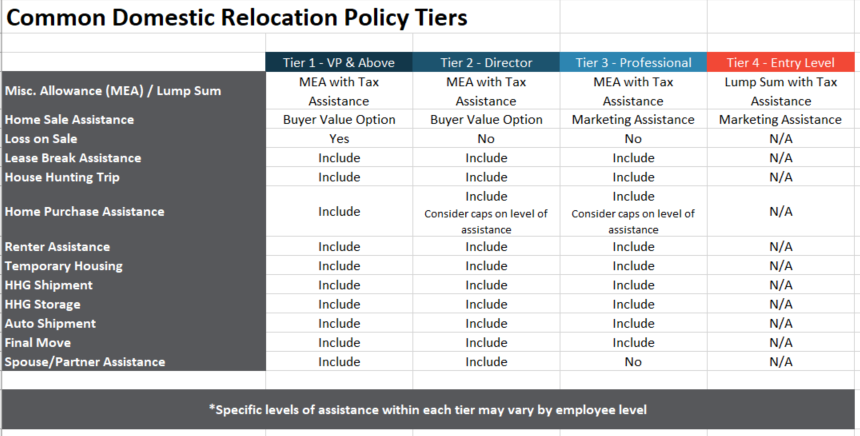
As every company has different goals and objectives for its relocation program, many-tiered relocation policies offer various levels of support for each employee. 

Here is a breakdown of the most common U.S. domestic relocation policy tiers per GMS research:

chart of relocation policy tiers

What Types Of Employees Receive Relocation Packages?

This aspect will depend upon the company’s need for each position and the importance of getting that employee to the new location. The best practice for relocation programs is to build a tiered system based on employee level. 

These tiers are commonly built around entry-level employees, professionals, directors, and vice presidents. Additionally, many companies offer executive relocation packages to cover the costs of relocation for most executive-level employees. Some companies may also provide international relocation packages for employees relocating globally.

Common Methods to Address Costs in Relocation Packages

Different policy tiers within your relocation program may require different strategies for covering your employee’s relocation costs. It is essential to understand the advantages and disadvantages of these standard methods.

Direct Billing: The relocation management company manages the procurement, organization, and direct payment to the service providers involved in your employee’s relocation. They review, combine, and forward the invoices to you for settlement. Although this approach may be pricier, it guarantees that your employee maximizes their benefits and reaches their new location promptly, alleviating any concerns about the expenses associated with the move. 

Expense Reimbursement: The employee pays for moving expenses upfront, and the company issues a reimbursement check at the end of the process. While not generally intended to cover an employee’s entire move (few families have the cash to pay tens of thousands of dollars for a move), reimbursements are commonly used for miscellaneous expenses as outlined in the company’s relocation policy. Typically, reimbursements are used for items such as travel costs or other related items.

Lump Sum: Unlike an expense reimbursement, a lump sum is commonly used as the primary financial benefit to a relocating employee. In a lump sum policy, a set amount of money is given upfront to the employee to handle the moving expenses as they see fit. 

Generally provided to entry-level or lower-level employees, the lump sum is typically the only relocation benefit offered. While the lump sum is seen as an excellent cost control tool for companies, it places additional burdens on employees, as they are left to manage their move independently. This is in addition to the lump sum, which is typically considered taxable income. Employees who receive their relocation benefits as a lump sum should note the payment for tax purposes. Employers should consider adding a tax gross-up to the lump sum to help mitigate the effects of the income tax on the employee’s benefit.

Ready to Set Up Relocation Packages for Employees?

Partnering with Global Mobility Solutions (GMS) ensures that your company offers comprehensive, cost-effective, and employee-centric relocation packages. GMS provides a tailored approach that aligns with your unique organizational needs, offering flexibility. This model allows you to select from a network of top-tier service providers or integrate your preferred partners, ensuring a customized experience for each relocation. Their expertise in managing all aspects of the relocation process—from pre-decision assessments to destination services—reduces risks, enhances employee satisfaction, and improves retention rates.

By leveraging GMS’s industry-leading MyRelocation® technology platform, your company can streamline relocation management, track expenses, and provide real-time support to transferees. This comprehensive support facilitates smoother transitions for employees and strengthens your employer brand by demonstrating a commitment to employee well-being. With over 30 years of experience and a global presence in over 140 countries, GMS has an expert team equipped to handle the complexities of workforce mobility, enabling your company to attract and retain top talent anywhere in the world.

We're Here to Help! Request a Courtesy Consultation

Are you ready to talk to a Mobility Pro? Learn how GMS can optimize your mobility program, enhance your policies to meet today’s unique challenges, receive an in-depth industry benchmark, or simply ask us a question. Your Mobility Pro will be in touch within 1 business day for a no-pressure, courtesy consultation.

Categories
Corporate relocation tips Domestic Relocation Domestic Relocation Challenges Domestic Relocation Tips Global Relocation Tips Global Relocation Trends Relocation Best Practices Relocation Management

How Often is the Core-Flex Approach Used in Global Mobility?

GMS Breaks Down Everything You Need to Know about Core-Flex Relocation Packages

When moving for a new job, a company may provide relocation assistance to assist the employee with moving costs and make the moving process easier. Typically, larger companies will offer various relocation packages tailored to the employee’s position, the scope of the move, and whether family members are involved. One type of relocation policy that is gaining popularity among companies is the core-flex model. Core-flex relocation policies comprise a core section offering essential relocation benefits, along with a selection of flexible, optional benefits that can be chosen based on the employee’s specific needs.

Core-flex relocation programs do not grant employees complete freedom regarding moving costs, unlike typical lump-sum global mobility packages. However, core-flex options eliminate stress associated with relocating employees, such as the hassle of hiring suppliers, service quality issues, expenses, and tax overruns.

Are Core-Flex Relocation Packages Common?

Traditional and capped programs are commonly used in corporate relocation. Still, core-flex policies have become increasingly popular for their flexibility in meeting the varied needs of transferees while controlling costs. A recent benchmarking study and survey of transferees’ satisfaction with different programs revealed that traditional policies were the most satisfying, followed by capped and core-flex policies. Transferees who received a lump sum were the least satisfied. This highlights the importance of offering a range of options to accommodate the diverse needs of relocated employees.

Companies must prioritize the satisfaction of transferees during their relocation process. Happy transferees experience less stress during the transition and are more productive in their new location. Companies can expect improved critical thinking, problem-solving abilities, and reduced errors by ensuring transferees are content. Providing a relocation policy that meets the needs of transferees is the first step in achieving their satisfaction and success in the new location.

What Are Some Common Relocation Benefits?

A core-flex policy typically includes:

Core Benefits – All transferees are offered a comprehensive package of necessary benefits to support their move, including a Miscellaneous Expense Allowance (MEA), temporary accommodation, household goods shipping, and travel for the final move.

Flexible Benefits—Transferees can select from a range of benefits that suit their specific requirements and situations. These benefits may cover expenses such as a trip to find a new house, early lease termination, financial aid for renting at their new location, buying or selling a home, relocating pets and vehicles, storing household goods, and supporting spouses.

Does A Core-Flex Package Help or Burden the Relocation Process?

Companies can effectively control and forecast relocation costs by offering a combination of standard and personalized benefits. Core-flex policies aim to balance managing expenses and give employees the freedom to select benefits that suit their individual needs. Tailored support offerings can enhance the relocation process and boost employee retention rates.

By offering a core-flex package, companies can cater to the individual needs of their employees during the relocation process. This helps reduce the stress and burden associated with relocating to a new location, ensuring that employees feel supported and valued by their employers. The flexibility provided by core-flex policies allows employees to make choices that align with their specific circumstances, ultimately leading to a smoother transition and a more positive relocation experience. In the long run, this can contribute to higher employee satisfaction and retention rates, benefiting both the employee and the company. Overall, a core-flex package can be valuable in streamlining the relocation process and ensuring a successful outcome for all parties involved.

Categories
Corporate relocation tips Domestic Relocation Global Mobility Global Relocation Global Relocation Tips Global Relocation Trends Relocation Programs

The Essential Role of a Relocation Coach in the Domestic Relocation Process

Learn how relocation management companies coach employees through their move

Domestic relocation refers to moving from one location to another within the same country. This can involve moving to a new city for a job, transitioning to a larger home, or simply seeking a change of scenery. While exciting, relocation can also be a daunting task filled with numerous challenges. Individuals often face logistical hurdles, emotional stress, and the need to adapt to a new environment. 

This is where the role of a relocation coach becomes invaluable. A relocation coach is a trained professional who guides individuals and families through the complexities of moving. They provide personalized support, helping clients navigate everything from packing and logistics to settling into their new community. Working with a relocation management company enhances this experience, as these organizations specialize in streamlining the relocation process and offering a range of services tailored to meet each client’s unique needs.

Why Do You Need a Relocation Coach?

Having a relocation coach can significantly ease the stress associated with moving. A relocation coach takes the time to understand each client’s specific needs and concerns. They create a customized plan that addresses individual circumstances, ensuring no detail is overlooked.
Relocation coaches are well-versed in the details of moving. They can provide valuable insights about neighborhoods, schools, and local amenities, helping clients make informed decisions about their new homes.

Moving can be an emotional rollercoaster. An experienced coach offers support and encouragement, helping clients cope with the anxiety and uncertainty that often accompany a significant life change.

A certified coach can save clients time and effort. Coaches can handle logistics, recommend reliable moving companies, and assist with paperwork, allowing clients to focus on other essential aspects of their move.

The Benefits of Working with a Relocation Management Company

Relocation management companies (RMCs) play a crucial role in domestic relocation. They work alongside relocation coaches to provide comprehensive services that facilitate a smooth transition. RMCs coordinate various services, including packing, transportation, and storage. This ensures that all aspects of the move are organized and executed efficiently. For companies relocating employees, these firms help develop policies that align with organizational goals. This includes determining what benefits to offer and how to support employees.

How a Relocation Coach and Management Company Work Together

A relocation coach is crucial in the overall process by working closely with the relocation management company. Together, they create a cohesive plan that addresses every detail of the move. The coach acts as a personal guide for the employee, providing support and resources, while the management company handles logistics and administrative tasks. This partnership ensures that all aspects of the relocation are synchronized, minimizing confusion and maximizing efficiency.

Every domestic relocation assignment is unique, and the relocation coach and the management company understand the importance of tailoring their services to meet specific needs. They collaborate to assess the individual circumstances of the employee or the company, considering factors such as family dynamics, job requirements, and personal preferences. By customizing the relocation plan, they can address potential challenges proactively, ensuring a smoother transition for everyone involved.

The combined efforts of a relocation coach and a management company lead to a more efficient and positive relocation experience. With their expertise and support, employees feel more confident and prepared for the changes ahead. This enhances employee satisfaction and boosts productivity as they settle into new roles and environments. Ultimately, a well-executed relocation process fosters a sense of belonging and stability, which is essential for both the individual and the organization.

Why Choose Global Mobility Solutions?

Global Mobility Solutions (GMS) is a trusted partner in domestic relocation, offering extensive experience and expertise in relocation management and coaching services. With years of industry knowledge, GMS Mobility understands the unique challenges of relocating employees. Their dedicated team is committed to providing personalized support tailored to each individual’s needs, ensuring a smooth transition.

One key advantage of choosing GMS Mobility is its comprehensive approach. They assist with the logistics of moving and focus on the emotional and psychological aspects of relocation. By offering coaching services, GMS Mobility helps employees navigate the uncertainties of moving to a new location, address concerns, and provide resources that empower them to adapt quickly.

Ultimately, choosing GMS Mobility means investing in a seamless relocation experience that prioritizes employee well-being. By partnering with GMS Mobility, organizations can enhance employee satisfaction, reduce turnover, and create a more engaged workforce ready to thrive in their new environment.

We're Here to Help! Request a Courtesy Consultation

Are you ready to talk to a Mobility Pro? Learn how GMS can optimize your mobility program, enhance your policies to meet today’s unique challenges, receive an in-depth industry benchmark, or simply ask us a question. Your Mobility Pro will be in touch within 1 business day for a no-pressure, courtesy consultation.

Categories
Global Mobility Global Relocation Global Relocation Challenges Global Relocation Tips Global Relocation Trends

Why It’s Important to Work with International Tax-Knowledgeable RMC

When it comes to employee relocation, taxes play a huge role

Companies that undertake employee relocations, whether domestic or international, are acutely aware of the complex nature of tax handling. Transferees moving from one state to another often grapple with the intricacies of filing for their new state. Similarly, individuals moving to a new country often need expert guidance to navigate the local tax system. 

Working with a relocation management company (RMC) with relocation tax specialists on staff can give your employees significant advantages in the relocation process. Relocation tax specialists are well-versed in the tax laws and regulations for employee relocations. 

They can provide valuable advice on tax planning, compliance, and optimization strategies to ensure that your employees are not only in compliance with tax laws but also taking advantage of any available tax benefits. By working with a tax-knowledgeable RMC, you can help your employees avoid costly mistakes and minimize their tax liabilities during the relocation process.

Furthermore, international tax-knowledgeable RMCs can also assist with tax equalization and tax protection policies, which are essential for ensuring that your employees are not unfairly burdened by tax implications resulting from their relocation. These policies help to ensure that employees are not disadvantaged financially due to tax differences between their home and host locations.

International Tax Compliance

Whether moving abroad permanently or for a temporary job, it’s crucial to understand that any expenses related to the relocation could raise tax concerns in both the country you’re leaving and the one you’re moving to. This highlights the need to carefully track potential tax liabilities from relocation payments to ensure accurate tax filings in your previous and new locations.

American citizens are obligated to report their worldwide income for tax purposes, regardless of where it was earned, in addition to complying with tax regulations in the country they are currently residing in. Even when an individual moves out of the United States, they must submit a US Federal Income tax return. Thankfully, the US offers a foreign tax credit that can offset the tax liability of the employee, potentially resulting in no taxes owed to the US government or a minimal amount. However, employers need to consider implementing tax equalization policies for employees moving abroad. This ensures that employees pay taxes similar to what they would in their home country, with the employer covering any differences in tax liabilities.

Work with the Best Full-Service RMC

Global Mobility Solutions (GMS) works with some of the best tax professionals in the relocation industry. For international and domestic assignments, GMS works with your employees from the very start to ensure we can make the relocation process as seamless as possible. Our expert team is willing to listen to your needs and then help you develop relocation programs that will help your employees, including tax needs. 

Contact us today to set up a free consultation with one of our business development managers.

We're Here to Help! Request a Courtesy Visa Program Consultation

Properly managing a visa and immigration program involves meticulous coordination, precise communication, and worldwide interaction with government agencies, corporate personnel, and relocating employees.

At GMS, we provide you with peace of mind in knowing your mobility program is fully compliant and being managed by the best in the industry.

Request a no-pressure, courtesy consultation from a GMS Mobility Pro. We’ll be in touch within 1 business day.

Looking for something?