Categories
Corporate Relocation Corporate relocation tips Domestic Relocation Global Relocation Relocation Challenges

5 Reasons to Outsource Global Mobility Management

Outsource global mobility management – As companies continue to focus on ways to reduce assignment costs, examining operational effectiveness for improved quality and costs savings has become more relevant, particularly with programs managed in-house and/or partially outsourced.

  1. Cost Management: often times, in house programs do not consider or do not have the processes for tracking and reporting mobility costs, which often results in misrepresentation of mobility costs and government fines.
  2. Cost Savings: Outsourcing mobility will generate cost savings from a variety of sources, including policy recommendations, fees vs. in-house operational costs and direct costs e.g. home sale, shipments, etc.
  3. Courtesy Enhancements: In-house programs typically do not offer “no costs” solutions such as pre-decision, expatriate auto lease programs, expatriate home purchase programs and other value add services companies gain from fully outsourcing.
  4. Core Responsibilities: Outsourcing non-core competencies, allows human resources, compensation and benefits and/or recruiting professionals to focus on their core business duties by eliminating the administrative burden of managing the relocation process.
  5. Compliance: Mobility programs offer significant tax and compliance advantages.

These are the top 5 reasons to outsource global mobility management.

Categories
Corporate Relocation Domestic Relocation Global Relocation

Global Mobility Solutions Wins Relocation Award For Third Consecutive Year

SCOTTSDALE, Ariz., Mar. 10, 2016 – GMS Wins Relocation Award 2016 – For the third year in a row, relocation management provider Global Mobility Solutions (www.gmsmobility.com) has earned top placement on HRO Today’s Baker’s Dozen Customer Satisfaction Survey. In their 2016 survey of the relocation management industry, HRO Today rated Global Mobility Solutions as the second best overall relocation management provider in the industry. As the largest customer survey of its kind, the Baker’s Dozen has become one of the industry’s most trusted talent management resources. You can find the complete survey results here.

“GMS is proud to be named at the top of the relocation management industry for the third year in a row” said Global Mobility Solutions President Steven Wester, CRP, SGMS-T. “This is validation of our consistent performance, the exceptional customer service provided by our employees, the breadth of our global mobility services, and the depth of our client relationships. We are truly honored and deeply grateful to our clients for giving us the opportunity to partner with them.”

According to editors at HRO Today “Rankings are based solely on feedback from buyers of the rated services, we collect feedback annually through online survey which we distribute directly to buyers through our own mailing list.” The annual survey analyzes relocation management providers under three categories: service quality, deal size, and breadth of service. Service quality is given the heaviest weight followed closely by breadth of service and finally size of deals. These results are then averaged together to determine the top overall providers in relocation management.

GMS Wins Relocation Award 2016

GMS clientele gave the company high ratings in service quality and breadth of services, driving the company to a number two overall placement in the industry for the second time in the last 3 years. As the nation’s premier publication on human resource operations and outsourcing, HRO Today’s annual publication of the Baker’s Dozen list is a much-anticipated event. Incorporating sound scientific methodology, the surveys underpinning the list are designed to offer meaningful and actionable feedback on what constitutes true customer satisfaction, making HRO Today’s 2016 survey a must read for both human resources and procurement professionals.

About Global Mobility Solutions
Founded in 1987, Global Mobility Solutions is a relocation management company that specializes in supplier management and relocation program development. The company’s relocation services include global assignment management, domestic relocation management and a range of pre-decision solutions.

Contact:

Thomas Belnap, Marketing Director
800-617-1904 ext. 8832
[email protected]

Categories
Corporate Relocation Domestic Relocation Domestic Relocation Trends Global Relocation Global Relocation Trends

GMS and Partners Donate 50,000 Meals to St. Mary’s Food Bank at 2016 Forum

2016 Global Mobility Solutions Partner Forum and Awards Dinner Features Insightful Discussions, Recognition for Top-performing Suppliers, and Philanthropy

SCOTTSDALE, Ariz., March 02, 2016 – Global Mobility Solutions (https://gmsmobility.com/) recently hosted its annual partner forum, an event recognizing members of its Premier Alliance Network – an elite partnership of transportation and relocation service providers. This year’s forum was branded as #TrendUp; the forum focused on emerging trends within the relocation management industry.

“GMS continues to grow, thanks in large part to its exceptional network of partners,” said President Steven Wester. “The relocation industry as a whole is rapidly evolving and keeping abreast of future trends has never been more important. Our partner forum is an opportunity to deliver practical business insights, honor top-performing suppliers within our network, and extends our support to noble causes in the communities we all serve. This year’s event was a big success on each of those fronts.”

The highlight of this year’s forum was the much-anticipated client panel. Suppliers held a lively Q and A session with human resources management from Fortune 500 companies, as well as one of the largest nonprofit health care providers in the world.

GMS recognizes outstanding contributions to its clientele through Partner of the Year awards. The primary criteria for these annual awards include customer satisfaction and on-time service – key indicators of quality and reliability among relocation providers. Partner of the Year award winners for 2016 included the following:

•    Global Services – Nomad Temporary Housing
•    International HHG – Chipman International
•    Domestic HHG (Silver Tier) – Merchants Moving/Atlas
•    Domestic HHG (Gold Tier) – Hilldrup/United
•    Domestic HHG (Platinum Tier) – Armbruster/Mayflower

GMS President Steven Wester (left) and GMS Transportation Director Ann Knapp (right) Award Armbruster Moving and Storage (center) with Platinum Partner of the Year AwardGMS President Steven Wester (left) and GMS Transportation Director Ann Knapp (right) Award Armbruster Moving and Storage (center) with Platinum Partner of the Year Award at 2016 Forum | #TrendUp.

In addition to the client panel and Partner of the Year awards, a trio of workshop sessions provided an opportunity for participants to gain insight into some fast-emerging trends in the relocation industry, led by experienced subject matter experts.

Chuck Matthews, Chief Executive Officer of WGM Holdings and a member of the FBI’s InfraGard partnership, headed a session on cyber security for small to mid-sized businesses. According to cyber security firm Symantec, 60% of cyber attacks target SMBs, resulting in billions in losses annually. Matthews offered background on the origin of these attacks and their continuously evolving levels of sophistication. The session focused primarily on what managers and owners can do to protect their valuable assets, not to mention their reputations, against digital fraud and hacking. Other sessions included “Standards Please,” in which GMS Vice President of Domestic Services Nancy Kritzer illustrated the importance of consistent standards in communication. Meanwhile, performance analytics as a critical tool for the modern enterprise was the theme of “Measuring What Matters” with GMS Vice President of Global Services John Fernandez.

Every year, the partner forum allows GMS and its Premier Alliance Network an opportunity to demonstrate their shared commitment to philanthropy. For GMS, that commitment has included significant efforts to end childhood hunger in local communities. This year’s forum featured both an online pre-forum raffle and an in-forum raffle that resulted in a donation of over 50,000 meals to St. Mary’s Food Bank in Phoenix to help eliminate hunger.

“We are so thankful for this amazing gift,” remarked Lisa Goin, Chief Development and Communications Officer at St. Mary’s Food Bank. “Here in Arizona, there are nearly 500,000 children who literally do not know if they will have dinner tonight. This gift will help feed 50,000 of them a nutritious meal.”

About Global Mobility Solutions

Founded in 1987, Global Mobility Solutions is a global corporate relocation services company that specializes in workforce mobility. The company’s corporate relocation services include global assignment management, domestic relocation management and a range of pre-decision solutions. Global Mobility Solutions is a back-to-back winner of HRO Today’s 2014 and 2015 client satisfaction survey, and rated number 1 in the relocation management industry for breadth of services.

Contact:

Thomas Belnap, Marketing Director
800-617-1904 ext. 8832
[email protected]

Categories
Corporate Relocation Domestic Relocation Global Relocation Relocation Challenges

Relocation Myths!

Sam Hoey: Relocation services policy consultant at Global Mobility SolutionsSam Hoey
Relocation Policy Consultant
at GMS for over 20 years

The Emmy nominated series MythBusters aims to uncover the truth behind popular myths and legends by mixing science, curiosity and ingenuity to create an experiment. As much as I would love to do an experiment to find out if Diet Coke and Mentos will make your stomach explode or if it is possible to beat a lie detector test, I am actually going to bust some common relocation myths heard in the relocation industry. As a professional relocation policy consultant, I have witnessed how some myths encourage mistakes when creating corporate relocation policies. These myths sometimes negatively impact a host of policy elements, including household goods move, transferee support services, language training limits, and even reimbursement considerations, which commonly stem from generalizations. Let’s uncover the truth behind some of these commonly held generalizations.

[divider line_type=”No Line” custom_height=”40″]

Myth 1: Every company needs a relocation policy.

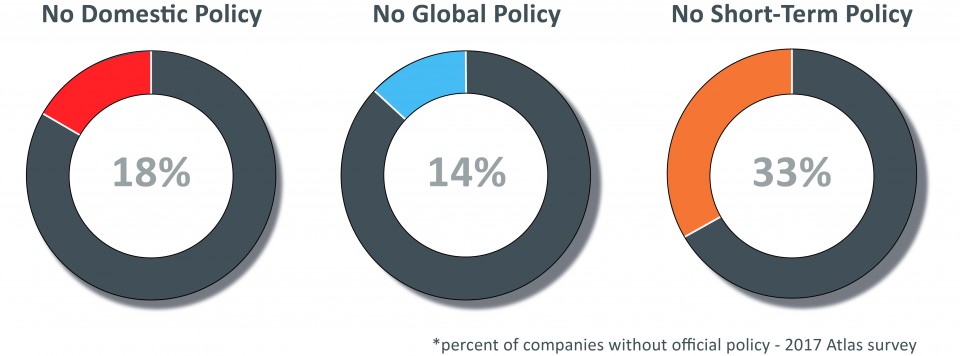
If you infrequently transfer employees and your transfers are mainly US Domestic an “offer letter” is as effective as a standard policy. When writing the “offer letter”, it’s important to clearly define the benefits offered. However, if you transfer more than a handful of employees annually then a well defined tiered relocation policy is recommended.[divider line_type=”No Line” custom_height=”1″]

Percentage of companies without official relocation policies

[divider line_type=”No Line” custom_height=”25″]

Myth 2: Lump sum programs save the company money.

[clickToTweet tweet=”When given a lump sum employees often cut corners with their relocation and pocket additional funds” quote=”When given a lump sum employees often cut corners with their relocation, pocketing additional funds” theme=”style3″]
Although a lump sum is a perfect solution for the college graduate new hire, it is rarely recommended for a more professional level of employee. The fact is, by cutting a lump sum check the employee often cuts corners with their relocation and then pockets the additional money. There are also tax disadvantages with the lump sum. If the company is not grossing up the lump sum, there are FICA taxes required to be paid by the company. If the company is not offering tax assistance, the amount of taxes that are withheld are significant and the employee is then paying tax on a benefit that is non taxable if the funds are used for the household goods move. There are also liability concerns with the employee choosing to rent a UHAUL and moving themselves. Bottom line is that the employee ends up being more stressed and unable to focus on the job since they are coordinating all aspects of their move.

[divider line_type=”No Line” custom_height=”40″]

Myth 3: Unpacking is a dream come true.

Reality is, unpacking can be a nightmare. Unpacking in the moving industry consists of the crew removing everything out of the boxes and placing it on the closest flat surface. It will be placed in the correct room, but will not be put away in cabinets or closets. Many people prefer to unpack at their leisure, prioritizing the most critical items first, and have it out of sight until they have time to get to it.

A recommended solution is to replace unpacking with debris pick-up which involves having the mover come pick up the boxes and materials when the unpacking is complete.   An additional advantage is that it saves the company between $300 and $1,000 per move.
[divider line_type=”No Line” custom_height=”20″]

Myth 4: Millennials only want self service options. 

[clickToTweet tweet=”While millennials love online resources, we find they lean heavily on relocation coaches.” quote=”While millennials love their online resources, we find they lean heavily on relocation coaches.” theme=”style3″]

I’ve heard time and again that millennials are all about self service, and would rather manage their own relocation via digital resources rather than speaking with a live relocation consultant. While millennials do tend to use more online resources than previous generations, we find this statement to be extremely false. In fact, most Millennials often need even more hand holding than the standard executive transferee since it may be their first time moving, first time buying or selling a home and may be inexperienced with relocation in general. Due to the newness of it all, they may have personal questions about how to navigate through breaking a lease or what neighborhood would best suit their lifestyle, etc.

Millennials will still rely on social networking websites like Facebook and LinkedIn to make virtual friends or connections at their new location even prior to moving there.[divider line_type=”No Line” custom_height=”20″]

Myths 5-12:

We put the industry’s most common assumptions to the test in our latest white paper for 2016.

These 12 Relocation Myths can hinder your relocation program, and even the effective management of your employee's relocation services!


Categories
Corporate Relocation Global Relocation Global Relocation Challenges

European Court of Justice Rejects Safe Harbor

European Court Rejects Safe Harbor: On October 6th, the European Court of Justice declared the US – EU Safe Harbor Framework invalid on several grounds which may create complications with cross Atlantic transfers of personal information. As a brief overview, the ECJ found that while the Safe Harbor framework did meet requirements in holding US companies accountable for the privacy of personal data transmission, it could not ensure or protect the privacy rights of EU citizens from public US institutions.

server-room European Court Rejects Safe Harbor

“The ECJ found Safe Harbor Framework insufficient in privacy protections.”
[divider line_type=”No Line” custom_height=”30″]
What was the EU SafeHarbor Framework?

Up until October 6th EU Safe Harbor provided U.S. companies the ability to transfer personal data from the EU to the US while complying with privacy rights provided to European Citizens under the EU Data Protection Directive. Companies would “self-certify” or confirm that they met the EU’s minimum requirements for data protection with the Department of Commerce and provide a public copy of their company’s privacy policy (accessible on company websites). The Federal Trade Commission acted as the enforcement arm of the agreement, investigating complaints and ensuring that companies kept the promises made during self certification.

The Max Schrems Complaint
The Schrems case came about when an Austrian law student brought concerns to the ECJ that his private Facebook data, in transfer from Ireland to the United States, did not comply with EU privacy rights. Schrems claimed that Public US institutions (such as the NSA) frequently mined data from US companies without oversight essentially violating his right to privacy as a citizen of the EU. After reviewing Schrems complaint, the ECJ came to the same conclusion and ruled the self certified approach invalid.

European Court Rejects Safe Harbor – Impact and Solutions
If your company transfers employee data from the EU to the US and used Safe Harbor to self certify, your company is no longer in compliance with EU regulations. However… don’t panic! Keep calm and consider implementing Model Contract Clauses or MCCs. There are 3 sets of model contract clauses provided by the EU to help corporations comply with EU privacy laws. Whether some or all clauses should be implemented at your organization depends on how your organization handles private information. For your convenience we’ve added the links to the 3 standard clauses recommended by the European Commission:

  1. EU controller to Non-EU controller Set 1
  2. EU controller to Non-EU controller Set 2
  3. EU controller to Non-EU processor

Depending on your organization’s international structure, you may also consider implementing “Binding Corporate Rules” which according to the European Commission are:

“internal rules (such as a Code of Conduct) adopted by multinational group of companies which define its global policy with regard to the international transfers of personal data within the same corporate group to entities located in countries which do not provide an adequate level of protection.

Final Thoughts and Necessary Disclaimer
While the information we’ve provided is accurate and sourced from the European Commission, we advise all organizations to consult with their legal team and/or representatives before taking any action. This article is intended to provide a leg up on the history and research currently available on the topic of European Court Rejects Safe Harbor consolidated into a single article and should be used for informational purposes only.

[divider line_type=”No Line” custom_height=””]Brought to you by Global Mobility Solutions, a trusted partner in global talent management.[divider line_type=”No Line” custom_height=””]

Categories
Corporate Relocation Global Relocation Relocation Challenges

The Yuan Effect on Global Real Estate

The recent devaluation of Chinese yuan could prompt China’s real estate investors to look towards the global real estate market to protect their investments. Capital is expected to move far from developing markets to be safe from increasing currency risks. There are expectations however that extreme wealthy Chinese real estate investors and developers will invest heavily in an established economy like the US before further yuan devaluation. Thomas Lam, a Senior Director and Head of Valuation & Consultancy with Knight Frank states, “mainlanders mostly buy overseas homes for immigration, for their children who are studying abroad or as holiday homes. They will be unlikely to sell in haste unless significant problems arise with that country’s property market such as political unrest.” Decisions to invest in the United States housing market will rest on how the Xi markets hedge the Renminbi against their currency or the industrial sector.

The Yuan's Progressive Decline

Although the yuan is projected to slip further, wealthy Chinese investors and developers will likely convert their money into other currencies or purchase properties in different countries with higher yields as an approach to fence hazard. David Crowe, NAHB Chief Economist, assures our economy to be healthy, “since the affordability had edged slightly lower in the second quarter. The Housing Opportunity Index (HOI) will remain well above 50. And where half the households can afford half the homes sold, low mortgage rates, pent-up demand and continued job growth should contribute to a gradual, steady rise in housing throughout the year.”

Countries such as Korea, Russia, Portugal and as of late New Zealand will continue to witness investment influx from mid-level Chinese investors as properties in developed economy like the United States may prove to be a greater expense. Some market experts say, more Chinese investors will invest in other countries as they seek diversification. It’s likely to witness a slight drop in the reported investment flow from China when reported in US dollars; one of the effects of yuan devaluation.


Records also show that “China is the largest investor in the American real estate sector over the last year”.  According to Michael Cole, an editor with Mingtiandi, “Chinese investors have already put $13.4 billion into overseas real estate this year, with over $3 billion heading to the US.” This confirms Chinese real estate developers today are experienced when it comes to foreign investment and their decision to invest in any country. However, the level of investiture will depend chiefly on the availability of properties and good exchange rates.

Categories
Corporate Relocation Domestic Relocation Global Relocation

Global Mobility Solutions Sponsors Global Workforce Symposium

SCOTTSDALE, Ariz., Sept. 1st, 2015 Global Mobility Solutions announces sponsorship of the 2015 Global Workforce Symposium, the annual gathering of relocation professionals from across the world.  This year’s Global Workforce Symposium will be held at Boston’s Hynes Convention Center from October 7–9. Global Mobility Solutions will be exhibiting at the event at booth 518.

GWS 2015 Sponsored by Global Mobility SolutionsWorldwide ERC’s Global Workforce Symposium is the largest conference of its kind.[divider line_type=”No Line” custom_height=”30″]
“Support of Worldwide ERC and participation in this global mobility event is very important to us” says GMS Executive Vice President Michael Setze. “ The chance to learn and share industry expertise with clients, prospective clients, and other workforce mobility professionals is exceptional. We also feel that Worldwide ERC provides strong value with their Certified Relocation Professional (CRP) and Global Mobility Specialist (GMS) certification programs. All of our relocation coaches have earned their CRPs.”[divider line_type=”No Line” custom_height=”30″]

The Global Workforce Symposium is organized annually by Worldwide ERC, also known as the Workforce Mobility Association. Founded in 1964, the organization’s membership includes individuals from diverse fields like HR, recruiting, consulting, relocation and real estate. Worldwide ERC holds the Americas Mobility Conference each spring and the Global Workforce Symposium each fall.

The upcoming symposium will feature a diverse slate of events. Keynote speaker Lisa Bodell, CEO of Futurethink and a board member of the Women’s Congress, will share her provocative insights on modern organizations. Peer 2 Peer Case Study sessions will provide an educational opportunity for attendees. Each 30-minute session presents best practices for specific workforce mobility challenges.

“Nearly 4 out of 5 employees are willing to relocate for the right opportunity, including millennials” adds Setze. “Our role is to help companies facilitate and manage the relocation process. Sponsoring and attending the Global Workforce Symposium is another means for us to be an integral part of the industry’s growth and evolution.”

[divider line_type=”No Line” custom_height=”30″]

About Global Mobility Solutions

Founded in 1987, Global Mobility Solutions is a global corporate relocation services company that specializes in workforce mobility. The company’s corporate relocation services include global assignment management, domestic relocation management and a range of pre-decision solutions. Global Mobility Solutions is a back-to-back winner of HRO Today’s 2014 and 2015 customer satisfaction survey, and rated #1 in the relocation services industry for breadth of services.

Contact:

Thomas Belnap
Marketing Director
800-617-1904 ext. 8832
[email protected]

Categories
Corporate Relocation Domestic Relocation Global Relocation

Powerful Cloud Relocation Technology Unveiled

SCOTTSDALE, Ariz., July 28, 2015 ­ Global Mobility Solutions (https://gmsmobility.com), a leader and innovator in the relocation and talent mobility space, has launched a proprietary, cloud-based MyRelocation technology solution for clients and their relocating employees. MyRelocation technology provides industry-leading tools and services along with advanced 24×7 information access from any device. These solutions support and empower corporate relocation programs across the globe.

MyRelocation Technology | Mobility Cloud TechnologyThe MyRelocation login shown on multiple devices, the cloud technology features a modern responsive design.[divider line_type=”No Line” custom_height=”30″]

“We are committed to offering the best technology value-added services for our clients,” says Global Mobility Solutions (GMS) President Steven Wester, “with a focus on providing the highest level of personal service and attention. Cloud-based MyRelocation technology achieves both of these objectives and underscores our continual focus on providing forward-thinking solutions and unparalleled value.”[divider line_type=”No Line” custom_height=”25″]

MyRelocation technology has been designed from the ground up with feedback from hundreds of human resource professionals and their transferring employees. A convenient transferee dashboard unlocks a wealth of information and functionality, from downloadable relocation guides to interactive Google Maps™ pre-programmed with origin and destination data. Relocating employees can view and track initiated services, submit expenses and connect with their relocation coach all with a few clicks. MyRelocation works with any connected device on any platform, with a responsive design that makes for unmatched ease of use on desktop, mobile or tablet devices.

“Simplicity was a high priority”, said Marketing Director Thomas Belnap. “Many technologies today offer complex dashboards with a melee of options. MyRelocation technology consolidates all of that to deliver a straight forward and intuitive user experience.”

This approach to simplicity is immediately apparent upon logging in to the customizable management dashboard. Initiating new employee relocations can be managed and activated on a single screen. According to GMS executives, MyRelocation also features over 200 customizable reports available on demand. Additionally, MyRelocation features an extensive “Relocation Knowledge Base” drawing upon decades of industry expertise and research. A selection of white papers, blog articles, and other valuable information helps both relocating employees and their employers.

Check Out The New MyRelocation FeaturesCheck Out the New MyRelocation Features

About Global Mobility Solutions

Founded in 1987, Global Mobility Solutions is a global corporate relocation services company that specializes in workforce mobility. The company’s corporate relocation services include global assignment management, domestic relocation management and a range of pre-decision solutions. Global Mobility Solutions is a back-to-back winner of HRO Today’s 2014 and 2015 customer satisfaction survey, and rated #1 in the relocation services industry for breadth of services.

Contact:

Thomas Belnap
Marketing Director
800-617-1904 ext. 8832
[email protected]

Categories
Corporate Relocation Domestic Relocation Global Relocation

Global Mobility Solutions Recognizes Top-performing Relocation Industry Partners at 2015 Forum and Awards Dinner

SCOTTSDALE, Ariz., Mar. 03, 2015 – Global Mobility Solutions, an international leader in corporate relocation services, recently hosted its 2015 Forum and Awards Dinner to honor members of its Premier Alliance Network who have shown extraordinary dedication to customer service throughout the year.

Armbruster Moving of Mayflower Transit received Platinum Partner of the Year award, while Unipack Global Relocation accepted honors for International Partner of the Year. Atlas Van Line providers V. Santini, Inc. and Lytle’s Transfer and Storage were awarded Silver and Gold Partners of the Year, respectively.

Adam Lowy, founder of non-profit Move For Hunger, speaking at GMS 2015 Forum & Awards Dinner | Service Unplugged.
[divider line_type=”No Line” custom_height=”30″]
The theme of this year’s forum was “Service Unplugged,” a nod to the fact that great customer service begins at the personal level – and that technological conveniences are merely tools. The event was held on February 5th at the Hotel Palomar in Phoenix. Hal Becker, bestselling author and renowned expert on customer service and sales, delivered the keynote address. Following Hal Becker’s Keynote speech, a Global Mobility Solutions Client Q&A Panel was held, where partner’s top priorities were discussed in depth. Guest speaker Adam Lowy, founder of Move For Hunger, offered some compelling remarks on how the relocation industry, and GMS in particular, have made tremendous strides toward ending food insecurity. In addition to guest speakers, the 2015 forum featured breakout education sessions between providers and Global Mobility Solutions’ leadership, discussing customer service improvements and efficiency.[divider line_type=”No Line” custom_height=”30″]

“Our 2015 forum and awards dinner was an opportunity to celebrate and recognize exceptional service within the Global Mobility Solutions’ Premier Alliance Network. I’d like to personally congratulate this year’s winners, who have consistently demonstrated the highest standards in customer service,” remarked Steven Wester, president of Global Mobility Solutions. “We simply can’t do what we do without the participation and support of these fine partners – they’ve contributed immensely to making our brand a trusted leader.”

Global Mobility Solutions 2015 Forum and Awards Dinner Keynote Speaker Hal Backer Posing with GMS President Steven Wester. From left: GMS Vice President of Global Services John Fernandez, Keynote Speaker Hal Becker, GMS President Steven Wester, GMS Chief Administrative Officer Fayette Wester.
[divider line_type=”No Line” custom_height=”30″]

“Service Unplugged” evokes the core, hands-on attributes that define winning customer service. For GMS, that means giving individuals and families the most seamless possible relocation experience – allowing them to focus on starting a new life in a new city rather than worrying about logistics. In selecting this year’s award winners, GMS relied on its in-house scoring system that grades the performance of every member of its Premier Alliance Network. On-time performance and claims are among the factors that generate a partner’s score, but customer satisfaction is the most heavily weighted data point.

About Global Mobility Solutions

Founded in 1987, Global Mobility Solutions is a global corporate relocation services company that specializes in workforce mobility. The company’s corporate services include global assignment management, domestic relocation management and a range of pre-decision solutions. Global Mobility Solutions was ranked second in the relocation industry for overall customer satisfaction in HRO Today’s Annual Relocation Survey.

View the full corporate relocation forum gallery on Facebook

Contact:

Thomas Belnap, Marketing Director
800-617-1904 ext. 8832
[email protected]

Categories
Global Relocation Global Relocation Trends

Changing real estate trends in Germany may affect assignee housing decisions

The real estate market in one of the most powerful economies in Europe is undergoing a major shift. History has shown Germans would much rather rent their homes than buy them, which may explain the country’s 43 percent home-ownership rate in 2013. However, this trend has recently shifted in a way that could impact global mobility down the road – particularly the way assignees go about finding a place to live.

A nation of renters
According to a recent article by digital business news outlet Quartz, Germans began renting in the 1930s and 1940s. After West Germany was established in 1949, the government created its first housing law. The law was designed to boost the construction of houses, and by 1956, the nation cut its housing shortage in two. Few Germans had enough money for a down payment on a house, though. The mortgage market was weak, so banks required citizens to front large sums of money for home ownership. As a result, the renting trend was born.

History has shown Germans would much rather rent than buy their homes, which may explain its 43 percent home-ownership rate in 2013. “History has shown Germans would much rather rent than buy their homes, which may explain its 43 percent home-ownership rate in 2013.”


Cheap rent has been a real estate mainstay for many years in Germany, partly because rent increases are capped at 15 percent over three years. Regulations prevent any increase in rent whatsoever during a tenant’s first year. For those living in urban areas where demand is high, new rent prices will be capped at 10 percent more than the area average, thanks in part to new rent brake legislation signed by Prime Minister Angela Merkel’s cabinet in January, national news outlet DW reported.

Government legislation in Germany traditionally favors renters over homeowners, which isn’t surprising considering this demographic has represented a large portion of the population for many years. For example, the German government does not allow homeowners to deduct mortgage-interest payments from their taxes; a sharp contrast to the benefits of homeownership in the United States.

Times are slowly changing
Despite the federal regulations favoring renters and cheap rent prices, real estate trends appear to be changing in Germany. According to the Cologne Institute for Economic Research, Germany experienced a sharp increase in the number of people buying homes between 2009 and 2013. This trend is largely due to the fact that people are taking advantage of low interest rates throughout the country. What’s more, foreign investors are showing great interest in the nation’s real estate.

Although there is legislation capping rental prices at 10 percent above market average in urban areas, that only limits price increases so much year over year. Research from the VDP Association of German Mortgage Banks found rent for newly leased apartments rose 4.6 percent year over year between the third quarter of 2013 and 2014, Bloomberg recently reported.

That, in conjunction with low interest rates and easy financing for property purchases, has home ownership growing in popularity in Germany. Home values have climbed 5.2 percent from last year, and multifamily housing also jumped more than 7 percent in value. Assignees relocating to Germany can take advantage of low-interest rate mortgages, particularly in Eastern Germany. The CIER’s five-year analysis of 402 German counties revealed that side of the country is a highly feasible region for buying a property. Assignees relocating to Germany can take advantage of low-interest rate mortgages, but need to ensure they consider all of the financial impacts. Higher down payments are usually required from expats because they represent a higher financial risk. Additionally, consideration must be given towards disposing of the property and any potential capital gains tax that might be owed if they relocate again.

Brought to you by Global Mobility Solutions, a trusted partner in global talent management.

Looking for something?