

Categories
Global Relocation Global Relocation Challenges Global Relocation Trends Immigration Rules Relocation Challenges

Switzerland Employers Must Communicate Job Openings in Occupations with Higher than Average Unemployment

Employers must communicate Switzerland job openings in occupations that have higher than average unemployment rates starting July 2018, according to a December 8, 2017 Federal Council decision. The Federal Council may issue a list of the occupations subject to mandatory communication of openings in early 2018. The Federal Council’s requirement for mandatory advertisements will start July 1, 2018 for positions that have 8% or higher unemployment, and then increase on January 1, 2020 for positions that have 5% or higher unemployment.

What is the Switzerland job openings issue?

An initiative called “Against Mass Immigration” was adopted by Switzerland on February 9, 2014. This initiative called for quota limits on immigration. However, the Swiss Parliament passed a compromise immigration law in 2016, hoping the country could continue to have its enhanced access to the European Union’s single market. The new law required employers to advertise job openings in occupations with higher than average unemployment at job centers and to prioritize local residents prior to recruiting from outside the country. Since the implementation of the “Against Mass Immigration” effort is coming to an end after four years, the new requirement aims to continue to give local job seekers priority in job openings in sectors with higher than average unemployment.

Who does this requirement affect?

Employers based in Switzerland planning to hire workers from outside the country.

What is the new requirement?

Under the new requirement, employers must advertise their job openings with the local job center and then wait five business days before advertising these openings through other venues. The local job center must forward applications from local job seekers who meet the requirements of the job opening within three business days. Companies must invite local candidates that meet the requirements of the job opening to an interview. They must also report the job openings they are able to fill through this channel to the job center. The temporary withholding of job opening information helps job seekers who are registered with the local job center to get priority access to the job advertisements.

Conclusion

Global Mobility Solutions’ team of global relocation experts have helped thousands of our clients with country-specific employment requirements, and we can help your company understand how to comply with Switzerland’s new job opening and advertising rules. Contact our experts online or give us a call at 800.617.1904 or 480.922.0700 today.

Categories
Immigration Rules Visas and International Travel

EU Citizen Rights: Arriving in UK During Post-BREXIT Transition May Not Secure Same Rights

EU citizen rights are not secure for those arriving in the UK during the post-BREXIT transition. Prime Minister Theresa May indicated EU citizens arriving post-BREXIT may not receive the same rights as those who arrived prior to the vote. Prime Minister May said while the details were a matter for negotiation with the EU, she is clear that there is a difference between the EU citizens who were in the UK prior to the vote, and those who arrive afterward, knowing the UK is leaving the EU.

What is the question on EU citizen rights?

Prime Minister May believes the government is doing what the British people asked the government to do, which is to deliver on the promise of BREXIT. As such, complete freedom of movement for EU citizens into the UK post-BREXIT is not supported during the transition period.

Prime Minister May has stated that EU citizens who arrive during the post-BREXIT transition must not have the same rights as those EU citizens within the UK prior to the vote. Prime Minister May has been very appreciative of the contributions EU citizens residing in the UK have made, and has clearly stated that “EU citizens living lawfully in the UK” will be able to stay in the UK post-BREXIT.

Who does this EU citizen rights issue affect?

  • Employers who have EU citizen employees currently residing in the UK.
  • EU citizens who arrive in the UK during the post-BREXIT implementation period and who are seeking residency.

What should employers and citizens expect from this EU citizen rights issue?

There may be an increase in applications for residency in the UK in response to Prime Minister May’s comments. Although the European Parliament believes citizen’s rights during implementation are in full effect and are not negotiable, Prime Minister May’s statements indicate negotiations on this point have not been finalized in her view. EU citizens may want to expedite their applications for residency with the expectation that a firm deadline will be negotiated.

Conclusion

Global Mobility Solutions’ team of global relocation experts have helped thousands of our clients manage relocation to the UK, as well as understand how BREXIT will impact their programs. We can help your company understand the impact of this EU citizen rights issue, and how to submit applications for residency in the UK. Contact our experts online or give us a call at 800.617.1904 or 480.922.0700 today.

Request your complimentary Visa Program Assessment

Categories
Corporate Relocation Global Mobility Global Relocation Global Relocation Challenges Global Relocation Trends Relocation Challenges Relocation Management Visas and International Travel

Germany Implements ICT Directive

Will you or your transferees be affected?

What has changed?

Effective immediately, Germany Implements ICT Directive – the German parliament has implemented an ICT Directive which intends to regulate the conditions for entry and residence of thirty-country nationals within the intra-company transfer (ICT) process.

Who is affected?

  • Employees working at the same group of companies for at least six (6) months being sent to Germany on an intra-company transfer
  • Employees working at the same group of companies for less than six (6) months intending to be sent to Germany on an intra-company transfer
  • Clients transferring employees to the same group of companies from another EU country to Germany

What to expect

The ICT Directive provides two different categories: firstly, third-country nationals who want to enter Germany directly from their home country (third-country); secondly, third-country nationals who already hold an ICT residence permit in another European Union (EU) Member State and are transferred to Germany for short or long-term transfer within the same group of companies.

The law divides it as follows:

1) ICT card for intra-company transferred workers (third-country nationals) must fulfill the following requirements:

  • Transfer must take place within the same company group
  • The employee must be either a leader (e.g. manager with leading function) or a specialist
  • Employee must have been with the company for at least six (6) months
  • The transfer must be for more than ninety (90) days, but cannot exceed three (3) years
  • An approval from the Federal Employment Agency must be obtained in advance
  • For the duration of the transfer, the assignee must have a valid assignment contract with his/her home employer and return to the home entity after the transfer
  • The remuneration (salary and monetary benefits) and working conditions (working time, leave, wage advancement in case of illness, etc.) must be comparable with a local employee

2a) Short-term mobility for intra-company workers (third-country nationals) must fulfill the following requirements:

  • Application in Germany up to ninety (90) days within 180 days
  • The assignee has a valid residence permit issued by another EU Member State pursuant to the ICT Directive
  • Proof that the domestic branch office belongs to the same company/group
  • Must have a valid passport
  • Confirmation on the entitlement to enter and residence for the purpose of intra-company transfer issued by the Federal Office for Migration and Refugees (Bundesamt für Migration und Flüchtlinge BAMF)

2b) Mobile ICT Card must fulfill the following requirements:

  • Transfer must take place within the same company/company group
  • The assignee must either be a leader (e.g. manager with a leading function) or a specialist
  • The assignee has a valid residence permit issued by another EU Member State according to the ICT Directive
  • The transfer is for more than ninety (90) days
  • An approval from the Federal Employment Agency must be obtained in advance
  • For the duration of the transfer, the assignee must have a valid assignment contract with his/her home employer and return to the home entity after the transfer
  • The remuneration (salary and monetary benefits) and working conditions (working time, leave, wage advancement in case of illness, etc.) must be comparable with a local employee

If the application was submitted at least twenty (20) days before the start date of the assignment and the assignment has already been submitted to the authorities of the other EU Member State on the first application, the stay and assignment in Germany will be allowed for a period of up to ninety (90) days before the decision was made by the German authorities.

Please note there will be a period of transition as Germany Implements ICT Directive and the authorities will need some time to get use to the new process. We anticipate having more details on the practical implementation and application procedures to share with you in the near future.


Modern Mobility Made Easy™

Planning ahead

To learn more about Germany Implements ICT Directive or any other issues that affect you or your mobile employees, be sure to speak with one of the Global Consultants at Global Mobility Solutions. From pre-decision to visa and immigration to language and cultural training, GMS has the award-winning programs and innovative technology to make relocating your employees and tracking their expenses simple and worry-free.

Request your complimentary Visa Program Assessment

Provided by Global Mobility Solutions network partner Emigra World News

Categories
Global Mobility Global Relocation Global Relocation Trends

Top 5 European Relocation Destinations

Which countries are attracting the most transferees?

While the United States is still the world’s top destination for relocation, there are still many companies relocating employees to work in Europe. A recent study of large corporations, that included the data of over 160,000 relocations covering 150 countries, revealed the Top 5 European Relocation Destinations for relocation.

London-England-White-Tag

#1 – United Kingdom
It is no surprise that the UK tops the list again. It’s long presence as a world financial center and home to headquarters of many large global companies makes the UK the leader in importing assignees and new hires. The fact that it is an English-speaking country allows for an easy transition for transferees from most countries. Cities like Bristol, Cardiff, Edinburgh, and London are top destinations for relocation assignments.

Zurich-Switzerland-White-Tag

#2 – Switzerland
Switzerland has one of the highest standards of living in the world. Home to the headquarters of many Fortune 500 corporations like Zurich Insurance, Novartis, UBS AG, and, of course, Nestle, this small nation is big on jobs. The four official languages of Switzerland are French, German, Italian, and Romansh. However, some say the fifth, though unofficial, language is English, Transferees on assignment from the United States should have no problem conversing and conducting business in Switzerland.

Amsterdam-Netherlands-White-Tag

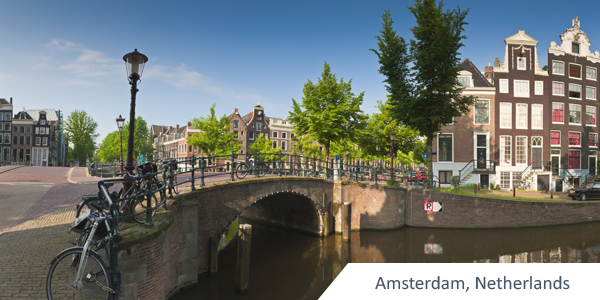
#3 – Netherlands
The Netherlands has one of the lowest rates of unemployment in Europe, and when combined with the 30 percent tax-free allowance available to people moving to work in the Netherlands, makes the country an attractive work destination. There is little to no culture shock when moving to the Netherlands from another Western country. Almost everyone is tolerant of non-Dutch speakers and has been taught to speak English from a young age. They also have an inclusive culture that isn’t materialistic, in which employers, employees and people of all ages socialize.

Berlin-Germany-White-Tag

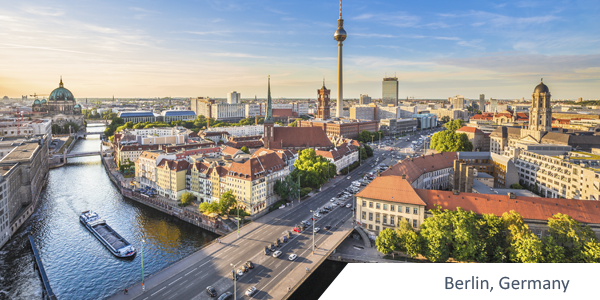
#4 – Germany
Germany’s job market is strong and the country’s working conditions are very good. The much-prized apprenticeship program has helped keep youth unemployment down. In contrast to many other countries, vocational education is properly valued in Germany and manual professions are considered equally prestigious as desk jobs. Germany is well-structured country with specific rules which makes living and working very organized. However, life is not all toil in the country. Germans know how to have fun, too. The country boasts an excellent work-life balance. Currently, Dresden has outpaced Berlin as the hot real estate location.

Dublin-Ireland-White-Tag

#5 – Ireland
Ireland is leading the tech boom in Europe. Practically all of the biggest tech and pharma companies in the world, including Google, Facebook, Apple, and Twitter, have their European HQs in Ireland. People in Ireland take their vacations seriously. It is customary for companies to offer 20 days of annual leave and they really want employees to use them. Housing is available for any budget. Those coming from the United States will feel very little culture shock as the people in Ireland are extremely accommodating and speak English. This beautiful country boasts great festivals, manic sports fans, and world-class educational institutions. Dublin is rapidly becoming a strong economic center, not only for Europe, but for the world.

Modern Mobility Made Easy™

What this means for you and your mobile workforce

If you plan on sending talent or importing talent to or from any of these Top 5 European Relocation Destinations, you will want to ensure that they are properly prepared. Global destinations spotlights offered by Global Mobility Solutions highlight the city information your transferees will need to know about their assignment locations. These guides will brief them on the city’s cost of living, arts and entertainment, visas and permits, schools, and other information necessary to adapt and be successful in their new country.

View the Global Mobility Solutions global spotlights now!

Destination-Spotlights-Button

Looking for something?