Categories
Corporate Relocation Corporate relocation tips Domestic Relocation Domestic Relocation Challenges Domestic Relocation Tips Global Mobility Global Relocation Global Relocation Challenges Relocation Challenges

5 Steps to a Successful Year-End Process

While most people are happily preparing for the holidays, you’re scrambling through the year-end reconciliation of all of your relocation expenses. Well, even though it’s only November, here is a gift that will help you not only navigate this year, but help you to have a successful year-end process for years to come.

Though many relocation managers might prefer battling crazed Black Friday crowds to year-end reporting, the process tends to go more smoothly when run by the relocation department. To maximize efficiency, be sure to utilize these five steps:

  1. Create a year-end checklist. A detailed checklist will help identify all of the information you need to accurately report year-end compensation. Your checklist should include due dates, responsible individuals and departments. Establishing the responsibility for reporting all of the relevant compensation data is an important component, and can include wages, imputed income, benefits, equity, taxes, and more. This year-end checklist will help you identify all the resources you will need to create a complete and accurate report. Your itemized checklist needs to include items such as early cutoff dates and all employees who will receive the tax filing services (employees on the tax eligibility list), as well as provide for the time needed for verification, approval and processing. A well-developed checklist will also set firm deadlines for the reporting and tax filings.
  1. Set up a year-end preparation call. When setting due dates, be cognizant of the vacation times made mandatory by some countries around the end of December. During the call, review your year-end checklist with all involved parties to ensure that they are aware of their role and due dates. Use this call as an opportunity to build understanding and develop relationships that will make year-end reporting easier in the future. If you have not already held a year-end preparation call, schedule one as soon as you finish reading the rest of this article!
  1. Verify all of your data! Accuracy is vital, especially when it comes to compensation reporting. Data such as addresses and tax ID numbers/Social Security numbers should be confirmed, as well as wages, benefits, sick and vacation time. Double-checking data prevents backtracking and costly errors down the line.
  1. Finalize your data. Make sure that the final payroll reports of the year have been included, plus any end-of-the-year benefits. Be sure to back up the program data again and be sure to save it in a secure location should it need to be referenced in the future.
  1. Get ready to submit your report. Double-check the deadlines for all the countries on your list and be prepared to provide specific data for each. Tax providers may ask for data for different assignee/transferee populations. Be sure to adhere to your year-end deadlines and, whenever possible, send the data ahead of time. Some international locations may have very tight turnaround times to make that final tax payment of the year.

As with anything, practice makes perfect. The more you follow these five steps, the easier year-end reporting will become for you and you can be confident of a successful year-end process.

Learn more about how to save time and money while managing your corporate relocations.

Categories
Corporate Relocation Domestic Relocation Global Relocation

3 Ways to Save with Global Mobility Programs

Save With Global Mobility Programs – The saying goes that it takes money to make money, and global mobility is no exception. Even though you understand that the talent you on-board or relocate will help your organization grow and prosper, getting the transferees from their origin to their destination locations can be expensive. Don’t be discouraged, there are several ways to save when creating your global mobility policies.


Use a tiered approach

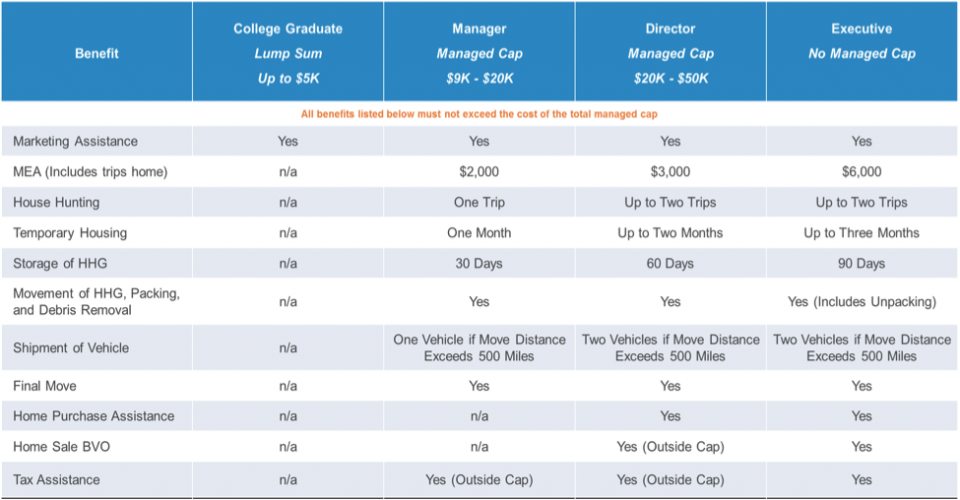
Not all employees are equal, therefore their relocation compensation shouldn’t be the same. It would make sense to pay the recent college graduate new hire substantially less than the amount awarded to a seasoned, executive-level employee. Additionally, not everyone requires the same amount of time to complete his or her move. Services can be tiered with regard to what they offer. For example, home-finding tours can be broken into half-day, one-day, or two-day options, then offered accordingly per your mobility policy. Tiered categories can be sorted by homeowners versus renters, or by how many school-age children a transferee has. Allowances for the shipping of household goods and vehicles can also be tiered based on the transferee’s position and distance to the destination location. It is very important to clearly state the various tiers in the company’s relocation policies. Tiered policies have been proven to reduce costs versus standard lump sum programs.

Below is an example of a tiered relocation policy based on position seniority:


Tiered-Policy-Sample global mobility programs


Bundle your services

As a company builds a relocation policy, it has many different services from which to choose – Pre-decision alone has over 30. By bundling various services together, such as home sale, household goods shipping, community tours, mortgage assistance, etc., companies can see significant savings. Typically, bundling can save companies up to 20% of what the services would cost individually.


Outsourcing

Lastly, by outsourcing mobility management needs to trusted, experienced, relocation experts, HR personnel can remain focused on department-specific tasks, such as enforcing company policies, finding new talent, and administering benefits and compensation. When expert mobility coaches guide transferees and their families through the relocation process, less calls are made to or by the human resources representatives. Generally, when working with a mobility management company, transferees arrive at their destinations happier, less stressed, and ready to work. In short, it saves sanity.


To learn more about the benefits of incorporating a mobility management company into your global mobility programs, please read Domestic Relocation Services and Global Relocation Services. You may also contact a GMS mobility specialist to get program details customized for your company’s specific needs.

Looking for something?