

Categories
Domestic Relocation Tips Domestic Relocation Trends Global Relocation Global Relocation Tips Household Goods Relocation Best Practices Relocation Management Relocation Programs

What are the Critical Questions to ask a Relocation Management Company?

Many companies approach their relocation program without a full understanding of what questions they should ask of a Relocation Management Company (RMC). Knowing which critical questions to ask is highly important for a company to get a full understanding of how the RMC will manage their relocation program. Missing critical questions can lead to a large gap in expectations and performance. It is in each party’s best interests to be sure the most important questions are asked, and answers returned for review and decision-making.

Global Mobility Solutions’ team of global relocation experts have identified 28 critical questions that they believe companies should ask an RMC. Answers to these questions will provide the company with the most critical knowledge they need in order to make confident and fully informed choices for their relocation program’s design and functionality.

The following five critical questions are representative samples of the types of questions that you should ask an RMC.

Five Representative Critical Questions:

1. What is your service delivery model?

Fully understanding the RMC’s service delivery model is of paramount importance to understanding how the RMC will manage your company’s relocation program. Purchasing relocation management is a much different process than sourcing parts or equipment. Ensuring the right fit for the right reasons is the most important factor when sourcing employee-facing services.

2. Describe your supplier network. Do you own or are obligated to provide business to your suppliers?

It is important to understand if the RMC owns their suppliers, or are in some way obligated to provide business to their suppliers. If this is the case, transferees may not have the ability to choose the provider they want for their relocation process. In some cases, fully qualified suppliers who would provide lower costs might not be able to provide services.

3. How do you ensure competitive pricing from your supplier base?

This is one of the critical questions that will provide great insight into how the RMC operates. In some cases, RMCs will provide for competitive pricing by opening up bidding to multiple suppliers. In other cases, an RMC will try to explain that they can provide competitive pricing by leveraging their own network and spreading costs over a large number of transferee relocations. Be sure you understand what these different responses actually mean. Either the RMC ensures competitive pricing by promoting competitive bidding, or they do not promote competitive bidding.

4. What metrics and service level agreements do you track and report on?

Service level agreements (SLAs) should be a standard part of an RMC’s quality program. Service quality promises might include on time delivery guarantee of household goods, or specific performance guarantees based on transferee ratings. SLAs might cover real estate services, household goods moving, destination services, and financial and reporting services.

5. How do you utilize technology in your approach to relocation management?

RMCs should have technology to complement their service models. Companies, their transferees, and their candidates should expect a seamless relocation experience. Look for RMCs that can provide a superior, proprietary, cross-platform, online relocation management suite. Systems should provide clients and their transferees an array of decision-making, tracking, and expense management tools, with anywhere, anytime access 365 days a year and 24 hours a day.

What should companies do with the answers they receive?

Companies should compare the answers they receive from each RMC to ensure they provide the desired result. Information should be complete, and the answers should be direct and clear without any cause for confusion. Good responses will help the company determine how the RMC will manage their relocation program. Companies should be sure to ask all 28 Critical Questions in order to get the best overall responses.

Conclusion

Global Mobility Solutions’ team of global relocation experts has helped thousands of our clients with their relocation programs. We can help your company understand which critical questions to ask of an RMC. These questions will help ensure you address the most critical relocation program points. Learn how to choose the best Relocation Management Company from Global Mobility Solutions, the relocation industry and technology experts who are dedicated to keeping you informed and connected. Contact our experts online or give us a call at 800.617.1904 or 480.922.0700 today.


Download the 28 Critical Questions to ask an RMC when submitting an RFP

Categories
Corporate relocation tips Domestic Relocation Tips Global Relocation Challenges Global Relocation Tips Relocation Challenges Relocation Programs

Why Choose Traditional Temporary Housing?

With all of the housing options available to you, why should you choose traditional temporary housing provided through a Relocation Management Company (RMC)? Newer providers like online “bnb” websites or rentals offered by owners seem to offer so much more flexibility to meet your travel needs. From studio apartments and lofts in artsy places, to luxurious vacation rentals, the supply of interesting and exotic abodes seems endless. Also, the draw of quick and easy rentals as well as anecdotal stories of great bargains make these places seem irresistible to savvy travelers and transferees alike. With so much to choose from, what could traditional temporary housing offer in comparison?

Before you book yourself and your family into a rental through online providers, look into these four specific areas to be sure the rental meets your full requirements:

1. Security Standards

Do you know if there is a security system at the location? Is the rental’s location in a safe and family-friendly neighborhood? What about the Wi-Fi System? Traditional temporary housing locations receive evaluations on several criteria. Employees must undergo background checks. Building security undergoes an assessment. Even if a rental location is advertised as having good security, or is claimed to be in a safe neighborhood, has this been verified? Do you know if the area changes character depending on the day or hour?

2. Cleanliness

Temporary housing must meet specific cleanliness and quality standards, and undergoes professional cleaning prior to rentals. Is this what you will find through an online rental provider? Travelers often see and remark on the differences in cleanliness standards among hotel chains. Do you know if there are any cleanliness standards at the online provider’s rental unit? Will you have to perform cleaning services yourself? How would you know if surfaces are clean and sanitary? Would you be able to determine if surfaces have simply been wiped down with a single cleaning rag throughout the entire rental unit?

3. Move-in Inspection

Traditional temporary housing provided by an RMC includes a full move-in inspection covering several points. This inspection is to ensure the renters can verify the state of the unit. They also have an opportunity to note any discrepancies within the rental paperwork before moving in to the unit. However, many online rental providers are not onsite to greet renters and may not offer a move-in inspection. As such, renters are often at risk if something is not in working order, missing, or broken, and they are unable to provide proof the item was in that condition prior to their moving in.

4. Maintenance and Emergencies

Traditional temporary housing provided by an RMC includes information and processes for renters to follow should any item require maintenance, or should an emergency arise. Major equipment receives maintenance and service on a regular schedule. However, online rental providers may not provide specific instructions and processes for maintenance. Also, they may not be in a position to assist the renters during emergencies. Major equipment may not be maintained by professionals on a regular basis. Also, there are usually no guarantees in place should the renter determine the unit no longer meets their needs even if major equipment does not work properly.

Conclusion

Global Mobility Solutions’ team of global relocation experts has helped thousands of our clients find traditional temporary housing that fully meets transferring employees and their family member’s requirements for security, cleanliness, and move-in readiness. As a result, we can help your company find the best temporary housing options for your relocation program. Contact our experts online or give us a call at 800.617.1904 or 480.922.0700 today.

Categories
Relocation Management Relocation Policy Review

Lump Sum Self-Service with Payment Options for Relocating Employees

What does a traditional Lump Sum relocation program entail as opposed to Lump Sum Self-Service? In traditional Lump Sum relocation programs, employees receive a specific amount of funds for relocation. They also work with a Relocation Management Company to select services within the parameters of their employer’s relocation policy. Global Mobility Solutions (GMS) can also arrange for relocating employees to receive a GMS MoveMoney™ debit card. With this card, funds are electronically transferred to the employee after their expense report is audited.

Lump Sum Self-Service

GMS is developing a new online Lump Sum Self-Service with Payment Options to provide relocating employees direct access to our network of suppliers through our proprietary MyRelocation™ website portal. Using the lump sum provided by their employer, the relocating employee will be able to choose any of the services and options within our network of providers. They will also be able to arrange payments directly to the providers. Furthermore, the employer does not have to track relocation expenses or be involved in the process. As a result, the relocating employee will have complete freedom of choice for their relocation process. They can utilize helpful packing and moving guides and other information as they manage their relocation.

Benefits of Lump Sum Self-Service

There will be several benefits to the Lump Sum Self-Service for relocating employees:

  • Immediate access to suppliers of proven quality and experience
  • Payment options with suppliers that are easy to set up
  • Information about services that they otherwise might not have found doing their own research
  • Anytime, anywhere access to the employee’s relocation information
  • Cost savings for the relocating employee with multiple suppliers bidding to provide services
  • Reduced administration costs and efforts for employers

Conclusion

Relocating employees provided with Lump Sum funds will soon be able to have access to a network of qualified suppliers through Lump Sum Self-Service. Asking providers to bid for services and choosing the lower cost options will help relocating employees save money for other relocation services. Employers choosing to provide Lump Sum funds to relocating employees should encourage the use of Lump Sum Self-Service with Payment Options.

The global relocation experts at GMS have the knowledge and expertise to help your company understand how to communicate the benefits of Lump Sum Self-Service with Payment Options to your relocating employees. Contact our team of experts to discuss your relocation policy needs, or call us at 800.617.1904 or 480.922.0700 today.

Request your complimentary relocation policy review

Categories
Global Relocation Global Relocation Challenges Global Relocation Tips Global Relocation Trends Immigration Rules Relocation Challenges Talent Mobility Visas and International Travel

Australian Senate Approves Skilling Australians Fund Levy Legislation

The Australian Senate has recently passed the Skilling Australians Fund (SAF) levy legislation aimed at developing a fund to provide training for Australians. This legislation is part of a larger group of initiatives that will change requirements for employers who would like to employ foreign workers to come to work in Australia. The SAF requires employers who sponsor temporary or permanent visas to pay levies. The SAF, while not yet fully implemented, is on track for implementation once the bill passes through Parliament.

The Skilling Australians Fund is seen as an important part of the Australian Government’s commitment to the private sector, growing the number of apprenticeships and traineeships and working in partnership with state and territory governments. The purpose of the SAF levy is to require employers who want to hire foreign workers to contribute to the skills development of Australians. This ensures those businesses that benefit from employing skilled foreign workers will also support training for Australians.

What are the key features of the Skilling Australians Fund legislation?

The SAF is designed to provide funds for Australian trainee and apprentice programs. When the legislation goes into effect, it will replace the current training requirement for employers. Currently, employers must demonstrate they are spending a sufficient amount of their business’s payroll on training programs.

Visa programs for which the levy will be assessed include:

  • Temporary Skill Shortage (TSS) (subclass 482) visa
  • Employer Nomination Scheme (ENS) (subclass 186) visa
  • Regional Sponsored Migration Scheme (RSMS) (subclass 187) visa

The applicable levies will be assessed in the following manner:

Temporary Skills Shortage (TSS) (482) Nomination

  • Small Business A$1200 per year
  • Large Business (turnover A$10million or over) A$1800 per year

Employer Nomination Scheme visa

  • Small Business A$3000
  • Large Business A$5000

Additional changes in the legislation impact Labor Market Testing requirements. The changes included in the legislation require the following:

  • Conduct testing no more than four months prior to submission of a nomination application
  • Advertising must increase and run for four weeks, instead of the current 21 days

What should employers expect with this legislation?

Employers who have plans to hire foreign workers for positions in Australia should prepare for upcoming changes in labor market testing and advertising requirements. Employers should also plan for increased budgetary impacts due to the new SAF levy.

What should employers do?

Employers should review their hiring plans for foreign workers in Australia to determine timeframes for labor market testing and position advertising. Employers should also review the budget impact of the new SAF levy as it applies to temporary and permanent visa sponsorships.

Conclusion

Global Mobility Solutions’ team of global relocation experts have helped thousands of our clients with country-specific employment and work pass requirements. We can help your company understand how to plan for the SAF levy requirements in Australia. Contact our experts online or give us a call at 800.617.1904 or 480.922.0700 today.

Request your complimentary Visa Program Assessment

Categories
Relocation Challenges Relocation Management Relocation Policy Review Talent Management Talent Mobility

Top 5 Healthcare Industry Recruiting and Relocation Trends

The Healthcare Industry has been growing at an increasing pace over the past several years. Factors such as the implementation of the Affordable Care Act, an aging population, and technological advances all contribute to the ever-expanding demand for qualified healthcare employees. The US Bureau of Labor Statistics predicts that Healthcare will be the largest employment sector in the US economy by 2024.

Growth in the healthcare industry presents a number of difficulties for HR professionals. Filling positions quickly and effectively, creating a workplace that encourages employee engagement, ensuring smooth succession processes, and reducing employee turnover are some of these seemingly insurmountable challenges.

Increasing Retirement Rates

In addition to greater demand for services, the industry is facing rapidly increasing retirement rates for experienced employees. Especially in the nursing field, the impact of retirement will have a large impact on staffing levels. At least 55% of the RN workforce is over the age of 50 and quickly approaching retirement age. According to an American Association of the Colleges of Nursing (AACN) summary of reports, there will be a growing shortage of registered nurses across the country between 2009 and 2030. By 2025 the US is expected to experience a nursing shortage “twice as large as any nursing shortage experienced in this country since the mid-1960s” with the rapidly aging nursing workforce as the primary contributor.

The combination of increasing demand for employees and increasing rates of retirement creates an ever-widening talent gap in the healthcare industry. There are not enough employees to occupy new positions, nor are there enough employees to backfill positions that open due to retirement. As a result, at least 33% of hospitals have job vacancy rates greater than 10%. Clearly, traditional healthcare recruiting strategies are not able to fill positions at a fast enough pace to keep up with demand.

As a result of these changes, the following five trends in healthcare industry recruiting and relocation are emerging:

Top 5 Healthcare Industry Recruiting and Relocation Trends

1. Provide Exceptional Candidate Experiences

Healthcare industry recruiters must focus on keeping candidates happy and engaged in the recruitment process. Providing each candidate an exceptional experience is necessary to keep your organization as the candidate’s first choice in their employment search. The organization should conduct a review of the entire candidate experience, including the application process, interviews, job offers, relocation benefits, and onboarding procedures.

HR professionals should put themselves through each of these processes to see how their organization treats and responds to candidates. Successful recruiting programs treat candidates respectfully and make them feel highly valued. Candidates are more likely to choose to work for an employer that treats them well.

2. Use Data to Enhance Healthcare Industry Recruiting

Healthcare organizations must analyze the effectiveness of their recruiting activities. Knowing which efforts are working well, and which efforts are not, will help the organization identify what it needs to improve. For example, an organization may have a job advertising program in place within a journal or news network. If these programs are not providing qualified candidates that proceed to job offers and acceptances, the organization should consider redirecting those resources.

Conversely, if a partnership with a local university proves to be a good source of qualified candidates that proceed to employment, consider enhancing the program or creating additional partnerships. Think beyond current geographical boundaries; partnerships can easily generate candidate interest within international locales. Relocation Management Companies (RMCs) are ideal sources for information on global candidate recruitment and relocation.

3. Recruit for Cultural Fit

Healthcare organizations searching for qualified employees may be able to easily identify those with the requisite skills, education, and experience. However, healthcare is a unique industry in that it is so highly focused on personal interactions. Healthcare organizations looking to fill job vacancies at a pediatric practice would want candidates who enjoy working with children.

Pre-Decision Services are critical for healthcare organizations as they provide valuable information about a candidate’s ability to accept a position and be successful. Behavioral assessments can be a strong predictor for cultural fit. Healthcare organizations can easily identify candidates with the qualities that match their organizational culture. Assessment data can be paired with structured interview questions to better understand the candidate’s interests, goals, and motivations.

4. Create a Superior Healthcare Industry Employer Brand

Highly-skilled healthcare workers are in great demand. As a result, these workers can easily choose where they want to work and for which organization they prefer. Seventy-five percent of employees seeking new jobs consider an employer’s brand before applying for open positions. Consider how your healthcare organization’s brand appears to job seekers. Does it generate positive industry news? Are online reviews favorable from current employees as well as current customers? If the employer brand you find does not fill you with positive feelings, then you can be sure candidates are also experiencing this same feeling.

To create a successful employer brand and generate positive feeling among job seekers, healthcare organizations should find out from current employees whether the organization is one where people want to work. Also, research comments from employees and candidates on review websites and social media. Determine which issues are of concern and address them. This will help you ensure employees will perceive your organization as the brand you prefer it to be. Follow through by updating recruiting materials, websites, social media, job postings, emails, and other venues to be sure you amplify the correct employer brand and messages. Consider creating a branded career website with enhanced relocation program messages to welcome candidates to your organization.

5. Speed the Process to Keep Candidates Engaged

Qualified candidates are always seeking new opportunities, and your organization is always looking to hire. The quicker you help candidates move through the process, the more they will remain engaged and likely to consider your organization for employment.

According to the 2018 Recruiting Benchmark Report from Jobvite, the time to fill job vacancies in the healthcare industry is 38 days. At the same time, the industry has 21 applications per job, which is one of the lowest among industries. If several days or even weeks can be taken out of the process, the organization will benefit tremendously and experience lower job vacancy rates.

Conclusion

GMS’ team of corporate relocation experts have helped thousands of our clients develop relocation programs that attract and retain qualified employees. Our team can help your healthcare company by designing a relocation program that represents industry best practices. This will increase your company’s ability to attract and retain new employees.

GMS was the first relocation company to register as a “.com.” The company also created the first online interactive tools and calculators, and revolutionized the entire relocation industry. GMS continues to set the industry pace as the pioneer in innovation and technology solutions with its proprietary MyRelocation® technology platform.

Global Mobility Solutions is proud to be named and ranked #1 Overall, and #1 in Quality of Service by HRO Today’s 2019 Baker’s Dozen Customer Satisfaction Survey.

Contact our experts online to discuss your healthcare company’s relocation program needs, or give us a call at 800.617.1904 or 480.922.0700 today.

Request your complimentary relocation policy review

Categories
Corporate Relocation Domestic Relocation Domestic Relocation Tips Global Relocation Global Relocation Tips Relocation Programs

What are the Benefits of Outsourcing Relocation Programs?

What are the benefits of outsourcing relocation programs? Companies that want to stay ahead of their competitors and attract highly qualified employees offer a well-designed corporate relocation program. Employees are looking for relocation programs to provide a wide range of benefits and services to ensure they have an easy and smooth relocation process. Companies that offer a relocation program that is managed entirely in-house face several challenges in trying to meet the demands and expectations of a widespread workforce. There are many benefits to  outsourcing relocation programs that companies should consider as they review their offerings.

There are five key in-house relocation program challenges, and five crucial benefits that outsourcing provides to help company relocation programs be successful:

1. Program Managed by Various Locations or Individuals

Local HR teams may have different interpretations of programs and policies, so variations may impact the benefits transferees receive.

Outsourcing Benefit: When choosing to outsource, company relocation programs benefit from central program management with local support. At all times, a consistent and coherent program is administered and fully supported in all locations, with no variations by locale or individual interpretation.

2. Employees or Local HR Assume Additional Responsibilities

A company choosing to offer an in-house relocation program must rely on current employees and local HR teams to assume additional responsibilities. Some current employees may not have experience with relocation programs, so there may be a learning curve requiring additional time and training.

Outsourcing Benefit: Teams of fully trained relocation experts handle the interpretation and delivery of policies, ensuring employees receive the same benefits across the board.

3. Frequent Exception of “Special Deals”

In-house relocation programs are susceptible to frequent exceptions of “special deals” when employees try to find ways to help transferees and their families with unique challenges. Companies often do not have the resources to understand the unique challenges posed with relocation and how they have been addressed by other companies, likely resulting in unforeseen and unbudgeted obligations.

Outsourcing Benefit: Relocation experts with significant industry experience can use their knowledge to help companies understand how best to manage exceptions, minimizing expenses and process disruptions.

4. Relocation Costs not Effectively Tracked

Over 70% of companies that manage relocation in-house are not aware of their program’s internal operating costs. Without effective relocation program expense tracking, the true costs are hidden and thus cannot be effectively controlled or minimized.

Outsourcing Benefit: “Best of the Best” providers are utilized so transferees and their families receive exceptional services while costs can be fully identified, tracked, and reviewed for budgetary impact and program performance.

5. Increased Likelihood of Assignment Failures

Companies offering a relocation program hope their transferees have a successful relocation. However, the likelihood of assignment failure is high due to the in-house team’s lack of experience and knowledge when helping transferees and their families understand and address the unique challenges they face during the relocation process.

Outsourcing Benefit: Companies can benefit from an outsourced solution that specializes in unique relocation needs including tax issues, visa applications, and compliance reporting. Working with relocation experts who have extensive experience in these and other areas can help a company avoid risk related to transferee’s requests for guidance and advice.

Conclusion

The most successful companies outsource their relocation programs so employees and their families have access to industry-leading resources and expert guidance. The corporate relocation experts at Global Mobility Solutions (GMS) help our clients understand how to create and administer a relocation program that gives them a competitive advantage and provides the highest level of relocation benefits and services for their employees.

To learn more about the many benefits outsourcing your corporate relocation program can provide for your company and employees, contact our team of experts online, or call us at 800.617.1904 or 480.922.0700 today.

Request your complimentary relocation policy review

Categories
Business Services Domestic Relocation Tips Global Relocation Talent Mobility

Spouse and Partner Career Support Programs Promote Successful Relocations

Employees expect their company’s relocation programs to provide a wide range of services, technology, and tools that will help make for an easy and smooth relocation process. Along with services targeted specifically for the transferee, the most successful company relocation programs also provide support programs for spouses and partners. Employee’s family members participate in the relocation process, and as such their buy-in and support can ensure a successful assignment.

When an employee is offered a relocation opportunity, their spouse or partner’s needs should be considered as well. Often a new job for a transferee may mean a job change for their spouse or partner, in addition to relocating to a new location. The more support and information a company provides for spouses and partners, the more likely the relocation will be successful.

Successful company relocation programs should provide the following spouse and partner support services:

Spouse/Partner Pre-Decision Support Programs

Spouses and partners should receive consultation for any questions and concerns they may have about the new location. Local average salary information, cost of living assessments, job market information, community amenities, and specific information about local companies or organizations that may fit the spouse or partner’s career goals are all helpful topics that support spouses and partners in their pre-decision process.

Online Assistance Portal

An online assistance portal that provides information to support local job searches or professional development opportunities in the new location is a welcome addition to a company’s relocation support programs for spouses and partners. Helpful resources such as lists of key employers organized by location and industry, resume posting services, and job search publications and white papers provide spouses and partners with information they need to pursue new opportunities.

Professional Career Services

Many spouses and partners benefit from structured programs that help them create their online personal brand through Linkedin profiles or job search engines, direct job search assistance, resume writing assistance, entrepreneur support, and professional development opportunities. Successful company relocation programs provide a wide range of these support programs so their transferees’ families are prepared to participate in the relocation process with a focus on success.

“The entrepreneur support services provided by my husband’s employer were instrumental to our successful relocation,” noted S. Fernandez, founder and Program Director of TLC Child Enrichment. “As he began his new career, I received extensive assistance to set up a new childcare and preschool business which has grown and provided me with a terrific opportunity.”

Conclusion

The most successful company relocation programs provide a wealth of support programs and services for spouses and partners since they are often key to ensuring a successful relocation. Global Mobility Solutions (GMS) provides its clients with an extensive array of spouse and partner support programs as well as other valuable business services so employee relocations are successful. Our high-touch service model fully extends to helping employee’s families with everything they need during their relocation process.

To learn more about the wide range of spouse and partner support programs we provide, download your industry benchmarking study, contact our team of relocation experts or give us a call at 800.617.1904 or 480.922.0700 today.

Download your industry benchmarking study

Categories
Relocation Programs

Which Travel Tools are the Most Helpful for Relocation Programs?

Successful companies design their corporate relocation programs to provide a valuable benefit to their relocating employees. To stay competitive in their industry, many companies review their relocation policies on a regular basis and adjust them as needed to meet industry benchmark performance levels. Travel tools and services tailored to meet their transferees’ needs are one area where a company can stay ahead of their competitors.

Our industry benchmarking study shows less than 23% of Relocation Management Companies (RMCs) offer any form of travel tools to clients. Global Mobility Solutions (GMS) is one of the few companies in the relocation industry to provide a full range of travel tools for transferees. We created our range of offerings in response to our client’s needs.

These are the most helpful travel tools for relocation programs:

Direct Billing

The ability to have travel costs direct billed to your organization or to GMS, with zero markup, reduces paperwork and administrative costs. Your employees won’t need to pay for out of pocket expenses or submit for reimbursements, and your company receives an itemized invoice noting all travel expenses, simplifying the process.

Travel Policy Compliance

Travel Policy guidelines within an online travel tool will communicate guidelines to your employees, ensuring compliance. A good travel policy online portal displays the specific options and features for your company’s policy, with limits that reflect your policy’s guidelines.

Entry/Re-entry/Tax Compliance

A good travel tool for companies will keep track of where assignees are located to ensure entry/re-entry compliance as well as the number of days within a country for tax compliance purposes.

Traveler Tracking (GPS)

The ability to track employee travel for safety and days-in-country purposes is a valuable travel tool. Tracking technology using software or log-in functionality can be leveraged to provide valuable travel information.

Comprehensive and Customizable Reporting

A robust reporting capability is an invaluable travel tool. Comprehensive and customizable reports will help you measure the effectiveness of your travel program, and easily find areas in need of further review.

Conclusion

Global Mobility Solutions (GMS) provides clients with a complete, comprehensive travel program, including the ability to book flights, trains, hotels, and cars worldwide, with the industry’s leading range of superior travel tools. Our clients can choose from three different levels of travel services through a tiered travel program.

To learn more about our three different levels of travel services, ask our relocation program experts to explain the benefits of our tiered travel program. We can help your company design an industry-leading travel policy with the travel tools to make your transferee’s experience smooth and easy. Contact us online or give us a call at 800.617.1904 or 480.922.0700 today.

Categories
Corporate Relocation Corporate relocation tips Domestic Relocation Domestic Relocation Tips Global Mobility Global Relocation Global Relocation Tips Relocation Best Practices Relocation Management

The Real Truth: Managed Cap vs. Lump Sum

Managed Cap vs Lump Sum – Key Things You Need to Consider

As a mobility manager, lump sum payments might seem like the fastest and easiest method of providing your employees with the funds they need to move. However, when looking at managed cap vs lump sum, lump sum payments come with their own unique set of problems. Some of the challenges include:

  • Transferees often left alone in the relocation process
  • No cost controls and often budgetary overages
  • Limited process or service structure
  • Non-taxable benefits are lost
  • Frustrated transferees mean elevated HR involvement and escalations

Fortunately, a managed cap program alleviates many of the problems associated with a lump sum. It also provides:

  • The desired simplicity and predictability of a lump sum program
  • Enhanced employee tax benefits, resulting in more dollars for relocation.

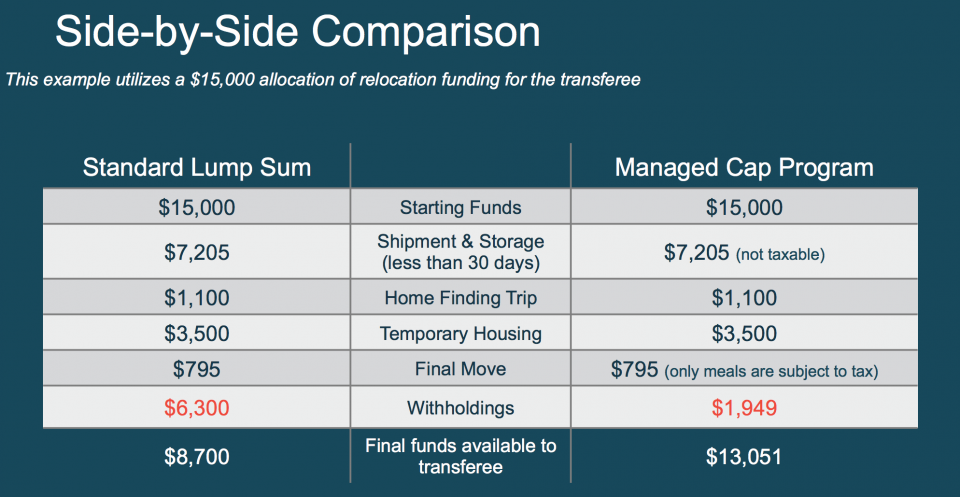
Let’s see the difference between a $15,000 lump sum payment and the same $15,000 from a managed cap program:

GMS-Managed-Cap-vs-Lump-Sum-Chart

A Winning Scenario

The Managed Cap Program provides the transferee with $4,351 more for relocation services!


Modern Mobility Made Easy™

What this means for you and your relocating employees

A Managed Cap program will ensure that your transferees get the most out of their relocation dollars and that you will reduce the amount of administrative burden dealing with exceptions. Global Mobility Solutions – a leader in mobility management since 1987 – has expert relocation consultants who understand how a Managed Cap program can benefit you and your company. Contact Global Mobility Solutions and learn how we can quickly implement a managed cap program custom-tailored for your needs. Request your complimentary managed cap program demo to see how much you can be saving.

Request-a-Demo

Categories
Corporate Relocation Domestic Relocation Global Relocation

Employee Relocation or Workforce Mobility?

Workforce mobility or employee relocation refers to the processes or relocation services involved in the transfer of employees or potential employees from one location to another. Other terms that refer to these processes may include:

  • Employee Transfer
  • Employee Mobility
  • Global Mobility
  • Domestic Relocation
  • Corporate Relocation

While some of these terms may be used interchangeably, the terms global and domestic mobility may differ in the range of services commonly required for relocating an employee. Reference to global mobility is commonly used as an umbrella term, and includes domestic mobility processes. Reference to domestic mobility usually excludes processes commonly needed for international employee relocation such as visa acquisition, repatriation or language training.

Generally, a company’s management of workforce mobility accounts for ongoing employee support services, supplier management, candidate selection, relocation benefits and expense management. Corporate relocation programs may vary between companies due to size, need, or destination.

The overall process of employee relocation is commonly divided into one of four service brackets including:

Pre-Decision Services

According to Worldwide ERC data, the average cost to relocate an executive level home-owning employee comes to $97,000. For this reason companies seek assurances that a given employee is a good fit for relocation. Pre-decision services aim to uncover any potential issues that may arise prior to the employees relocation in order to reduce the risk of a failed relocation. Some of the most common reasons for failed relocations according to Worldwide ERC include:

  • Negative home equity
  • Slow real estate housing market
  • Family resistance to move
  • Spousal employment
  • High costs of housing

The below are examples of a few common pre-decision services:

Candidate Assessment – Services that assess candidate expectation, skills, personal qualities, family circumstance, financial preparedness, etc.

Cost of Living analysis – Cost of living comparison of origin and destination cities to help determine acceptable or competitive salary range.

Market analysis – Determines the likely home sale timeline and identifies potential home sale challenges such as negative equity.

School Reports – Public and Private School reports provided to the relocating employee to aid community selection.

Moving Cost Estimates – Cost estimates on household goods transport, helps budget for relocation costs.

Community Search and Tours – Coordinates community orientation tours to familiarize relocating employees to their new location, and assist in selecting an area that fits their particular interests.

Origin services

Origin services account for all services necessary at the transferring employees origin location. Some of these services include:

Expense Management – Establishment of expense reporting and management services for both the company and employee. Designed to track and contain costs during the relocation process. Utilized throughout the entire relocation process*

Home Sale Assistance – May include connecting employees with real estate agents, home marketing assistance, home buying programs, etc.

Household Goods Management – Management of household goods transport from origin to destination. May include procurement of van line services, replacement insurance, and guaranteed “not to exceed” estimates for goods transportation, etc.

Visa and Immigration Services – For international relocations, visa and immigration services organize company and employee documents required for visa acquisition.

Property Management – For employees not selling their home. May include rental marketing assistance, tenant management, vacant property management, landlord consulting, or property maintenance.

Destination services

Destination services account for all services necessary at the transferring employees destination location. The range of destination services sometimes includes a further segmentation of “settling in services” aimed at helping the employee acclimate to their new location. Some of these services may include:

Home Finding Services – Services include connecting employees with real estate agents at destination, home buying assistance, corporate housing, temporary housing, rental assistance, home finding tours, etc.

Settling in Services – Services that aid employee acclimation to their new location including access to online resources, attaining local driver’s license, child care, connecting utilities, locating a primary care physician, etc.

Vehicle Lease or Purchase – Services that assist relocating employees acquire a vehicle including loan support, lease negotiation, etc.

Family Assistance – Services that assist the relocating employee’s family, including spousal employment support, counseling services, stress management assistance, etc.

Return or Repatriation Services

In most cases,  employee relocation services for individuals returning from temporary domestic assignments are equivalent to services provided at departure. While there are some short term domestic relocation programs amongst companies, the majority of return services handle an employee’s return from international assignment. International assignments are usually classified into one of four categories:

  1. Extended Business Travel (EBT): an assignment of 3 months or less.
  2. Short Term: an assignment lasting 6 months to a year. (range may go up to 2 years)
  3. Long term assignments: An assignment lasting 2-3 years.
  4. Permanent: An assignment lasting 3 years or more.

For EBT, short term, and long term assignments, repatriation plans have become an industry recognized necessity for effective employee retainment. According to Atlas surveys around 40% of expatriate employees leave their sponsoring company after assignment. Repatriation services seek to close this gap, and help organizations maximize their workforce investment and retain employees that have acquired substantial knowledge capital. Repatriation is a dynamic service area that has wide variation. For example repatriation counseling helps employees returning from international assignment manage culture shock, and re-acclimate to domestic life. Other services may include:

  • Lease termination assistance
  • Home services termination (such as utilities)
  • Tax equalization

In all, workforce mobility seeks to analyze, manage, execute and optimize the processes involved in transferring an employee from one location to another. For more detailed descriptions of relocation services visit the following pages:

Global Relocation
North America Relocation

We're Here to Help! Request a Courtesy Consultation

Are you ready to talk to a Mobility Pro? Learn how GMS can optimize your mobility program, enhance your policies to meet today’s unique challenges, receive an in-depth industry benchmark, or simply ask us a question. Your Mobility Pro will be in touch within 1 business day for a no-pressure, courtesy consultation.

Looking for something?