

Categories
Domestic Relocation Trends Global Relocation Trends Talent Management Talent Mobility

Human Resources Innovation and Talent Management

How does human resources innovation impact talent management? Human Resources is central to a company’s ability to attract, keep, and manage talent. In the current work economy, with technology driving so much change in company processes, human resources innovation might include new and varied ways to promote communication on a local and global level. This ensures employees remain fully engaged and informed wherever their current assignment may be.

Technological Advances

Technological advances that promote greater communication include video conferencing and social media engagement. On the employee-specific level, personal recognition including rewards for health and wellness efforts, social responsibility programs, and fostering creative cultures.

Talent Management in Human Resources Innovation

Talent Management can leverage Human Resources innovation by embracing technology. Additionally, it can utilize new thinking regarding what companies need to do to attract and retain talent. In some cases, technology can be used to help employees manage their own work processes, styles, education, and times that result in greater collaboration and employee satisfaction. Companies should provide employees access to several helpful online resources and guides for education.

For example, the Clinical Psychology Education Guide, Online Counseling Programs, and the Online Counseling Degree Guide all provide extensive information that employees can use to further their educational pursuits. The focus on talent management might improve with a new initiative on allowing employees to manage themselves.

Those employees interested in earning their MBA in Human Resources can easily find several resources for an Online MBA in Human Resources. Online education is gaining in popularity due to its ease of access and flexibility for scheduling. Financing MBA education options and descriptive guides to taking the Graduate Management Admission Test (GMAT) help employees determine how best to proceed with their future education.

Workforce Mobility and Employee Relocation

Workforce mobility and employee relocation also benefit from human resources innovation. Transferees are more likely to accept assignments knowing they have a wealth of technological resources, programs, and support for themselves and their families to assist in their relocation. Leading relocation technology that can be used anytime, anywhere provide a direct link from the company to the transferee. The technology promotes communication and provides employees with ease of mind regarding the challenges they face during their relocation.

Future of Human Resources Innovation

The 2017 Deloitte Global Human Capital Trends report notes the future of work is in the augmented workforce. This refers to reinventing jobs due to artificial intelligence (AI), robotics, and cognitive tools. These tools are growing in use and sophistication. This fundamental shift in the future of work will lead employers to focus more heavily on the role of human skills, the customer and employee experiences, and redefining the employment value proposition—what they offer employees and why employees would want to remain with the company. Companies can utilize an augmented workforce approach with their relocation programs to create unique and creative assignments for transferees. Relocation assignments that focus on new technology will help both the company and the employee learn and grow successfully.

Conclusion

The corporate relocation experts at Global Mobility Solutions (GMS) have the knowledge and expertise to help your company manage its talent and provide your employees the best relocation experience. Contact our team of experts to discuss how we can help your talent management and employee relocation process, request a demonstration of our relocation technology, or call us directly at 800.617.1904 or 480.922.0700 today.


Request a relocation technology demo

Categories
Domestic Relocation Tips Domestic Relocation Trends

What Does the US Rental Market Look Like for 2018?

Employers with plans to relocate employees either to US cities or between two different US cities should be aware that the US rental market continues to experience rent increases outpacing the rate of overall national inflation. However, each rental market is unique. The number of units, state and local economics, and even natural disasters all impact rental rates. A regular review of the state of the US Rental Market can uncover opportunities for transferees to consider new assignments as rental market affordability increases.

On a national basis, rents are 2.8% higher, outpacing the current 2.2% overall rate of inflation, and the average hourly earnings rate of 2.5% over the past 12 months, according to an analysis prepared by online rental marketplace ApartmentList.com.

US Rental Market Areas with Rising Rents

The fastest rent growth in the US continues to be in the city of Sacramento, California, with an increase of 9.3% over the past year. Why is Sacramento experiencing high rents? Several factors are at work, including job growth, low inventory of rental units, and the influx of other California residents from the Bay Area who are seeking lower costs in Sacramento.

The US rental market imbalance in this region of California is threatening to displace thousands of low-income Sacramento residents. The solution to Sacramento’s rising rents may lie with other cities such as San Jose and San Francisco, which have effectively priced residents out of their markets due to low inventory and soaring rents.

Following Sacramento in the rising rent category are Vancouver, Washington at 7.9 % and Orlando, Florida at 6.8%, due to increasing job growth and an ever-expanding population.

US Rental Market Areas with Declining Rents

The largest decline in rents is occurring in Anchorage, Alaska, with rents declining by 1.7% over the past year. There are several reasons for the declining rents, with the greatest impact due to an economy in recession that is causing significant job losses. There is also much uncertainty over issues and changes in Alaska’s state government based in Juneau, creating further instability in the Anchorage job market.

Following Anchorage in the declining rent category is Portland, Oregon at 3.5%; however, this decline in Portland’s booming market is due mostly to a large amount of new construction, fostering competition for renters and driving US rental market rents downward.

Conclusion

The relocation experts at Global Mobility Solutions (GMS) have helped thousands of our clients manage relocation both to and within the US. We have the knowledge and expertise to help your company determine the best plan forward as the US rental market continues to experience increases in some cities and declines in other cities.

Contact our team of experts online to discuss how we can help your company’s relocation plans and the US rental market, or call us directly at 800.617.1904 or 480.922.0700 today.

Categories
Corporate Relocation Domestic Relocation Domestic Relocation Tips Global Relocation Global Relocation Tips Relocation Programs

What are the Benefits of Outsourcing Relocation Programs?

What are the benefits of outsourcing relocation programs? Companies that want to stay ahead of their competitors and attract highly qualified employees offer a well-designed corporate relocation program. Employees are looking for relocation programs to provide a wide range of benefits and services to ensure they have an easy and smooth relocation process. Companies that offer a relocation program that is managed entirely in-house face several challenges in trying to meet the demands and expectations of a widespread workforce. There are many benefits to  outsourcing relocation programs that companies should consider as they review their offerings.

There are five key in-house relocation program challenges, and five crucial benefits that outsourcing provides to help company relocation programs be successful:

1. Program Managed by Various Locations or Individuals

Local HR teams may have different interpretations of programs and policies, so variations may impact the benefits transferees receive.

Outsourcing Benefit: When choosing to outsource, company relocation programs benefit from central program management with local support. At all times, a consistent and coherent program is administered and fully supported in all locations, with no variations by locale or individual interpretation.

2. Employees or Local HR Assume Additional Responsibilities

A company choosing to offer an in-house relocation program must rely on current employees and local HR teams to assume additional responsibilities. Some current employees may not have experience with relocation programs, so there may be a learning curve requiring additional time and training.

Outsourcing Benefit: Teams of fully trained relocation experts handle the interpretation and delivery of policies, ensuring employees receive the same benefits across the board.

3. Frequent Exception of “Special Deals”

In-house relocation programs are susceptible to frequent exceptions of “special deals” when employees try to find ways to help transferees and their families with unique challenges. Companies often do not have the resources to understand the unique challenges posed with relocation and how they have been addressed by other companies, likely resulting in unforeseen and unbudgeted obligations.

Outsourcing Benefit: Relocation experts with significant industry experience can use their knowledge to help companies understand how best to manage exceptions, minimizing expenses and process disruptions.

4. Relocation Costs not Effectively Tracked

Over 70% of companies that manage relocation in-house are not aware of their program’s internal operating costs. Without effective relocation program expense tracking, the true costs are hidden and thus cannot be effectively controlled or minimized.

Outsourcing Benefit: “Best of the Best” providers are utilized so transferees and their families receive exceptional services while costs can be fully identified, tracked, and reviewed for budgetary impact and program performance.

5. Increased Likelihood of Assignment Failures

Companies offering a relocation program hope their transferees have a successful relocation. However, the likelihood of assignment failure is high due to the in-house team’s lack of experience and knowledge when helping transferees and their families understand and address the unique challenges they face during the relocation process.

Outsourcing Benefit: Companies can benefit from an outsourced solution that specializes in unique relocation needs including tax issues, visa applications, and compliance reporting. Working with relocation experts who have extensive experience in these and other areas can help a company avoid risk related to transferee’s requests for guidance and advice.

Conclusion

The most successful companies outsource their relocation programs so employees and their families have access to industry-leading resources and expert guidance. The corporate relocation experts at Global Mobility Solutions (GMS) help our clients understand how to create and administer a relocation program that gives them a competitive advantage and provides the highest level of relocation benefits and services for their employees.

To learn more about the many benefits outsourcing your corporate relocation program can provide for your company and employees, contact our team of experts online, or call us at 800.617.1904 or 480.922.0700 today.

Request your complimentary relocation policy review

Categories
Business Services Domestic Relocation Tips Global Relocation Talent Mobility

Spouse and Partner Career Support Programs Promote Successful Relocations

Employees expect their company’s relocation programs to provide a wide range of services, technology, and tools that will help make for an easy and smooth relocation process. Along with services targeted specifically for the transferee, the most successful company relocation programs also provide support programs for spouses and partners. Employee’s family members participate in the relocation process, and as such their buy-in and support can ensure a successful assignment.

When an employee is offered a relocation opportunity, their spouse or partner’s needs should be considered as well. Often a new job for a transferee may mean a job change for their spouse or partner, in addition to relocating to a new location. The more support and information a company provides for spouses and partners, the more likely the relocation will be successful.

Successful company relocation programs should provide the following spouse and partner support services:

Spouse/Partner Pre-Decision Support Programs

Spouses and partners should receive consultation for any questions and concerns they may have about the new location. Local average salary information, cost of living assessments, job market information, community amenities, and specific information about local companies or organizations that may fit the spouse or partner’s career goals are all helpful topics that support spouses and partners in their pre-decision process.

Online Assistance Portal

An online assistance portal that provides information to support local job searches or professional development opportunities in the new location is a welcome addition to a company’s relocation support programs for spouses and partners. Helpful resources such as lists of key employers organized by location and industry, resume posting services, and job search publications and white papers provide spouses and partners with information they need to pursue new opportunities.

Professional Career Services

Many spouses and partners benefit from structured programs that help them create their online personal brand through Linkedin profiles or job search engines, direct job search assistance, resume writing assistance, entrepreneur support, and professional development opportunities. Successful company relocation programs provide a wide range of these support programs so their transferees’ families are prepared to participate in the relocation process with a focus on success.

“The entrepreneur support services provided by my husband’s employer were instrumental to our successful relocation,” noted S. Fernandez, founder and Program Director of TLC Child Enrichment. “As he began his new career, I received extensive assistance to set up a new childcare and preschool business which has grown and provided me with a terrific opportunity.”

Conclusion

The most successful company relocation programs provide a wealth of support programs and services for spouses and partners since they are often key to ensuring a successful relocation. Global Mobility Solutions (GMS) provides its clients with an extensive array of spouse and partner support programs as well as other valuable business services so employee relocations are successful. Our high-touch service model fully extends to helping employee’s families with everything they need during their relocation process.

To learn more about the wide range of spouse and partner support programs we provide, download your industry benchmarking study, contact our team of relocation experts or give us a call at 800.617.1904 or 480.922.0700 today.

Download your industry benchmarking study

Categories
Domestic Relocation Domestic Relocation Tips Relocation Best Practices Relocation Management

What are the Top 3 Business Relocation Budget Tips?

With today’s digitally-driven business landscape, your business relocation budget might include relocating an operational arm or corporate headquarters to a different region. For some companies, it makes economic sense to move employees to other parts of the country or globe. However, although these moves often have the intention of boosting bottom-line revenue, relocation costs can add up quickly.

Keeping that in mind, here are the top three business relocation tips you can use to help save on corporate relocation budgets:

Get Estimates from Multiple Providers

Assuming that a business has already chosen a new market and a new office space, the logistical aspects of moving now come into play. Moving offices and employees is a massive undertaking, and it is important for a business to get the most value from the relocation. Obtain multiple estimates from reputable firms and determine the best option that fits your business relocation budget. Rates can often be negotiable; a Relocation Management Company that has experts in group move coordination on staff can leverage volume for better rates with van lines.

Understand Your Rights

The U.S. Department of Transportation’s Federal Motor Carrier Safety Administration outlines a number of rights and responsibilities that businesses are entitled to before, during and after their relocation. For instance, a van line must move a client’s belongings in a timely manner. The moving company must provide a written record called a reasonable dispatch service, and if there is a delay, the company must then prepare a written record of its amended date for delivery. Since your business relocation budget requires adherence to cost guidelines, it is important for companies to ensure the entire logistical process runs smoothly.

Work with a Relocation Management Company

Choose a Relocation Management Company that has expert knowledge and extensive experience in corporate relocation services. Corporate relocation programs provide companies and employees all of the resources and tools they need to ensure a smooth and successful relocation process, and to keep your business relocation budget within guidelines. Look for a company that provides ongoing employee support services, supplier management, relocation benefits, and expense management. Since your employees will be moving to the new location, you should be sure to provide a wealth of resources for them and their families so they feel confident in accepting their new assignments and enthusiastic about the company’s relocation.

Conclusion

The corporate relocation experts at Global Mobility Solutions (GMS) have the knowledge and expertise to help your company manage its business relocation budget and offer your employees the best relocation experience. Contact our team of experts to discuss how we can help your company’s business relocation budget stay within company guidelines, or call us directly at 800.617.1904 or 480.922.0700 today.

Categories
Corporate Relocation Domestic Relocation Global Mobility Relocation Management

What is Employee Relocation or Workforce Mobility?

Employee relocation or workforce mobility refers to the processes or relocation services involved in the transfer of employees or potential employees from one location to another. Additional terms that refer to these processes may include:

Some of these terms may be used interchangeably. However, the terms global relocation and North America relocation may differ in the range of services commonly required for relocating an employee. Reference to global relocation is usually as an umbrella term, and includes North America relocation processes. Reference to North America relocation usually excludes processes commonly needed for international employee relocation such as visa acquisition, repatriation, and language training.

Generally, a company’s management of workforce mobility accounts for ongoing employee support services, supplier management, candidate selection, relocation benefits, and expense management. Corporate relocation programs vary between companies due to size, need, or destination.

The overall process of employee relocation is usually divided into one of four service brackets including:

Pre-Decision Services:

According to Worldwide ERC data, the average cost to relocate an executive level home-owning employee is approximately $97,000. For this reason, companies seek assurances that an employee is a good fit for relocation. Pre-decision services aim to uncover any potential issues that may arise prior to the employee’s relocation. As a result, these services reduce the risk of a failed relocation. Some of the most common reasons for failed relocations according to Worldwide ERC include:

  • Negative home equity
  • Slow real estate housing market
  • Family resistance to move
  • Spousal employment
  • High costs of housing

Examples of a few common pre-decision services include:

Candidate Assessment – Services that assess candidate expectation, skills, personal qualities, family circumstance, and financial preparedness.

Cost of Living Analysis – Cost of living comparison of origin and destination cities to help determine acceptable or competitive salary range.

Market Analysis – Determines the likely home sale timeline and identifies potential home sale challenges such as negative equity.

School Reports – Public and Private School reports provided to the relocating employee to aid community selection.

Moving Cost Estimates – Cost estimates on household goods transportation, helps budget for relocation costs.

Community Search and Tours – Coordinates community orientation tours to familiarize relocating employees to their new location, and assist in selecting an area that fits their particular interests.

Origin Services for Employee Relocation

Origin services account for all services necessary at the transferring employee’s origin location. Some of these services include:

Expense Management – Establishment of expense reporting and management services for both the company and employee. Also, this is designed to track and contain costs during the relocation process. Utilized throughout the entire relocation process*

Home Sale Assistance – May include connecting employees with real estate agents, home marketing assistance, and home buying programs.

Household Goods Management – Management of household goods transport from origin to destination. May include procurement of van line services, replacement insurance, and guaranteed “not to exceed” estimates for goods transportation.

Visa and Immigration Services – For international relocations, visa and immigration services organize company and employee documents required for visa acquisition.

Property Management – For employees not selling their home. May include rental marketing assistance, tenant management, vacant property management, landlord consulting, and property maintenance.

Destination Services for Employee Relocation

Destination services account for all services necessary at the transferring employee’s destination location. The range of destination services sometimes includes a further segmentation of “settling in services.” These services are aimed at helping the employee and their family acclimate to their new location. Some of these services may include:

Home Finding Services – Services include connecting employees with real estate agents at destination, home buying assistance, corporate housing, temporary housing, rental assistance, and home finding tours.

Settling in Services – Services that aid employee acclimation to their new location including access to online resources, attaining local driver’s license, child care, connecting utilities, and locating a primary care physician.

Vehicle Lease or Purchase – Services that assist relocating employees acquire a vehicle including loan support, and lease negotiation.

Family Assistance – Services that assist the relocating employee’s family, including spousal employment support, counseling services, and stress management assistance.

Return or Repatriation Services

In most cases, employee relocation services for individuals returning from temporary North America assignments are equivalent to services provided at departure. While there are some short term North America relocation programs among companies, the majority of return services handle an employee’s return from international assignment. International assignments are usually classified into one of four categories:

  1. Extended Business Travel (EBT): an assignment of 3 months or less.
  2. Short Term: An assignment lasting 6 months to a year (range may go up to 2 years).
  3. Long Term: An assignment lasting 2-3 years.
  4. Permanent: An assignment lasting 3 years or more.

For EBT, short term, and long term assignments, repatriation plans have become an industry recognized necessity for effective employee retention. According to Atlas surveys, around 40% of expatriate employees leave their sponsoring company after assignment. Repatriation services seek to close this gap. They also help organizations maximize their workforce investment. As a result, they retain employees that have acquired substantial knowledge capital. Repatriation is a dynamic service area that has wide variation. For example, repatriation counseling helps employees returning from international assignment manage cultural differences, and re-acclimate to North America life. Additional services may include:

  • Lease termination assistance
  • Home services termination (includes utilities)
  • Tax equalization

Workforce mobility seeks to analyze, manage, execute and optimize the processes involved in transferring an employee from one location to another. For more detailed descriptions of relocation services, please visit the following pages:

Global Relocation
North America Relocation

Conclusion

The corporate relocation experts at Global Mobility Solutions (GMS) have the knowledge and expertise to help your company remain competitive, reduce costs, and offer your employees the best relocation experience.

GMS was the first relocation company to register as a .com. The company also created the first online interactive tools and calculators, and revolutionized the entire relocation industry. GMS continues to set the industry pace as the pioneer in innovation and technology solutions with its proprietary MyRelocation® technology platform.

Global Mobility Solutions is proud to be named and ranked #1 Overall, and #1 in Quality of Service by HRO Today’s 2019 Baker’s Dozen Customer Satisfaction Survey.

Contact our team of experts to discuss how we can help improve your company’s corporate relocation program, or call us at 800.617.1904 or 480.922.0700 today.

Request your complimentary relocation policy review

Categories
Corporate relocation tips Domestic Relocation Domestic Relocation Challenges Domestic Relocation Tips Global Mobility Global Relocation Global Relocation Challenges Global Relocation Tips Relocation Best Practices Relocation Challenges Relocation Management

Top 3 Considerations When Implementing Relocation

Keys to working smarter, faster, and more cost-effectively

HR, Recruitment, Payroll, Accounts Payable, IT Security, and other relocation stakeholders commonly face a never-ending variety of evolving and often overwhelming challenges when it comes to the implementation of benefits administration, which includes relocation outsourcing decisions.

As employee benefits become more complex, critical, and increasingly subject to regulatory compliance requirements, employers must accurately assess their team’s capacity when it comes to implementing relocation programs.

Global Mobility Solutions (GMS) recently compiled the data on thirty four (34) recent implementations it managed, representing key industries and includes several multinational companies (including and not limited to manufacturing, technology, healthcare, and energy). This study was derived from initial and post-implementation surveys that are focused on implementation Critical Success Factors (CSF).

Top 3 Critical Success Factors

  1. Implementation Management
    Assessing an organization’s goals and creating a realistic road map of key milestones is a critical part of delivering an effective implementation. The process begins by identifying the right mix of internal/external resources and flexible technology that support a collaborative approach to implementation that stays on track. This study confirms that proper planning and management is an essential to any successful relocation implementation.
  2. Cycle Times
    All organizations, large and small, have finite resources, making the maximization of productivity and cycle times a CSF. Properly planned and executed implementations reduce typical and customary cycle times.
  3. Time Investment = Real Dollars
    The old adage of “time is money” has a direct association to relocation program implementation. This is evident by the time investment required to complete implementation by multiple disciplines within an organization, such as Human Resources, Payroll, Accounts Payable, preferred vendors and the RMC.

Modern Mobility Made Easy™
What this means for you and your relocating employees
Our findings conclude that organizations with solid implementation oversight and supporting technology experience shorter cycle times, spend less and have a better overall experience. Global Mobility Solutions, a leader in corporate relocation since 1987, provides companies like yours with proven leadership, time tested procedures and advanced technology to ensure that no more than 10% of their time is spent on implementing a relocation management program. GMS completes new implementations within 5 to 22 days, while maintaining 98% planning accuracy and 100% implementation satisfaction. To learn how to quickly and easily implement your relocation program, all within your planned budget, by requesting an implementation demo.

Request a relocation implementation demo from Global Mobility Solutions

Categories
Corporate Relocation Domestic Relocation Domestic Relocation Trends

50 U.S. Cities with the Most New Jobs

Big opportunities in relatively small towns. 

With unemployment near a ten-year low and new jobs surpassing monthly expectations, one might be wondering, “Where are all of these opportunities, what are the 50 US cities with the most jobs?”

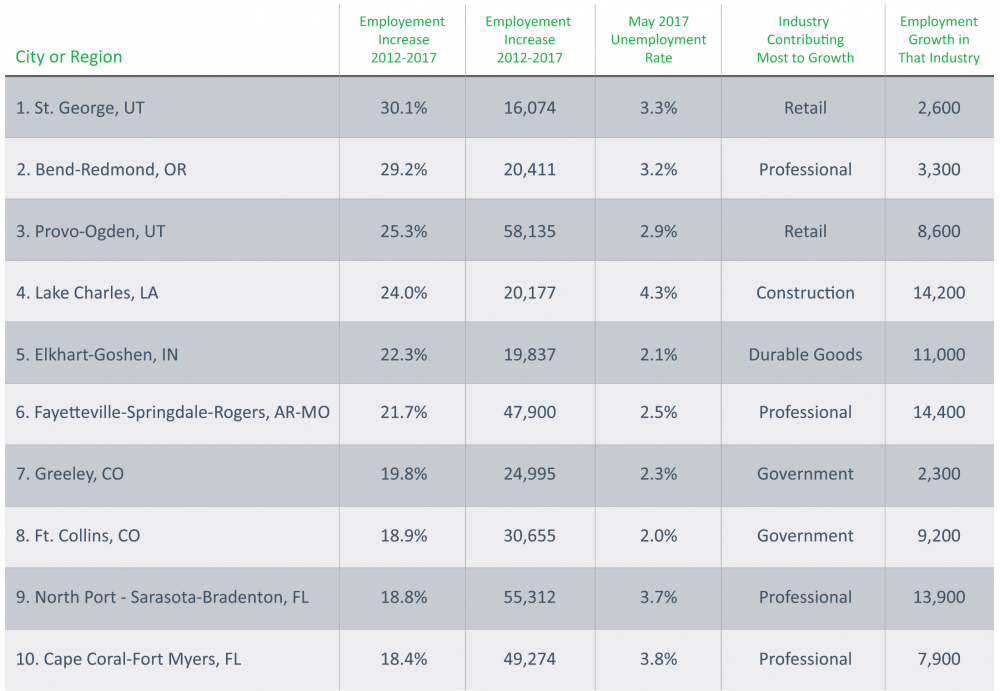
In an article for msn.com this July, writer Michael B. Sauter composed a comprehensive list of the top 50 cities for job growth in the United States. The data was tracked from 2012 through 2017 and details the percentage of employment increase, the number of new jobs, the industry (excluding agriculture) contributing most to the growth in opportunities, as well as other key factors.

The top ten cities experienced job growth from 18% to over 30%. Here is a sampling of the top ten cities from Mr. Sauter’s article:

TOP-GROWTH-CITIES-2012-2017

Not surprising, early 50% of the cities on the comprehensive list were from states that have the highest inbound relocation activity1. Fort Myers, FL earned the number one spot on a list of the top U.S. cities for relocation, as posted by US News & World Report.


Modern Mobility Made Easy™

What this means for you and your relocating employees


Global Mobility Solutions (GMS) has destination spotlights for many of the cities mentioned in the overall list. These spotlights contain information about a city’s climate, geography, transportation, entertainment, culture, sports, schools, and more. GMS spotlights are great tools for helping mobility managers explain the benefits of a relocation assignment and for transferees to become accustomed to an area before actually moving there.

Destination-Spotlights-Button

  1. Miami Herald, January 5, 2017
Categories
Domestic Relocation Global Mobility Global Relocation Relocation Best Practices Relocation Management

Global Mobility Solutions Recognized as a Leader

Leader Recognition – For the past 34 years, the LEAD Awards have identified and recognized organizations with the top leadership programs, strategies, and solutions with regard to global leadership development. These prestigious leadership awards salute the world’s top leadership practitioners and programs and highlight their roles in developing their most important asset – their people.

Global Mobility Solutions (GMS) was recognized as a leader for its excellence in leadership training and education. GMS placed in the top 10 of 100 companies for Best Sales Leadership Program and Top 18 of 200 for the Best Global Leadership Program.


Global Mobility Solutions a winner of Best Sales Leadership Program

Global Mobility Solutions a winner of Best Global Leadership Program


The competition was strong as GMS went up against such household names as 3M, Boston Scientific, Cisco, Dell, Microsoft, and many others. In fact, the other winners have a combined average annual revenue 453% larger than GMS and an average of 383% more employees. It is an honor and accomplishment to be recognized amongst such giants of industry.


Learn how GMS can help your transferees become leaders in their new destinations

Is your relocation program the best it can be? Receive your free relocation policy review.


About LEAD2017 LEAD2017 is a 2-day leadership forum, February 7th and 8th, 2017 in Nashville, Tennessee, at the Music City Center. Designed to inspire leadership in people from all walks of life in person at the conference as well as live simulcast to hundreds of remote host sites internationally. The event brings together top thought leaders and the world’s best leadership practices that can be shared by attendees to develop leadership programs in their own organizations and communities http://www.lead2017.com/ February 8th will be broadcasted globally with the goal of touching 1 million lives to choose leadership.

About HR.com and the LEAD Awards HR.com, the largest global social networking and resource site for HR Professionals is committed to providing a deeper understanding of the HR function for over 290,000+ members by offering an annual global leadership annual event – LEAD, the LEAD Awards, HR Certification Exam Prep Courses, certification programs, a personal development app, monthly themed HR e-publications, 4,500+ webcasts, 1,200+ eLearning credits, 230+ virtual conferences, blogs, community networks, industry news and advisory boards. See www.hr.com for more information.

Categories
Corporate Relocation Corporate relocation tips Domestic Relocation Domestic Relocation Challenges Domestic Relocation Tips Global Mobility Global Relocation Global Relocation Challenges Global Relocation Tips Relocation Best Practices Relocation Challenges Relocation Management

Managing Mobility Costs

Department heads all over the globe are constantly asked to identify cost-saving opportunities within their departments. Human resources, employee mobility, talent acquisition, and procurement are no exceptions. As you scrutinize your budget, try utilizing these three steps to help better manage and ultimately reduce your relocation expenses:

Cost Estimates

Managing mobility costs starts with understanding what those expenses are. First estimate what costs should be involved with your vision of a successful mobility program. A cost estimate will provide you with a clear picture of the potential costs of individual relocation assignments. You can then use these cost estimates to correctly establish a budget prior to initiating any relocations.

One effective way to determine your cost estimates is by utilizing cost estimate technology. There are many software programs that by using the latest upgrades will help you:

  • Save time
  • Reduce human error
  • Ensure compliance

Policy Reviews

By reviewing your relocation policies, either internally or with an outside relocation management company (RMC), you will be able to identify cost-saving opportunities and eliminate expensive exceptions. When reviewing your mobility management policies, you should:

  • Do so in conjunction with cost
  • Benchmark against other companies within your industry
  • Leverage technology for key services (i.e. Virtual destination tours, online school reports, etc.)

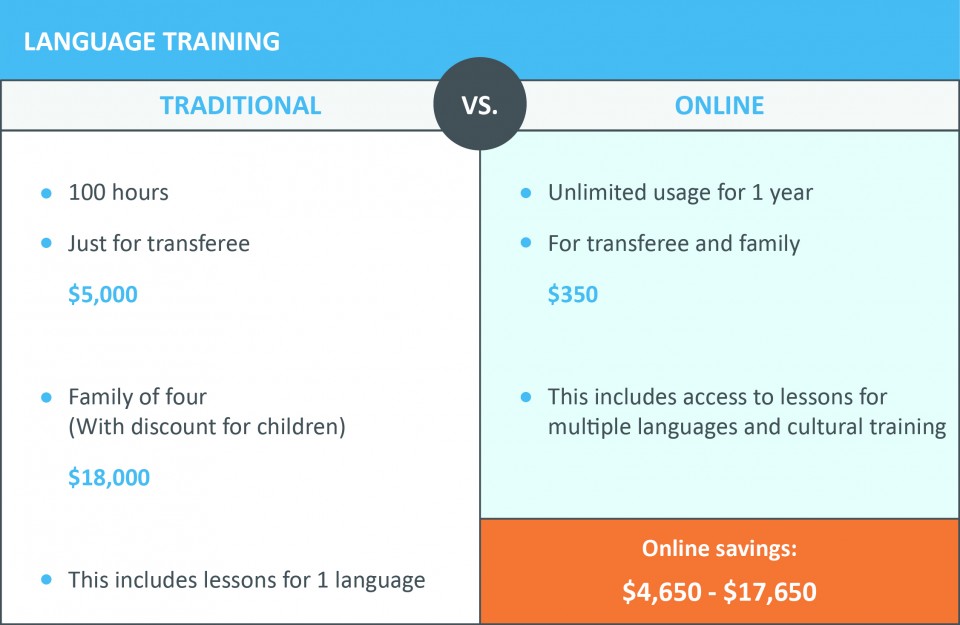
Example:

Using online language tools can reduce relocation costs by roughly $5,000 - $20,000.

Tracking and Reporting

Lastly, you want to ensure that you are continuously tracking all expenses and reporting any overages or savings. Get a detailed account of how your cost estimates match up with your actual spending. Then the whole process repeats itself. Once you have your data:

  • Take action – Make any necessary adjustments to your budget, policy, or both
  • Review – Go over the detailed reports to identify more cost-saving opportunities
  • Incorporate technology – Save time and money by offering key services online

Global Mobility Solutions (GMS) is an award-winning RMC and, since 1987, has been helping companies save time and money with regard to their corporate relocations. As a courtesy service, GMS will review your current relocation policies and provide expert feedback to ensure that your policies are competitive within your industry and to identify any cost-saving opportunities, so you can focus on managing mobility costs.

Click here for your free relocation policy review

Looking for something?