Categories
Relocation Management Relocation Policy Review

Lump Sum Self-Service with Payment Options for Relocating Employees

What does a traditional Lump Sum relocation program entail as opposed to Lump Sum Self-Service? In traditional Lump Sum relocation programs, employees receive a specific amount of funds for relocation. They also work with a Relocation Management Company to select services within the parameters of their employer’s relocation policy. Global Mobility Solutions (GMS) can also arrange for relocating employees to receive a GMS MoveMoney™ debit card. With this card, funds are electronically transferred to the employee after their expense report is audited.

Lump Sum Self-Service

GMS is developing a new online Lump Sum Self-Service with Payment Options to provide relocating employees direct access to our network of suppliers through our proprietary MyRelocation™ website portal. Using the lump sum provided by their employer, the relocating employee will be able to choose any of the services and options within our network of providers. They will also be able to arrange payments directly to the providers. Furthermore, the employer does not have to track relocation expenses or be involved in the process. As a result, the relocating employee will have complete freedom of choice for their relocation process. They can utilize helpful packing and moving guides and other information as they manage their relocation.

Benefits of Lump Sum Self-Service

There will be several benefits to the Lump Sum Self-Service for relocating employees:

  • Immediate access to suppliers of proven quality and experience
  • Payment options with suppliers that are easy to set up
  • Information about services that they otherwise might not have found doing their own research
  • Anytime, anywhere access to the employee’s relocation information
  • Cost savings for the relocating employee with multiple suppliers bidding to provide services
  • Reduced administration costs and efforts for employers

Conclusion

Relocating employees provided with Lump Sum funds will soon be able to have access to a network of qualified suppliers through Lump Sum Self-Service. Asking providers to bid for services and choosing the lower cost options will help relocating employees save money for other relocation services. Employers choosing to provide Lump Sum funds to relocating employees should encourage the use of Lump Sum Self-Service with Payment Options.

The global relocation experts at GMS have the knowledge and expertise to help your company understand how to communicate the benefits of Lump Sum Self-Service with Payment Options to your relocating employees. Contact our team of experts to discuss your relocation policy needs, or call us at 800.617.1904 or 480.922.0700 today.

Request your complimentary relocation policy review

Categories
Relocation Challenges Relocation Management Relocation Policy Review Talent Management Talent Mobility

Top 5 Healthcare Industry Recruiting and Relocation Trends

The Healthcare Industry has been growing at an increasing pace over the past several years. Factors such as the implementation of the Affordable Care Act, an aging population, and technological advances all contribute to the ever-expanding demand for qualified healthcare employees. The US Bureau of Labor Statistics predicts that Healthcare will be the largest employment sector in the US economy by 2024.

Growth in the healthcare industry presents a number of difficulties for HR professionals. Filling positions quickly and effectively, creating a workplace that encourages employee engagement, ensuring smooth succession processes, and reducing employee turnover are some of these seemingly insurmountable challenges.

Increasing Retirement Rates

In addition to greater demand for services, the industry is facing rapidly increasing retirement rates for experienced employees. Especially in the nursing field, the impact of retirement will have a large impact on staffing levels. At least 55% of the RN workforce is over the age of 50 and quickly approaching retirement age. According to an American Association of the Colleges of Nursing (AACN) summary of reports, there will be a growing shortage of registered nurses across the country between 2009 and 2030. By 2025 the US is expected to experience a nursing shortage “twice as large as any nursing shortage experienced in this country since the mid-1960s” with the rapidly aging nursing workforce as the primary contributor.

The combination of increasing demand for employees and increasing rates of retirement creates an ever-widening talent gap in the healthcare industry. There are not enough employees to occupy new positions, nor are there enough employees to backfill positions that open due to retirement. As a result, at least 33% of hospitals have job vacancy rates greater than 10%. Clearly, traditional healthcare recruiting strategies are not able to fill positions at a fast enough pace to keep up with demand.

As a result of these changes, the following five trends in healthcare industry recruiting and relocation are emerging:

Top 5 Healthcare Industry Recruiting and Relocation Trends

1. Provide Exceptional Candidate Experiences

Healthcare industry recruiters must focus on keeping candidates happy and engaged in the recruitment process. Providing each candidate an exceptional experience is necessary to keep your organization as the candidate’s first choice in their employment search. The organization should conduct a review of the entire candidate experience, including the application process, interviews, job offers, relocation benefits, and onboarding procedures.

HR professionals should put themselves through each of these processes to see how their organization treats and responds to candidates. Successful recruiting programs treat candidates respectfully and make them feel highly valued. Candidates are more likely to choose to work for an employer that treats them well.

2. Use Data to Enhance Healthcare Industry Recruiting

Healthcare organizations must analyze the effectiveness of their recruiting activities. Knowing which efforts are working well, and which efforts are not, will help the organization identify what it needs to improve. For example, an organization may have a job advertising program in place within a journal or news network. If these programs are not providing qualified candidates that proceed to job offers and acceptances, the organization should consider redirecting those resources.

Conversely, if a partnership with a local university proves to be a good source of qualified candidates that proceed to employment, consider enhancing the program or creating additional partnerships. Think beyond current geographical boundaries; partnerships can easily generate candidate interest within international locales. Relocation Management Companies (RMCs) are ideal sources for information on global candidate recruitment and relocation.

3. Recruit for Cultural Fit

Healthcare organizations searching for qualified employees may be able to easily identify those with the requisite skills, education, and experience. However, healthcare is a unique industry in that it is so highly focused on personal interactions. Healthcare organizations looking to fill job vacancies at a pediatric practice would want candidates who enjoy working with children.

Pre-Decision Services are critical for healthcare organizations as they provide valuable information about a candidate’s ability to accept a position and be successful. Behavioral assessments can be a strong predictor for cultural fit. Healthcare organizations can easily identify candidates with the qualities that match their organizational culture. Assessment data can be paired with structured interview questions to better understand the candidate’s interests, goals, and motivations.

4. Create a Superior Healthcare Industry Employer Brand

Highly-skilled healthcare workers are in great demand. As a result, these workers can easily choose where they want to work and for which organization they prefer. Seventy-five percent of employees seeking new jobs consider an employer’s brand before applying for open positions. Consider how your healthcare organization’s brand appears to job seekers. Does it generate positive industry news? Are online reviews favorable from current employees as well as current customers? If the employer brand you find does not fill you with positive feelings, then you can be sure candidates are also experiencing this same feeling.

To create a successful employer brand and generate positive feeling among job seekers, healthcare organizations should find out from current employees whether the organization is one where people want to work. Also, research comments from employees and candidates on review websites and social media. Determine which issues are of concern and address them. This will help you ensure employees will perceive your organization as the brand you prefer it to be. Follow through by updating recruiting materials, websites, social media, job postings, emails, and other venues to be sure you amplify the correct employer brand and messages. Consider creating a branded career website with enhanced relocation program messages to welcome candidates to your organization.

5. Speed the Process to Keep Candidates Engaged

Qualified candidates are always seeking new opportunities, and your organization is always looking to hire. The quicker you help candidates move through the process, the more they will remain engaged and likely to consider your organization for employment.

According to the 2018 Recruiting Benchmark Report from Jobvite, the time to fill job vacancies in the healthcare industry is 38 days. At the same time, the industry has 21 applications per job, which is one of the lowest among industries. If several days or even weeks can be taken out of the process, the organization will benefit tremendously and experience lower job vacancy rates.

Conclusion

GMS’ team of corporate relocation experts have helped thousands of our clients develop relocation programs that attract and retain qualified employees. Our team can help your healthcare company by designing a relocation program that represents industry best practices. This will increase your company’s ability to attract and retain new employees.

GMS was the first relocation company to register as a “.com.” The company also created the first online interactive tools and calculators, and revolutionized the entire relocation industry. GMS continues to set the industry pace as the pioneer in innovation and technology solutions with its proprietary MyRelocation® technology platform.

Global Mobility Solutions is proud to be named and ranked #1 Overall, and #1 in Quality of Service by HRO Today’s 2019 Baker’s Dozen Customer Satisfaction Survey.

Contact our experts online to discuss your healthcare company’s relocation program needs, or give us a call at 800.617.1904 or 480.922.0700 today.


Request your complimentary relocation policy review

Categories
Global Relocation Global Relocation Challenges Global Relocation Tips Relocation Challenges

Expatriate Health Insurance

Expatriate health insurance is an important consideration for both clients and assignees. Employees relocating to international locations for extended periods of time should have access to quality health care. Options and costs may vary greatly depending on assignment location. Employers may need to consider the range of relocation benefits they provide for their mobile workforce to account for expatriate health insurance needs. There are three specific factors that clients and their relocating employees should consider when examining their options:

1. Uninsured Employees May Incur Large Healthcare Costs and Need Expatriate Health Insurance

\Now Health International, an international insurance provider, conducted a survey that included a question about expatriate employee’s attitudes about health insurance coverage. As reported by Relocate Magazine, the survey found 25% of respondents did not have health insurance because they were currently healthy and believed they would not fall ill. Many respondents live and work in many well-developed locations such as Hong Kong, Singapore, and Thailand, and several believe they have coverage in their new country’s state healthcare system. However, many countries are working to limit medical care for expatriates to only accident and emergency coverage. This trend could leave expatriates with large, unreimbursed healthcare costs if they do become ill.

2. Medical Care Quality Varies by Country

Some countries provide good expatriate healthcare options, based on the medical resources they provide and their level of industrialization. In its most recent Expat Explorer 2017 Survey, HSBC found that healthcare standards and the ease of setting up healthcare are seen as best in France, Malaysia, and Australia. As noted in the survey, better healthcare standards is a key reason that 58% of expatriate retirees have moved to France, and 53% of all expatriates in France say their physical health is better than it would be at home. Other countries such as Taiwan provide a national health insurance system which expatriates can join and are well-known for high satisfaction with healthcare affordability. Alternatively, countries such as the US, which spends a large amount on healthcare, may have according to the Organization for Economic Cooperation and Development.

3. Expatriate Health Insurance Costs May Seem Prohibitive

Talent Management and HR reports that employers should offer health insurance benefits because it is a strong factor in employee attraction and retention. This applies to expatriates as well. The fact that assignees are located in an international setting does not reduce their interest in health insurance. Insurance companies such as Expacare provide several international health and medical insurance plans for expatriates. Although many employers might believe expatriate health insurance would be cost prohibitive, several have found options that meet their needs. With many countries looking to limit access to their national health insurance programs, out of pocket medical costs might be even more prohibitive if expatriates are left without health insurance coverage.

Conclusion

Employers should consider expatriate health insurance as they develop their relocation program. Assignees should have access to health care without worrying about prohibitive out of pocket costs. A wide range of options are available. The global relocation experts at Global Mobility Solutions (GMS) have the knowledge and expertise to help your company understand the options available for expatriate health insurance. Our experts can also help your team understand and communicate information about health insurance to your assignees to provide them with the best relocation experience. Contact our team of experts online or call us directly at 800.617.1904 or 480.922.0700 today. Request your complimentary relocation policy review

Categories
Corporate relocation tips Domestic Relocation Domestic Relocation Challenges Domestic Relocation Tips Global Mobility Global Relocation Global Relocation Challenges Global Relocation Tips Relocation Best Practices Relocation Challenges Relocation Management

Top 3 Considerations When Implementing Relocation

Keys to working smarter, faster, and more cost-effectively

HR, Recruitment, Payroll, Accounts Payable, IT Security, and other relocation stakeholders commonly face a never-ending variety of evolving and often overwhelming challenges when it comes to the implementation of benefits administration, which includes relocation outsourcing decisions.

As employee benefits become more complex, critical, and increasingly subject to regulatory compliance requirements, employers must accurately assess their team’s capacity when it comes to implementing relocation programs.

Global Mobility Solutions (GMS) recently compiled the data on thirty four (34) recent implementations it managed, representing key industries and includes several multinational companies (including and not limited to manufacturing, technology, healthcare, and energy). This study was derived from initial and post-implementation surveys that are focused on implementation Critical Success Factors (CSF).

Top 3 Critical Success Factors

  1. Implementation Management
    Assessing an organization’s goals and creating a realistic road map of key milestones is a critical part of delivering an effective implementation. The process begins by identifying the right mix of internal/external resources and flexible technology that support a collaborative approach to implementation that stays on track. This study confirms that proper planning and management is an essential to any successful relocation implementation.
  2. Cycle Times
    All organizations, large and small, have finite resources, making the maximization of productivity and cycle times a CSF. Properly planned and executed implementations reduce typical and customary cycle times.
  3. Time Investment = Real Dollars
    The old adage of “time is money” has a direct association to relocation program implementation. This is evident by the time investment required to complete implementation by multiple disciplines within an organization, such as Human Resources, Payroll, Accounts Payable, preferred vendors and the RMC.

Modern Mobility Made Easy™
What this means for you and your relocating employees
Our findings conclude that organizations with solid implementation oversight and supporting technology experience shorter cycle times, spend less and have a better overall experience. Global Mobility Solutions, a leader in corporate relocation since 1987, provides companies like yours with proven leadership, time tested procedures and advanced technology to ensure that no more than 10% of their time is spent on implementing a relocation management program. GMS completes new implementations within 5 to 22 days, while maintaining 98% planning accuracy and 100% implementation satisfaction. To learn how to quickly and easily implement your relocation program, all within your planned budget, by requesting an implementation demo.

Request a relocation implementation demo from Global Mobility Solutions

Categories
Corporate Relocation Corporate relocation tips Domestic Relocation Domestic Relocation Tips Domestic Relocation Trends Global Mobility Global Relocation Global Relocation Tips Global Relocation Trends Household Goods Relocation Best Practices Relocation Management

Relocation Models for 5 Major Industries

Traditional vs. Lump Sum Relocation Programs

Which is best model for your company?

There is more than one way to get your relocating employees to their new assignments. Many companies opt for either a traditional relocation program, a lump sum/managed cap program, or a combination of the two, depending on the position of the transferee and other special circumstances.

What are the Differences?

With a lump sum or managed cap model, relocating employees are given a pre-determined amount of money to cover all aspects of their move. From the shipping of goods to temporary housing, the transferees are responsible for researching and obtaining all the services needed to get them to their new destinations. There is no tracking or reporting available to HR or finance departments to let them know whether their relocation policies are too generous, costing the company more money than necessary to relocate their employees, or too limited, forcing transferees to pay out of pocket unnecessarily. This approach leaves the entire move is managed by the transferees, many who might not have any prior moving experience.

Conversely, a traditional relocation model is managed by a relocation management company (RMC). The RMC coordinates everything for the transferees. This includes, but is not limited to, home selling, household goods movement, temporary living, and home purchasing. The RMC sets up the various services with reputable, vetted network partners. Since the RMCs use direct billing back to the client companies, the transferees rarely have to open their wallets. HR and finance departments receive detailed expense reports from the RMCs that capture all the costs related to relocating their transferees.

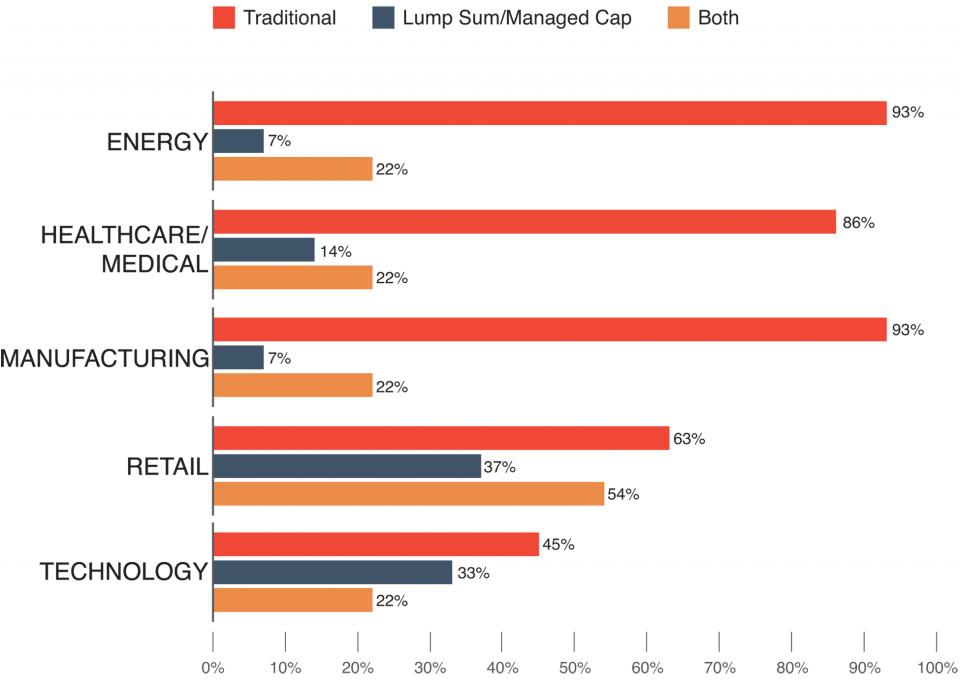
Based on comprehensive relocation surveys, here are findings of how companies in five different industries utilize either traditional, managed cap/lump sum, or a combination of these relocation programs:

Relocation Models by Industry: Energy, Healthcare/Medical, Manufacturing, Retail, Technology

The figures above illustrate that across all the industries in this survey, traditional relocation programs are used more frequently than lump sum or managed cap programs. However, in all the industries, there is a large percentage of companies that utilize a combined approach. A best practice consideration is to adopt a combination of traditional and managed cap relocation models.

Modern Mobility Made Easy™
Helping you manage your relocating employees

Global Mobility Solutions, an innovative leader in corporate relocations since 1987, can analyze and create mobility management programs customized for your unique needs. Additionally, we have compiled benchmarking studies and relocation best practices for numerous industries. To learn more about what type of relocation model would fit best with your company, get the full relocation benchmarking study for your specific industry:

Download your industry benchmarking study

Categories
Corporate Relocation Corporate relocation tips Domestic Relocation Domestic Relocation Tips Global Mobility Global Relocation Global Relocation Tips Relocation Best Practices Relocation Management

The Real Truth: Managed Cap vs. Lump Sum

Managed Cap vs Lump Sum – Key Things You Need to Consider

As a mobility manager, lump sum payments might seem like the fastest and easiest method of providing your employees with the funds they need to move. However, when looking at managed cap vs lump sum, lump sum payments come with their own unique set of problems. Some of the challenges include:

  • Transferees often left alone in the relocation process
  • No cost controls and often budgetary overages
  • Limited process or service structure
  • Non-taxable benefits are lost
  • Frustrated transferees mean elevated HR involvement and escalations

Fortunately, a managed cap program alleviates many of the problems associated with a lump sum. It also provides:

  • The desired simplicity and predictability of a lump sum program
  • Enhanced employee tax benefits, resulting in more dollars for relocation.

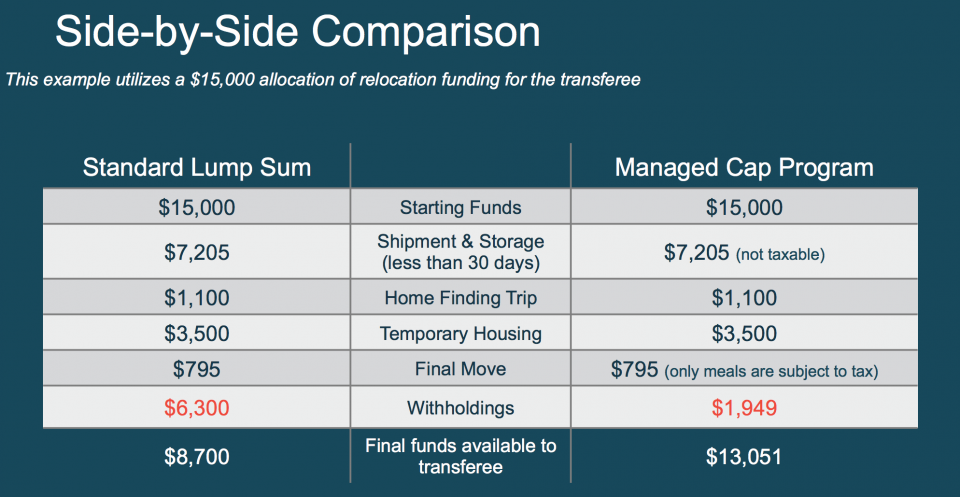
Let’s see the difference between a $15,000 lump sum payment and the same $15,000 from a managed cap program:

GMS-Managed-Cap-vs-Lump-Sum-Chart

A Winning Scenario

The Managed Cap Program provides the transferee with $4,351 more for relocation services!


Modern Mobility Made Easy™

What this means for you and your relocating employees

A Managed Cap program will ensure that your transferees get the most out of their relocation dollars and that you will reduce the amount of administrative burden dealing with exceptions. Global Mobility Solutions – a leader in mobility management since 1987 – has expert relocation consultants who understand how a Managed Cap program can benefit you and your company. Contact Global Mobility Solutions and learn how we can quickly implement a managed cap program custom-tailored for your needs. Request your complimentary managed cap program demo to see how much you can be saving.

Request-a-Demo

Looking for something?