Categories
Corporate Relocation Domestic Relocation Global Mobility Relocation Management

What is Employee Relocation or Workforce Mobility?

Employee relocation or workforce mobility refers to the processes or relocation services involved in the transfer of employees or potential employees from one location to another. Additional terms that refer to these processes may include:

Some of these terms may be used interchangeably. However, the terms global relocation and North America relocation may differ in the range of services commonly required for relocating an employee. Reference to global relocation is usually as an umbrella term, and includes North America relocation processes. Reference to North America relocation usually excludes processes commonly needed for international employee relocation such as visa acquisition, repatriation, and language training.

Generally, a company’s management of workforce mobility accounts for ongoing employee support services, supplier management, candidate selection, relocation benefits, and expense management. Corporate relocation programs vary between companies due to size, need, or destination.

The overall process of employee relocation is usually divided into one of four service brackets including:

Pre-Decision Services:

According to Worldwide ERC data, the average cost to relocate an executive level home-owning employee is approximately $97,000. For this reason, companies seek assurances that an employee is a good fit for relocation. Pre-decision services aim to uncover any potential issues that may arise prior to the employee’s relocation. As a result, these services reduce the risk of a failed relocation. Some of the most common reasons for failed relocations according to Worldwide ERC include:

  • Negative home equity
  • Slow real estate housing market
  • Family resistance to move
  • Spousal employment
  • High costs of housing

Examples of a few common pre-decision services include:

Candidate Assessment – Services that assess candidate expectation, skills, personal qualities, family circumstance, and financial preparedness.

Cost of Living Analysis – Cost of living comparison of origin and destination cities to help determine acceptable or competitive salary range.

Market Analysis – Determines the likely home sale timeline and identifies potential home sale challenges such as negative equity.

School Reports – Public and Private School reports provided to the relocating employee to aid community selection.

Moving Cost Estimates – Cost estimates on household goods transportation, helps budget for relocation costs.

Community Search and Tours – Coordinates community orientation tours to familiarize relocating employees to their new location, and assist in selecting an area that fits their particular interests.

Origin Services for Employee Relocation

Origin services account for all services necessary at the transferring employee’s origin location. Some of these services include:

Expense Management – Establishment of expense reporting and management services for both the company and employee. Also, this is designed to track and contain costs during the relocation process. Utilized throughout the entire relocation process*

Home Sale Assistance – May include connecting employees with real estate agents, home marketing assistance, and home buying programs.

Household Goods Management – Management of household goods transport from origin to destination. May include procurement of van line services, replacement insurance, and guaranteed “not to exceed” estimates for goods transportation.

Visa and Immigration Services – For international relocations, visa and immigration services organize company and employee documents required for visa acquisition.

Property Management – For employees not selling their home. May include rental marketing assistance, tenant management, vacant property management, landlord consulting, and property maintenance.

Destination Services for Employee Relocation

Destination services account for all services necessary at the transferring employee’s destination location. The range of destination services sometimes includes a further segmentation of “settling in services.” These services are aimed at helping the employee and their family acclimate to their new location. Some of these services may include:

Home Finding Services – Services include connecting employees with real estate agents at destination, home buying assistance, corporate housing, temporary housing, rental assistance, and home finding tours.

Settling in Services – Services that aid employee acclimation to their new location including access to online resources, attaining local driver’s license, child care, connecting utilities, and locating a primary care physician.

Vehicle Lease or Purchase – Services that assist relocating employees acquire a vehicle including loan support, and lease negotiation.

Family Assistance – Services that assist the relocating employee’s family, including spousal employment support, counseling services, and stress management assistance.

Return or Repatriation Services

In most cases, employee relocation services for individuals returning from temporary North America assignments are equivalent to services provided at departure. While there are some short term North America relocation programs among companies, the majority of return services handle an employee’s return from international assignment. International assignments are usually classified into one of four categories:

  1. Extended Business Travel (EBT): an assignment of 3 months or less.
  2. Short Term: An assignment lasting 6 months to a year (range may go up to 2 years).
  3. Long Term: An assignment lasting 2-3 years.
  4. Permanent: An assignment lasting 3 years or more.

For EBT, short term, and long term assignments, repatriation plans have become an industry recognized necessity for effective employee retention. According to Atlas surveys, around 40% of expatriate employees leave their sponsoring company after assignment. Repatriation services seek to close this gap. They also help organizations maximize their workforce investment. As a result, they retain employees that have acquired substantial knowledge capital. Repatriation is a dynamic service area that has wide variation. For example, repatriation counseling helps employees returning from international assignment manage cultural differences, and re-acclimate to North America life. Additional services may include:

  • Lease termination assistance
  • Home services termination (includes utilities)
  • Tax equalization

Workforce mobility seeks to analyze, manage, execute and optimize the processes involved in transferring an employee from one location to another. For more detailed descriptions of relocation services, please visit the following pages:

Global Relocation
North America Relocation

Conclusion

The corporate relocation experts at Global Mobility Solutions (GMS) have the knowledge and expertise to help your company remain competitive, reduce costs, and offer your employees the best relocation experience.

GMS was the first relocation company to register as a .com. The company also created the first online interactive tools and calculators, and revolutionized the entire relocation industry. GMS continues to set the industry pace as the pioneer in innovation and technology solutions with its proprietary MyRelocation® technology platform.

Global Mobility Solutions is proud to be named and ranked #1 Overall, and #1 in Quality of Service by HRO Today’s 2019 Baker’s Dozen Customer Satisfaction Survey.

Contact our team of experts to discuss how we can help improve your company’s corporate relocation program, or call us at 800.617.1904 or 480.922.0700 today.


Request your complimentary relocation policy review

Categories
Choosing a Relocation Company Corporate Relocation Corporate relocation tips Domestic Relocation Domestic Relocation Tips Global Relocation Relocation Best Practices Relocation Management

Top 5 Reasons for Expedited Bidding

What is Expedited Bidding?

The Expedited Bidding Process (EBP) is not an abbreviated approach. It is a request for proposal (RFP) that, like a traditional RFP, demands complete and detailed answers from relocation management companies (RMC). However, through expedited bidding, a company’s purchasing department only sends RFPs to a small, select group of key RMCs.

The trend in utilizing an EBP for the outsourcing of relocation management is at an all-time high. Global Mobility Solutions consulting team’s recent study shows that EBP utilization is up more than 200% over the last year. Why are so many companies turning to expedited bidding when looking for a mobility management solution?

Buying Solutions, Not Widgets
Purchasing relocation management is not like sourcing for parts. Ensuring the right fit for the right reasons is key when purchasing employee-facing services.

Courtesy Mobility Consulting
Policy reviews, recommendations, program design, and policy development can be part of the process. This allows for an evaluation of the RMC experience, knowledge, and quality of consulting work.

Immediate Cost Savings
Competition often equates to implicit cost savings through no fee implementation, less administrative burden and time investment, improved fee structures, and reduced direct costs.

Quicker Program Implementation
90% of EBP implementations are completed within 22 days, allowing for immediate efficiencies and realized savings.

Full RFP Avoidance
Eliminates the administrative burden for the purchasing department and reduces the need for extensive resources when compared to a formal Request for Proposal method.

Modern Mobility Made Easy™

What this means for you and your relocating employees

The Global Mobility Solutions benchmarking study shows that companies utilizing an expedited bidding process achieve savings up to 61% over typical RFP costs. Expedited bidding is one of many ways that Global Mobility Solutions recommends to make choosing an RMC fast, easy, and cost-effective. Before you send your next RFP, Download the 28 Critical Questions to ask an RMC. For more information on EBPs, and to learn more about Global Mobility Solutions’ corporate relocation programs, contact us online or give us a call at 800.617.1904 today.

Download the 28 Critical Questions to ask an RMC when submitting an RFP

Categories
Corporate relocation tips Domestic Relocation Domestic Relocation Tips Global Mobility Global Relocation Global Relocation Tips Relocation Best Practices Relocation Management

5 Easy Steps for Year-End Relocation Expense Reporting

While most people are busy preparing for the holidays, you’re scrambling through the year-end reconciliation of your relocation expense data. Well, even though it’s only November, here is a gift that will help you navigate your year-end process this year and for years to come.

Though many relocation managers might prefer holiday gift shopping to year-end reporting, the process tends to go more smoothly when run by the relocation department. To maximize efficiency, be sure to follow these five steps:

1. Checklist

Create a year-end checklist. A detailed checklist will identify the information you need to accurately report year-end compensation. Your checklist should include due dates, responsible individuals, and departments. Establishing the responsibility for reporting relevant compensation data is critical and may include several components such as wages, imputed income, benefits, equity, and taxes. This year-end checklist will help you identify all the resources you need to create a complete and accurate report. Your itemized checklist should include items such as early cutoff dates, all employees who will receive the tax filing services (employees on the tax eligibility list), and provide for the time needed for verification, approval, and processing. A well-developed checklist will also set firm deadlines for reporting and tax filings.

2. Preparation Call

Set up a year-end preparation call. When setting due dates, remember the mandatory vacation times required by some countries toward the end of December. During the call, review your year-end checklist with all involved parties to ensure they are aware of their role and deadlines. Use this call as an opportunity to build understanding and develop relationships that will make year-end reporting easier in the future. If you have not already held a year-end preparation call, schedule one as soon as you finish reading the rest of this article!

3. Verify Data

Verify all of your data. Accuracy is vital, especially for compensation reporting. Data such as addresses and tax ID numbers/Social Security numbers should be confirmed, as well as wages, benefits, sick days, and vacation time. Verifying relocation expense data eliminates backtracking and costly errors.

4. Finalize Data

Finalize your relocation expense data. Make sure that the final payroll reports of the year have been included, plus any end-of-the-year benefits. Be sure to back up the program data again and save it in a secure location for easy future reference.

5. Submit Report

Get ready to submit your report. Double-check the deadlines for all the countries on your list and be prepared to provide specific data for each country. Tax providers may ask for data for different assignee/transferee populations. Be sure to adhere to your year-end deadlines and, whenever possible, send the data ahead of time. Some international locations may have very tight turnaround times to make that final tax payment of the year.

Modern Mobility Made Easy™

What this means for you and your relocating employees

As with anything, practice makes perfect. The more you follow these five steps, the easier your year-end reporting will become. Global Mobility Solutions – a leader in mobility management since 1987 – has expert relocation consultants who can help you quickly implement relocation policies custom-tailored for your needs, as well as expense reporting to make your year-end reconciliation easier. Request a professional audit of your year-end process.

Request your complimentary relocation program audit

Categories
Corporate relocation tips Domestic Relocation Domestic Relocation Challenges Domestic Relocation Tips Global Mobility Global Relocation Global Relocation Challenges Global Relocation Tips Relocation Best Practices Relocation Challenges Relocation Management

Top 3 Considerations When Implementing Relocation

Keys to working smarter, faster, and more cost-effectively

HR, Recruitment, Payroll, Accounts Payable, IT Security, and other relocation stakeholders commonly face a never-ending variety of evolving and often overwhelming challenges when it comes to the implementation of benefits administration, which includes relocation outsourcing decisions.

As employee benefits become more complex, critical, and increasingly subject to regulatory compliance requirements, employers must accurately assess their team’s capacity when it comes to implementing relocation programs.

Global Mobility Solutions (GMS) recently compiled the data on thirty four (34) recent implementations it managed, representing key industries and includes several multinational companies (including and not limited to manufacturing, technology, healthcare, and energy). This study was derived from initial and post-implementation surveys that are focused on implementation Critical Success Factors (CSF).

Top 3 Critical Success Factors

  1. Implementation Management
    Assessing an organization’s goals and creating a realistic road map of key milestones is a critical part of delivering an effective implementation. The process begins by identifying the right mix of internal/external resources and flexible technology that support a collaborative approach to implementation that stays on track. This study confirms that proper planning and management is an essential to any successful relocation implementation.
  2. Cycle Times
    All organizations, large and small, have finite resources, making the maximization of productivity and cycle times a CSF. Properly planned and executed implementations reduce typical and customary cycle times.
  3. Time Investment = Real Dollars
    The old adage of “time is money” has a direct association to relocation program implementation. This is evident by the time investment required to complete implementation by multiple disciplines within an organization, such as Human Resources, Payroll, Accounts Payable, preferred vendors and the RMC.

Modern Mobility Made Easy™
What this means for you and your relocating employees
Our findings conclude that organizations with solid implementation oversight and supporting technology experience shorter cycle times, spend less and have a better overall experience. Global Mobility Solutions, a leader in corporate relocation since 1987, provides companies like yours with proven leadership, time tested procedures and advanced technology to ensure that no more than 10% of their time is spent on implementing a relocation management program. GMS completes new implementations within 5 to 22 days, while maintaining 98% planning accuracy and 100% implementation satisfaction. To learn how to quickly and easily implement your relocation program, all within your planned budget, by requesting an implementation demo.

Request a relocation implementation demo from Global Mobility Solutions

Categories
Corporate Relocation Corporate relocation tips Domestic Relocation Domestic Relocation Tips Domestic Relocation Trends Global Mobility Global Relocation Global Relocation Tips Global Relocation Trends Household Goods Relocation Best Practices Relocation Management

Relocation Models for 5 Major Industries

Traditional vs. Lump Sum Relocation Programs

Which is best model for your company?

There is more than one way to get your relocating employees to their new assignments. Many companies opt for either a traditional relocation program, a lump sum/managed cap program, or a combination of the two, depending on the position of the transferee and other special circumstances.

What are the Differences?

With a lump sum or managed cap model, relocating employees are given a pre-determined amount of money to cover all aspects of their move. From the shipping of goods to temporary housing, the transferees are responsible for researching and obtaining all the services needed to get them to their new destinations. There is no tracking or reporting available to HR or finance departments to let them know whether their relocation policies are too generous, costing the company more money than necessary to relocate their employees, or too limited, forcing transferees to pay out of pocket unnecessarily. This approach leaves the entire move is managed by the transferees, many who might not have any prior moving experience.

Conversely, a traditional relocation model is managed by a relocation management company (RMC). The RMC coordinates everything for the transferees. This includes, but is not limited to, home selling, household goods movement, temporary living, and home purchasing. The RMC sets up the various services with reputable, vetted network partners. Since the RMCs use direct billing back to the client companies, the transferees rarely have to open their wallets. HR and finance departments receive detailed expense reports from the RMCs that capture all the costs related to relocating their transferees.

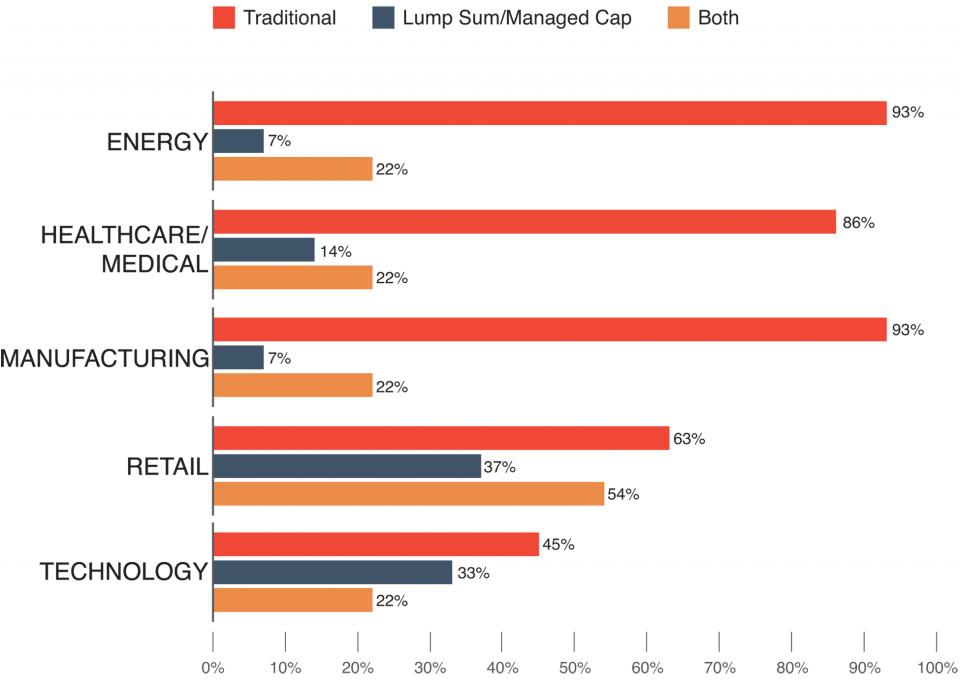
Based on comprehensive relocation surveys, here are findings of how companies in five different industries utilize either traditional, managed cap/lump sum, or a combination of these relocation programs:

Relocation Models by Industry: Energy, Healthcare/Medical, Manufacturing, Retail, Technology

The figures above illustrate that across all the industries in this survey, traditional relocation programs are used more frequently than lump sum or managed cap programs. However, in all the industries, there is a large percentage of companies that utilize a combined approach. A best practice consideration is to adopt a combination of traditional and managed cap relocation models.

Modern Mobility Made Easy™
Helping you manage your relocating employees

Global Mobility Solutions, an innovative leader in corporate relocations since 1987, can analyze and create mobility management programs customized for your unique needs. Additionally, we have compiled benchmarking studies and relocation best practices for numerous industries. To learn more about what type of relocation model would fit best with your company, get the full relocation benchmarking study for your specific industry:

Download your industry benchmarking study

Categories
Corporate Relocation Domestic Relocation Global Mobility Global Relocation Relocation Management

Global Mobility Solutions Expands Headquarters

Scottsdale Mayor kicks off the headquarters expansion celebration

Headquarters Expansion – Global Mobility Solutions (GMS), a leader in corporate relocation solutions and technology, held an Open House Wednesday, September 20th, to celebrate its headquarters expansion.

The Open House ran from 3:00 pm to 5:00 pm and Guest of Honor was Jim Lane, the Mayor of Scottsdale, performed a ribbon-cutting ceremony to officially commemorate the new office.

Global Mobility Solutions ribbon-cutting ceremony. (From left to right) Rich Ganley, GMS Founder and Board Member; Steven Wester, GMS President and Board Member; Jim Lane, Mayor of Scottsdale; Mark Hiegel, President and CEO of Scottsdale Chamber of Commerce; Steve Ziomek, GMS Founder, Designated Broker, and Board Member.

GMS president, Steven Wester, praised his staff and network partners for their role in the expansion, and stated that the company shows no sign of slowing its growth.

“This is a big milestone for Global Mobility Solution. Not only are we celebrating our thirtieth anniversary this year, but to expand by fifty percent is a testament to all our wonderful employees.” Mr. Wester continued, “This growth is also attributed to innovative technology solutions and our strong client partnerships.”

Mayor Lane stated, “It’s always great to see success here in Scottsdale.” The Mayor reminisced, “In this particular case, thirty years ago, I had a consulting company and these guys were my clients. So,” said the smiling Mayor, “I take a little bit of responsibility for their success.”

Mark Hiegel, President and CEO of the Scottsdale Chamber of Commerce, also provided some words of congratulations before Mr. Wester invited the guests to tour the office and enjoy the food and beverages.

This event provided an excellent opportunity for clients and network partners to meet the individuals with whom they do business, and for neighboring companies to learn about Global Mobility Solutions.

About Global Mobility Solutions

Founded in 1987, Global Mobility Solutions is a relocation management company that specializes in supplier management and relocation program development. The company’s relocation services include global assignment management and domestic relocation management, as well as a range of pre-decision solutions and relocation technology applications. To learn more about how Global Mobility Solutions can help you with your relocation management, contact us now.


Categories
Corporate Relocation Corporate relocation tips Domestic Relocation Domestic Relocation Tips Global Mobility Global Relocation Global Relocation Tips Relocation Best Practices Relocation Management

The Real Truth: Managed Cap vs. Lump Sum

Managed Cap vs Lump Sum – Key Things You Need to Consider

As a mobility manager, lump sum payments might seem like the fastest and easiest method of providing your employees with the funds they need to move. However, when looking at managed cap vs lump sum, lump sum payments come with their own unique set of problems. Some of the challenges include:

  • Transferees often left alone in the relocation process
  • No cost controls and often budgetary overages
  • Limited process or service structure
  • Non-taxable benefits are lost
  • Frustrated transferees mean elevated HR involvement and escalations

Fortunately, a managed cap program alleviates many of the problems associated with a lump sum. It also provides:

  • The desired simplicity and predictability of a lump sum program
  • Enhanced employee tax benefits, resulting in more dollars for relocation.

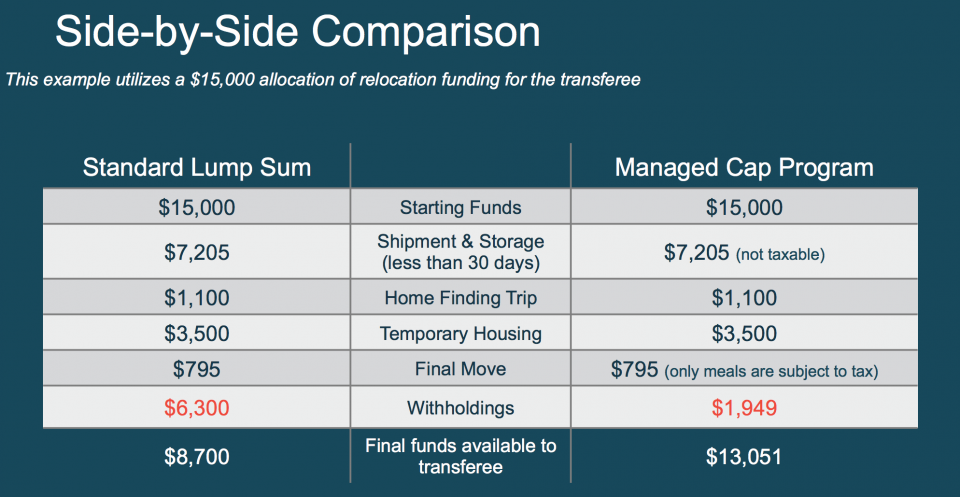
Let’s see the difference between a $15,000 lump sum payment and the same $15,000 from a managed cap program:

GMS-Managed-Cap-vs-Lump-Sum-Chart

A Winning Scenario

The Managed Cap Program provides the transferee with $4,351 more for relocation services!


Modern Mobility Made Easy™

What this means for you and your relocating employees

A Managed Cap program will ensure that your transferees get the most out of their relocation dollars and that you will reduce the amount of administrative burden dealing with exceptions. Global Mobility Solutions – a leader in mobility management since 1987 – has expert relocation consultants who understand how a Managed Cap program can benefit you and your company. Contact Global Mobility Solutions and learn how we can quickly implement a managed cap program custom-tailored for your needs. Request your complimentary managed cap program demo to see how much you can be saving.

Request-a-Demo

Categories
Corporate Relocation Domestic Relocation Domestic Relocation Trends

50 U.S. Cities with the Most New Jobs

Big opportunities in relatively small towns. 

With unemployment near a ten-year low and new jobs surpassing monthly expectations, one might be wondering, “Where are all of these opportunities, what are the 50 US cities with the most jobs?”

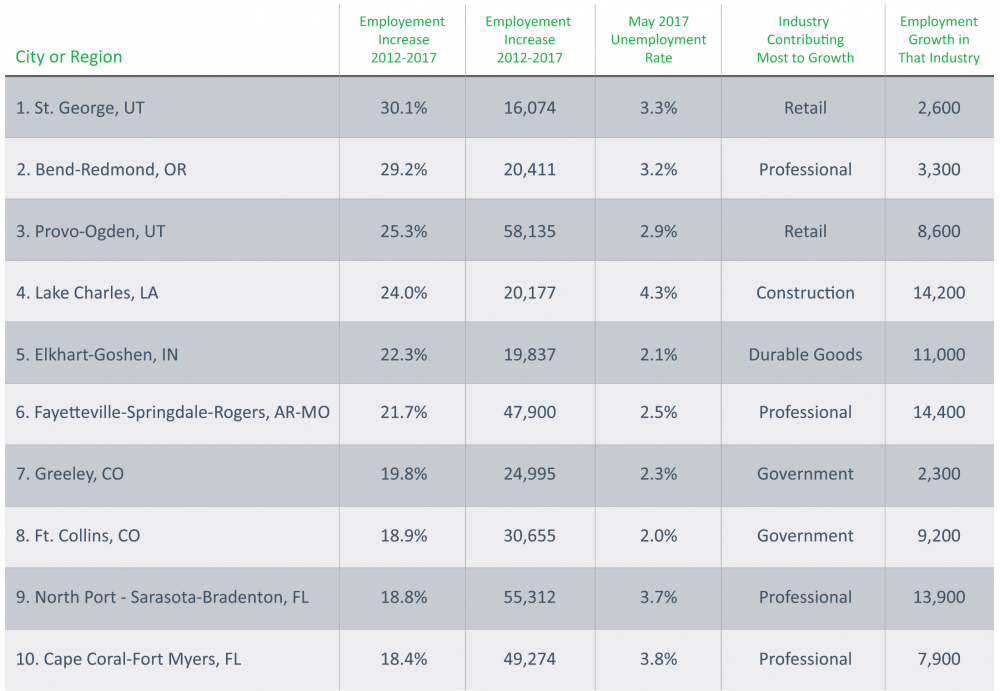
In an article for msn.com this July, writer Michael B. Sauter composed a comprehensive list of the top 50 cities for job growth in the United States. The data was tracked from 2012 through 2017 and details the percentage of employment increase, the number of new jobs, the industry (excluding agriculture) contributing most to the growth in opportunities, as well as other key factors.

The top ten cities experienced job growth from 18% to over 30%. Here is a sampling of the top ten cities from Mr. Sauter’s article:

TOP-GROWTH-CITIES-2012-2017

Not surprising, early 50% of the cities on the comprehensive list were from states that have the highest inbound relocation activity1. Fort Myers, FL earned the number one spot on a list of the top U.S. cities for relocation, as posted by US News & World Report.


Modern Mobility Made Easy™

What this means for you and your relocating employees


Global Mobility Solutions (GMS) has destination spotlights for many of the cities mentioned in the overall list. These spotlights contain information about a city’s climate, geography, transportation, entertainment, culture, sports, schools, and more. GMS spotlights are great tools for helping mobility managers explain the benefits of a relocation assignment and for transferees to become accustomed to an area before actually moving there.

Destination-Spotlights-Button

  1. Miami Herald, January 5, 2017
Categories
Corporate Relocation Domestic Relocation Domestic Relocation Trends

Top U.S. Cities for Relocation

\A Trend Toward High Temperatures and Low Cost of Living

There was a time when the bright lights of huge coastal metropolises like New York and Los Angeles attracted hordes of people seeking employment. However, today’s relocating employees are drawn to lower-cost markets – especially in the southeastern states.

According to US News & World Report, the majority of 2016 relocations went to Florida, Texas, and North Carolina. Half of the top-ten list of cities from US News & World Report is comprised of cities from the “Sunshine State.” Not surprisingly, when comparing the cost of living in New York City to that of Ft. Myers, Florida, it is easy to see the savings that can be realized by both residents and businesses. Compared to Ft. Myers, New York has consumer prices that are 40.75% higher, average rent that is 225.70% higher, and grocery prices that are 30.95% higher(1). The median home purchase price in New York is $825,000 ($1,728,950 in Manhattan), while it is only $247,000 in Ft. Myers(2). Lastly, utility costs and transportation expenses in the Big Apple are 37% higher and 24% higher respectively than the costs in Ft. Myers(3).

Here are the complete lists of the top US relocation destinations in 2016:

US News & World Report Top Cities

  1. Fort Myers, FL
  2. Sarasota, FL
  3. Austin, TX
  4. Orlando, FL
  5. Charleston, SC
  6. Daytona Beach, FL
  7. Houston, TX
  8. San Antonio, TX
  9. Lakeland, FL
  10. Raleigh/Durham, NC

Forbes Top Cities

  1. Tampa, FL
  2. Jacksonville, FL
  3. Charlotte, NC
  4. San Antonio, TX
  5. Austin, TX
  6. Las Vegas, NV
  7. Orlando, FL
  8. Nashville, TN
  9. Raleigh, NC
  10. Portland, OR

At Global Mobility Solutions (GMS), we see this trend in action. In 2016, roughly one third of all our relocations were to the Top US Cities in southeastern and southwestern states.

If you are thinking about relocating to another destination, request your complimentary city-to-city cost comparison. This free report will detail the cost of living expenses of any two locations of your choosing. Learn before you leap.

Request your Complimentary City 2 City Comparison now!

Sources:
1. http://www.numbeo.com, accessed 06/30/2017
2. http://www.zillow.com, accessed 06/30/2017
3. http://www.areavibes.com, accessed 06/30/2017

Categories
Corporate Relocation Domestic Relocation Domestic Relocation Trends Global Mobility Global Relocation Global Relocation Trends Relocation Best Practices

Global Mobility Solutions Named a Top Relocation Company

Global Mobility Solutions (GMS) is proud to be recognized by HRO Today as a top relocation company for the fourth year in a row. Every year, HRO Today compiles customer surveys and other data to produce their Baker’s Dozen list of the best relocation companies.

HRO Today’s Baker’s Dozen rankings are based solely on feedback from buyers of the rated services; the ratings are not based on the opinion of the HRO Today staff. Feedback is collected annually through an online survey, which is distributed both directly to buyers through HRO Today’s own mailing lists and indirectly by sending service providers the link to send to their clients. Overall ranking is determined by analyzing the results across three subcategories: features breadth, deal sizes, and quality. Using a predetermined algorithm that weighs questions and categories based on importance, HRO Today calculates scores in all three subcategories as well as an overall score. The rankings are based on those scores.

The fact that our customers continually place GMS into the Baker’s Dozen list of top relocation companies speaks volumes with regard to our outstanding service, our breadth of programs, and the value that we bring to our clients.

To see how GMS can make your life with regard to workforce mobility easier, simply ask for a complimentary relocation policy review and our expert consultants will discuss how to improve acceptance rates, make assignments more successful, and make the whole process more cost-efficient.

Get your complimentary Relocation Policy Review today!

Looking for something?