Categories
Corporate Relocation Corporate relocation tips Domestic Relocation Tips Domestic Relocation Trends Global Mobility Global Relocation Labor Force

The Essential 2026 Employee Relocation Checklist: What Companies Need to Know

Employee mobility is evolving fast, and 2026 will bring new expectations, new compliance requirements, and new opportunities for organizations relocating talent. Whether you move one employee a year or manage a global mobility program, a clear, updated relocation checklist is essential for staying compliant, supporting employees, and controlling costs.

At Global Mobility Solutions (GMS), we work with organizations every day to anticipate mobility trends before they become challenges. This 2026 Relocation Checklist is built to help HR, talent acquisition, and mobility leaders prepare for the year ahead with confidence.

Review 2026 Legal, Tax & Compliance Changes

The regulatory landscape is shifting, especially in states like California, New York, and Washington, as well as across global markets. For 2026, companies should prepare for:

✔ Updated repayment agreement requirements

Several states—including California—are enforcing stricter rules on when and how employers can require employees to repay relocation or training costs. Review:

  • Standalone repayment agreements

  • Mandatory review periods

  • Caps or restrictions on reimbursable costs

  • Interest-free repayment structures

✔ Remote-work–related tax exposure

Hybrid and remote policies may trigger:

  • Multi-state tax withholding

  • Permanent establishment risks for international relocations

  • Location-based payroll adjustments

✔ Evolving visa and immigration rules

With global talent shortages continuing into 2026, organizations must anticipate:

  • Longer processing times

  • New digital immigration platforms

  • Changing work authorization requirements

  • Increased scrutiny around corporate sponsorships

A mobility partner like GMS can help track changing regulations across all relocation destinations.

Align Relocation Policies With 2026 Workforce Expectations

Today’s employees expect more personalization, transparency, and flexibility. In 2026, competitive mobility programs should include:

✔ Tiered or core-flex relocation models

These allow employees to choose benefits that match their lifestyle—for example:

  • Pet relocation

  • Spousal/partner job support

  • Childcare sourcing

  • Flexible home-finding assistance

✔ Clear cost coverage guidelines

Define what your company will cover:

  • Household goods relocation

  • Temporary housing

  • Lump-sum allowances

  • Home purchase or sale benefits

  • Travel and visa fees

✔ DEI-informed relocation support

Many employees expect culturally informed services, including language training, community integration support, and neighborhood insights.

Prepare for the 2026 Housing & Rental Market

Housing will remain a major challenge for companies relocating talent in 2026. Trends to plan for:

✔ Limited inventory in key job markets

Major tech and business hubs—including Phoenix, Austin, Denver, and Boston—continue to experience low housing supply.

✔ Rising rental costs

Budget planning should include updated rental caps and temporary housing timelines.

✔ Extended home-finding timeframes

Employees may need longer search periods or temporary living arrangements due to competitive markets.

GMS home-finding and destination services can help reduce employee stress and shorten move-in timelines.

Evaluate Cost Management Strategies for 2026

Budget predictability is one of the top concerns for HR and mobility teams.

✔ Audit current relocation spend

Look for opportunities to reduce costs through:

  • Pre-negotiated supplier rates

  • Policy adjustments

  • Relocation benchmark comparisons

  • Lump-sum utilization analysis

✔ Plan for inflation impacts

Household goods shipments, rental cars, flights, and temporary housing continue to fluctuate—especially for international moves.

✔ Use relocation technology to track costs

GMS relocation technology gives employers full visibility into spend, trends, exceptions, and employee progress.

Modernize the Employee Experience

Relocating employees want streamlined support, real-time updates, and simple communication.

✔ Mobile-first relocation tools

Employees expect apps that track:

  • Tasks and timelines

  • Housing appointments

  • Household goods shipments

  • Immigration steps

  • Expense uploads

✔ 24/7 support

A high-touch relocation experience improves retention and reduces employee frustrations.

✔ Mental well-being & family support

Relocation is stressful. Consider:

  • Settling-in services

  • School search assistance

  • Community and cultural integration

  • Counseling or wellness resources

Build Your 2026 Relocation Checklist

Use this quick checklist to ensure your mobility program is ready:

2026 Relocation Checklist

  • ☐ Update relocation policies for 2026 laws and compliance

  • ☐ Ensure repayment agreements follow state-specific rules

  • ☐ Review global immigration timelines and requirements

  • ☐ Implement tiered or core-flex benefits

  • ☐ Audit relocation budget and cost controls

  • ☐ Update home-finding and temporary housing guidelines

  • ☐ Prepare for rental and housing market challenges

  • ☐ Implement or enhance relocation technology

  • ☐ Strengthen employee communication and support resources

  • ☐ Evaluate vendor partners and supply chain performance

Prepare for 2026 With GMS

As the mobility landscape continues to transform, companies need a relocation partner that stays ahead of regulatory, economic, and talent trends. GMS has been leading the global mobility industry for over 30 years, helping organizations create compliant, cost-effective, employee-friendly relocation programs.

If your organization is planning to relocate employees in 2026, GMS can help you build the strategy, tools, and support needed for a successful year.


Contact us today to get started.

Categories
Domestic Relocation Domestic Relocation Challenges Domestic Relocation Tips Domestic Relocation Trends Global Mobility Global Relocation Relocation Best Practices Relocation Programs

The Future of Employee Relocation: Trends Shaping Global Mobility

In today’s rapidly evolving workforce, global mobility is no longer just about moving employees from one location to another—it’s about enabling people to thrive wherever business takes them. As organizations continue to expand across borders, the future of employee relocation is being shaped by technology, flexibility, and a deeper focus on employee experience.

At Global Mobility Solutions (GMS), we help companies stay ahead of these shifts by providing data-driven insights, innovative technology, and expert guidance to make every relocation successful. Here’s a look at the key trends defining the future of employee relocation and how they’re transforming global mobility programs.

Technology and AI Redefining the Relocation Experience

Technology remains one of the most powerful forces driving change in employee relocation. Artificial intelligence (AI), automation, and predictive analytics are simplifying the process for both employers and relocating employees.

AI-driven tools can now deliver personalized area insights, customized housing recommendations, and real-time cost analysis—all designed to help employees make informed, stress-free decisions. These solutions also give HR and mobility teams access to data that improves policy design, cost forecasting, and overall program efficiency.

At GMS, we leverage technology to streamline every stage of the relocation journey. From interactive dashboards to automated reporting and digital communication tools, our approach helps clients save time, increase transparency, and enhance employee satisfaction.

Flexibility Becomes a Core Benefit

One of the most significant shifts in recent years has been the growing demand for flexibility. Employees expect relocation programs that reflect their unique needs, lifestyles, and family situations. Companies are responding by offering more adaptable policies—such as lump-sum programs, core-flex models, and destination support options that can be customized to fit individual preferences.

Flexibility not only improves employee satisfaction but also helps organizations manage costs more effectively. By giving employees the freedom to choose the services that matter most to them, companies can provide meaningful support without unnecessary spending.

The most successful global mobility programs will continue to balance structure with personalization, ensuring every relocating employee feels supported, valued, and empowered to succeed in their new environment.

Sustainability and Social Responsibility Take Center Stage

Sustainability has become a defining theme across business operations, and global mobility is no exception. More organizations are prioritizing environmentally responsible relocation practices—such as reducing shipping emissions, choosing eco-friendly housing, and supporting local communities.

In addition, partnerships with purpose-driven organizations are helping companies make a positive impact through their relocation programs. For example, GMS is proud to support Plant With Purpose, a global nonprofit focused on environmental restoration and poverty alleviation. Through this partnership, GMS makes charitable donations on behalf of clients to help restore ecosystems and empower communities worldwide.

As sustainability becomes increasingly important to employees and employers alike, companies that integrate these values into their relocation programs will strengthen their brand reputation and appeal to socially conscious talent.

Employee Wellbeing and Experience at the Forefront

Relocation can be one of the most stressful life events an employee faces. Forward-thinking companies are recognizing the need to prioritize employee wellbeing throughout the mobility journey.

Comprehensive support—such as destination services, cultural training, mental health resources, and family assistance—helps ensure a smooth transition and successful assignment. Technology also plays a key role here, giving employees easy access to information and support whenever they need it.

A positive relocation experience not only improves retention but also contributes to higher engagement and productivity in the new role. As the competition for global talent intensifies, companies that prioritize employee wellbeing in their relocation policies will stand out as employers of choice.

Data-Driven Decision Making

The future of global mobility is built on data. Companies are increasingly turning to analytics to gain visibility into relocation costs, policy performance, and employee satisfaction. This data allows HR and mobility leaders to identify trends, optimize budgets, and demonstrate the strategic value of their relocation programs.

By combining technology and human expertise, GMS helps organizations turn complex data into actionable insights—empowering them to make smarter, more informed mobility decisions that align with broader business goals.

GMS is Here to Help!

The global mobility landscape is evolving faster than ever. As technology advances and workforce expectations shift, organizations that embrace flexibility, sustainability, and data-driven strategy will be best positioned for success.

At Global Mobility Solutions, we’re committed to helping companies navigate this transformation with innovative tools, personalized support, and proven expertise. Whether you’re managing relocations across the country or around the world, GMS is here to make every move brighter, smoother, and more successful.

Ready to future-proof your employee relocation program? Contact GMS today to learn how we can help your organization stay ahead of the trends shaping global mobility.

Categories
Choosing a Relocation Company Global Mobility Global Relocation Tips Global Relocation Trends Relocation Management Talent Management

Common Employee Relocation Packages

A Look at Typical Relocation Packages

Relocation packages, also known as relocation benefits, are policies and support that companies offer employees transferring to a location for a position. Each company will have different needs when it comes to relocation benefits, and it can be challenging for companies to determine exactly what should be covered in these policies and what employees should be responsible for on their own. 

To ensure the selected applicant receives a strong and appealing offer, providing a comprehensive and competitive relocation package for relocating employees is highly advisable. When crafting a relocation package, companies typically consider several key components to make the transition as smooth as possible for their employees.

By offering a well-rounded relocation package, companies ease the transition for their employees and demonstrate their commitment to supporting their workforce. This can lead to increased employee satisfaction, decreased turnover, and a more positive company culture. As businesses continue to adapt to a global workforce, investing in comprehensive relocation benefits will remain a crucial strategy for attracting and retaining top talent.

Companies can typically tailor relocation programs to each hiring situation. Some companies choose to have their HR department handle employee transfers. Still, if the company wants to be consistent with its relocation packages on each hire, using a reliable relocation management company is probably a good idea.

What Does A Standard Relocation Package Include?

Most relocation policies outline some form of reimbursement or coverage for many of the everyday expenses associated with moving. Relocation benefits often include full packing and unpacking services and a quality and reliable moving company to get the employee’s household goods from point A to point B. 

In addition to moving expenses, home sale assistance is another common benefit offered to transferees. This can include selling programs that utilize vetted real estate agents specializing in relocation to help ensure a quicker and more prosperous home sale for the relocating employee. 

Specific policies might support employees who need to terminate their rental agreements prematurely, helping them manage any associated penalties. Additionally, the relocation package may encompass house-hunting trips. This implies that the employer could finance one or two visits for the relocating employee to explore their future neighborhood and inspect various houses or apartments before making a decision.

Corporate housing options, also known as temporary housing, are typically included in most relocation policies. This provides the employee with a temporary accommodation after they’ve relocated to find a permanent home in their new location, allowing them to start on their desired start date for the position without delay. 

Many companies also offer transportation coverage or reimbursement as part of their relocation packages. This might cover airfare for the employee and their family or expenses for driving across state lines. In some instances, companies may also cover the employee’s transportation costs for their vehicle.

What Expenses Are Typically Covered During Relocation?

While not an exhaustive list, the following are common relocation costs for which many companies provide support to their relocating employees:

  • Corporate housing options 
  • Household goods transportation (HHG)
  • Storage facility (temporary storage of the HHG shipment
  • Miscellaneous expense allowance
  • Home sale costs
  • Spousal employment assistance
  • Travel-related costs, such as airfare, meals, and hotel nights

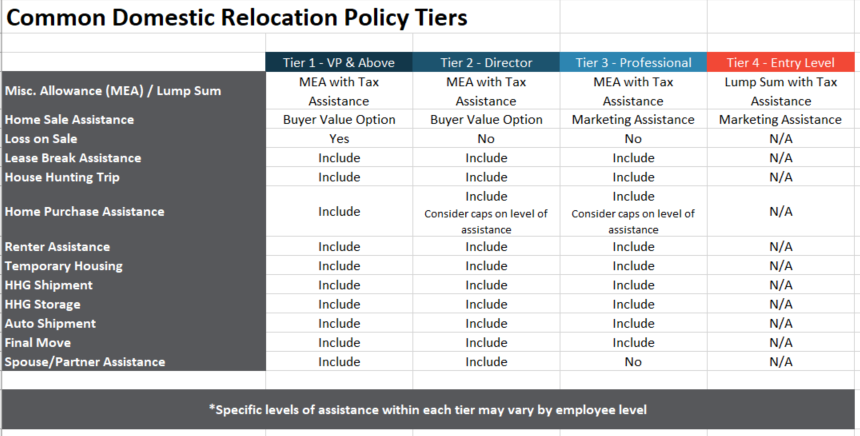
As every company has different goals and objectives for its relocation program, many-tiered relocation policies offer various levels of support for each employee. 

Here is a breakdown of the most common U.S. domestic relocation policy tiers per GMS research:

chart of relocation policy tiers

What Types Of Employees Receive Relocation Packages?

This aspect will depend upon the company’s need for each position and the importance of getting that employee to the new location. The best practice for relocation programs is to build a tiered system based on employee level. 

These tiers are commonly built around entry-level employees, professionals, directors, and vice presidents. Additionally, many companies offer executive relocation packages to cover the costs of relocation for most executive-level employees. Some companies may also provide international relocation packages for employees relocating globally.

Common Methods to Address Costs in Relocation Packages

Different policy tiers within your relocation program may require different strategies for covering your employee’s relocation costs. It is essential to understand the advantages and disadvantages of these standard methods.

Direct Billing: The relocation management company manages the procurement, organization, and direct payment to the service providers involved in your employee’s relocation. They review, combine, and forward the invoices to you for settlement. Although this approach may be pricier, it guarantees that your employee maximizes their benefits and reaches their new location promptly, alleviating any concerns about the expenses associated with the move. 

Expense Reimbursement: The employee pays for moving expenses upfront, and the company issues a reimbursement check at the end of the process. While not generally intended to cover an employee’s entire move (few families have the cash to pay tens of thousands of dollars for a move), reimbursements are commonly used for miscellaneous expenses as outlined in the company’s relocation policy. Typically, reimbursements are used for items such as travel costs or other related items.

Lump Sum: Unlike an expense reimbursement, a lump sum is commonly used as the primary financial benefit to a relocating employee. In a lump sum policy, a set amount of money is given upfront to the employee to handle the moving expenses as they see fit. 

Generally provided to entry-level or lower-level employees, the lump sum is typically the only relocation benefit offered. While the lump sum is seen as an excellent cost control tool for companies, it places additional burdens on employees, as they are left to manage their move independently. This is in addition to the lump sum, which is typically considered taxable income. Employees who receive their relocation benefits as a lump sum should note the payment for tax purposes. Employers should consider adding a tax gross-up to the lump sum to help mitigate the effects of the income tax on the employee’s benefit.

Ready to Set Up Relocation Packages for Employees?

Partnering with Global Mobility Solutions (GMS) ensures that your company offers comprehensive, cost-effective, and employee-centric relocation packages. GMS provides a tailored approach that aligns with your unique organizational needs, offering flexibility. This model allows you to select from a network of top-tier service providers or integrate your preferred partners, ensuring a customized experience for each relocation. Their expertise in managing all aspects of the relocation process—from pre-decision assessments to destination services—reduces risks, enhances employee satisfaction, and improves retention rates.

By leveraging GMS’s industry-leading MyRelocation® technology platform, your company can streamline relocation management, track expenses, and provide real-time support to transferees. This comprehensive support facilitates smoother transitions for employees and strengthens your employer brand by demonstrating a commitment to employee well-being. With over 30 years of experience and a global presence in over 140 countries, GMS has an expert team equipped to handle the complexities of workforce mobility, enabling your company to attract and retain top talent anywhere in the world.

We're Here to Help! Request a Courtesy Consultation

Are you ready to talk to a Mobility Pro? Learn how GMS can optimize your mobility program, enhance your policies to meet today’s unique challenges, receive an in-depth industry benchmark, or simply ask us a question. Your Mobility Pro will be in touch within 1 business day for a no-pressure, courtesy consultation.

Categories
Domestic Relocation Tips Domestic Relocation Trends Employee Development Global Relocation Tips Global Relocation Trends

How Employee Relocation Has Changed Over the Years

Here’s an overview of how talent mobility programs have transformed

Corporate relocation is a relatively recent development compared to farming, production, and hospitality industries. Nevertheless, the sector has experienced significant growth in recent years due to the increasing demand for relocation services.

Throughout history, it has been a frequent practice to transport groups of individuals over long distances to achieve a particular goal. This could be seen in the nomadic tribes who journeyed to find food, the exploration expeditions as countries competed for land, or the missions to procure specific resources. Industry pioneers have traversed vast distances for centuries and engaged with unfamiliar societies to conduct business. The concept of relocating for employment has been ingrained in human culture for centuries, but modern relocation practices took off in the 1950s. 

Following the conclusion of the Second World War, the corporate landscape underwent a significant transformation. Companies began to look for opportunities to grow outside of their domestic markets. The war had paved the way for cross-cultural collaborations, introducing a new era of interconnectedness. This global transition resulted in a notable rise in international assignments, as significant corporations sent their top talent to work in foreign countries.

In 1964, a significant achievement was made in talent relocation history. The establishment of what eventually evolved into the foremost organization for talent management and global mobility expertise, the Worldwide Employee Relocation Council (WERC), represented a significant milestone. This organization played a vital role in shaping the industry as we see it today.

The New Millennium of the 2000's

The significance of relocation services such as Destination Services and Intercultural Training became apparent following major mishaps that led to unsuccessful transactions. The 2000s saw a shift towards prioritizing the well-being of employees as individuals and ensuring the satisfaction of accompanying family members.

Relocation technology also took a huge step forward in making the relocation process more manageable for transferees and their employees. As companies began to recognize the importance of employee satisfaction and retention, the focus on providing comprehensive relocation services grew. This included assistance with finding housing and settling into a new location and support with cultural integration and language training. The emphasis on employee well-being led to the development of more personalized relocation packages tailored to the specific needs of each individual and their family.

Advancements in technology also revolutionized the relocation process, making it easier for employees to navigate the complexities of moving to a new country or city. Online platforms and mobile apps were introduced to streamline the relocation process, providing access to resources and information at the touch of a button. This improved the efficiency of relocation services and enhanced the overall experience for employees and their families.

Overall, the 2000s marked a significant shift in how companies approached employee relocation, emphasizing the well-being and satisfaction of their workforce. The evolution of relocation services and technology during this time laid the foundation for the modern global mobility industry, setting the stage for continued innovation and improvement in the years to come.

The Relocation Industry Today and Beyond

In today’s global economy, Switzerland, China, the United States, Mexico, the United Kingdom, Germany, Singapore, and Canada are top choices for international corporate relocations. Successful companies have flexible relocation partnerships to navigate the fast-paced business landscape. Dwellworks is well-equipped to streamline moves with a comprehensive range of services one interconnected company provides. 

Like many other sectors, the corporate relocation sector has been impacted by technological advancements. Cultural training services can now be accessed remotely and at flexible times to accommodate the hectic schedules of relocating workers. By utilizing technology, cultural trainers and Destination Services Consultants can customize their services to offer the most precise and practical support to new arrivals.

GMS Is, and Has Always, Been the Industry Leader

Global Mobility Solutions (GMS) has been a leader in the relocation industry since 1987. Our expert team is always willing to listen to your talent mobility needs and assist you in creating the best employee relocation policies.

With the rise of technology, GMS has adapted to provide top-notch services to meet the evolving needs of its clients. From virtual cultural training sessions to personalized consultations, GMS ensures that every aspect of the relocation process is tailored to the individual needs of each employee. This commitment to excellence has solidified GMS’s reputation as the industry leader in corporate relocation services.

Furthermore, GMS’s long-standing presence in the industry has allowed it to establish strong relationships with a network of trusted partners worldwide. This extensive network ensures that employees receive seamless support throughout the relocation process, regardless of where they are moving.

In conclusion, GMS’s dedication to innovation, personalized service, and global partnerships make it the go-to choice for companies seeking reliable and efficient corporate relocation solutions. Trust GMS to handle your talent mobility needs with professionalism and expertise. 

Contact us today if you’re ready to speak with a relocation expert.

We're Here to Help! Request a Courtesy Consultation

Are you ready to talk to a Mobility Pro? Learn how GMS can optimize your mobility program, enhance your policies to meet today’s unique challenges, receive an in-depth industry benchmark, or simply ask us a question. Your Mobility Pro will be in touch within 1 business day for a no-pressure, courtesy consultation.

Categories
Corporate Relocation Corporate relocation tips Domestic Relocation Domestic Relocation Challenges Domestic Relocation Tips Domestic Relocation Trends

How Spousal Support and Family Services Affect Relocation Decision-Making

The success of a relocation heavily depends on the happiness of the relocating employee and their family

The “spousal assistance” benefits have evolved from a small aid to a powerful support system. Companies now understand the importance of the well-being of both employees and their families in a successful relocation. This once-overlooked perk has become a valuable tool for personal and professional development. 

Employee and family assistance has become a must-have component in corporate relocation services by providing support that boosts confidence, helps overcome challenges, and reduces stress about the move. It is no longer an afterthought but a crucial component that can make a significant difference in the success of a move.

In the past, companies have seen corporate moves as simply moving an employee from one place to another as efficiently and inexpensively as possible. The concept of providing job search help for spouses, now known as “spouse assistance,” became popular in the 1980s. However, this support was usually only given to those spouses or partners who specifically requested it or even insisted on it.

In recent years, significant discussion has concerned the employee experience in the industry. However, policies have mostly stayed the same, and financial resources must be expanded.

In the current competitive job market, with a renewed emphasis on health and environmental responsibility following the pandemic, employers are reconsidering the concept of employee relocation. Instead of viewing it as a work-related change, companies recognize that moving affects every aspect of an individual’s personal and professional life. It is essential to acknowledge that employees are people first and foremost, and their well-being should be prioritized. This shift in perspective leads to a reassessment of how the relocation sector can better assist employees and their families during the moving process.

“spouse assistance” has transformed into “employee and family assistance,” enabling companies to support the overall well-being of the entire household proactively. This approach ultimately helps employees thrive in their new roles.

This shift in perspective recognizes the importance of considering the holistic needs of employees and their families when it comes to relocation. By supporting the employee and their spouse and children, companies can create a smoother transition and help ensure the employee’s overall well-being and productivity in their new location.

Employee and family assistance programs may include services such as helping spouses find employment in the new location, providing resources for children to adjust to a new school, offering counseling services for the entire family to cope with the stress of moving, and even assistance with finding housing and settling into the new community.

By taking a more comprehensive approach to relocation support, companies can demonstrate their commitment to the well-being of their employees and their families. This helps with employee retention and satisfaction and contributes to a positive company culture that values its workforce’s personal lives and happiness. Ultimately, investing in the well-being of employees and their families during a relocation can lead to tremendous success and productivity in the long run.

What GMS Does to Help Provide Spousal and Family Support Services

Offering a comprehensive array of career assistance and additional tools for transferees and their families is crucial for ensuring smooth relocations. The seasoned professionals at Global Mobility Solutions (GMS) possess the skills and know-how needed to aid your company in evaluating potential candidates for assignments and offering top-notch relocation services for employees and their loved ones.

Our team at GMS understands the importance of supporting the transferee and their family during the relocation process. We offer various services such as spouse career support, school search assistance, and settling-in services to ensure the entire family feels supported and comfortable in their new location. By providing comprehensive support to the employee and their family, we can help reduce stress and increase the likelihood of a successful relocation. Contact us today to learn more about how GMS can help provide your employees spousal and family support services.

We're Here to Help! Request a Courtesy Consultation

Are you ready to talk to a Mobility Pro? Learn how GMS can optimize your mobility program, enhance your policies to meet today’s unique challenges, receive an in-depth industry benchmark, or simply ask us a question. Your Mobility Pro will be in touch within 1 business day for a no-pressure, courtesy consultation.

Categories
Choosing a Relocation Company Corporate Relocation Corporate relocation tips Domestic Relocation Trends Global Relocation Trends

Things to Consider When Planning a Group Move

Relocating multiple employees at once can be challenging; here’s what to know

Effective project management and control are crucial for a successful group relocation. Addressing all the different components involved is essential to ensure a smooth corporate move. Uncertainties can lead to issues and disarray, resulting in crucial tasks needing to be addressed.

Working with a relocation management company (RMC) specializing in international relocation and domestic moves can vastly help improve the employee process. Just handing employees a check to cover moving expenses can lead to a flawed relocation process for the transferee and the employer.

Knowing the Difference Between a Group Move and One-off Relocation

Typically, a corporate transfer refers to the relocation of an individual employee to a foreign country. However, the growing demand for international workers has led to an increase in large-scale corporate relocation projects. This poses various challenges for in-house HR professionals managing such moves.

Moving a group of people has numerous distinctions compared to relocating an individual worker. Every aspect of the process is magnified. Previously, you would have overseen the relocation of a single person, which involved tasks such as shipping, immigration procedures, cultural assimilation, providing support to their family, and more. Now, you must handle the same components but for multiple staff members.

You must also consider additional factors regarding corporate relocation. A collective relocation could involve a whole department or even an entire company. It might be necessary to obtain extra office space in foreign countries, transport office equipment, and get clearance permissions from customs and immigration authorities.

Here are some factors to keep in mind when executing a group move

  1. Communication: Clear and effective communication is critical to a successful group relocation. Ensure that all employees are informed about the move, including its reasons, the timeline, and any changes that may affect them. Encourage open dialogue and address any concerns or questions promptly.
  2. Budgeting: Moving multiple employees can be costly, so it’s crucial to establish a realistic budget. Consider expenses such as transportation, accommodation, and necessary equipment or resources. It’s also wise to allocate some funds for unexpected costs that may arise during the relocation process.
  3. Logistics: Careful logistics planning is crucial to avoid disruptions or delays. Determine the most efficient way to transport employees and their belongings, whether hiring a moving company or arranging company vehicles. The new location must also have the necessary infrastructure and facilities to support the employees’ work.
  4. Employee Support: Relocating can be a stressful experience for employees, so providing support is essential. Offer assistance finding suitable housing, schools for their children, and any other necessary services in the new location. Consider organizing orientation sessions to help employees acclimate to their new surroundings and foster a sense of community.
  5. Legal and Administrative Considerations: Depending on the nature of the move, there may be legal and administrative requirements to fulfill. Ensure compliance with local laws and regulations, such as obtaining work permits or visas for employees moving to a different country. Additionally, employee contracts and benefits packages should be updated to reflect any changes resulting from the relocation.
  6. Time Management: Planning a group move requires careful time management. Create a detailed timeline that outlines all the necessary tasks and deadlines. Assign responsibilities to team members and regularly monitor progress to ensure everything stays on track. Be prepared to adapt the timeline if unexpected challenges arise.

Considering and addressing these factors can increase the chances of a successful group relocation. Remember, effective management and attention to detail are vital in minimizing disruptions and ensuring a smooth transition for all employees involved.

Why You Should Work with GMS for Group Moves

Global Mobility Solutions (GMS) is the global mobility industry leader regarding group moves. We assist clients in providing a seamless relocation process for their employees and their families. Our dedicated team of professional moving specialists can ensure your employees get from point A to point B on time while keeping company costs in check. 

There is no assignment we cannot handle. The GMS team can help with international relocation needs and domestic moves for employees and their families. If you plan to move a group of employees in the next 12 to 14 months or have other relocation questions, please contact us today to set up a free call with one of our business development managers. 

A GMS representative will reach out to you, listen to your thoughts and needs regarding relocation assignments, and then help you map out the best action to tackle those needs.

We're Here to Help! Request a Courtesy Consultation

Are you ready to talk to a Mobility Pro? Learn how GMS can optimize your mobility program, enhance your policies to meet today’s unique challenges, receive an in-depth industry benchmark, or simply ask us a question. Your Mobility Pro will be in touch within 1 business day for a no-pressure, courtesy consultation.

Categories
Corporate Relocation Domestic Relocation Domestic Relocation Challenges Domestic Relocation Tips Global Relocation Global Relocation Challenges Global Relocation Tips Relocation Policy Review Talent Mobility

Family Matters and Career Support for Spouses Impacted by Relocations

Learn why it’s important to include family and spousal support in relocation assignments

Relocating employees often have questions regarding their children’s education, family healthcare, eldercare, and the job market and career support for their accompanying partner or spouse. Understanding your employee’s needs is essential to their relocation process. By providing valuable resources for transferees and their families, your company can help ensure a successful relocation.

In Worldwide ERC’s report, U.S. Transfer Activity, Policy & Cost Survey, the average cost to relocate a home-owning employee is approximately $79,000. Family concerns about the relocation often make employees reluctant to accept transfer assignments. Reasons include fears about the new location, spouse reluctance to leave their current position, housing market issues, and cost of living differences. There are many actions employers can take to ensure their employees and family members have a positive relocation experience.

Pre-Decision Services

Your company should provide Pre-Decision Services for employees to help them learn about the relocation assignment. Candidate assessments and family pre-decision evaluations help your company determine the employee’s expectations, skills, personal qualities, family situation, and financial readiness for the relocation. Helpful information your company can provide to the employee and their family for their decision-making process includes:

  • Cost of living analysis
  • Market analysis for home sales
  • School reports
  • Moving cost estimates
  • Community searches and tours to familiarize employees and their family members with the new location

Significant benefits to the organization include increased job acceptances, accurate budgets, minimal policy exceptions, and cost savings. Benefits for employees include expert counsel to help understand all their relocation assistance, a dedicated consultant and support services for spouses and partners.

Career Support

Your company should provide career support services to the partners and spouses of relocating employees. An experienced and well-qualified Relocation Management Company (RMC) can provide industry best practices and a relocation benchmarking study for guidance on how to set up your relocation program. Career support should include the following:

  • Comprehensive career assistance that reviews a candidate’s experience, identifies personality type, discusses the importance of corporate culture, develops an application schedule and goals, offers resume review, provides networking and interview preparation, and assists candidates in navigating job listings and online resources.
  • Access to the company’s network of recruiters it uses for its staffing requirements; some Relocation Management Companies (RMCs) can provide access to a larger recruiter than the company’s current in-house program.
  • Partners or spouses may have a small business with unique needs and require specific guidance when relocating their business. Resources for partners or spouses looking to start a new business or relocate an existing company may include market analysis, networking assistance, and introductions to the startup community in the new location.

Family Support

Relocating employees and their family members often deal with several stressful factors and situations as they relocate. Your company can help smooth the process by providing resources to help everyone acclimate to their new location. Relocation programs should include resources for settling into the area, such as:

  • Access to online resources and community networks in the new location
  • Attaining a local driver’s license
  • Child care arrangements
  • Connecting utilities and arranging for installations
  • Interim health insurance coverage
  • Locating a primary care physician in the new location

Let GMS Assist Your Employees and Their Families

Providing a full range of career support and other resources for transferees and their families serves to ensure successful relocations. The corporate relocation experts at Global Mobility Solutions (GMS) have the knowledge and expertise to help your company assess candidates for assignments and provide your employees and their family members with the best relocation experience.

Contact our team of experts to discuss how we can help strengthen your relocation assistance offerings. We will ensure your company stays competitive in job offers with comprehensive relocation packages. Then, we will assist your employees in the most seamless relocation process possible.

We're Here to Help! Request a Courtesy Consultation

Are you ready to talk to a Mobility Pro? Learn how GMS can optimize your mobility program, enhance your policies to meet today’s unique challenges, receive an in-depth industry benchmark, or simply ask us a question. Your Mobility Pro will be in touch within 1 business day for a no-pressure, courtesy consultation.

Categories
Global Relocation Global Relocation Tips Global Relocation Trends

What are the Top Calgary Industries Leading the City’s 2023 Economic Development?

Updated for 2023

What are the top Calgary industries leading the city’s 2023 economic development? For the last few years, much of the local economic news has been filled with the effects of the COVID-19 pandemic. The Conference Board of Canada reported that the province of Alberta took a massive hit during the pandemic, with the most damaging effects due to the pandemic and declining global oil prices. Calgary is the largest city in Alberta, the city and the surrounding region will experience these adverse effects.

However, the population of the Calgary Metropolitan Region exceeds 1.2 million residents. As a result, both the city and the region are positioned well for significant future growth. Before the pandemic, this year was projected to be Alberta’s first year of full economic recovery.

Top Calgary Industries

According to Calgary Economic Development, 8 Key Sectors drive Calgary and Alberta’s economy. Each sector, in turn, helps Calgary industries to grow with investments and jobs.

1. Aerospace & Logistics

Calgary is home to one of Canada’s busiest airports. Also, one of the nation’s major airlines is in the city. Several Calgary companies are focused on commercializing aerospace technologies such as drones. Aerium Analytics provides Unmanned Aerial Vehicle (UAV) flight and analytics to address issues such as airport wildlife management, building inspections, and forestry management.

2. Agribusiness

Agribusiness is one of the top Calgary industries. This sector is poised to be the fastest-growing adopter of several transformative digital technologies. Spending on these technologies is expected to increase by 23% from 2019-2022. Decisive Farming focuses on precision agronomy, farm management, and crop marketing with services and technologies.

3. Creative Top Calgary Industries

The Calgary Film Centre is located just 25 minutes from the city’s airport. The Centre includes:

4. Energy

The energy sector represents a significant portion of the top Calgary industries. Clean technologies include those that derive from solar, wind, bioenergy, and geothermal sources. Calgary industries focusing on energy are the most well-known in the city. Alberta is Canada’s largest producer of natural gas and oil. Over 70% of the province’s CleanTech company headquarters are in Calgary.

5. Financial Services

What is FinTech? This term describes the use of new technology to improve and further automate both the delivery and use of financial services. It may also include concepts such as cryptocurrencies like bitcoin. Companies like Bitfury are leading the effort in implementing blockchain technology and artificial intelligence solutions.

6. Interactive Digital Media

Over 60 companies in Calgary produce video games and/or immersive media products. The Calgary Game Developers Association has over 800 members and represents a strong talent pool.

7. Life Sciences Top Calgary Industries

There are over 110 life science companies in Calgary, making for a sizable segment of the top Calgary industries. Oncolytics Biotech Inc. is developing an immuno-oncolytic virus to kill cancer. The Calgary Cancer Centre is scheduled to open in 2023. The centre will increase capacity and add to Calgary’s leading role in cancer services.

8. Technology

Calgary businesses are projected to spend $7.5B on digital transformation (DX) from 2019-2023, representing a 20% compound annual growth rate. What is DX? DX refers to applying new technologies to change work processes and customer experiences and enhance value. It’s not just making current technologies work better in a defined process. It uses new technologies to change the function and gain advantages through innovation and disruption.

What Should Employers in the Top Calgary Industries Do?

Employers in the top Calgary industries should examine their employment needs as economic growth fosters competition for job seekers with requisite skills and training. They should review their relocation program to determine if it benefits their talent acquisition goals and corporate objectives. Employers should work with a Relocation Management Company with the knowledge and expertise to help them design a relocation program promoting talent acquisition.

GMS has recently published several Industry Benchmarking Studies to help employers in the top Calgary industries learn whether their company’s relocation program is designed following industry-specific best practices. There are many benefits to a corporate relocation policy benchmarking. For example, employers can learn how they can ensure their competitiveness in their industry to attract and retain talent with the highest level of skills and experience.

Industry best practice is to schedule a relocation program and policy review every 12 to 18 months to ensure your company maintains its competitive position. This review will also help your company learn how the relocation industry is evolving to meet increased employee demands.

Stay up-to-date with GMs

GMS’ team of global relocation experts has helped thousands of our clients develop hiring and recruiting programs to attract highly skilled job seekers. Our team can help your company determine how to attract job seekers looking for employment opportunities in any of the top Calgary industries.

GMS was the first relocation company to register as a .com. The company also created the first online interactive tools and calculators and revolutionized the entire relocation industry. GMS continues to set the industry pace as the pioneer in innovation and technology solutions with its proprietary MyRelocation® technology platform.

Contact our experts online to discuss your company’s recruiting, hiring, and relocation program needs as they relate to the top Calgary industries, or give us a call at 800.617.1904 or 480.922.0700 today.

We're Here to Help! Request a Courtesy Consultation

Are you ready to talk to a Mobility Pro? Learn how GMS can optimize your mobility program, enhance your policies to meet today’s unique challenges, receive an in-depth industry benchmark, or simply ask us a question. Your Mobility Pro will be in touch within 1 business day for a no-pressure, courtesy consultation.

Categories
Corporate Relocation Corporate relocation tips Domestic Relocation Domestic Relocation Challenges Domestic Relocation Tips

What Does The Employee Relocation Timeline Look Like?

Breaking down the standard outline preparation of the relocation process

Relocating for a new job can be an excellent move for both career and personal reasons. New scenery for work and life can provide new growth opportunities. If you accepted a position with a different company, there is probably a lot going through your head. That’s normal, moving can also be a testing process. 


If your new company is providing you and your family with corporate relocation benefits, it’s essential to review all aspects of those benefits to take advantage of each one. 


It is also highly recommended to speak with a representative from the relocation management company (RMC) that your new company works with for their talent mobility needs. Most companies work with an RMC to set up their corporate relocation programs, and RMCs in some cases, will provide one-on-one consultations for all transferees. The point of this is to keep the employee relocation process as understandable as possible. 


Moving to a new job can raise many questions, especially if there is a tight start date with the new company. Of course, the relocation timeline is not always the same for every employee, but some commonalities can be covered to ensure the process can be completed in a timely manner. Here are a few things to review when you are about three to four weeks out from moving to your new destination:

4 Weeks Out

Many corporate relocation packages will include a destination visit. This will give employees a chance to see their new office, maybe do some meet and greets with teammates, and hopefully have time to check out some real estate options. 


When researching places to live, it could be a good idea to add soon-to-be teammates on LinkedIn to ask them about the office building, parking, and commutes from certain areas. As far as housing options go, it would be worth asking the RMC if corporate housing can be utilized. 


Corporate housing options are places where relocating employees can stay anywhere for 30-90 days while they look for their new home. Companies tend to provide corporate housing so that employees are not forced to make real estate decisions on the spot within the four weeks they typically give for their start date. 


This gives you more time to look for a home in which your family will be happy and comfortable. Short-term housing options also allow you to go ahead while kids finish school or your partner finishes their notice at their current job. 


It should also be noted that prepping for household goods to be moved should start almost as soon as the offer letter is signed for your new position. Anything that can be wrapped, boxed, or packed now helps save time before the moving rush hits. 

3 Weeks Out

Once all the major pieces like home buying and selling and packing have been set in motion, it is a good idea to review the budget for the actual move. The relocation timeline moves quickly, you want to make sure you know everything your talent mobility benefits cover so that you do not go over budget. 


A reliable RMC will provide transferees with cloud-based technology so that they can track their move with expenses and receipts in order to stay within budget. Having a platform to track the move also helps the RMC, company, and employees know exactly where they are at in the process. 

The three-week mark is always a good time to plan with the movers. Assure they will be able to come to get your household goods, leaving enough days for them to travel to the new destination and unload. Depending upon your corporate relocation package, there can be different ways to go about paying for movers. Some packages will be through employee reimbursement, other packages will be worked out by the company to have already moving vendors paid for. 

GMS Is a Top RMC Who Is Here to Help

Global Mobility Solutions (GMS) is the industry leader when it comes to providing corporate relocation programs. We help companies build, or update, talent mobility packages that are sure to attract the top talent for any job. 


We provide each of our transferees a relocation coach. This coach is a relocation expert who will guide the moving employee every step of the way. On top of personal coaches, we also set every transferee up with a Relocation login. This is a cloud-based platform that assists moving employees track their relocation timeline from start to finish. 


For over 30 years, GMS has assisted companies with their employee relocation needs. If you have any questions, please set up a free online consultation. We will listen to your needs and help you take the best course of action, getting your employees from point A to point B while staying within your budget. 

We're Here to Help! Request a Courtesy Consultation

Are you ready to talk to a Mobility Pro? Learn how GMS can optimize your mobility program, enhance your policies to meet today’s unique challenges, receive an in-depth industry benchmark, or simply ask us a question. Your Mobility Pro will be in touch within 1 business day for a no-pressure, courtesy consultation.

Categories
Domestic Relocation Domestic Relocation Trends Job Market Job Seekers

What are the 2020 Fastest Growing Industries in the US?

What are the 2020 fastest growing industries in the US? Although the COVID-19 pandemic dampens business and social activities, US economic growth continues its blistering pace. With 3rd Quarter 2020 Gross Domestic Product (GDP) increasing by a record-breaking 33.1%, the US economy has been gaining ground lost to the pandemic. The initial pandemic closures resulted in significant economic losses with 2nd Quarter 2020 GDP declining by 31.4%.

The United States Department of Commerce Bureau of Economic Analysis attributes 3rd Quarter 2020 growth to businesses reopening and resuming activities that were postponed or restricted due to COVID-19.

Several industries also act as growth engines for the US economy. The 2020 fastest growing industries in the US reflect the impact of the COVID-19 pandemic, and to a lesser extent technology trends. IbisWorld reports that the top 10 as measured by revenue growth include:

Consumer Market

  • Massage Business Franchises
  • Grocery Store Sales via Online Portals
  • Pet Food and Supply Store Sales via Online Portals

Energy

  • Hydraulic Fracturing Services (also known as “fracking”)

Finance

  • US Stock Exchanges and Commodity Markets

Manufacturing

  • Autonomous Underwater Vehicles
  • 3D Printing and Prototype Services

Medical

  • Medical and Recreational Marijuana Farms
  • Thermometer Manufacturing
  • Medicines for Colds and Coughs

2020 Fastest Growing Industries on both 2019 and 2020 Lists

Interestingly, the only two industries that were at the top of the list in both 2019 and 2020 are:

  • Massage Business Franchises
  • Medical and Recreational Marijuana Farms

These two industries benefit from consumer’s shifts in perceptions. Many consumers spend more on luxury goods, and enjoy the therapeutic benefits of massage therapy. Consumers are also more accepting of legal access to medical marijuana.

The 2019 industries that dropped off the list in 2020 include:

  • Social Networking Platforms
  • Solar Power Installation and Production
  • Wind Turbine Installation
  • Online Mortgage Brokers
  • Peer-to-Peer Lending Platforms
  • Automated Guided Vehicle Manufacturing
  • Telehealth Services
  • Medical and Recreational Marijuana Retail Stores

What Trends Drive the 2020 Fastest Growing Industries?

One major trend drives most of the 2020 fastest growing industries: the COVID-19 pandemic. Online shopping accelerated dramatically in 2020. As retail stores closed or limited hours, consumers turned to online portals. Online shopping lets them avoid contact with other people. They can also find products that could be delivered right to their front door, so there is no need to travel to retail locations.

Medical product sales rose as consumers stocked up on medicines, thermometers, and other items to help them with illnesses as they avoided going to doctor offices. A major trend is for businesses and offices to take temperatures of staff and visitors, since that is an early sign of exposure to coronavirus.

Highlight on Autonomous Underwater Vehicles

What is an Autonomous Underwater Vehicle (AUV)? These are vehicles for conducting underwater research that are not manned by a pilot, and are not physically connected to another vessel with a line or tether. They operate independently, and some fully autonomous vehicles carry their own power in the form of batteries, fuel cells, or rechargeable solar power

The top AUV manufacturers include several with US locations, such as:

Boston Engineering Corporation (Waltham, Massachusetts, US)

Fugro (Nootdorp, the Netherlands)

General Dynamics Corporation (Reston, Virginia, US)

Graal Tech Srl (Genoa, Italy)

International Submarine Engineering Limited (Port Coquitlam, British Columbia, Canada)

Kongsberg Maritime (Kongsberg, Norway)

Lockheed Martin Corporation (Bethesda, Maryland, US)

Teledyne Technologies Incorporated (Thousand Oaks, California, US)

The ECA Group (La Garde, France)

What Should Job Seekers do About the 2020 Fastest Growing Industries?

People seeking a job should look into the 2020 fastest growing industries opportunities. A number of resources are available to learn about jobs in the AUV Industry. Professional networks such as Linkedin also have useful information on companies and contacts in this industry.

Job seekers may want to focus on a specific location such as Boston or Washington, and then target companies in those cities. It is a good idea to leverage professional career services to enhance job searches. Job seekers are more likely to find success in their search and objectives.

What Should Employers in the 2020 Fastest Growing Industries do?

Employers in the 2020 fastest growing industries should look into their needs for employees. Continuing economic growth creates stiff competition for job seekers with the necessary experience, education, skills, and training. They should review their relocation program to determine if the program supports their specific talent acquisition goals and corporate objectives.

Employers should work with a Relocation Management Company (RMC) that has knowledge and experience helping companies in the 2020 fastest growing industries. RMCs will help employers develop a relocation program that follows industry best practices and promotes their talent acquisition goals.

Industry Benchmarking Studies Help Employers Ensure Competitiveness

GMS has several Industry Benchmarking Studies that describe industry-specific best practices. These studies will help employers in the 2020 fastest growing industries learn if their company’s relocation program is designed to support their corporate objectives.

Corporate relocation policy benchmarking provides many benefits for employers. By benchmarking their relocation policy, employers can ensure their policy is comparable to their industry competitors. As a result, this will help them attract and retain talent with the highest level of skills and experience.

Industry best practice is to schedule a relocation program and policy review every 12 to 18 months to ensure your company maintains its competitive position. A thorough policy review will help your company learn how the relocation industry continues to evolve to meet increased employee demands. During the COVID-19 pandemic, the demands of compliance for safety leads to rapidly changing requirements for both employers and employees.

Conclusion

GMS’ team of corporate relocation experts has helped thousands of our clients develop hiring and recruiting programs to attract highly skilled job seekers. As a result, our team can help your company determine how to attract job seekers looking for employment opportunities in the 2020 fastest growing industries.

GMS was the first relocation company to register as a “.com.” The company also created the first online interactive tools and calculators, and revolutionized the entire relocation industry. GMS continues to set the industry pace as the pioneer in innovation and technology solutions with its proprietary MyRelocation® technology platform.

Contact our experts online to discuss your company’s recruiting, hiring, and relocation program needs as they relate to the 2020 fastest growing industries, or give us a call at 800.617.1904 or 480.922.0700 today.

We're Here to Help! Request a Courtesy Consultation

Are you ready to talk to a Mobility Pro? Learn how GMS can optimize your mobility program, enhance your policies to meet today’s unique challenges, receive an in-depth industry benchmark, or simply ask us a question. Your Mobility Pro will be in touch within 1 business day for a no-pressure, courtesy consultation.

Looking for something?