Categories
Immigration Rules Talent Management Talent Mobility Visas and International Travel

2025 U.S. Immigration Trends: What Employers Need to Know

U.S. immigration trends in 2025 continue to play a significant role in whether companies can achieve their corporate goals. Access to a skilled workforce is often the foundation of corporate success, and many organizations rely on global talent to stay competitive. As immigration policies evolve and global mobility demand increases, employers must remain informed to manage their hiring, relocation, and retention strategies effectively.

Key Facts About U.S. Immigration

According to the Migration Policy Institute, immigrants remain a significant part of the U.S. labor force. In 2025, more than 28 million immigrants will be active in the workforce, representing nearly 18% of all U.S. workers. Immigrants also make up roughly 14% of the total U.S. population, highlighting their vital role in sustaining economic growth.

The Pew Research Center reports that approximately 36 million immigrants legally reside in the U.S. Current immigration policies are shaped by two main priorities:

  • Employment-based migration to fill critical skills gaps.
  • Family reunification ensures strong social and community ties.

2025 U.S. Immigration Policy Updates

In recent years, U.S. immigration policy has shifted toward a balance between employment-based needs and humanitarian considerations. For 2025, several key updates are shaping immigration trends:

  • Visa Modernization: The Biden administration has emphasized reducing green card and work visa backlogs, with new digital processing systems being rolled out.
  • STEM and High-Skill Focus: Expanded opportunities for foreign nationals with advanced degrees, particularly in science, technology, engineering, and mathematics (STEM).
  • Family Reunification: Continued prioritization of family-based visas to support immigrant communities.
  • Public Charge Policy Reversal: The restrictive 2019 “public charge” rule has been rescinded, reducing barriers for lawful immigrants applying for permanent residence.

How U.S. Immigration Trends Impact Companies

Immigration policies have a direct impact on organizations competing for talent. According to the 2025 Envoy Global Immigration Trends Report, employers are adapting their strategies in several ways:

  • Global Assignments: Companies are increasingly sending employees to international hubs for training, development, and retention while awaiting U.S. visa approvals.
  • Simplification: Businesses are seeking a more predictable and transparent immigration process, advocating for streamlined regulations.
  • Sponsorship: Offering employer-sponsored green cards and covering immigration costs has become a critical differentiator in attracting global talent.
  • Employee Experience: Companies are improving internal processes to provide a smoother immigration journey for employees and their families.

What Employers Should Do

To remain competitive in the global market for skilled workers, employers should:

  1. Stay informed about immigration policy updates and visa quota changes.
  2. Leverage Relocation Management Companies (RMCs) to design compliant, efficient relocation programs that attract international talent.
  3. Develop proactive sponsorship strategies to support long-term employee retention.
  4. Adopt technology-driven solutions that simplify relocation and immigration management.

Work with the Right RMC

As U.S. immigration continues to evolve in 2025, companies that stay ahead of policy changes will be best positioned to recruit and retain global talent. Partnering with an experienced RMC like Global Mobility Solutions (GMS) ensures employers can navigate the complexities of immigration while supporting both corporate growth and employee success.

GMS was the first relocation company to register as a .com, created the first online relocation tools and calculators, and continues to lead the industry with its MyRelocation™ technology platform. Recognized by HRO Today’s Baker’s Dozen Customer Satisfaction Survey as a top provider, GMS delivers innovative solutions that drive results.

Contact our team today at 800.617.1904 or 480.922.0700, or visit us online to learn how we can help your company adapt to 2025 U.S. immigration trends.

Related Posts

Categories
Choosing a Relocation Company Global Mobility Global Relocation Tips Global Relocation Trends Relocation Management Talent Management

Common Employee Relocation Packages

A Look at Typical Relocation Packages

Relocation packages, also known as relocation benefits, are policies and support that companies offer employees transferring to a location for a position. Each company will have different needs when it comes to relocation benefits, and it can be challenging for companies to determine exactly what should be covered in these policies and what employees should be responsible for on their own. 

To ensure the selected applicant receives a strong and appealing offer, providing a comprehensive and competitive relocation package for relocating employees is highly advisable. When crafting a relocation package, companies typically consider several key components to make the transition as smooth as possible for their employees.

By offering a well-rounded relocation package, companies ease the transition for their employees and demonstrate their commitment to supporting their workforce. This can lead to increased employee satisfaction, decreased turnover, and a more positive company culture. As businesses continue to adapt to a global workforce, investing in comprehensive relocation benefits will remain a crucial strategy for attracting and retaining top talent.

Companies can typically tailor relocation programs to each hiring situation. Some companies choose to have their HR department handle employee transfers. Still, if the company wants to be consistent with its relocation packages on each hire, using a reliable relocation management company is probably a good idea.

What Does A Standard Relocation Package Include?

Most relocation policies outline some form of reimbursement or coverage for many of the everyday expenses associated with moving. Relocation benefits often include full packing and unpacking services and a quality and reliable moving company to get the employee’s household goods from point A to point B. 

In addition to moving expenses, home sale assistance is another common benefit offered to transferees. This can include selling programs that utilize vetted real estate agents specializing in relocation to help ensure a quicker and more prosperous home sale for the relocating employee. 

Specific policies might support employees who need to terminate their rental agreements prematurely, helping them manage any associated penalties. Additionally, the relocation package may encompass house-hunting trips. This implies that the employer could finance one or two visits for the relocating employee to explore their future neighborhood and inspect various houses or apartments before making a decision.

Corporate housing options, also known as temporary housing, are typically included in most relocation policies. This provides the employee with a temporary accommodation after they’ve relocated to find a permanent home in their new location, allowing them to start on their desired start date for the position without delay. 

Many companies also offer transportation coverage or reimbursement as part of their relocation packages. This might cover airfare for the employee and their family or expenses for driving across state lines. In some instances, companies may also cover the employee’s transportation costs for their vehicle.

What Expenses Are Typically Covered During Relocation?

While not an exhaustive list, the following are common relocation costs for which many companies provide support to their relocating employees:

  • Corporate housing options 
  • Household goods transportation (HHG)
  • Storage facility (temporary storage of the HHG shipment
  • Miscellaneous expense allowance
  • Home sale costs
  • Spousal employment assistance
  • Travel-related costs, such as airfare, meals, and hotel nights

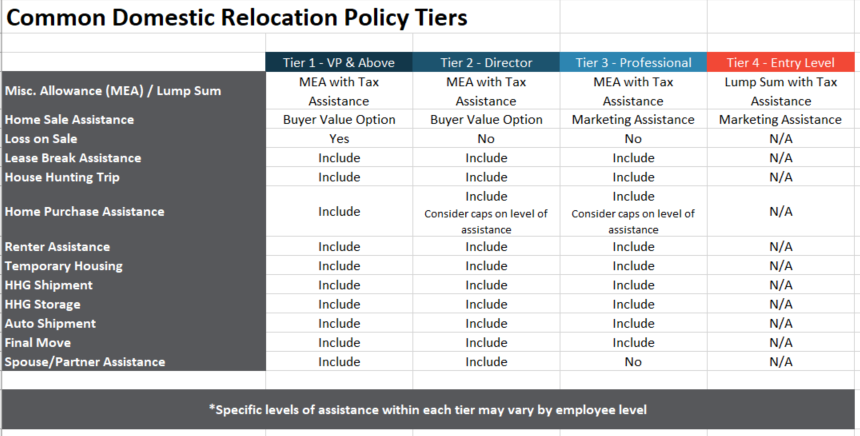
As every company has different goals and objectives for its relocation program, many-tiered relocation policies offer various levels of support for each employee. 

Here is a breakdown of the most common U.S. domestic relocation policy tiers per GMS research:

chart of relocation policy tiers

What Types Of Employees Receive Relocation Packages?

This aspect will depend upon the company’s need for each position and the importance of getting that employee to the new location. The best practice for relocation programs is to build a tiered system based on employee level. 

These tiers are commonly built around entry-level employees, professionals, directors, and vice presidents. Additionally, many companies offer executive relocation packages to cover the costs of relocation for most executive-level employees. Some companies may also provide international relocation packages for employees relocating globally.

Common Methods to Address Costs in Relocation Packages

Different policy tiers within your relocation program may require different strategies for covering your employee’s relocation costs. It is essential to understand the advantages and disadvantages of these standard methods.

Direct Billing: The relocation management company manages the procurement, organization, and direct payment to the service providers involved in your employee’s relocation. They review, combine, and forward the invoices to you for settlement. Although this approach may be pricier, it guarantees that your employee maximizes their benefits and reaches their new location promptly, alleviating any concerns about the expenses associated with the move. 

Expense Reimbursement: The employee pays for moving expenses upfront, and the company issues a reimbursement check at the end of the process. While not generally intended to cover an employee’s entire move (few families have the cash to pay tens of thousands of dollars for a move), reimbursements are commonly used for miscellaneous expenses as outlined in the company’s relocation policy. Typically, reimbursements are used for items such as travel costs or other related items.

Lump Sum: Unlike an expense reimbursement, a lump sum is commonly used as the primary financial benefit to a relocating employee. In a lump sum policy, a set amount of money is given upfront to the employee to handle the moving expenses as they see fit. 

Generally provided to entry-level or lower-level employees, the lump sum is typically the only relocation benefit offered. While the lump sum is seen as an excellent cost control tool for companies, it places additional burdens on employees, as they are left to manage their move independently. This is in addition to the lump sum, which is typically considered taxable income. Employees who receive their relocation benefits as a lump sum should note the payment for tax purposes. Employers should consider adding a tax gross-up to the lump sum to help mitigate the effects of the income tax on the employee’s benefit.

Ready to Set Up Relocation Packages for Employees?

Partnering with Global Mobility Solutions (GMS) ensures that your company offers comprehensive, cost-effective, and employee-centric relocation packages. GMS provides a tailored approach that aligns with your unique organizational needs, offering flexibility. This model allows you to select from a network of top-tier service providers or integrate your preferred partners, ensuring a customized experience for each relocation. Their expertise in managing all aspects of the relocation process—from pre-decision assessments to destination services—reduces risks, enhances employee satisfaction, and improves retention rates.

By leveraging GMS’s industry-leading MyRelocation® technology platform, your company can streamline relocation management, track expenses, and provide real-time support to transferees. This comprehensive support facilitates smoother transitions for employees and strengthens your employer brand by demonstrating a commitment to employee well-being. With over 30 years of experience and a global presence in over 140 countries, GMS has an expert team equipped to handle the complexities of workforce mobility, enabling your company to attract and retain top talent anywhere in the world.

We're Here to Help! Request a Courtesy Consultation

Are you ready to talk to a Mobility Pro? Learn how GMS can optimize your mobility program, enhance your policies to meet today’s unique challenges, receive an in-depth industry benchmark, or simply ask us a question. Your Mobility Pro will be in touch within 1 business day for a no-pressure, courtesy consultation.

Categories
Talent Management Talent Mobility Visas and International Travel

How to Get an IMM 5257 Visitor Visa (Temporary Work Visa) in Canada

Here's what you should know

If you aren’t a Canadian citizen or permanent resident, you are a visitor, which allows you to do a few things. First, you can come to Canada on vacation, to see family, or to conduct some manner of business. Your stay is restricted, and you need to follow some rules. One of them might be that you need a visa, especially if you plan to work in Canada.

These IMM 5257 visas will be significant for you to enjoy your stay in Canada, and they are also a little complicated to get (though, are only some government documents? Thankfully, rather than dealing with the headaches that can arise when you try to get a visa alone, you can instead focus on reading this article and getting all the help you need.

What Temporary Work Visas Can You Get?

There are two different types of work visas that you can apply for. The first is an employer-specific work permit that allows you to work in Canada while you follow the conditions on the license. These conditions include the name of the employer you can work for, how long you can work, and sometimes where you can work.

You will also need a full copy of your employment contract and the offer of employment number or a copy of the labor market impact assessment. This can be useful if a specific employer in Canada already hires you and is entering the country to work a particular job.

An Open Work Permit allows you to work for any employer in Canada during your stay, except for those on the list of blacklisted employees. 

Additionally, you may need a medical exam if you have lived in certain territories or countries for 6 months or more or have applied to come to Canada within one year. Additionally, suppose you plan to work in certain occupations (such as in the field of healthcare, with children, or within agriculture occupations). In that case, you will need a medical exam no matter what.

You will not need a medical exam if you want to work in Canada for six months or less and do not meet the above conditions. Once you have your work visa and all the paperwork from your employer, you can begin the application process.

Using an IMM 5257 PDF Template

Having a template to work off of can be a lifesaver, especially with government documents. You need to work off of an IMM 5257 PDF Template, and one that is correct and fully updated. Then, you can confidently fill in the blanks and submit your information correctly. No worries, no fuss, and you can work in Canada if your other documents are handled correctly.

How To Apply For A Temporary Work Visa

You can apply for a temporary work visa online and must submit various forms. These can include, but are not limited to, IMM 1295—Application for Work Permit Made Outside of Canada, Schedule 1—Application for Temporary Resident Visa, and Family Information Form IMM 5645.

Additionally, you will need a valid passport, two applicable photos of yourself, police record certificates, and bank statements proving you have enough funds to remain in Canada while having enough funds to return home, as well as your resume. You will also need extra documents if you bring your spouse and family members.

Now, all of this can be extremely overwhelming, and if you make a mistake, forget to include a document, or have another problem happen, you will need to start over. That can be a massive problem, especially if you have a job that can’t wait.

Can I Extend My Temporary Work Visa?

If your work permit is still valid, then you can extend it. Whether you have fallen in love with the job, the country, the food, or the people, you can extend your temporary work visa while in Canada as long as you meet the following conditions. 

You must make any changes, alterations, or extensions at least 30 days before the visa expires, and you can’t extend your work permit beyond the expiration date of your passport. However, other than those conditions, extending your temporary work visa is pretty straightforward. Whatever drew you to Canada, you can continue experiencing it until your passport expires.

No matter what you plan to do, you can get a temporary work visa in Canada. Just make sure you get the steps right the first time!

Contact Global Mobility Solutions today for more information on work visas and relocating to Canada.

We're Here to Help! Request a Courtesy Visa Program Consultation

Properly managing a visa and immigration program involves meticulous coordination, precise communication, and worldwide interaction with government agencies, corporate personnel, and relocating employees.

At GMS, we provide you with peace of mind in knowing your mobility program is fully compliant and being managed by the best in the industry.

Request a no-pressure, courtesy consultation from a GMS Mobility Pro. We’ll be in touch within 1 business day.

Categories
Buy a Home Corporate Relocation Talent Management United States Economy

18 States Require Written Buyer Agency Agreements

Litigation filed or ongoing in various jurisdictions across the US

As of December 2023, buyer agency agreements will be mandatory in 18 states, each with different rules affecting aspects like dual agency, offering cooperative compensation, and disclosing fees. In 2024, more states are expected to introduce additional buyer agency agreements and laws on fee transparency.

This trend towards increased regulation and transparency in buyer agency agreements reflects a growing emphasis on consumer protection and ensuring buyers are fully informed and represented in real estate transactions. By requiring agents to disclose potential conflicts of interest, such as dual agency, and to be transparent about fees and compensation, states aim to create a more fair and equitable real estate market for all parties involved.

Buyer agency agreements can provide buyers with dedicated representation and advocacy throughout the home buying process, helping them navigate the complexities of the real estate market and negotiate the best possible deal. However, it is essential for buyers to carefully review and understand the terms of these agreements before signing, as they can vary significantly from state to state.

As the real estate industry continues to evolve and adapt to changing consumer expectations and regulatory requirements, we will likely see further developments in buyer agency agreements and fee transparency legislation in the coming years. Buyers should stay informed and work with experienced and knowledgeable real estate agents who can guide them through the process and protect their interests.

Here are the states that now require written buyer agency agreements

  1. Arkansas
  2. Alaska
  3. Georgia
  4. Idaho
  5. Maryland
  6. Minnesota
  7. Missouri
  8. Nebraska
  9. New Hampshire
  10. North Carolina
  11. North Dakota
  12. Pennsylvania
  13. South Carolina
  14. Utah
  15. Vermont
  16. Virginia
  17. Washington
  18. Wisconsin

Stay in the Know with GMS

Buyers need to understand the laws and regulations in their state regarding buyer agency agreements and fee transparency. By working with a reputable real estate agent and relocation management company, buyers can ensure their interests are protected and fully informed throughout the home-buying process. Global Mobility Solutions (GMS) is a reliable resource for expert guidance in real estate services. Stay informed by regularly checking their blog and contacting them with any questions. Buyers can confidently navigate the real estate market with the proper knowledge and support; reach out to GMS today to see how we can assist you and your employees in getting from point A to point B.

Ready to Calculate YOur Program Savings? Request Access Now!

Are you ready to calculate your potential relocation program savings? Request access to our easy-to-use Relocation Cost Savings Calculator. Your Mobility Pro will grant your access request within 1 business day.

Categories
Global Mobility Global Relocation Global Relocation Challenges Global Relocation Tips Global Relocation Trends Talent Management Talent Mobility Visas and International Travel

Global Talent Shortage Can Be Mitigated With Global Relocation

Learn how offering relocation benefits can help hire top talent

It’s no secret that your company must set itself apart from the competition if you want top talent for job openings. What factors can put your company above the rest when hiring for vacant positions?

Offering relocation benefits to those who have to move for the job could be a great way to lure top talent. But just how much does the offering of global relocation packages help persuade candidates to your side?

Korn Ferry’s study “Global Talent Crunch” highlights the skilled talent shortage impacting countries and specific industries worldwide. Many countries are already facing a skilled talent shortage across several industries. The study examines the talent shortage issue across twenty major developed and developing countries, including:

  • Americas: Brazil, Mexico, United States
  • EMEA: France, Germany, Netherlands, Russia, Saudi Arabia, South Africa, United Arab Emirates, United Kingdom
  • Asia Pacific: Australia, China, India, Indonesia, Japan, Malaysia, Singapore, Thailand

Which industries are most at risk due to talent shortage?

The financial and business services industries are the most at risk due to talent shortage. According to the study, these industries could be facing a shortage of nearly 11 million workers by 2030, with about $1.3 trillion negative impact. Across the globe, technological advancement is at risk due to a skilled talent shortage of over 4 million Technology, Media, and Telecommunications (TMT) workers by 2030. Additionally, manufacturing will have a surplus of workers through 2023, quickly becoming a skilled talent shortage of nearly 8 million workers by 2030.

Which countries are most at risk due to talent shortage?

The greatest vulnerability to talent scarcity lies in advanced nations. France and Germany in Europe and Japan in Asia encounter the highest levels of risk. The United States and Australia also confront a significant deficit in skilled personnel, with the US anticipating a staggering loss of approximately $1.8 trillion in yearly earnings by 2030. Conversely, India stands alone among the countries examined, as it remains in possession of an excess of skilled talent until 2030.

What should employers expect?

Employers should expect to find it increasingly difficult to recruit and hire in several countries and industries. Those with plans to expand into new markets should consider this as they develop their hiring plans and corporate objectives.

Employers finding difficulties hiring and recruiting for positions in specific countries and industries should consider highlighting their relocation program’s benefits in their recruiting materials. The healthcare industry has been facing a critical talent shortage for several years. Healthcare employers have responded in several ways, including:

  1. Providing Exceptional Candidate Experiences
  2. Using Data to Enhance Recruiting
  3. Recruiting for Cultural Fit
  4. Creating a Superior Employer Brand
  5. Speeding the Process to Keep Candidates Engaged

Relocation Management Companies (RMCs) are ideal sources for information on global candidate recruitment and relocation. Pre-Decision Services are critical for employers as they provide valuable information about a candidate’s ability to accept a position and be successful. Assessment data can be paired with structured interview questions to understand better the candidate’s interests, goals, and motivations.

Contact GMS for More Resources

The team of professionals at Global Mobility Solutions (GMS) specializes in assisting companies with corporate relocation, creating effective relocation programs that can successfully appeal to and maintain skilled employees. By implementing industry-leading strategies, our team can help your company design a relocation program that enhances your ability to attract and retain new employees and alleviate the challenges of a talent shortage. 

GMS became the inaugural relocation firm to become a registered .com. Additionally, they developed the initial digital tools and calculators, which significantly changed the relocation sector. GMS persists in leading the industry by introducing pioneering innovations and technological solutions through their exclusive MyRelocation™ technology platform.

Contact our experts online to discuss your company’s relocation program needs.

We're Here to Help! Request a Courtesy Consultation

Are you ready to talk to a Mobility Pro? Learn how GMS can optimize your mobility program, enhance your policies to meet today’s unique challenges, receive an in-depth industry benchmark, or simply ask us a question. Your Mobility Pro will be in touch within 1 business day for a no-pressure, courtesy consultation.

Categories
Business Services Career Services Choosing a Relocation Company Corporate Relocation Global Relocation Relocation Best Practices Relocation Management Talent Management

Top Tips for Writing a Relocation Offer Letter

Use These Tips & Templates for a Relocation Assignment Offer Letter

An employee transfer letter or relocation offer letter is a document given to an employee being transferred to another department, branch, or location under the same employer. These letters not only provide transferees common professional courtesy on the company’s behalf, but it also gives the relocating employee an overview of what they can expect and their benefits for the process. These ground rules should provide the moving employee an understanding of all costs and services they are entitled to during their move. 

Larger companies or companies that often relocate employees more than likely have relocation policies in place. These are typically lengthy 10 to 30-page documents covering every relocation protocol aspect. Companies that might have such policies will rely on customized employee relocation offer letters and emails for each employee willing to do so. 

Here is a look at some top tips for constructing employee relocation offer letters, along with an example of a basic offer letter format.

Tip 1: Identify the Reason for Relocation Offer

While the employee will most likely understand it, you’ll want to cover in the offer letter why, how, and when the employee will be transferred. This will help with recordkeeping and provide the employee with in-depth insight into why their position is needed in the new location.

Giving a specific explanation to the relocating employee in writing can help show the employee that you care. This will also take the stress off of your HR department because the employees will know all of the details about why they will be offered the relocation. As a result, this should help set the stage, allowing things to run smoothly from the beginning.

Tip 2: State the Exact Effective Date(s) the Transfer Will Take Place

Companies cannot expect an employee to relocate the next day; however, it also shouldn’t be up to the employee entirely as to when the transfer will occur. Setting realistic dates and times for the employee to move and to get settled is vital in ensuring a smooth transfer experience. 

It should also be stated at this stage in the letter, how long the employee is eligible for relocation benefits. For example, many companies will allow employees X number days or months to utilize the short-term relocation policy stated in the transfer letter. There are many variables that come into play when an employee is trying to move out of state.

Tip 3: Provide Names and Contact Info

The transferring employee is probably nervous, but excited to take on the new role for the company. It is a good idea to provide the employee with the name and direct contact info for who they will be reporting to. This will give the employee a chance to reach out to the manager with any questions or concerns regarding their new position. It also gives the employee the opportunity to let their new manager know if there are any roadblocks with the relocation process. 

Conversely, it could also be a good idea to urge the new manager to reach out to the employee directly. This communication will allow the manager to inform the transferring employee of any necessary information. 

Tip 4: Note Every Detail of the Employee’s New Job

The employee should be well-informed about this step, but to cover the company and the employee it is a good idea to list out all expectations, requirements, wages (including bonuses), benefits, and anything else that will be different for the employee once they move. This provides documentation for both parties if there are ever any issues after the relocation has occurred. Being crystal clear at this stage helps straighten out any communication breakdowns later on. 

Use This Employee Transfer Letter Example

[Date]

[Sender’s Name]

[Sender’s Address]

Dear [Recipient’s Name],

We are pleased with the work you’ve completed with us so far and management sees great potential for you to grow in [transfer location]. The management team would like to extend you an offer for promotion to [new position] where you will be responsible for [responsibilities of the position].

This will provide you with an opportunity to expand your skillset as you move from the [current position] in [current location] to a new position in [transfer location]. 

The company is here to help you and your family relocate and readjust to your new role by providing relocation benefits. This letter summarizes that support in several areas.

New Job Title: 
New Supervisor/Manager: 
Department: 
Effective Date of Transfer:

New Duties: 

New Compensation/Bonuses: 

Below is a summary of the relocation benefits that are extended to you as part of this offer. 

Relocation Expenses
[Details of what the company will and will not cover.]

Household Goods Moving
[Moving expenses the company will or will not pay for.]

Home Marketing Assistance
[Info on home selling assistance ]

Home Finding Assistance
[Explain which resources the company can provide]

Repayment Agreement Terms
[Details of the repayment agreement that the employee is subject to]

Please review this information at your earliest convenience. You can contact me directly or Human Resources with questions, comments, or concerns. I would appreciate your acceptance or denial of this new position by [desired date].

From,

[Sender’s position and name]

GMS Is Here For You

Global Mobility Solutions (GMS) is a leader in the employee relocation industry. In addition to assisting with employee transfer letters, GMS would love to help your company create and implement customized relocation policies for your mobile workforce. Our team specializes in almost every area of the relocation process, so we can equip your staff and transferees with the knowledge and technology they need to make their move as seamless as possible. 

Getting started with us is easy. Contact us today for a free consultation with one of our relocation experts. From there, we will help you decide the best course of action for your company regarding your global mobility needs. Whether your company relocates internationally or just within the US or Canada, we can assist you in creating the best offer letters and relocation policies in your industry.

We're Here to Help! Request a Courtesy Consultation

Are you ready to talk to a Mobility Pro? Learn how GMS can optimize your mobility program, enhance your policies to meet today’s unique challenges, receive an in-depth industry benchmark, or simply ask us a question. Your Mobility Pro will be in touch within 1 business day for a no-pressure, courtesy consultation.

Categories
Job Market Job Seekers Talent Management

Blind Recruiting: What is it?

Some companies are turning to blind recruiting methods to hire open positions

Recent job searchers prioritize workplace diversity when assessing potential employers. Most job seekers believe this is vital to a company’s identity. Establishing a DE&I strategy early in the recruitment process can attract the best talent, and blind recruitment can help ensure no one is overlooked.

It has been demonstrated that organizations with various qualified employees are 25% more likely to be successful and profitable. More and more companies are beginning to recognize the importance of having a diverse workforce, yet many need assistance achieving this goal. Unintentional bias in the hiring process may lead to fewer opportunities for diversity, so it is vital to have the correct recruitment approach to decrease this risk and maintain inclusivity.

What Is Blind Recruiting?

The practice of ‘blind’ or anonymous recruiting seeks to remove personal specifics from an applicant’s profile in the evaluation stage. This most often means the removal of names. However, in certain situations, like when using Applied, more information is taken away, such as age, address, and educational background, to eliminate potential bias.

To ensure fair and equitable treatment of job applicants, blind CVs have been gaining traction in recent years as they effectively remove personal biases that might come into play when viewing a candidate’s resume.

Currently, various recruiting techniques focus on diversity. One of these is blind recruiting, which eliminates a job applicant’s personal information to prevent anything from harming the hiring process.

By eliminating any type of recruiter prejudice—whether intentional or not—quality applicants are more likely to be hired based solely on their abilities and work history, as opposed to their identity, orientation, cultural heritage, impairment status, or history. 

Biases can prevent impartial hiring practices, but blind sourcing can limit the effect of these biases by obscuring information that could lead to prejudicial decisions.

How to Incorporate Blind Recruiting Techniques

It can be challenging to overcome unconscious prejudice, but blind hiring can assist recruiters in making unbiased decisions when selecting the most suitable applicants. Taking the following steps can make the pursuit of a diverse recruitment strategy more effective:

  • Set up training for hiring managers about hiring bias.
  • Use anonymity on job applications and résumés.
  • Review the current recruiting process to ensure it complies with state and federal hiring equity laws.
  • Perform regular metrics assessments on HR teams and hiring managers.

Relocation Pre-Decision Services Can Assist in Recruiting

Global Mobility Solutions (GMS) leads the global mobility industry with our award-winning pre-decision services. We offer 30% more benefits than any other relocation company. The expert team at GMS understands that relocating employees is a hard job involving much more than moving an employee’s household goods. 

That is why our pre-decision services can help you when recruiting new employees. Having relocation packages ready for employees and other benefits can allow your recruiting and hiring managers to brag about the smooth process. 

Schedule a free consultation today if you are ready to get more info on our pre-decision services. One of our relocation experts will share how we can assist you.

MyRelocation Technology Logo

Our cloud-based MyRelocation® relocation technology is designed to help you streamline your company’s relocation management. Schedule a demo with a Mobility Pro for a no-pressure look at how our technology can help you.

Schedule a tech demo

Categories
Corporate relocation tips Domestic Relocation Domestic Relocation Challenges Domestic Relocation Tips Global Relocation Tips Global Relocation Trends Talent Management

Common Reasons Why Employees Won’t Relocate for Work

How to overcome an employee denying a relocation assignment

It is no secret that most people are creatures of habit. Moving to a different city or country may sound fun in theory, but when it comes down to it, most are still deciding whether to leave their comfort zone. Here are some common reasons why employees don’t want to relocate for work. If your employee seems reluctant about accepting a relocation assignment, you may want to find ways to make the offer more tempting. Take their concerns into account and try to win them over by negotiating and including a competitive relocation package that provides full-service mobility programs. 

Prioritizing Family

One of the most common reasons why employees don’t want to relocate for work is family. The move will affect everyone if the employee is married with children. If the kids are small, the transition can be done more efficiently. However, if the employee’s children are older, it may be challenging to yank them out of their environment. They will be against leaving behind their friends, school, neighborhood, football team, or drama club. In addition, the other spouse may also have an important work commitment they cannot abandon. All in all, it may be pretty challenging to get this employee on board with the relocation.

To make the offer more attractive, create relocation programs that include benefits for spouses and children. A health plan, school options, and similar incentives may make the offer more appealing.

Not Wanting to Deal with the Hassle of Moving

No matter how you look at it—moving is a big undertaking. Just to start, the employees need to sell their homes and deal with the hassle that comes along with that. That hurdle alone would deter most people at the get-go. Not to mention the ever-changing housing market, that the home sale can end up losing them money. And this is just scratching the surface. Even if they manage, they must pack all their belongings and move them to the new location. Moving advisors from Master Moving Guide say that one of the more stressful parts of moving is having to deal with switching utility providers, updating all of the information at the new location, and many more bureaucratic tasks that come with the move. It is no wonder that some employees may give up at the thought of having to go through all that, especially if they have had an experience with a similar task recently.

The Cost of Living and the Pay Do Not Add Up

The relocation needs to make sense for the employee in more ways than one. In addition to the hassle and turning their lives upside-down, they need to have an incentive in the form of pay. And even if that seems like a good deal, what if the cost of living is higher in the new location? The employee must weigh all the options and conduct proper research before deciding. If the pay raise does not cover the increased cost of living posed by the new location, they are unlikely to accept the offer.

Relocating employees needs to come with great benefits, a significant pay raise, and an evident opportunity for future promotions. If the employee sees that the move is disorganized, in the spur of the moment, and at a professional dead-end, they will be more inclined to stay put. Finding a higher-paid job where they are will seem like a much better compromise.

Work with GMS to Relocate Employees

Although a move may seem like an adventure and a new leaf for some employees, many will not be thrilled by the idea of relocating. Many employees don’t want to relocate for work because they are not tempted enough by your offer. Weigh all your options and ways to keep those employees essential to your business. If they are someone who has proven to be an asset to your company, ensure you offer them a relocation package that will make long-term sense for them and their family. 

At Global Mobility Solutions (GMS), our employees are top service providers in the mobility industry. We know first-hand that relocating for a job can be a scary thought for many employees. But working with us to create comprehensive relocation programs can help the move look more appealing to employees. 

And when working with GMS, we assign a specialized relocation coach to each employee. The coach ensures that the relocation process can be as smooth as possible for them and their family. 

Schedule a free consultation today if you are ready to update your current relocation policies or create new packages altogether. One of our relocation experts will meet with you to hear all of your needs and wants. From there, we will be able to understand your relocation needs better and execute them. 

We're Here to Help! Request a Courtesy Consultation

Are you ready to talk to a Mobility Pro? Learn how GMS can optimize your mobility program, enhance your policies to meet today’s unique challenges, receive an in-depth industry benchmark, or simply ask us a question. Your Mobility Pro will be in touch within 1 business day for a no-pressure, courtesy consultation.

Categories
Business Services Career Services Employee Development Talent Management

Top 10 Most Spoken Languages in the Business World

A Countdown on the Most Spoken Languages in Business

Learning a second or third language is a great way to open the door to more job and business opportunities. Business is conducted throughout the world in every single language and between every culture. 


Being bilingual as a call center representative, helping close the lucrative sales deal in a foreign language, or even relocating a family to a new country, the benefits of speaking more than one language are endless. Not to mention the number of doors that open in any particular career field for multilingual candidates. 


However, some languages can serve you better than others. Let’s explore the top 10 languages spoken in the business world. These top ten business languages feature markets with high growth, language demands for business, diverse industries, and many future opportunities:

1) English – The True Global Language

It might not be surprising to learn that English is the most prominent language in business, science, and academics. English is spoken widely in 94 countries by over 1.1 billion people as a native and supplementary language. Being fluent in English opens up massive opportunities for people all around the globe.


In fact, English is the most commonly used language on the Internet. It accounts for 25.9% of languages used on websites. And it is a diverse language that takes the form of American English, United Kingdom English, and Commonwealth English. Together, they make for the most critical language to be fluent in.

2) Mandarin (Chinese) – The Language of Purchasing Power

China’s heated economic expansion and vast population make Mandarin a top business language. Mandarin is the official language of the People’s Republic of China and is spoken globally by over 1.2 billion people. The economic leaps that China has undergone means that nearly every country in the world deals with it. That means a huge opportunity for those looking to learn the world’s most widely spoken business language.

3) Arabic – The Dynamic Language of Growth

Arabic is spoken widely across the Middle East, Africa, and the rest of the world. Arabic is also one of the world’s fastest growing languages in addition to being one of the Internet’s fastest growing languages. EMEA’s diversifying economies mean more opportunity for foreign investment. Learning Arabic can open up opportunities in varied industries like infrastructure, architecture, and even fashion design.

4) Spanish – The Language of Greater Opportunity

Spanish is the world’s second most spoken native language and the second most spoken language in the United States. Spanish speakers range from Spain itself to North and South America. However, the amount of Internet content in Spanish is estimated to be only 4%. This presents a massive opportunity for companies looking to expand into the Latin American, Caribbean, and Spanish markets.

5) Russian – Where Old and New Money Mix

The capital of Russia, Moscow, has more billionaires living in it than any other city in the world. Russia is a nation with vast deposits of oil, minerals, metals, and an educated populace. It also is a large economy that does extensive business with European and Asian countries. Russian-speaking countries in Eastern Europe and Central Asia and their developing economies means that Russian is great to learn for business.

6) German – Science, Industry, and Finance

Germany is a stable and prosperous economic and industrial powerhouse of Europe. It is also one of the three procedural languages of the European Commission. Learning German as a business language opens up businesses to the United Nations’ science, industry, and financial leader. Learning German also helps for doing business in German-speaking countries, like Belgium, Austria, Holland, Switzerland, Liechtenstein, Luxembourg, and Denmark.

7) French – Bridging Europe and Africa’s Futures

French is the official language of more than 29 countries. Growing and resource-rich nations in Africa, such as Cote d’Ivoire, Rwanda, Mozambique, Tanzania, and the Democratic Republic of Congo, all feature French-speaking populations. France is also the United Kingdom’s largest trading partner. The future of European and African trade and economic partnerships will rely on French as a language that links the two continents.

8) Portuguese – The New Frontier of Science and Medicine

Brazil’s and Portugal’s economies drive the importance of learning Portuguese as a business language. Portuguese is becoming a major source of scientific and medical research thanks to Brazil’s investments in the biotech and energy industries. The growing Brazilian economy means a larger-than-ever demand for Portuguese speakers. Increased interest from European, Asian, and American companies means new frontiers for fluent speakers.

9) Japanese – Combining Research, Development, and Tech

Japan’s reputation for technological advancement and e-commerce is rightly earned. Its diverse economy and high GDP are coupled with a highly educated populace. The combination of massive corporations and medium-sized technology firms means that Japan is a global leader in cutting-edge research, development, and investment. Learning Japanese is an important first step in understanding how to thrive in its lucrative market.

10) Hindi – The Burgeoning Internet Giant

India is a large and diverse country united by its official language of Hindi. Hindi is the world’s 10th most spoken language and is also widely spoken throughout South Asia. This massive region is undergoing an investment effort to build up its Internet and technology infrastructure. Learning Hindi will open people up to doing business in one of the world’s future consumer superpowers.

Additional Business Languages for Consideration

While the world speaks well over 6,000 different languages, the above-mentioned languages are some of the most prevalent in business and major economies today. What languages a professional chooses to learn may be influenced beyond simple numbers, such as the size of a given economy. These decisions may be influenced by geography or the desire to enter a smaller market. Some additional business languages to consider include Dutch, Italian, Korean, Polish, and Swedish.

GMS Is Here to Create a Better Business Future for your Organization

Global Mobility Solutions feels that there are no downsides to learning any of the top 10 most spoken languages in the business world. The best way to start your journey is to ensure you are working with a partner that is dedicated to teaching your professionals to become fluent in a new language. GMS has a proven, award-winning network that is geared towards helping your relocating employees and their families learn new languages and settle into their new country.


Our language partners deliver private in-person lessons and online language lessons direct to our clients. These talented language instructors and translators provide customized lessons for your fluency level and needs. These language learning services are combined with flexible scheduling and an easy-to-use online learning content management system. To learn more, reach out to GMS today and we will help guide you in the right direction to speaking a new language.

We're Here to Help! Request a Courtesy Consultation

Are you ready to talk to a Mobility Pro? Learn how GMS can optimize your mobility program, enhance your policies to meet today’s unique challenges, receive an in-depth industry benchmark, or simply ask us a question. Your Mobility Pro will be in touch within 1 business day for a no-pressure, courtesy consultation.

Categories
Career Services Global Relocation Tips Talent Management

What Is Tax Gross-Up & How Do You Calculate It?

How to Handle Tax Gross-Up Methods When Relocating

The relocation process can be hard to understand. Relocation policies and rules may seem like insurance terms that don’t always make sense to those who are utilizing the policies. Tax gross-up is one of the more common aspects of a solid relocation policy offered by companies to employees. 

Tax gross-up (when it comes to relocation terms) refers to money that an employer can add to an employee’s payroll records to help offset federal ,state, OASDI or Medicare taxes. These taxes come into play as the majority of moving expense reimbursements, or payments to service providers on the employee’s behalf, are seen as taxable income to the employee in the eyes of the government. 

In simplest terms, tax gross-up is a benefit included in an employee’s relocation package, and there is no right or wrong way to calculate it. Employers can add as much as needed to make the relocation policy appealing for the employee to relocate. However, payroll withholding is a requirement and companies should remit payroll taxes on taxable relocation expenses. The calculated amount of tax gross-up is used to pay a solid portion of the required payroll taxes on that company’s payroll. 

How Should Relocation Tax Gross-Up Methods Be Applied on Policies?

Global Mobility Solutions advises our clients to keep gross-up simple, allowing employees to understand the method used and verify the amount. Also, GMS cautions companies from telling transferees that they can completely avoid any tax liability resulting from their move. Instead, companies should refer to tax gross-up as a “tax assistance” program. This way relocating employees do not get the impression that they will be “made whole” and avoid paying taxes altogether.

The Different Methods of How to Calculate Tax Gross-Up

There are a few different tax gross-up methods that companies can utilize when it comes to helping employees. Here are some of the more common methods used for relocation policies:

Inverse Supplemental: Tax on Tax

This is the most common method to calculate tax gross-up. This method uses the current Federal and State supplemental rates for calculation. This method is the easiest to administer and explain to relocating employees.

Typical methodology includes:

  • Federal Rate: Supplemental Rate (currently 22%)
  • State Rate: Supplemental rate of applicable payroll state
  • OASDI: 6.2% up to the applicable annual cap
  • Medicare: 1.45% + Surtax when applicable

Total to be added – 34.65% assuming a 5% State. But remember that this is also taxed so it is a complex situation that GMS can help with.

Marginal Rate: Tax on Tax

This calculates the employee’s estimated taxable income before receiving the relocation expense reimbursement and then compares the estimated taxable income to the IRS Tax Tables. The tax table rate is then used to determine the tax assistance amount. The tax rate will not change for the expense and therefore is not blended.

While this method provides for additional tax protection by considering the employee’s actual income level, it will typically add to the gross-up cost for the company.

Typical methodology includes:

  • Federal Rate: Based on the higher annualized actual salary. Includes company source income only
  • State Rate: Supplemental rate of applicable payroll state
  • OASDI: 6.2% up to the applicable annual cap
  • Medicare: 1.45% + Surtax when applicable

Flat Rate

This method determines a fixed percentage to be used in the tax-assistance calculation. This option does not take deductions, exemptions, or child credits into account.

Client Directed

Because gross up is a policy decision, there are other methods available. If the methods above do not align with your objectives, we can work with you to create a custom gross-up policy that satisfies both your needs and those of your relocating workforce.

Questions Companies Should Ask When Selecting a Gross-Up Methodology

  • Why are we asking employees to relocate? Are we recruiting or downsizing? 
    • Downsizing may be saving jobs by offering employees an opportunity to relocate and remain employed with the company. Thus, a company may not need to be as generous. 
    • Recruiting may require a company to provide a more generous gross-up benefit.
  • What is the typical income of the relocating employee population?
  • What is the company gross-up philosophy?
  • Did the company request the employee to relocate or is relocation a mutually beneficial partnership?

GMS Can Help with your Tax Gross-Up Policies

At GMS, our financial services offer employees access to tools and technologies including gross-up calculators that our competitors don’t offer. On top of that, our financial team is qualified to help you implement a tax gross-up methodology that works best for your needs. Our team is always willing to field questions or concerns relating to our service offerings, including how to effectively utilize tax assistance policies for relocation programs. Reach out to GMS for any of your relocation-related tax needs.

We're Here to Help! Request a Courtesy Consultation

Are you ready to talk to a Mobility Pro? Learn how GMS can optimize your mobility program, enhance your policies to meet today’s unique challenges, receive an in-depth industry benchmark, or simply ask us a question. Your Mobility Pro will be in touch within 1 business day for a no-pressure, courtesy consultation.

Looking for something?