

Categories
Business Services Choosing a Relocation Company Relocation Management

Does Your Relocation Management Company Provide a Customized, Right-Fit Program?

Companies achieve the most success with a customized, right-fit program for relocation that is specifically designed to meet their unique requirements. Employees and their families expect a broad range of services to help them during their relocation process. How can you be sure your company is competitive with your relocation program and able to attract and retain the best talent?

Here are five questions you should ask your Relocation Management Company (RMC) to ensure you receive a customized, right-fit program:

Why You Should Choose Global Mobility Solutions for your right-fit program

Does Your Program Align With Our Needs?

Your RMC should thoroughly review and understand your company’s mobility needs, objectives, move patterns, locations, and any other specific requirements. Ask your RMC how the program they provide will address each of these areas. Ask them how it will be in full alignment with your company’s worldwide mobility needs.

Does Your Program Provide Dedicated Account Management and Mobility Consulting?

You should have dedicated account management for your company so you can be sure your needs are met quickly and efficiently. Ask your RMC if they provide mobility consulting so Human Resources, Procurement, and Recruiting team members can have access to expert advice and guidance.

Is There a Single Point of Coordination?

Ask your RMC if they provide a single point of coordination for your employees and their families. Relocating employees should have a dedicated advocate who understands their specific needs. A single point of coordination allows for ease of communication and provides assistance for employees throughout their relocation process.

Does Your Program Provide Access to a World-Class Partner Network?

Your company should have access to a world-class partner network of providers. Employees and their families should receive the best service during their relocation process as it promotes successful relocations. Ask your RMC how they can assure your company receives the highest levels of quality at the lowest cost on a worldwide basis.

What Global Technology Does Your Program Provide?

Your employees and their families should have access to user-friendly tools and features so their relocation process is smooth and easy. Ask your RMC what technology they provide on a global basis. Your employees should always have access to the tools and resources they need, when and where they need it.

Conclusion

The most successful corporate relocation programs are customized, providing a right-fit that aligns with company objectives and employee’s expectations. Global Mobility Solutions (GMS) provides its clients with a Freedom of Choice™ model that sets the industry standard of excellence. For example, we have no affiliation with any service provider. As a result, we make supplier selections by using performance ratings and guaranteed savings. We provide a customized program that is a “Right-Fit” to our client’s needs and requirements.

Our Team of corporate relocation experts can provide a customized, right-fit program for your company. Contact our team of relocation experts to request a presentation, or give us a call at 800.617.1904 or 480.922.0700 today.

Request your complimentary relocation policy review

Categories
Global Relocation Global Relocation Challenges Global Relocation Tips Relocation Challenges

Expatriate Health Insurance

Expatriate health insurance is an important consideration for both clients and assignees. Employees relocating to international locations for extended periods of time should have access to quality health care. Options and costs may vary greatly depending on assignment location. Employers may need to consider the range of relocation benefits they provide for their mobile workforce to account for expatriate health insurance needs. There are three specific factors that clients and their relocating employees should consider when examining their options:

1. Uninsured Employees May Incur Large Healthcare Costs and Need Expatriate Health Insurance

\Now Health International, an international insurance provider, conducted a survey that included a question about expatriate employee’s attitudes about health insurance coverage. As reported by Relocate Magazine, the survey found 25% of respondents did not have health insurance because they were currently healthy and believed they would not fall ill. Many respondents live and work in many well-developed locations such as Hong Kong, Singapore, and Thailand, and several believe they have coverage in their new country’s state healthcare system. However, many countries are working to limit medical care for expatriates to only accident and emergency coverage. This trend could leave expatriates with large, unreimbursed healthcare costs if they do become ill.

2. Medical Care Quality Varies by Country

Some countries provide good expatriate healthcare options, based on the medical resources they provide and their level of industrialization. In its most recent Expat Explorer 2017 Survey, HSBC found that healthcare standards and the ease of setting up healthcare are seen as best in France, Malaysia, and Australia. As noted in the survey, better healthcare standards is a key reason that 58% of expatriate retirees have moved to France, and 53% of all expatriates in France say their physical health is better than it would be at home. Other countries such as Taiwan provide a national health insurance system which expatriates can join and are well-known for high satisfaction with healthcare affordability. Alternatively, countries such as the US, which spends a large amount on healthcare, may have according to the Organization for Economic Cooperation and Development.

3. Expatriate Health Insurance Costs May Seem Prohibitive

Talent Management and HR reports that employers should offer health insurance benefits because it is a strong factor in employee attraction and retention. This applies to expatriates as well. The fact that assignees are located in an international setting does not reduce their interest in health insurance. Insurance companies such as Expacare provide several international health and medical insurance plans for expatriates. Although many employers might believe expatriate health insurance would be cost prohibitive, several have found options that meet their needs. With many countries looking to limit access to their national health insurance programs, out of pocket medical costs might be even more prohibitive if expatriates are left without health insurance coverage.

Conclusion

Employers should consider expatriate health insurance as they develop their relocation program. Assignees should have access to health care without worrying about prohibitive out of pocket costs. A wide range of options are available. The global relocation experts at Global Mobility Solutions (GMS) have the knowledge and expertise to help your company understand the options available for expatriate health insurance. Our experts can also help your team understand and communicate information about health insurance to your assignees to provide them with the best relocation experience. Contact our team of experts online or call us directly at 800.617.1904 or 480.922.0700 today. Request your complimentary relocation policy review

Categories
Choosing a Relocation Company Corporate Relocation Corporate relocation tips Domestic Relocation Domestic Relocation Tips Global Relocation Relocation Best Practices Relocation Management

Top 5 Reasons for Expedited Bidding

What is Expedited Bidding?

The Expedited Bidding Process (EBP) is not an abbreviated approach. It is a request for proposal (RFP) that, like a traditional RFP, demands complete and detailed answers from relocation management companies (RMC). However, through expedited bidding, a company’s purchasing department only sends RFPs to a small, select group of key RMCs.

The trend in utilizing an EBP for the outsourcing of relocation management is at an all-time high. Global Mobility Solutions consulting team’s recent study shows that EBP utilization is up more than 200% over the last year. Why are so many companies turning to expedited bidding when looking for a mobility management solution?

Buying Solutions, Not Widgets
Purchasing relocation management is not like sourcing for parts. Ensuring the right fit for the right reasons is key when purchasing employee-facing services.

Courtesy Mobility Consulting
Policy reviews, recommendations, program design, and policy development can be part of the process. This allows for an evaluation of the RMC experience, knowledge, and quality of consulting work.

Immediate Cost Savings
Competition often equates to implicit cost savings through no fee implementation, less administrative burden and time investment, improved fee structures, and reduced direct costs.

Quicker Program Implementation
90% of EBP implementations are completed within 22 days, allowing for immediate efficiencies and realized savings.

Full RFP Avoidance
Eliminates the administrative burden for the purchasing department and reduces the need for extensive resources when compared to a formal Request for Proposal method.

Modern Mobility Made Easy™

What this means for you and your relocating employees

The Global Mobility Solutions benchmarking study shows that companies utilizing an expedited bidding process achieve savings up to 61% over typical RFP costs. Expedited bidding is one of many ways that Global Mobility Solutions recommends to make choosing an RMC fast, easy, and cost-effective. Before you send your next RFP, Download the 28 Critical Questions to ask an RMC. For more information on EBPs, and to learn more about Global Mobility Solutions’ corporate relocation programs, contact us online or give us a call at 800.617.1904 today.

Download the 28 Critical Questions to ask an RMC when submitting an RFP

Categories
Corporate relocation tips Domestic Relocation Domestic Relocation Tips Global Mobility Global Relocation Global Relocation Tips Relocation Best Practices Relocation Management

5 Easy Steps for Year-End Relocation Expense Reporting

While most people are busy preparing for the holidays, you’re scrambling through the year-end reconciliation of your relocation expense data. Well, even though it’s only November, here is a gift that will help you navigate your year-end process this year and for years to come.

Though many relocation managers might prefer holiday gift shopping to year-end reporting, the process tends to go more smoothly when run by the relocation department. To maximize efficiency, be sure to follow these five steps:

1. Checklist

Create a year-end checklist. A detailed checklist will identify the information you need to accurately report year-end compensation. Your checklist should include due dates, responsible individuals, and departments. Establishing the responsibility for reporting relevant compensation data is critical and may include several components such as wages, imputed income, benefits, equity, and taxes. This year-end checklist will help you identify all the resources you need to create a complete and accurate report. Your itemized checklist should include items such as early cutoff dates, all employees who will receive the tax filing services (employees on the tax eligibility list), and provide for the time needed for verification, approval, and processing. A well-developed checklist will also set firm deadlines for reporting and tax filings.

2. Preparation Call

Set up a year-end preparation call. When setting due dates, remember the mandatory vacation times required by some countries toward the end of December. During the call, review your year-end checklist with all involved parties to ensure they are aware of their role and deadlines. Use this call as an opportunity to build understanding and develop relationships that will make year-end reporting easier in the future. If you have not already held a year-end preparation call, schedule one as soon as you finish reading the rest of this article!

3. Verify Data

Verify all of your data. Accuracy is vital, especially for compensation reporting. Data such as addresses and tax ID numbers/Social Security numbers should be confirmed, as well as wages, benefits, sick days, and vacation time. Verifying relocation expense data eliminates backtracking and costly errors.

4. Finalize Data

Finalize your relocation expense data. Make sure that the final payroll reports of the year have been included, plus any end-of-the-year benefits. Be sure to back up the program data again and save it in a secure location for easy future reference.

5. Submit Report

Get ready to submit your report. Double-check the deadlines for all the countries on your list and be prepared to provide specific data for each country. Tax providers may ask for data for different assignee/transferee populations. Be sure to adhere to your year-end deadlines and, whenever possible, send the data ahead of time. Some international locations may have very tight turnaround times to make that final tax payment of the year.

Modern Mobility Made Easy™

What this means for you and your relocating employees

As with anything, practice makes perfect. The more you follow these five steps, the easier your year-end reporting will become. Global Mobility Solutions – a leader in mobility management since 1987 – has expert relocation consultants who can help you quickly implement relocation policies custom-tailored for your needs, as well as expense reporting to make your year-end reconciliation easier. Request a professional audit of your year-end process.

Request your complimentary relocation program audit

Categories
Corporate Relocation Relocation Best Practices Relocation Challenges Relocation Management Relocation Technology

Top 5 Considerations When Choosing Relocation Technology

How to get better relocation technology and mobility management at your fingertips

In all aspects of life, technology has made things faster, easier, and more cost-effective. The same is true regarding relocation. Here are some benefits of relocation technology to consider when upgrading your mobility management.

  1. Is it safe, secure, and compliant?
  2. How can it help make my life easier?
  3. How can it help my relocating employees?
  4. Will it integrate with other systems I use?
  5. Is it customizable and scalable?

Safety. To ensure the privacy and protection of your transferees’ personal information, you will want to ensure that your relocation technology has the appropriate level(s) of Privacy Compliance and Service Organization Controls.

Making your life easier. A robust single-platform technology solution should provide human resources, recruiting, and other administrative stakeholders with the tools needed to efficiently oversee relocation, such as:

  • Pre-hire and decision analytics and tools
  • Customizable online relocation initiation and approval process
  • Customizable “at-a-glance” dashboards to easily display the data you want
  • Online relocation cost estimating
  • Detailed and comprehensive performance analytics (SLAs and Metrics)
  • Fully-customizable and robust service and financial reporting suites on demand
  • Online tools and resources to plan and manage your mobility program

With a look at your screen and the touch of a button, you can easily track the progress of transferees, expenses, manage any exceptions, and more.

Helping your relocating employees. Today’s relocation technology should be accessible on any device, including tablets and smartphones. This technology should be available to anyone relocating with your company, including candidates who can benefit from the full scope of pre-employment features offered. Your workforce will move with ease using features like:

  • Virtual Destination and Guides
  • Access relocation benefit details
  • Relocation tools like mortgage vs. rent calculators
  • Online expense submission and tracking
  • Simplified travel booking
  • Real-time expense submissions and reimbursements
  • Language and cultural tools
  • Text and email alerts

It needs to work with what you already have. A good relocation technology solution should integrate with your existing human resources, payroll, and other critical systems and seamlessly enhance your work flow, not complicate it.

You want your solution to grow with your company. As evidenced by many of the preceding bullets, the ability to customize is a key factor when choosing relocation technology. From how you view information on the screen, to the data included on reports, you need a technology solution that gives you what you want, when you want it.

Modern Mobility Made Easy™
What this means for you and your relocating employees

Global Mobility Solutions believes in the use of technology to complement our high touch service model to provide a seamless relocation experience for you and your transferring employees.

MyRelocation™ is our single-platform, online relocation management suite that provides our clients and their transferees an array of decision-making, tracking, and expense management tools – right at their fingertips – anywhere, anytime. To see what MyRelocation™ can do for you, request a quick demo.

Request a relocation technology demo

Categories
Corporate relocation tips Domestic Relocation Domestic Relocation Challenges Domestic Relocation Tips Global Mobility Global Relocation Global Relocation Challenges Global Relocation Tips Relocation Best Practices Relocation Challenges Relocation Management

Top 3 Considerations When Implementing Relocation

Keys to working smarter, faster, and more cost-effectively

HR, Recruitment, Payroll, Accounts Payable, IT Security, and other relocation stakeholders commonly face a never-ending variety of evolving and often overwhelming challenges when it comes to the implementation of benefits administration, which includes relocation outsourcing decisions.

As employee benefits become more complex, critical, and increasingly subject to regulatory compliance requirements, employers must accurately assess their team’s capacity when it comes to implementing relocation programs.

Global Mobility Solutions (GMS) recently compiled the data on thirty four (34) recent implementations it managed, representing key industries and includes several multinational companies (including and not limited to manufacturing, technology, healthcare, and energy). This study was derived from initial and post-implementation surveys that are focused on implementation Critical Success Factors (CSF).

Top 3 Critical Success Factors

  1. Implementation Management
    Assessing an organization’s goals and creating a realistic road map of key milestones is a critical part of delivering an effective implementation. The process begins by identifying the right mix of internal/external resources and flexible technology that support a collaborative approach to implementation that stays on track. This study confirms that proper planning and management is an essential to any successful relocation implementation.
  2. Cycle Times
    All organizations, large and small, have finite resources, making the maximization of productivity and cycle times a CSF. Properly planned and executed implementations reduce typical and customary cycle times.
  3. Time Investment = Real Dollars
    The old adage of “time is money” has a direct association to relocation program implementation. This is evident by the time investment required to complete implementation by multiple disciplines within an organization, such as Human Resources, Payroll, Accounts Payable, preferred vendors and the RMC.

Modern Mobility Made Easy™
What this means for you and your relocating employees
Our findings conclude that organizations with solid implementation oversight and supporting technology experience shorter cycle times, spend less and have a better overall experience. Global Mobility Solutions, a leader in corporate relocation since 1987, provides companies like yours with proven leadership, time tested procedures and advanced technology to ensure that no more than 10% of their time is spent on implementing a relocation management program. GMS completes new implementations within 5 to 22 days, while maintaining 98% planning accuracy and 100% implementation satisfaction. To learn how to quickly and easily implement your relocation program, all within your planned budget, by requesting an implementation demo.

Request a relocation implementation demo from Global Mobility Solutions

Categories
Corporate Relocation Corporate relocation tips Domestic Relocation Domestic Relocation Tips Domestic Relocation Trends Global Mobility Global Relocation Global Relocation Tips Global Relocation Trends Household Goods Relocation Best Practices Relocation Management

Relocation Models for 5 Major Industries

Traditional vs. Lump Sum Relocation Programs

Which is best model for your company?

There is more than one way to get your relocating employees to their new assignments. Many companies opt for either a traditional relocation program, a lump sum/managed cap program, or a combination of the two, depending on the position of the transferee and other special circumstances.

What are the Differences?

With a lump sum or managed cap model, relocating employees are given a pre-determined amount of money to cover all aspects of their move. From the shipping of goods to temporary housing, the transferees are responsible for researching and obtaining all the services needed to get them to their new destinations. There is no tracking or reporting available to HR or finance departments to let them know whether their relocation policies are too generous, costing the company more money than necessary to relocate their employees, or too limited, forcing transferees to pay out of pocket unnecessarily. This approach leaves the entire move is managed by the transferees, many who might not have any prior moving experience.

Conversely, a traditional relocation model is managed by a relocation management company (RMC). The RMC coordinates everything for the transferees. This includes, but is not limited to, home selling, household goods movement, temporary living, and home purchasing. The RMC sets up the various services with reputable, vetted network partners. Since the RMCs use direct billing back to the client companies, the transferees rarely have to open their wallets. HR and finance departments receive detailed expense reports from the RMCs that capture all the costs related to relocating their transferees.

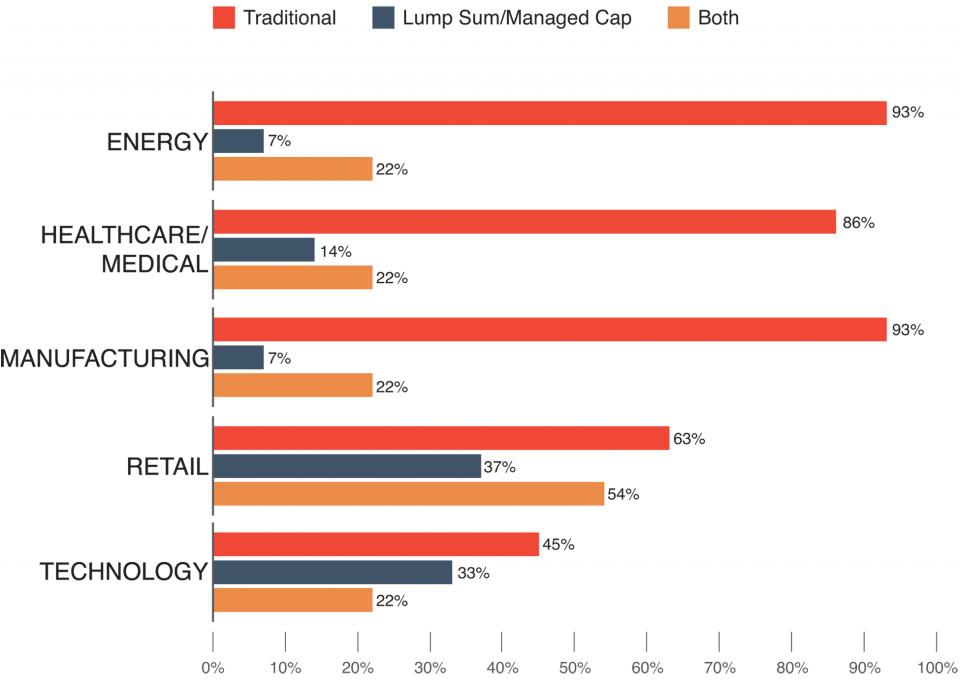
Based on comprehensive relocation surveys, here are findings of how companies in five different industries utilize either traditional, managed cap/lump sum, or a combination of these relocation programs:

Relocation Models by Industry: Energy, Healthcare/Medical, Manufacturing, Retail, Technology

The figures above illustrate that across all the industries in this survey, traditional relocation programs are used more frequently than lump sum or managed cap programs. However, in all the industries, there is a large percentage of companies that utilize a combined approach. A best practice consideration is to adopt a combination of traditional and managed cap relocation models.

Modern Mobility Made Easy™
Helping you manage your relocating employees

Global Mobility Solutions, an innovative leader in corporate relocations since 1987, can analyze and create mobility management programs customized for your unique needs. Additionally, we have compiled benchmarking studies and relocation best practices for numerous industries. To learn more about what type of relocation model would fit best with your company, get the full relocation benchmarking study for your specific industry:

Download your industry benchmarking study

Categories
Corporate Relocation Corporate relocation tips Domestic Relocation Domestic Relocation Tips Global Mobility Global Relocation Global Relocation Tips Relocation Best Practices Relocation Management

The Real Truth: Managed Cap vs. Lump Sum

Managed Cap vs Lump Sum – Key Things You Need to Consider

As a mobility manager, lump sum payments might seem like the fastest and easiest method of providing your employees with the funds they need to move. However, when looking at managed cap vs lump sum, lump sum payments come with their own unique set of problems. Some of the challenges include:

  • Transferees often left alone in the relocation process
  • No cost controls and often budgetary overages
  • Limited process or service structure
  • Non-taxable benefits are lost
  • Frustrated transferees mean elevated HR involvement and escalations

Fortunately, a managed cap program alleviates many of the problems associated with a lump sum. It also provides:

  • The desired simplicity and predictability of a lump sum program
  • Enhanced employee tax benefits, resulting in more dollars for relocation.

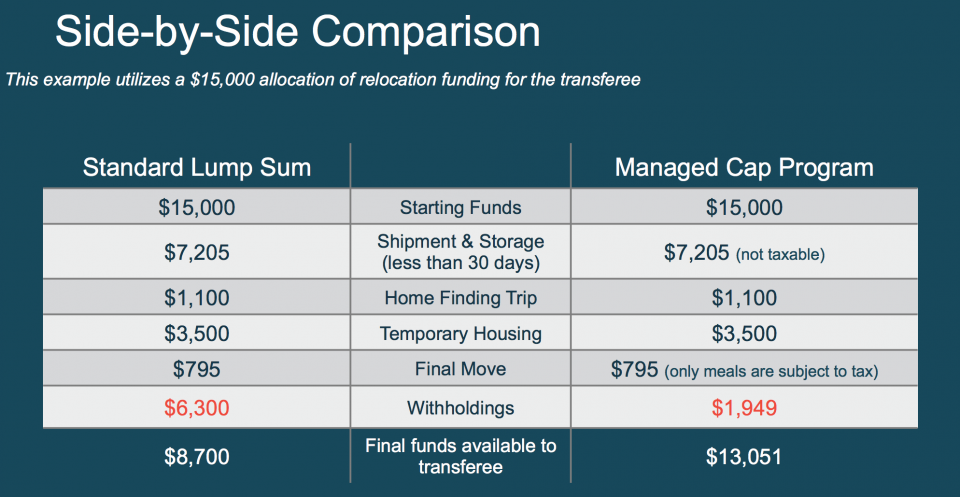
Let’s see the difference between a $15,000 lump sum payment and the same $15,000 from a managed cap program:

GMS-Managed-Cap-vs-Lump-Sum-Chart

A Winning Scenario

The Managed Cap Program provides the transferee with $4,351 more for relocation services!


Modern Mobility Made Easy™

What this means for you and your relocating employees

A Managed Cap program will ensure that your transferees get the most out of their relocation dollars and that you will reduce the amount of administrative burden dealing with exceptions. Global Mobility Solutions – a leader in mobility management since 1987 – has expert relocation consultants who understand how a Managed Cap program can benefit you and your company. Contact Global Mobility Solutions and learn how we can quickly implement a managed cap program custom-tailored for your needs. Request your complimentary managed cap program demo to see how much you can be saving.

Request-a-Demo

Categories
Corporate relocation tips Global Mobility Global Relocation Global Relocation Challenges Global Relocation Trends

New Documentation Requirements for Household Goods Moves into the United Kingdom

The United Kingdom has pushed forth changes and new regulations for shipping household goods to England, Northern Ireland, Scotland, and Wales. The UK has implemented these changes, even though their exit from the European Union is not complete, thus making the old C3 (Relief) form no longer valid.

Now, in order to obtain Relief under the Transfer of Normal Residence (ToR) to the UK, a transferee and his or her personal effects need to meet the following criteria:

  • Transferee must have resided for at least 12 months in country of origin outside the EU, prior to shipment packing date
  • The consignment consists of all normal, household effects that have been used by the transferee for at least 6 months prior to shipment packing date.
  • Transferee is moving his or her normal home to the UK
  • There are no effects which would be liable to duty or tax
  • The effects are expected to arrive no more than 6 months prior or 12 months after the transferee’s arrival date in the UK
  • The transferee intends to reside and use all effects for at least 12 months in the UK

The Relief does not apply to:

  • Taxable or dutiable goods such as alcohol, tobacco, business materials
  • Furnishings from secondary home
  • Inheritance goods

In order to apply for tax relief on household goods, one must complete the ToR1 form, which can be obtained by visiting this link: https://www.gov.uk/government/publications/application-for-transfer-of-residence-tor-relief-tor01 


Mobility Made Easy™

What this means for relocation managers and transferees

At Global Mobility Solutions (GMS), we strive to get you the latest information to help you relocate your mobile workforce from point A to point B as easily, efficiently, and stress-free as possible. The new rule for shipping household goods to the UK will determine what items are eligible for tax relief. This will affect the final cost of a relocation to the UK and can influence what a transferee may decide to bring along to his or her new assignment. Be aware, applying for the ToR takes a lot of time and goods can’t be imported without the ToR, so plan accordingly by speaking with your relocation management company and household goods providers.

To ensure that your relocation policies are up-to-date and take into account the new documentation requirements on household goods for the UK, ask for your complimentary policy review today!

GMS-Policy-Review-Button

Categories
Corporate Relocation Domestic Relocation Domestic Relocation Trends Global Mobility Global Relocation Global Relocation Trends Relocation Best Practices

Global Mobility Solutions Named a Top Relocation Company

Global Mobility Solutions (GMS) is proud to be recognized by HRO Today as a top relocation company for the fourth year in a row. Every year, HRO Today compiles customer surveys and other data to produce their Baker’s Dozen list of the best relocation companies.

HRO Today’s Baker’s Dozen rankings are based solely on feedback from buyers of the rated services; the ratings are not based on the opinion of the HRO Today staff. Feedback is collected annually through an online survey, which is distributed both directly to buyers through HRO Today’s own mailing lists and indirectly by sending service providers the link to send to their clients. Overall ranking is determined by analyzing the results across three subcategories: features breadth, deal sizes, and quality. Using a predetermined algorithm that weighs questions and categories based on importance, HRO Today calculates scores in all three subcategories as well as an overall score. The rankings are based on those scores.

The fact that our customers continually place GMS into the Baker’s Dozen list of top relocation companies speaks volumes with regard to our outstanding service, our breadth of programs, and the value that we bring to our clients.

To see how GMS can make your life with regard to workforce mobility easier, simply ask for a complimentary relocation policy review and our expert consultants will discuss how to improve acceptance rates, make assignments more successful, and make the whole process more cost-efficient.

Get your complimentary Relocation Policy Review today!

Looking for something?