


Categories
Buy a Home Global Relocation Global Relocation Tips Global Relocation Trends Relocation Best Practices

How to Prepare International Transferees for U.S. Home Purchase

Here are some tips for international employees to use when looking to buy a home in the U.S.

Moving to a new country for a new job can be a lot of work. Preparing the family for the move, finding a place to live, ensuring all visa documents are accounted for, etc. There is a lot that goes into international relocation. As many people know, purchasing a home is one of the lengthiest parts of the relocation process. The home-buying process can be extended, and those not used to real estate regulations in the US will find it even more confusing. 

For those relocating to the US for a job on an H1-B visa or even those looking to buy a home to live in a while on a long-term international assignment, the standard process for buying a home in the US differs significantly from most countries in Asia or Europe. 

The first and most crucial step when preparing to move overseas is to review your international relocation package provided by your employer carefully. See what relocation benefits your new company offers, then ask how to utilize each. Many international relocation service providers will help companies create unique benefits for each transferee. And in most cases, relocation benefits include home-buying programs that can help in a significant way, both process-wise and financially. 

With that said, here are a few things to keep in mind when purchasing a home if you are relocating to the U.S. for work: 

Visa & Immigration Documents Needed to Buy a Home in the U.S.

Working with a full-service relocation management provider can help immensely with visa and immigration documentation. They can help you file for the proper visa, in turn, they can also help you with which immigration documents you will need to apply for mortgage approval when buying a home in the U.S. Each mortgage lender will have different requirements when filling out applications, but among the most common documents needs are: 

  • Valid foreign passport
  • U.S. visa and/or a driver’s license
  • Social security number or ITIN
  • Bank statements 
  • Financial documentation from your foreign bank
  • Evidence of reserves
  • Paycheck stubs
  • Tax return for the last two or three years

Can International Transferees Buy a Property without a US Credit Score?

Yes. International buyers are eligible for loans from U.S. mortgage providers even if they do not have a U.S. credit history. In some cases, lenders even offer special programs for immigrants and non-resident buyers with no credit to get a competitive rate still. And some relocation management companies work with lenders to set up specialized programs for H1-B and L-1 visa holders.

Next Steps After Mortgage Approval

Once the international transferee has been approved for a mortgage from a U.S. brokerage, they know their realistic budget. From there, they should work with a real estate agent specializing in relocation home purchases. These relocation preferred real estate agents will know how to handle the transaction regarding closing date, move-in date, days to close, and other aspects that might vary from an international move. 

Once a real estate agent is chosen, the transferee and agent can start working together on finding their dream home in the new destination. It’s worth checking your relocation package to see if your new company includes any house-hunting trips. These trips are usually a few days so that you can view homes with your real estate agent. It also serves as a time to check on international schools if relocating with children. 

Once a budget and area are set, then comes time to start putting offers on houses that are appealing. Your real estate agent will help you arrange a competitive bid on a property, then assist in negotiating with the seller for a final price. Remember that relocation packages will often include home-buying programs that can help with closing costs and commissions.

After the Offer is Accepted

If your offer is accepted and the home inspection goes well, you are ready to start your relocation process. The typical closing window for a home sale in the U.S. is about 30-45 days. Once all your visa and immigration paperwork is filed and accepted, you can work with your relocation service provider to begin scheduling movers to assist with getting your household goods to the new destination. A reputable global mobility provider will provide a relocation coach who can help you every step of the way through the moving process.

Keep Taxes Top of Mind

The home buying process in the U.S. might present a different variety of taxes compared to what you are used to in your country. A few tax regulations to keep in mind when closing on a home include Capital Gains Tax, Withholding Tax, and State Property Tax.

 Be sure to stay in the loop on all taxes due by asking your mortgage lender and real estate agent. If you are assigned a relocation expert to assist you in moving, they should have some insight into what taxes should be paid. They also might know of some tax breaks that can help you from buying a home.

GMS Can Help International Transferees Relocate

Global Mobility Solutions (GMS) specializes in helping corporations worldwide relocate their employees internationally. We help companies create competitive international relocation packages that attract top talent for open positions. From there, we assign a relocation coach to each transferee. 

This gives a single point of contact to each employee relocating. This relocation expert will help the employee handle all aspects of the relocation process, including getting them in touch with a relocation real estate agent. 

GMS only works with the top real estate agents across the U.S., and we ensure that all agents specialize in working with relocating families. Our expert relocation team also specializes in visa and immigration applications.  If you are ready to hear more about how GMS can help you with your global mobility needs, please reach out today to set up a free consultation.

We're Here to Help! Request a Courtesy Visa Program Consultation

Properly managing a visa and immigration program involves meticulous coordination, precise communication, and worldwide interaction with government agencies, corporate personnel, and relocating employees.

At GMS, we provide you with peace of mind in knowing your mobility program is fully compliant and being managed by the best in the industry.

Request a no-pressure, courtesy consultation from a GMS Mobility Pro. We’ll be in touch within 1 business day.


Categories
Career Services Corporate Relocation Domestic Relocation Global Mobility Global Relocation Global Relocation Challenges

Top Coping Tips for Culture Shock During Employee Relocation

Use these tips when adjusting to a new destination for work

Moving to a new city or a country, no matter the reason for your move, is never without a challenge. However, one of the toughest challenges to adjust to is the “culture shock” that comes with moving from one cultural environment to another. In a business environment, culture shock after relocation can negatively impact employee motivation. Due to stress, people who experience culture shock may leave their current roles or withdraw from their coworkers. That’s why we’re listing some of our top coping tips and some of the best methods of preventing culture shock.

Defining The "Culture Shock"

Before we get started on methods for dealing with culture shock after employee relocation, we first have to cover the basics. “Culture shock” is a feeling of anxiousness and alienation when a person is exposed to a foreign environment and culture. It’s one of the most significant relocation challenges people face when moving to a new country. While there are definite signs and stages of culture shock, people often experience it differently.

The most common stages of culture shock are the following:

  1.   The Honeymoon Period – This stage usually lasts for a few weeks or months after a move. It’s when a person finds the new environment interesting and exciting.
  2.   The Frustration Stage – The difficulties of the new environment start to become apparent at this point, and their effects can be felt. The most common symptom is a decline in confidence one feels in themselves.
  3.   The Adjustment Stage – The person slowly grows to adapt to their new surroundings.
  4.   The Acceptance Stage – Finally, the person can enjoy their new life in the new country.

Different people will go through these many stages in their way, or they can get trapped in one stage forever. Culture shock becomes a severe issue when a person is trapped in the frustration phase.

How To Prevent and Cope With the Culture Shock?

Although you can’t completely prevent culture shock after employee relocation, many believe you can cope with it and minimize it by doing some of the following things:

Research and Prepare

Researching thoroughly before entering a new culture might ease the transition process for your employees. To minimize culture shock, a person moving to a new culture should read up on the customs as much as possible. This is important because some cultures have different rules and a sense of humor. Additionally, you or your employee should try to learn a few simple phrases in the country’s official language – nothing too flashy, just a simple greeting and a few most common phrases. The company sometimes includes language learning and culture seminars in its relocation package

Finally, before moving, your employee should read about the city they’ll be moving to and try to memorize their commute, for example.

Organize a Visit

Another thing that can help minimize culture shock after employee relocation is organizing a visit to the destination country ahead of the actual move. If you or your employee are moving overseas for a new job, you shouldn’t just leap into it. The best way is to take it slow so you can know what to expect after you move. It would be best if you used an opportunity to experience the new surroundings and the culture first-hand. This first visit could be anywhere between three days and a month long. If your employee starts showing frustration and culture shock symptoms after a short time, they might not be the right fit.

Have a Support System

One of the best ways of coping with culture shock is to have a support system in place to help with your feelings of isolation and frustration. Similarly, you can help your employees by creating an environment that welcomes and accepts newcomers and creates a community for them. Moreover, you can help them stay in touch or even bring their family members to a new country. In some cases, even moving their pet with them is a great help when dealing with culture shock.

Find a Healthy Outlet

Every person should have a way of dealing with destructive emotions. However, not all those healthy outlets are available all the time. For example, a person who enjoys running as a way to deal with stress can’t do that in the freezing weather in their new country. Or, a person who enjoys long walks might not like it when it’s 100 degrees outside. If you’re moving to a new country, you should find a way to deal with your emotions healthily. Journaling is always a good example. It’s excellent for relieving stress and coping with feelings that may come from culture shock.

Meet New People

Whether it’s meeting and hanging out with coworkers or other local people, forming new connections is an excellent way of coping with the culture shock after employee relocation. At first, it could seem pretty scary, but if you get right in, you’ll meet various people who can help you adjust to the cultural differences. Maybe you’ll even make a friend or partner for life.

If you’re too scared to go out alone, that’s understandable. But know that you must make the first move and leave your apartment to get to know anyone. If you’re unsure about approaching people at a bar or restaurant, you can always join a social club or a sports team as a way to meet people.

Help Cut Down on Stress by Working with the Best

The relocation process can be a trying time for employees and their families. But one of the best ways to fight culture shock is to work with a reliable international relocation management company (RMC) that will assist you every step. 

Global Mobility Solutions (GMS) takes pride in helping employees move. Our award-winning customer service team is happy to coach employees every step of the way as they relocate to their new destinations. Since 1987, our relocation coaches have led the industry in the service provided and technology created, with one goal in mind. That goal is to provide employees with the best relocation experience possible. 

Our experts not only help with moves but can help create relocation packages that suit both your company and employees alike. Schedule a free consultation today to learn more about how GMS can assist with relocation services.

We're Here to Help! Request a Courtesy Consultation

Are you ready to talk to a Mobility Pro? Learn how GMS can optimize your mobility program, enhance your policies to meet today’s unique challenges, receive an in-depth industry benchmark, or simply ask us a question. Your Mobility Pro will be in touch within 1 business day for a no-pressure, courtesy consultation.

Categories
Global Relocation Global Relocation Challenges Global Relocation Tips Global Relocation Trends Relocation Management

Best Solution to H-1B Visa Denial?: Global Parking

Global Parking Might Be Best Option if Denied H-1B Case

After implementing some updated guidelines last spring, the U.S. Citizenship and Immigration Services (USCIS) started to release the H-1B visa lottery results for 2022 and 2023. One of the new guidelines capped registration at an annual quota of 85,000. From that number, about 20,000 registrants were candidates who earned a degree from a U.S. college or university, while the remaining registrations were left for other qualified candidates. 

Those applicants who were chosen in the lottery were probably relieved, but what about those who registered and were not selected? When it comes to visa and immigration issues, it is important to be extremely diligent when it comes to matters like these. Those who are in the U.S. on a work assignment have a few options if they are denied an H-1B visa. Looking into global relocation options might be the best way to go. Global parking is one of the most common workarounds for being denied in a visa lottery.

What Is Global Parking?

If an employee is not selected for an H-1B visa, the employer may want to look into relocating the employee to an affiliate outside of the U.S. for a short-term assignment. This is a common strategy to “park” an employee aboard for a small length of time to prepare for the next steps. Many companies choose to utilize this method because H-1B applicants are highly skilled employees in most cases. In simpler terms, companies don’t want to lose the specialized employees, so they will justify covering the relocation costs while the employee is on this assignment. From there, the company can then assist the employee in taking another shot at the H-1B the following year. 

The biggest advantage of global parking is that business operations can continue to run smoothly, because the company is not spending time, money, or training efforts on a new employee. While the obvious downside (for the short-term) is that the employee has to relocate. Talent mobility options are the best way for companies to retain top employees.

What If the Plan is for the Employee to Work in the U.S Long-term?

Global parking can open doors that lead to alternative visa and immigration options. When a company parks talent outside the U.S. for a short-term global assignment, it can make the employee eligible to return under what is known as the Intra-Company Transfer (ICT) category. To sum this up, if a company relocates an employee aboard for a set number of days, they then have options to transfer them back. 

Another option employees have if they are sent on an assignment outside the U.S., is they can now become eligible to apply for the L-1B and L-1A visas. These visas are not subject to a lottery and could be a great option to get the employee back stateside quickly.

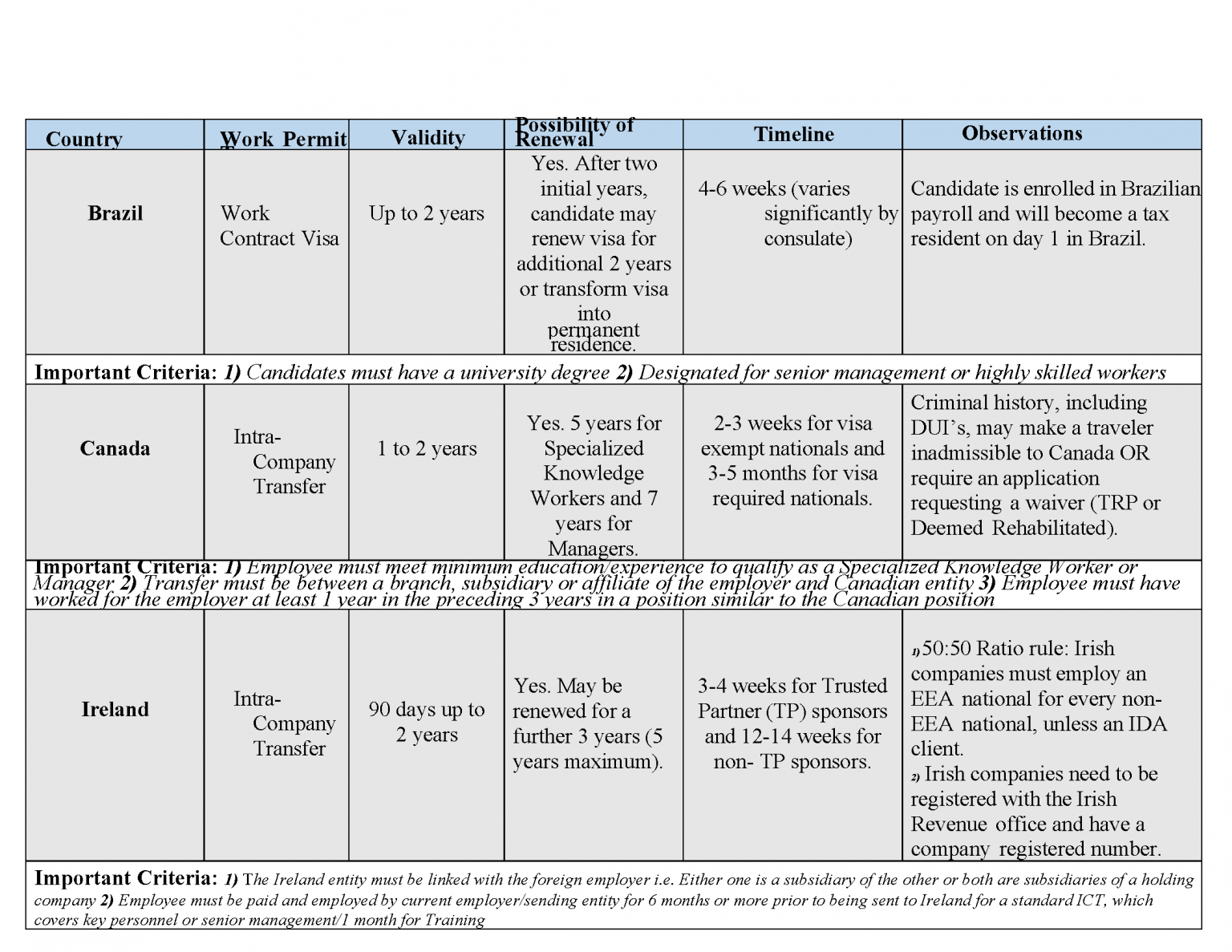
Some examples of Global Parking:

listed examples of global parking

Are There Rules and Regulations for Global Parking?

In most instances, in order to go the route of global parking, companies must have an affiliate branch or entity in the destination country of choice. If not, one solution is to utilize a Professional Employer Organization (PEO) that can act as a co-employer by placing the employee on a local-level contract and payroll. 

GMS Wants to Help Companies Retain Top Talent

Global Mobility Solutions (GMS) has been helping companies with their global relocation assignments since 1987. Our team can also help with relocation policies, visas, and immigration needs. We understand firsthand how hard it is to retain top-level employees. Relocation options open up countless opportunities to keep good talent within a company. Reach out to us today to learn more about global parking or any relocation services questions. Feel free to check out our Knowledge Base which is updated weekly with in-depth relocation, job market, and real estate topics.

We're Here to Help! Request a Courtesy Visa Program Consultation

Properly managing a visa and immigration program involves meticulous coordination, precise communication, and worldwide interaction with government agencies, corporate personnel, and relocating employees.

At GMS, we provide you with peace of mind in knowing your mobility program is fully compliant and being managed by the best in the industry.

Request a no-pressure, courtesy consultation from a GMS Mobility Pro. We’ll be in touch within 1 business day.
Categories
Global Mobility Global Relocation Global Relocation Tips Global Relocation Trends Visas and International Travel

Zoom Town Options for International Relocation

Check Out These Countries That Offer Relocation Incentives

Countless companies are continuing to allow their teams to work remotely. These changes have primarily been due to the COVID-19 pandemic and the resulting shift in corporate culture. Working remotely from home has become a new normal for numerous industries. It has gotten to the point where “home” can be somewhere new almost every year. Employees are relocating to where they are most comfortable for their personal life as they no longer need to report to a physical office on a daily basis. Because of this, many cities and provinces are seeing an influx of new workers (and new taxpayers) as their populations grow.

What Are Zoom Towns?

A Zoom Town can be loosely defined as a town or province seeing an increase in population due to remote employees opting to move in. The phrase was coined from the broadly popular corporate movement to allow people to work remotely during the pandemic and the meteoric rise of “Zoom” as the virtual meeting platform of choice. 


Due to this phenomenon, various local and regional governments around the globe are getting creative in their competition for new wage earners. It has gotten to the point where these destinations are offering relocation incentives to remote workers considering a move within their borders. Many of these towns are looking to revitalize and compete by growing their population and gaining more working professionals. 


Now that people are accustomed to working remotely, many are looking into international relocation. There are Zoom Towns in other countries, some offering lucrative relocation incentives. If you’re looking to relocate internationally within the next year, here are some of the fastest-growing Zoom Towns abroad:

Switzerland

The village of Alibnen in the mountains of Switzerland is offering a rich relocation incentive. The town will shell out USD 25,200 to newcomers. On top of that, the Swiss government will give USD 10,000 per child that relocates with the family. Of course, there is some fine print for this great incentive. First off, applicants have to be under the age of 45. The property purchased in Alibnen has to be a permanent home, not a secondary residence. Also, the property has to hold a minimum value of 200,000 francs (about USD 201,600).

Italy

When many people think about Italy, they think about gorgeous landscapes and delicious food. This is why it is a popular destination for remote workers researching international relocation destinations. If you are considering Italy, it is worth looking at the town of Candela. This small town is offering grants of €800 euros per person and up to €2,000 for couples with children. Applicants of the grant can also take advantage of tax breaks. The only major requirement for this program is that the relocating workers have to live in Candela full-time, rent a house, and have a job with a minimum yearly salary of €7,500.

Greece

Another example of a creative incentive program is the Greek island of Antikythera. The program is closed as of the time of this article, but the island of Antikythera was trying hard to boost and revitalize it’s population number of 50 residents by offering relocation incentives. Those willing to relocate there could apply to receive housing, land, and an allowance of 500 euros a month for the three years from the Greek Orthodox Church, approximately USD 20,000 in incentives. 


Fortunately, Antikythera’s incentives worked! The island has seen an influx of young families and is now home to a climate research center.

Croatia

Legrad is a small town in northern Croatia that is looking to increase its population of just over 2,000 residents. In doing so, anyone looking to relocate to Legrad can bid on a house starting at just $0.16 (1 kuna). While an entire home for only 16 cents sounds great, there is a drawback. There are a limited number of homes in the town that can be purchased at the incentive price. However, there is good news – the mayor of Legrad pledged up to $3,979 (25,000 kuna) towards any refurbishments that newcomers would like to make to their houses. 

GMS Can Help with International Relocation

Global Mobility Solutions (GMS) is the industry leader in the corporate mobility market. Since 1987 we have been helping companies relocate their employees both domestically and internationally. Our relocation-specialized team stays up-to-date on all the government-provided relocation incentives offered in various cities, states/provinces, and countries. 


Our team also can help with any visa and immigration questions you may have when it comes to moving an employee to a new destination. You can contact us today with any questions or book a free consultation with one of our experienced consultants who can provide you with a courtesy review of your current relocation program and provide feedback on how to maintain a competitive talent mobility program.

We're Here to Help! Request a Courtesy Consultation

Are you ready to talk to a Mobility Pro? Learn how GMS can optimize your mobility program, enhance your policies to meet today’s unique challenges, receive an in-depth industry benchmark, or simply ask us a question. Your Mobility Pro will be in touch within 1 business day for a no-pressure, courtesy consultation.

Categories
Domestic Relocation Challenges Domestic Relocation Tips Domestic Relocation Trends Employee Development Global Mobility

4 Products in Low Supply: Impact on Relocating Employees

Pricing on these products could affect relocation

It can be more complicated than just hiring a moving company to ship their household goods when relocating an employee. Many factors need to be taken into consideration when getting a transferee to their new destination. One of the significant factors to think about is the cost of living difference between their current home and the new destination. When certain products or materials are harder to get or are experiencing pricing increases, it can place additional pressure on the employee and jeopardize the relocation. 

Since the COVID-19 pandemic began, there have been supply chain issues and shipping delays around the world. Some products are back-ordered for months at a time, ultimately increasing prices on many products, further complicated by lack of manufacturing productivity. This can affect those moving for a new job through increased prices on common cost of living items such as food and fuel, potentially increasing employees’ wage requirements. While companies can’t always raise salary expectations right away, keeping the cost of living changes in mind when sending the employee an offer letter is recommended. 

If your company relocates employees, these four product shortages might affect their lives in their new destination:

Food Costs

This one probably hits close to home for a lot of people. With grocery stores also having labor challenges and with problems in food production, grocery prices may stay higher than usual in 2022. COVID-19 and its variants upended operations in food manufacturing plants around the world. As workers called in sick or day-to-day production policies had to be changed to keep workers safe, many fell behind in their order fulfillment and still have not caught up yet. Food product shortages are also due to the trucker driver shortage that the US and Canada are experiencing right now. 

When you look at the difference in food costs from city to city, that alone creates a cost of living increase or decrease. Typically, groceries are more expensive in high-end markets such as San Fransico, CA than in Topeka, KS. The addition of product shortages and shipping problems adds to the total price for someone moving from a mid-sized or small city to a larger one.

Lumber

Lumber prices have soured as of late to the point where homebuilders are increasing prices in an attempt to offset the demand. Many lumber mills were forced to shut down during the pandemic due to safety concerns. Then when the mills reopened, they were already behind in producing enough lumber to fulfill the extreme housing market needs. The real estate trends in calls for lumber were not just new-build homes either. As many workers started working from home and mortgage rates dropped to new lows, there was a rise in home remodeling

Many people might not realize that the price of wood also impacts moving supplies such as paper and cardboard. Lumber prices for the shipping industry also impact items such as shipping crates and pallets, which are produced for moving companies. Increases in material prices are naturally passed along to the end-customers who are moving.

Furniture

Always known as the “hidden cost of moving,” buying furniture for a new home is something that most people don’t calculate when making offers on houses. The furniture industry saw a boom when work from home became the new normal for many workers. People were more likely to spend more updating their furniture in order to be comfortable while spending most of their days from home. Because many U.S. furniture parts come from China, the global shipping container shortage has delayed many shipments that have some furniture companies months behind on orders. Once again, because of all the issues with shipping containers, the furniture industry can only ship out so many sets each month.

Semiconductors

Demand for computer chips has naturally lowered supply. Many companies are shifting their workforce remotely, meaning more laptops and computer products are needed for employees working from home. Semiconductor manufacturers are trying to ramp up production, but with sky-high demand, it is hard to see them catching up to the curve before the end of 2022. 

Additionally, semiconductors are used in vast swathes of products these days, including vehicles. Near the onset of the pandemic, rental car companies sold perceived excesses in their fleets. Demand surprisingly skyrocketed, but due to shortages in semiconductors, vehicle manufacturers couldn’t keep up with rental fleet production demand which, in turn, caused shortages of rental vehicles. This has caused significant increases in rental car costs for employees who are relocating and need temporary transportation while traveling.

GMS Keeps You Up to Date with Industry News

At Global Mobility Solutions (GMS) we take pride in being the industry leader for providing global mobility services. Our team assists companies in relocating employees and providing benchmarking studies specific to our clients’ industries. We also keep our customers on top of industry trends in relocation, real estate, transportation, and more. Fill out the form below to receive courtesy information on your particular industry today!

We're Here to Help! Request a Courtesy Consultation

Are you ready to talk to a Mobility Pro? Learn how GMS can optimize your mobility program, enhance your policies to meet today’s unique challenges, receive an in-depth industry benchmark, or simply ask us a question. Your Mobility Pro will be in touch within 1 business day for a no-pressure, courtesy consultation.

Categories
Employee Development Global Relocation Global Relocation Tips Global Relocation Trends Visas and International Travel

2023 H-1B Registration Details

Get more details on H-1B Cap registration

Looking to file a new H-1B case? With some updated guidelines, employers must complete registrations using the U.S. Citizenship and Immigration Services (USCIS) online H-1B registration system. This online process is a simple way to complete H-1B registrations, where employers submit details for their desired candidates who they intend to sponsor for a new H-1B in 2022 or 2023. The online form avoids manual paperwork and can cut down on costs for employers. The cost for registration is $10 per sponsored candidate.

New H-1B case registrations are capped at an annual quota of 85,000. From that number, 20,000 are available to candidates who have earned an advanced degree from a U.S. college or university, making the remaining 65,000 available for other qualified candidates.

USCIS introduced the concept of H-1B registration in 2020. There were just over 380,000 registrations filed for FY 2022 and about 275,000 registrations filed for FY 2021.

H-1B Lottery

When USCIS receives more than 85,000 registration cases, a random lottery will be run on the pool of registrations. Once the lottery is finalized, USCIS notifies those chosen. From there, successful selectors then file a full H-1B petition. One for each candidate must be filled out.

Cap-subject petitioners looking to get H-1B, or their representatives, will be able to create accounts starting at noon Eastern on Feb. 21, 2022. Candidate submissions open March 1, 2022, for any company that is set up in the system. 

It is highly anticipated that USCIS will receive more than 85,000 registrations by the March 18th, 2022 deadline, from there they will plan to run a lottery then notify successful registrants by March 31, 2022.

H-1B cap-subject petitions include those for beneficiaries eligible for the advanced degree exemption. Only those with a valid registration number selected during the H-1B registration process may petition.

GMS Can Help with Any Visa & Immigration Needs

Global Mobility Solutions is a full-fledged international relocation services company. Our goal is to help companies get their employees to their new destinations as easily as possible. GMS works with the most knowledgeable people in the industry when it comes to visa and immigration needs. We can help your employees get all of their paperwork done and questions answered. Feel free to reach out to us today to get started the process of fulfilling all your global mobility needs.

We're Here to Help! Request a Courtesy Visa Program Consultation

Properly managing a visa and immigration program involves meticulous coordination, precise communication, and worldwide interaction with government agencies, corporate personnel, and relocating employees.

At GMS, we provide you with peace of mind in knowing your mobility program is fully compliant and being managed by the best in the industry.

Request a no-pressure, courtesy consultation from a GMS Mobility Pro. We’ll be in touch within 1 business day.

Categories
Domestic Relocation Domestic Relocation Challenges Domestic Relocation Tips Domestic Relocation Trends Global Relocation Global Relocation Challenges Global Relocation Tips Global Relocation Trends Relocation Policy Review Relocation Programs

Relocation Policy Review: Anticipating Changes and Challenges

Why Companies should review their Relocation Policies?

It is important, and highly recommended, that companies review their relocation policies at the start of each year. This will help your company remain at the forefront of your industry, ahead of your competitors, and in line with best practice recommendations. Most companies are not completely immune to global forces, market changes, and unique challenges such as the COVID-19 global pandemic. Often these issues directly impact employees on international assignments.

There are several reasons why companies need relocation benefits. Often, relocation perks are used for hiring a recruit for an open position. Other times, companies may use relocation to transfer knowable employees to different job sites or as part of a development program offered through the company when promoting an existing employee. But no matter the reason, all sizes of company who offer talent mobility should have their relocation policies reviewed with some regularity. Here is a breakdown of why relocation policy review is important:


Address Strategic Objectives in Your Relocation Policy Review

Growing companies often have strategic plans that guide activities and investments. Many of these plans lay out specific goals and actions. For example, a company that wants to grow into a new market might leverage their relocation policy review in several ways to achieve this goal. This may include investigating the services of an International Professional Employer Organization (PEO). PEOs can help a company establish a presence in a new market within a very short timeframe and with no direct investment. As a result, companies can focus on achieving strategic objectives and responding nimbly to market changes. In return, the company saves time, effort, and resources. Also, the overall costs of service fees and financing international employees’ payroll are significantly lower than the cost of establishing a foreign entity.

Cost Reductions and Process Improvements Can Be Found

Relocation Management Companies (RMCs) with extensive industry knowledge and experience can help identify cost reductions. There may be several areas that offer cost reduction opportunities during a relocation policy review. Also, the mobility industry often changes rapidly in response to needs, preferences, and regulations. As a result, knowledgeable RMCs can easily identify and share new ideas for cost reductions.

RMCs are often drivers in the mobility industry for process improvements. Technology can lead to dramatic increases in productivity. For example, a Relocation API can replace many time-consuming data entry tasks and responsibilities. In turn, valuable resources are freed up to focus on critical business and department issues.

Maintaining Your Company’s Competitive Market Position

Every relocation policy review should include and reference benchmarking studies. These studies should show what your company’s industry competitors are providing in their policies. Your company should have information to know whether its relocation policy provides benefits that at least match the competition. A thorough relocation policy review can help identify areas that need to change in order to maintain your organization’s competitive position.

Ensures Company Policy Remains Compliant

National and international regulations can frequently change. Constant changes in visa requirements, immigration, tax laws, health recommendations, and other regulations directly impact relocation programs and employees. Conducting a relocation policy review helps your company learn what is changing, what may change in the future, and how to adjust your relocation policy accordingly. The review also provides information that your company can share with internal company stakeholders and employees who utilize the policy.

When Should Relocation Benefits Be Reviewed?

Companies should arrange a relocation policy review about every 12 months. As markets and global dynamic forces change at an ever faster pace, transferees are often some of the first employees to face direct impacts. As a result, the company’s relocation policy should be current and provide industry-leading solutions. This will result in greater employee satisfaction, and enhance talent acquisition and retention efforts.

GMS’ team of global relocation experts has helped thousands of our clients with their relocation policy review. Our mobility consulting team understands the dynamic nature of the corporate relocation market. GMS provides expert guidance for relocation policies, as a result, our team ensures that our clients’ transferees receive immediate assistance as required, clients remain competitive, their relocation programs maximize efficiencies, and they can leverage several cost reduction opportunities.

GMS was the first relocation company to register as a .com. The company also created the first online interactive tools and calculators, and revolutionized the entire relocation industry. GMS continues to set the industry pace as the pioneer in innovation and technology solutions with its proprietary MyRelocation® technology platform.

To schedule your relocation policy review or to receive an industry-specific policy benchmarking overview, contact our experts online or give us a call at 800.617.1904 or 480.922.0700 today.

We're Here to Help! Request a Courtesy Consultation

Are you ready to talk to a Mobility Pro? Learn how GMS can optimize your mobility program, enhance your policies to meet today’s unique challenges, receive an in-depth industry benchmark, or simply ask us a question. Your Mobility Pro will be in touch within 1 business day for a no-pressure, courtesy consultation.

Categories
Corporate Relocation Domestic Relocation Household Goods Relocation Best Practices Relocation Management

Understanding Third-Party Household Goods Shipping

Why Relocation Service Providers Use Third-Party Moving Companies

Relocating for a new job can be a great opportunity for an individual or family. It can lead to new job opportunities, new friends, and new beginnings. Most people who have moved to a new area know that along with the excitement comes stress. Companies that provide their relocating employees with mobility benefits through a relocation management company (RMC) can help reduce the stress of the move. 

The RMC assists the company in providing all the services that one might need to move for their new job. Shipping one’s household goods from their current home to their new place is usually a key benefit that is included for those who are taking advantage of their company’s relocation policies. 

If you are an employee that is about to go through the relocation process, you might have already noticed that the RMC you are working with uses a third-party moving company to handle the shipping of all household goods. But why are third-party transportation companies used and what does the typical move process look like? 

What Role Does the Third-Party Moving Company Play?

Typically, the RMC will reach out to the relocating employee to gather information on the employee’s household goods that need to be shipped to their location. The RMC will use that information to set the employee up with a trusted, high-quality moving company from an already vetted network of providers. In some cases, some RMCs will get multiple quotes before choosing third-party services for a relocating employee. This is also the stage where the mover can note if they have any items that need special attention before being moved, like being taken apart or packed in a specific manner. These items usually consist of artwork, glass items, TVs, pianos, and other higher valued items. 

From there, the moving company will coordinate with the transferring employee to set up packing days, loading, transit, and delivery days. To assure the household goods can arrive on time for the employee, RMCs will often assign a relocation specialist or coach to aid the employee in coordinating the various moving parts of their relocation, including the shipment of their household goods. The employee’s Relocation Coach will help coordinate with the moving company and ensure that the employee is maximizing their benefits and that they are being used properly. This point of contact will also typically provide check-ins with the employee during the pack and load process, tracking updates, and shipment status information.

Third-party Specialty Services Might Have to Be Used

Another advantage that the RMC’s third-party service provider network can help with is if custom crating and specialty moving services are needed to move the employee’s household goods. Many fragile and high-valued items will require specialized crating due to the unique nature of each individual item. Crating provides the highest level of damage protection during the moving process. These specialty services are used for items such as pianos, billiard tables, televisions, and more. Many local moving companies may not be qualified to manage the movement of these types of items. 

These specialty services can support the move process by disassembling furniture to safe shipment and the reduction of space needed on the moving truck or shipping container. Unmounting/mounting wall-mounted televisions, the removal and packaging of chandeliers, and the movement of bulky or heavy items (such as exercise equipment or safes) can also fall under the purview of a moving specialist. The use of these specialists helps to add an extra layer of protection to the employee’s household goods, ensuring that their belongings will be moved properly with little to no damage or loss.

GMS Ensures Quality with Third-Party Household Goods Shipping

Global Mobility Solutions has a vast network of reputable moving, storage, and specialty companies that we work with when helping employees move. It is our goal at GMS to only work with 3rd-party service providers who deliver guaranteed customer service and competitive market rates. On top of that, GMS emphasizes the overall customer experience and constantly monitors feedback through our surveys to identify what is working and what may need improvement.

Relocation can seem like a long process, but in working with an RMC like GMS, we can help streamline your program, help develop competitive workforce mobility policies and manage a worldwide network of mobility professionals on your behalf. If you have any questions about corporate relocation or are looking to update your company’s relocation policies, reach out to us today. 

Categories
Global Relocation Global Relocation Tips Global Relocation Trends Immigration Rules Visas and International Travel

Canada Citizenship Path to Expand for Foreign Residents

In an effort to encourage foreign temporary residents to stay, the Canada citizenship path will expand to make it easier for them to become a permanent resident. Currently there are over one million temporary residents in Canada. However, the COVID-19 pandemic has reduced the number of immigrants entering the country.

Canada migration consists of both permanent and temporary residents. Net immigration statistics show the impact of the pandemic:

 2019 (annual)2020 (1st 6 months)
Temporary Residents+190,952-18,221
Permanent Residents+252,000 est.+128,430

Canada is seeking to add immigrants at an aggressive rate, with a goal of adding over 1 million immigrants by the end of 2021. The country’s plan for immigration includes the following:

2019350,000
2020360,000
2021370,000

Canada’s plan includes immigration relating to several factors:

  • Federal economic and provincial/territorial nominees
  • Those eligible for family reunification programs
  • Refugees

Why is Expanding the Canada Citizenship Path Important?

Canada is relying on immigrants to power its economy and counteract the long-term demographic impact of an aging population. Currently, Canada’s population is less than 37 million residents. Of these residents, nearly 20 percent are immigrants. The country is exceptionally welcoming to immigrants, with Prime Minister Trudeau publicly noting “Diversity is our strength #WelcomeToCanada.”

Canada is considered underpopulated, and as a result often has more jobs than workers. Immigration is key to helping the Canadian economy grow. The country’s population rate of growth for 2020 is only 0.89%, the lowest rate for the past several years. Expanding the Canada citizenship path will hopefully increase the population growth rate.

Programs to Draw Immigrants to Canada

The country has instituted many unique programs to draw immigrants. One immigration pilot initiative seeks to attract highly skilled immigrations to smaller cities and towns in the province of Ontario. Another initiative focuses on attracting students and youth of Hong Kong with a new open work permit and a broader Canada citizenship path. Criteria will include one year of work experience in Canada, and a minimum level of language proficiency and education. The new open work permit allows young people in Hong Kong to come to and hopefully stay in Canada while they gain work experience.

Among large industrialized countries, Canada has one of the lowest populations, ranking at #39. By comparison, countries including the US, UK, China, India, Germany, Mexico, France, Italy, and Spain all have much higher populations than Canada. The country’s best hope to keep residents in the face of the continuing pandemic is to expand the Canada citizenship path for its temporary residents.

What Does This Mean?

Canada’s immigration ministry is working to identify a new Canada citizenship path for the country’s temporary workers. It is also looking to expand opportunities to draw immigrants to Canada. The country’s economic growth depends on a steady supply of highly skilled workers. Also, increasing immigration will lessen the impact of an aging population on the country’s social services budgets.

What Should Employers Expect with an Expanding Canada Citizenship Path?

Employers in Canada should expect to see an increase in the number of immigrants seeking to leverage the expanding Canada citizenship path. With nearly twenty percent of the country comprised of immigrants, the atmosphere is welcoming and supportive. Employers should also expect to see a rise in job seekers utilizing the open work permit program.

Employers not currently in Canada should look into the country as a strategic location for future corporate expansion. The services of an International Professional Employer Organization (PEO) may be useful in this respect. International PEOs can help employers enter new markets quickly and determine the prospect for their future success.

What should Employers do as the Canada Citizenship Path Expands?

Work with a Qualified Relocation Management Company

Employers in Canada should review their talent acquisition program to ensure it aligns with a growing number of immigrants in their workforce. They should also work with a qualified Relocation Management Company (RMC). RMCs can help employers review their relocation and visa programs with a goal of encouraging highly skilled immigrants to choose their job opportunities.

Investigate the Services of an International Professional Employer Organization

Employers outside of Canada should consider utilizing the services of an International PEO. By working with an International PEO, companies can increase their international employment in Canada quickly and easily. RMCs can provide expert assistance to employers looking to expand their corporate presence through the services of an International PEO.

Conclusion

GMS’ team of global relocation experts has helped thousands of our clients develop relocation programs that attract and retain qualified employees. Our team can help your company determine how to benefit from an expanding Canada citizenship path.

GMS was the first relocation company to register as a “.com.” The company also created the first online interactive tools and calculators, and revolutionized the entire relocation industry. GMS continues to set the industry pace as the pioneer in innovation and technology solutions with its proprietary MyRelocation® technology platform.

Contact our experts online to learn how your company can benefit from an expanding Canada citizenship path, or give us a call at 800.617.1904 or 480.922.0700 today.

We're Here to Help! Request a Courtesy Visa Program Consultation

Properly managing a visa and immigration program involves meticulous coordination, precise communication, and worldwide interaction with government agencies, corporate personnel, and relocating employees.

At GMS, we provide you with peace of mind in knowing your mobility program is fully compliant and being managed by the best in the industry.

Request a no-pressure, courtesy consultation from a GMS Mobility Pro. We’ll be in touch within 1 business day.

Categories
Corporate Relocation Corporate relocation tips Domestic Relocation Domestic Relocation Tips Global Relocation Global Relocation Tips Relocation Best Practices Relocation Management Relocation Policy Review Relocation Programs

Expedited Bidding Benefits: How Your Company Can Gain Immediate Results

If your company is seeking better results from your relocation program, expedited bidding benefits bring immediate savings. As many companies learn, outsourcing the management of their relocation program to a Relocation Management Company (RMC) provides several advantages. Doing so through a quick process helps the company achieve even greater results in the short term. Companies that use an expedited bidding process report significant savings in both time and costs.

GMS’ benchmark study of companies that leverage an expedited approach to bidding on the management of their relocation program show why this is a preferred process. Our team of global relocation experts has identified the top five expedited bidding benefits that companies can expect.

Top 5 Expedited Bidding Benefits

1. Cost Savings Right from the Start

Companies instituting an expedited approach create competition in the process. Relocation Management Companies pursuing their business will put forth their most competitive fee structures. Direct costs are likely to be the lowest in the quest to obtain the account. With these immediate savings from the expedited bidding process, companies are assured of cost effective solutions.

2. Complimentary Consulting

Some of the most valuable expedited bidding benefits related to mobility consulting. As part of the process, companies can request many of the following at no cost:

  1. Policy development and revisions
  2. Relocation program design
  3. Current policy reviews

As part of this process, companies can learn much about an RMC’s abilities, including:

  1. Knowledge of relocation processes
  2. Level of experience on points important to the company
  3. Consulting work quality and timeliness

3. Speedy Implementation Saves Time and Offers Quick Access to Expedited Bidding Benefits

Expedited bidding benefits relating to time savings can directly correlate to cost savings. The quicker a relocation program be implemented, the quicker the company achieves program savings and efficiencies. GMS’ data shows that on average, more than 90% of companies using expedited bidding complete their relocation program implementation in just 22 days. Given the amount of work that may be involved, including creating relocation APIs, policy documents, and communication, a shorter implementation timeframe lets the company quickly return its focus to other strategic objectives.

4. Process is a Better Fit for Buying Solutions

Companies that retain an RMC to manage its relocation program understand they are buying solutions that will help their employees. As a result, these solutions require a much different approach than the process they would use to purchase equipment parts or to source machinery. Ultimately, relocation management requires that the company ensures the right fit for the right reasons. The right fit ensures the company will maximize their expedited bidding benefits.

5. Frees up Administrative Burden of Formal Requests

Companies that fully understand their purchasing processes know the amount of administrative burdens and resources necessary to complete formal Requests for Information and/or Proposals. By foregoing these types of resource-intensive approaches that often create more problems for the company, employees can pursue value-added activities while RMCs carry the burden of responses.

What Should Companies do to Gain Expedited Bidding Benefits?

Companies should seek to gain expedited bidding benefits by utilizing an expedited process for outsourcing the management of their relocation program. Relocation Management Companies with extensive industry experience and knowledge will prove to be the best resources in this effort. Qualified RMCs will guide companies to successful results with a customized, right-fit program and greater expedited bidding benefits.

Conclusion

GMS’ team of corporate relocation experts has helped thousands of our clients with their relocation programs.  Our team can help your company gain the maximum amount of expedited bidding benefits by leveraging our expertise to present the most cost-effective and efficient relocation management solutions.

GMS was the first relocation company to register as a “.com.” The company also created the first online interactive tools and calculators, and revolutionized the entire relocation industry. GMS continues to set the industry pace as the pioneer in innovation and technology solutions with its proprietary MyRelocation® technology platform.

New SafeRelo™ COVID-19 Knowledge Portal

GMS recently launched its new SafeRelo™ COVID-19 Knowledge Portal featuring a number of helpful resources including:

  • Curated selection of news and articles specific to managing relocation programs and issues relating to COVID-19
  • Comprehensive guide to national, international, and local online sources for current data
  • Program/Policy Evaluation (PPE) Tool for instant relocation policy reviews

Contact our experts online to discuss your company’s interest in obtaining expedited bidding benefits, or give us a call at 800.617.1904 or 480.922.0700 today.

We're Here to Help! Request a Courtesy Consultation

Are you ready to talk to a Mobility Pro? Learn how GMS can optimize your mobility program, enhance your policies to meet today’s unique challenges, receive an in-depth industry benchmark, or simply ask us a question. Your Mobility Pro will be in touch within 1 business day for a no-pressure, courtesy consultation.

Looking for something?